After Siegel and Shuster relinquish control of the character in 1947, other writers and editors devise many changes in Superman. He is supposed to be extinct planet Krypton's last son, yet, adding human interest for the mainly adolescent readers, his legend keeps expanding to include countless Kryptonian survivors: eventually "discovered" are relatives, pets, villains, and an entire living city shrunken into a huge glass bottle. (He also encounters a synthetic cube-shaped
Bizarro World, peopled with chalk-white, ill-grammared duplicates of himself and Lois Lane, and several complicated "parallel universes"--created to help untangle some of the discrepancies about his origin and powers). Meanwhile, with rival publisher Marvel Comics setting the trend, comic-book characters begin acquiring realistic angst and stricter continuity during the 1960s. Superman, too, is often further modified, becoming increasingly more sympathetic and believable. By the late '80s, to compete with the other publishers' fresher characters and to promote sales to the newer demographics of comic-book buyers, DC Comics makes dramatic changes to simplify Superman's saga.Prior to this definitive 1986 overhauling, DC publishes a 12-issue "maxi-series" called Crisis on Infinite Earths marking major events: the final appearance of Superboy--who is Superman in his teens fighting crimes on "Earth-1"--(issue 12), the death of Supergirl in battle (issue 7), and the elimination of parallel worlds--called Earth-Prime, Earth-2, et cetera. (Today's standardized stories take place on our regular Earth.)
Crisis clears the way, Superman's eponymously-named comic book is renumbered (the second series starting June 1986), and the Superman legend is reinvented. The streamlined post-Crisis stories in today's titles--Superman, Adventures of Superman, Superman in Action Comics, and Superman, Man of Steel--gradually reintroduce familiar characters and create new ones in consistent, subplotted narratives, to make Superman more relevant and realistic.
The different media's Superman portrayals influence one another, introducing new aspects to his myth. Combining, comparing, and examining many of these versions helps shed light on how the Man of Steel has been rewritten with deeper, more mature concerns than when he first appeared at the end of The Great Depression as a pulp-fiction hero for children.
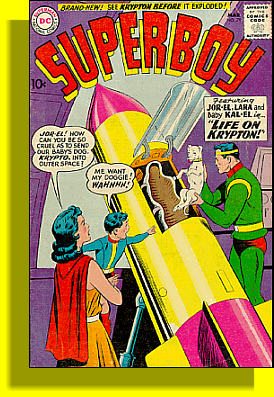
Superman's story usually begins during his infancy on the planet Krypton. He is named Kal-El by his parents, Jor-El, a brillaint scientist, and Lara, his supportive wife (called Jor-L and Lora in 1939). They are a model-attractive, thirtysomething couple, Jor-El looking nearly identical to the grown-up Kal-El. On Krypton, a technocracy without separate countries, the scientists decide global social policies. Jor-El invents a relatively humane method of punishing convicted criminals--the Phantom Zone Projector, which banishes dangerous prisoners into a noncorporeal existence in another dimension.
(Above:
Lara, Kal-El, Krypto, and Jor-El. Art from 1960 by Curt Swan)Jor-El also discovers Krypton is off its orbit, straying too close to its red sun, causing a nuclear reaction at its uranium core. According to the film, Superman: the Movie, when Jor-El's warnings are disregarded by the control-obsessed government elders, he is not just ignored, as in the comics, but coerced into agreeing not to leave Krypton. As the comic-book legend goes, Jor-El has no time to construct a spaceship large enough for him, Lara, and infant Kal-El. He does have a working prototype of a rocket large enough to accommodate a dog (this version is from 1948 before animal experimentation becomes controversial)--a dog or a child. As their city, Kryptonopolis, begins crumbling, Jor-El and Lara agree to send Kal-El away in the tiny spacecraft. In the 1940 radio show's first installment, there is room enough in the ship for Lara, but she chooses to save their infant son instead.

(Click on the above Superman button to hear the 1940 radio scene. Allow time for the sound file to load.)
It features Agnes Moorehead as Lara and Ned Wever as Jor-El.THERE IS MUCH MORE! Please press
A for the rest of this History. More pictures and sound files!|
Metropolis is the home page |
You are on A 1. |
|
Press here or A to continue this article on A 2. |


All Superman related names, sounds, and images are © DC COMICS


Blue
letters mean you haven't been there yet. Red ones mean you have.This page hosted by
 Get your own Free Home Page