 |
| The Ganpati Page on Krsnaint |
 |
 |
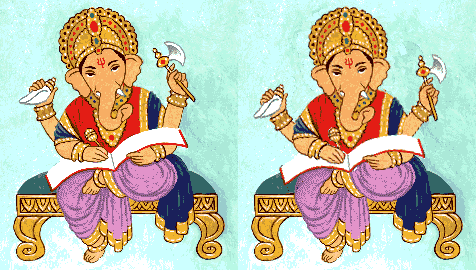
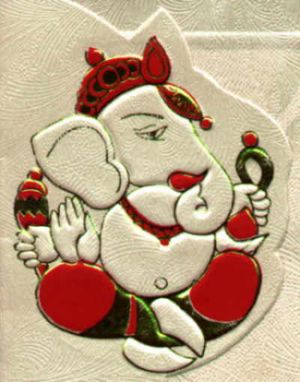
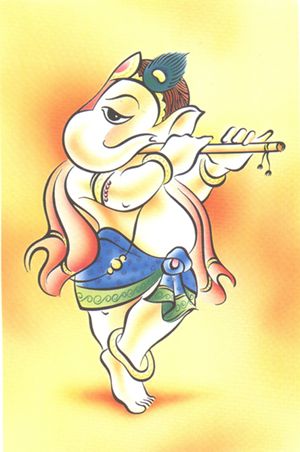
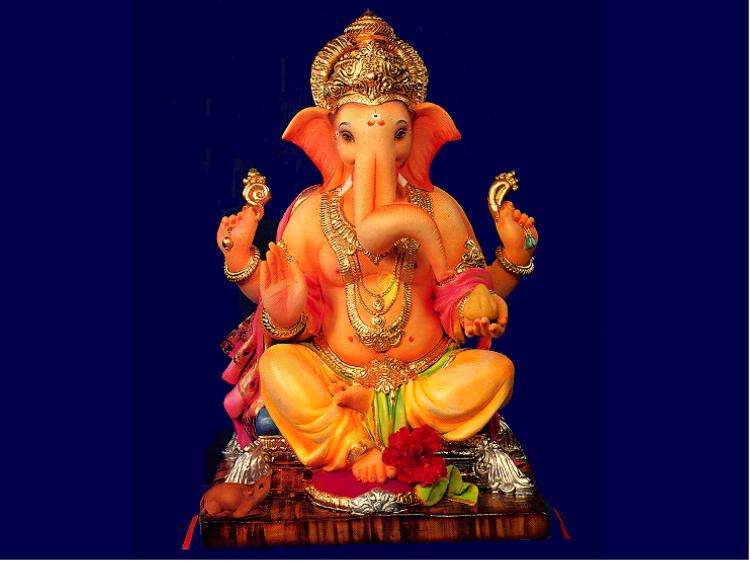
Ganpati Ganpati, also known as Ganesh, is the eldest son of Shiva & Parvati Ganpati is described as the leader (Vinayaka) or the Leader of Ganas,who attends upon and follows at all times ,Lord Shiva, as Vighaneshwara, the dispeller of all obstacles. These names clearly show that he is the master of all circumstances and even the divine forces can never obstruct his Path. Due to this no Hindu Ritual or auspicious act is ever undertaken without invoking Him. With his Grace, It is believed that no undertaking can fail due to any subjective or objective Obstacles. He is believed to have both Lakshmi and Saraswati as His Consorts and hence Wealth and knowledge follow Him. In short, He is the master of Knowledge and the Champion of Worldly achievements. In this characterization, Ganpati represents a Man of Perfect Wisdom, and a fully realized Vedantin. Westerners are shocked to notice that Hindus revere a Divine Form, which is so ridiculous and absurd. However, the Elephant-headed Lord of all difficulties in life, indeed represents the Highest and the best that have ever been mentioned in our Scriptures. To a Vedantic Student since his depthof knowledge is essentially intellectual, he must have a great Head to concieve and understand the logic of Vedantic thought, and in fact, the truth of Vedanta can only be comprehended through listening to a teacher and therefore, Shravanam (listening) is the initial stage to be mastered by the new initiate. Therefore, Sri Ganesh has Large Ears representing continuos and intelligent listening to the teacher After listening to the truth of Upanishads, a Vedantic, must independently reflect on what he has heard, for which he needs a sensitive intelligence and ample sympathy to discover in himself sufficient accomodation for all living creatures in the Universe. His intellect must have such depth and width in order to embrace in his Vision the entire World of plurality. Not only must he, in his visualisation, embrace the entire Cosmos, but He must have the subtle discriminative Power (Viveka) in him to distinguish the changing, perishable matter from the Eternal, Immutable, All-pervading Consciousness, the Spirit. This discrimination is possible only when the intellect of the student has consciously cultivated this power to a large degree of perfection. The Trunk, coming down the forehead of the elephant face has a peculiar effeciency and beats all achievements of man and his ingenuity in the mechanical and scientific world. Here is a Tool which in one instant can uproot a large tree or pick a pin from the ground. The Elephant can lift and pull heavy weights with his trunk and at the same time, it is so sensitive that it can pick up a needle from a haystack. Man-made mechanical instruments cannot have this range of adaptability, nor the finesse. The spanner that is used for tightening the bolts of a gigantic wheel cannot be used to repair a lady's watch. Like the elephant's trunk, so should be the perfect discriminative faculty of an evolved intellect so that it can use its discrimination fully in the outer world for resolving gross problems, and at the same time, efficiently, employ its discrimination in the subtle realms of the inner personality layers. The discriminative powers in a human being function only when there are two factors to discriminate. These TWO factors represent the tusks and the trunk growing between the two. We must discriminate between the good and the evil, the right and wrong and arrive at our judgement. Ganpati is said to have broken one tusk during a duel with Parshurama. Ganpati has the widest mouth and possesses a good appetite. In Kubera's palace, he devoured all the food and not satisfied started devouring the vessels and the pandal itself. It was only when the Lord Shiva offered him some puffed Rice (POHA) that he was satiated. A man of perfection has an endless appetite for life. To him every experience, good or bad is only a play of the infinite through him. The Guru alone can satisfy the hunger of such students by giving them a handful of roasted seeds, indicating the baked Vasanas burnt in the fire of Knowledge. When the Vasanas are burnt up, the inordinate enthusiasm of experiencing life is wetted... Similarly, a large belly is symbolic of the vast storage space required for all knowledge. In the representation of Ganpati, we always find a small mouse at his feet, looking up at the Lord, shivering with anticipation but not daring to touch anything without the master's command. A mouse though a small animal with tiny teeth can create disaster when left in a barn house. Similarly, there is a small mouse within each of us. This is the power of desire. A man of perfection should have mastered this mouse and keep it in check Lord Vighneshwara has four arms, representing the Antahkarana. In one hand, he has a rope and an axe in the other. With the axe, he cuts off the attachments of his Devotees and thus ends all consequent sorrows and with the rope, he brings them nearer to the Truth. In his third hand he holds a Modak , which is the symbolic reward and with the fourth hand he showers his Blessings. The Hindu Puranas narrate such stories with symbolic meanings and it is for the discriminating Student to find out the message behind these stories. Knowledge was revealed in this cryptic language, since knowledge falling into wrong hands can have several repercussions. The Mantras are similar to the Cyber Programs of to-day, whereby a complete change can occur and they are imparted to students, who have proved their bonafides and the teacher finds them worthy of being given this knowledge. This is similar in to-days context to the fact that an Atomic Bomb in the hands of a Fanatic can bring about the end of this Earth and hence such guarded secrets should not be imparted to unworthy persons. |
 |
 |
| Krsna Page |
 |
| Ganesha Album |
 |
| Visnu Album |
 |
 |
| Shiva Darshan |
|
| Shrinathji Darshan |
| Please Sign my Guest Book |
 |
 |
|
| Please visit other Pages and Albums Choose from the options Just Click on the Picture next to the Link You want |
| Srimad Bhagwat |
 |
 |
 |
|
 |
 |
 |

|
   |
 |
|