| Sri Caitanya Mahaprabhu |
| Lord Caitanya's Acintya-bheda-bheda-tattva Lord Caitanya Mahaprabhu accepted the doctrine of Sri Madhvacarya, while at the same time recognizing certain important aspects contained in the tattva of the other three Vaisnava sampradayas. Lord Caitanya brought these teachings together in the perfection of prema dharma. Lord Caitanya's own words, as quoted by Sri Jiva Goswami: "From Madhva, I will take two essential teachings: his complete rejection and defeat of the Mayavadi philosophy and his service to the deity of Krishna, accepting Him as an eternal spiritual personality. From Ramanuja, I will accept two teachings: the concept of devotional service, unpolluted by karma and jnana, and service to the devotees. From Vishnuswami's teachings I will accept two elements: the sentiment of exclusive dependence on Krishna and the path of raga-marga, or spontaneous devotion. From Nimbarka, I will take two very important principles: the necessity of taking shelter of Srimati Radharani and the high esteem of the gopi's love for Krishna." "Lord Caitanya instructed the mass of people in the sankhya philosophy of acintya-bhedabheda-tattva, which maintains that the Supreme Lord is simultaneously one with and different from His creation. Lord Caitanya taught this philosophy through the chanting of the holy name of the Lord. He taught that the holy name of the Lord is the sound incarnation of the Lord and that since the Lord is the absolute whole, there is no difference between His holy name and His transcendental form. Thus by chanting the holy name of the Lord one can directly associate with the Supreme Lord by sound vibration. As one practices this sound vibration, one passes through three stages of development: the offensive stage, the clearing stage and the transcendental stage. In the offensive stage one may desire all kinds of material happiness, but in the second stage one becomes clear of all material contamination. When one is situated on the transcendental stage, one attains the most coveted position--the stage of loving God. Lord Caitanya taught that this is the highest stage of perfection for human beings." Caitanya-caritamrta, Adi lila, Preface "....The Supreme Personality of Godhead, who emanates the material and spiritual worlds, is the Supreme Spirit. As an individual spirit soul is almost identical to his gross and subtle bodies, so the Supreme Lord is almost identical to the material and spiritual worlds. The material world, full of conditioned souls trying to lord it over matter, is a manifestation of the external energy of the Supreme Lord, and the spiritual world, full of perfect servitors of the Lord, is a manifestation of His internal energy. Since all living entities are minute sparks of the Supreme Personality of Godhead, He is the Supreme Soul in both the material and spiritual worlds. The Vaisnavas following Lord Caitanya stress the doctrine of acintya-bhedabheda-tattva, which states that the Supreme Lord, being the cause and effect of everything, is inconceivably, simultaneously one with His manifestations of energy and different from them." Caitanya-caritamrta, Adi lila 2:37 "....We Gaudiya Vaisnava follow Srila Ramanuja's philosophy almost in the same manner. Sri Caitanya Mahaprabhu gives the identification of jiva soul as the eternal servant of Krishna and is situated as marginal potency of the Lord based on the philosophy of acintya-bheda bheda-tattva. This is almost similar to Visistadvaita vada. Vaisnava philosophy is now being pushed on all over the world under the Hare Krishna movement, and we feel Sripada Ramanuja a great support for the Vaisnava philosophical understanding. It is like a combination of nyaya sruti and smrti prasthans. The Bhagavad-gita supports the Vedanta Sutra brahma-sutra-padais caiva. hetumadbhir viniscitaih. (BG. 13:5.) To the jiva brahman identification is one part of acintya-bheda bheda-tattva. As spirit soul or identical brahman, or jiva brahman is identical with the Supreme Brahman or the param brahma. In this sense jiva soul is abheda or non-different from the param brahma. But on account of the param brahma being the supreme, the biggest, the identical brahman or jiva brahman being very minute, it is different from the param brahma. The summary is that the simultaneous one and different jiva brahman is simultaneously one with and different from the param brahma. Because it is appreciated simultaneously which is very difficult to comprehend by the common man, this philosophy is called acintya-bheda bheda tattva, inconceivable. This is supported by the Katho Upanisad 2.5.13 nityo nityanam cetanas cetananam. eko bahunam yo vidadhati kaman. This is almost similar to the visista-dvaita vada. So far I am personally concerned, following the footsteps of my guru maharaj Srila Bhaktisiddhanta Sarasvati Thakura Prabhupada, we accept the principles of all the acaryas, although officially we belong to the Madhva sampradaya. Our sampradaya is known as the Madhva Gaudiya sampradaya. We find great shelter at the lotus feet of Sri Ramanujacarya because his lotus feet are the strongest fort to combat the mayavadi philosophy." Srila Prabhupada Letter to V.S.R. Chakravarti, 11-24-74 |
| Lord Caitanya is the Supreme Personality of Godhead Himself, who appeared as a devotee some 500 years ago and surcharged the Brahma-Madhva sampradaya. Lord Caitanya, a yuga avatara of Lord Krsna, came accompanied by His transcendental associates. As stated in Caitanya-caritamrta Adi-Lila, 7.4, "Sri Caitanya Mahaprabhu is always accompanied by His plenary expansion Sri Nityananda Prabhu, His incarnation Sri Advaita Prabhu, His internal potency Sri Gadadhara Prabhu and His marginal potency Srivasa Prabhu. He is in the midst of them as the Supreme Personality of Godhead. One should know that Sir Caitanya Mahaprabhu is always accompanied by these other tattvas." Lord Caitanya, appearing together with these four associates as a single incarnation, is known as the Pancha-tattva. "This is the method of parampara, or disciplic succession. Similarly, Srimad-Bhagavatam explains that Krsna imparted knowledge into the heart of Lord Brahma (the first created creature within the universe). Brahma imparted those lessons to his disciple Narada, and Narada imparted that knowledge to his disciple Vyasadeva. Vyasadeva imparted it to Madhvacarya, and from Madhvacarya the knowledge has come down to Madhavendra Puri, to Isvara Puri, and to Sri Caitanya Mahaprabhu. One may ask that if Caitanya Mahaprabhu is Krsna Himself, then why did He need a spiritual master? Of course He did not need a spiritual master, but because He was playing the role of an acarya (one who teaches by example), He accepted a spiritual master. Even Krsna Himself accepted a spiritual master, for that is the system. In this way the Lord sets the example for humans. We should not think, that the Lord takes a spiritual master because He is in want of knowledge. But He is simply stressing the importance of accepting spiritual master in the disciplic succession." Caitanya-caritamrta, Adi lila Introduction "At the end of the month of January in the year 1432 sakabda (A.D. 1511), Sri Caitanya Mahaprabhu accepted the sannyasa order from Kesava Bharati, who belonged to the Sankara-sampradaya." Caitanya-caritamrta, Adi lila 7:34 "You belong to our Sankara-sampradaya and live in our village, Varanasi. Why then do You not associate with us? Why is it that You avoid even seeing us?" Purport: "A Vaisnava sannyasi or a Vaisnava in the second stage of advancement in spiritual knowledge can understand four principles namely; the Supreme Personality of Godhead, the devotees, the innocent and the jealous, and he behaves differently with each. He tries to increase his love for Godhead, make friendship with devotees and preach Krsna consciousness among the innocent, but he avoids the jealous who are envious of the Krsna consciousness movement. Lord Caitanya Mahaprabhu Himself exemplified such behavior, and this is why Prakasananda Sarasvati inquired why He did not associate or even talk with them. Caitanya Mahaprabhu confirmed by example that a preacher of the Krsna consciousness movement generally should not waste his time talking with Mayavadi sannyasis, but when there are arguments on the basis of sastra, a Vaisnava must come forward to talk and defeat them in philosophy. According to Mayavadi sannyasis, only one who takes sannyasa in the disciplic succession from Sankaracarya is a Vedic sannyasi. Sometimes it is challenged that the sannyasis who are preaching in the Krsna consciousness movement are not genuine because they do not belong to brahmana families, for Mayavadis do not offer sannyasa to one who does not belong to a brahmana family by birth. Unfortunately, however, they do not know that at present everyone is born as sudra (kalau sudra-sambhavah). It is to be understood that there are no brahmanas in this age because those who claim to be brahmanas simply on the basis of birthright do not have the brahminical qualifications. However, even if one is born in a non-brahmana family, if he has the brahminical qualifications he should be accepted as a brahmana, as confirmed by Srila Narada Muni and the great saint Sridhara Svami. This is also stated in Srimad-Bhagavatam. Both Narada and Sridhara Svami completely agree that one cannot be a brahmana by birthright but must possess the qualities of a brahmana. Thus in our Krsna consciousness movement we never offer the sannyasa order to a person whom we do not find to be qualified in terms of the prescribed brahminical principles. Although it is a fact that unless one is a brahmana he cannot become a sannyasi, it is not a valid principle that an unqualified man who is born in a brahmana family is a brahmana whereas a brahminically qualified person born in a non-brahmana family cannot be accepted. The Krsna consciousness movement strictly follows the injunctions of Srimad-Bhagavatam, avoiding misleading heresy and manufactured conclusions." Caitanya-caritamrta, Adi lila 7:67 "Sri Madhavendra Puri, also known as Sri Madhava Puri, belonged to the disciplic succession from Madhvacarya and was a greatly celebrated sannyasi. Sri Caitanya Mahaprabhu was the third disciplic descendant from Sri Madhavendra Puri. The process of worship in the disciplic succession of Madhvacarya was full of ritualistic ceremonies, with hardly a sign of love of Godhead; Sri Madhavendra Puri was the first person in that disciplic succession to exhibit the symptoms of love of Godhead and the first to write a poem beginning with the words ayi dina-dayardra natha, "O supremely merciful Personality of Godhead." In that poem is the seed of Caitanya Mahaprabhu's cultivation of love of Godhead." Caitanya-caritamrta, Adi lila 9:10 "Our sampradaya belongs to the disciplic succession of Madhavendra Puri, who belonged to the Madhva-sampradaya. We are in the disciplic succession of Sri Caitanya Mahaprabhu, who was initiated by Sri Isvara Puri, a disciple of Madhavendra Puri's. Our sampradaya is therefore called the Madhva-Gaudiya-sampradaya. As such, we must carefully follow in the footsteps of Sri Madhavendra Puri and observe how he installed the Gopala Deity on top of Govardhana Hill, how he arranged and performed the Annakuta ceremony in only one day, and so forth. Our installation of Deities in America and in the wealthy countries of Europe should be carried out in terms of Sri Madhavendra Puri's activities. All the servitors of the Deity must be strictly qualified as brahmanas and, specifically, must engage in the Vaisnava custom of offering as much prasada as possible and distributing it to the devotees who visit the temple to see the Lord." Caitanya-caritamrta, Madyam lila 4:87 |
 |
 |
 |
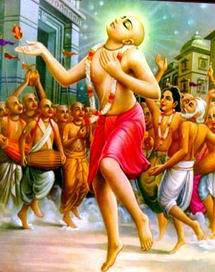
| Mahaprabhu dancing with His associates |
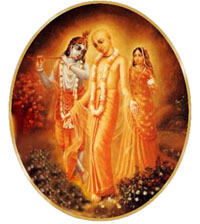
| Mahaprabhu as combined incarnation of Srimati Radharani & Sri Krishna |
| Caitanya Mahaprabhu as Sannyasa |
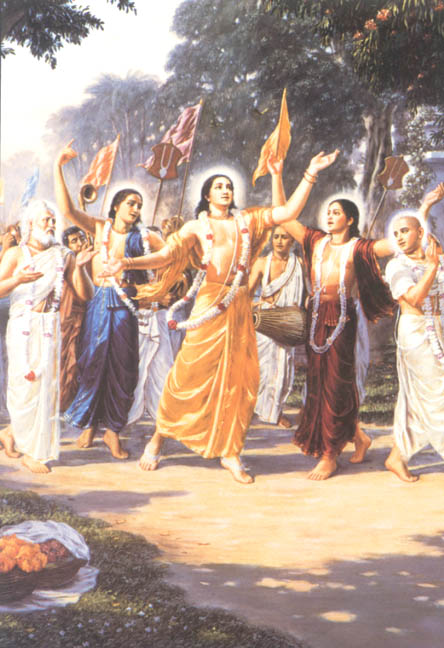 |
| Lord Caitanya engaged in 'kirtana' with His Associates |
 |
 |
 |