THE FOUNDER OF THE
AHMADIYYA MOVEMENT IN ISLAM
1989
ISLAM INTERNATIONAL PUBLICATION LTD
Reproduced under the responsibility of RAM Service.
Copyright © 1996 RAM Service Inc. All rights reserved.
This is an English version of an Urdu treatise written by the Holy Founder of
the Ahmadiyya Movement in Islam, Hazrat Mirza Ghulam Ahmad (1835-1908). The
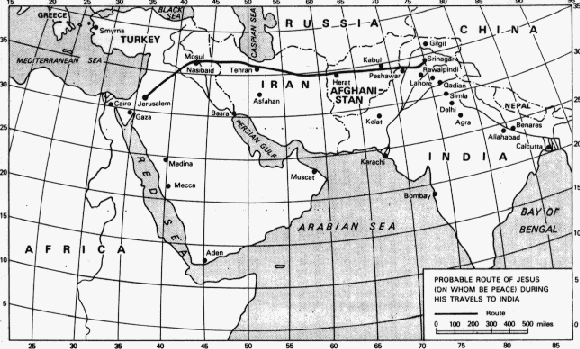
theme is the escape of Jesus from death on the cross, and his journey to India
in search of the lost tribes of Israel. Christian as well as Muslim scriptures,
and old medical and historical books including ancient Buddhist records, provide
evidence about this journey. Jesus is shown to have reached Afghanistan, and to
have met the Jews who had settled there after deliverance from the bondage of
Nebuchadnezzar. From Afghanistan Jesus went on to Kashmir, where other Israelite
tribes had settled. There he made his home, and there in time he died; his tomb
has been found in Srinagar.
Preface
Introduction
Chapter 1
Chapter 2 : On the Evidence of Quran and authentic traditions in proofs
survival' of Jesus
Chapter 3 : On the Evidence derived from books and medicine
Chapter 4 : Evidence from books of history
Section 2 : Evidence from books on Buddihsm
Section 3 : On the evidence from books of history which show that the coming of
Jesus to the Punjab and neighbouring terretories was inevitable.
Appendix
PREFACE
Jesus in India is an English version of Masih Hindustan mein, an Urdu treatise
written by the Holy Founder of the Ahmadiyya Movement in Islam, Hazrat Mirza
Ghulam Ahmad (1835 - 1908).
The main thesis expounded in the treatise is Jesus' escape from an ignominious
death on the Cross and his subsequent journey to India in quest of the lost
tribes of Israel whom he had to gather into his fold as mentioned in the New
Testament.
Abundant evidence has been furnished from Christian as well as Muslim
Scriptures, old medical books and books of history, including ancient Buddhistic
records, to illustrate the theme.
Starting upon his journey from Jerusalem and passing from thence through Nasibus
and Iran, Jesus is shown to have reached Afghanistan, where he met the Jews who
had settled there after their deliverance from the bondage of Nebuchadnezzar.
From Afghanistan Jesus went to Kashmir, where some Israelite tribes had also
settled. He made this place his home and here he died. His tomb has been traced
and found in Khanyar Street, Srinagar.
In the section dealing with the evidence adduced from ancient Buddhistic
records, Hazrat Ahmad has resolved a question which, owing to its difficult
nature, has for a long time confounded many a Western writer.
These writers have been baffled by the striking resemblance that exists between
Christian and Buddhistic teachings and between the life events of both Jesus and
Buddha as revealed in their respective Scriptures.
Some of these writers hold the view that Buddhistic teachings must somehow have
reached Palestine and been assimilated by Jesus in his own sermons. But there is
absolutely no historical proof to support this theory.
A Russian traveller named Nicolas Notovitch stayed for quite some time with
Lamas in Tibet and had their sacred books translated for him. He is of the
opinion that Jesus must have come to Tibet before the crucifixion and gone back
to Palestine after having imbibed Buddhistic teachings. This also is a mere
statement unsupported by reliable historical evidence.
Repudiating both these views, Hazrat Ahmad writes that Jesus came to India not
before the event of the Cross but after it and that it was not he who borrowed
Buddhistic teachings but the followers of Buddha who seem to have reproduced the
entire picture of the Gospels in their books.
According to Hazrat Ahmad Jesus also visited Tibet during his travels in India
in search of the lost tribes of Israel. He preached his messages to Buddhistic
monks, some of whom were converted Jews. The followers of Buddha were deeply
impressed by his teachings and took him to be the manifestation of Buddha and
their Promised Teacher. With faith in him as their Master, they mixed his
teachings with their own records and ascribed it all to the Buddha. Ample
evidence in support of this is furnished from ancient Buddhistic records.
Masih Hindustan mein was written in 1899 and it marks the end of an era in which
for centuries Muslims and Christians had believed in the ascension of Jesus to
Heaven. It being the first book ever written on the subject with such a rational
approach, the book produced a most profound impact.
Its arguments were broadcast and in the past half-century it has achieved
remarkable success in divesting Jesus of false appurtenances of divinity and in
presenting him to the world merely as a divine prophet as he actually was.
In Muslim circles the effect has been so marked that the Rector of the Al-Azhar
University in Cairo issued a Fatwa (verdict) that according to the Holy Quran
Jesus had died a natural death. Its influence on the Christian mind has also
been greatly disturbing.
As stated in the Introduction and also at the end of the book, Hazrat Ahmad
intended to write a second part in which he would have given, besides some
additional proofs of Jesus' journey to India, a comparative evaluation of the
teachings of Islam and Christianity with some cogent arguments in proof of the
truth of Islam as well as of his own claim to be the Promised Messiah.
Though no other book among his writings bears this title, yet Hazrat Ahmad has
discussed thoroughly all these issues with many more important ones concerning
the truth of Islam, of his own claim and of the death of Jesus in quite a number
of books which he wrote after the above-mentioned book.
The present English translation was made by Qazi Abdul Hamid, formerly editor of
a weekly, The Sunrise, Lahore, in which it appeared serially during 1938-39. It
was first published in book form in 1944 by Nashr-o-Ishaat, Sadr Anjuman
Ahmadiyya, Qadian.
Besides others who have assisted us in any way in the production of this book,
our thanks are due to Mr. Mauloud Ahmad Khan, a former Imam of the London
Mosque, who went to great pains to gather relevant quotations from the original
books which have been referred to by Hazrat Ahmad in support of his thesis. The
quotations have been attached to the book in the form of an appendix.
Vakil-ut-Tabshir, Tahrik-i-Jadid, Rabwah, Pakistan
MAY 1962
IN THE NAME OF ALLAH,
THE BENEFICENT, THE MERCIFUL
WE PRAISE HIM AND
INVOKE HIS BLESSINGS UPON
HIS NOBLE PROPHET
Lord! Judge between us and our people with truth;
Thou art the best of judges
INTRODUCTION
I have written this book, so that, by adducing proofs from established facts,
from conclusive historical evidence of proved value and from ancient documents
of non-Muslims, I might remove the serious misconceptions which are current
among Muslims and among most Christian sects regarding the earlier and the later
life of Jesus (on whom be peace) - misconceptions, the dangerous implications of
which have not only injured and destroyed the conception of Divine Unity, but
the unwholesome and poisonous influence of which has for long been noticed in
the morals of the Muslims of this country. Spiritual maladies, i.e., want of
good morals, evil thoughts, callousness, want of sympathy, are spreading among
most Islamic sects, being the result of beliefs in unfounded stories and
anecdotes of this kind. Human sympathy, pity and love of justice, humility and
humble-mindedness - all good qualities - are disappearing day by day, as if they
will soon bid a last farewell to this community. This callousness and this
immorality make many a Muslim appear no better than the beasts of the jungle. A
Jain or a Buddhist is afraid of and avoids killing even a mosquito or a flea,
but, alas! there are many among us Muslims who, while they kill an innocent man
or commit wanton murder, are not afraid of the powerful God, who rates human
life higher than that of all the animals. What is this callousness and cruelty
and want of sympathy due to? It is due to this - that from their very childhood,
stories and anecdotes and wrong views of the doctrine of Jehad are dinned into
their ears and inculcated into their hearts, the result being that gradually
they become morally dead and cease to feel the heinousness of their hateful
actions; nay, rather, the man who murders another man unawares and thus brings
ruin to the murdered man's family thinks that he has done a meritorious deed; or
rather, that he has made the most of an opportunity to win favour with his
community. As no lectures or sermons are delivered in our country to stop such
evils - and if there are any such lectures they have an element of hypocrisy in
them - the common people think approvingly of such misdeeds. Accordingly, taking
pity upon my own people, I have compiled several books in Urdu, Persian and
Arabic, in which I have stated that the popular view of Jehad prevalent among
Muslims, that is, the expectation of a bloody Imam, full of spite and hostility
for other people, is a texture of false beliefs inculcated by shortsighted Ulema;
otherwise, Islam does not allow the use of the sword for the Faith; except in
the case of defensive wars, or in the case of wars waged to punish a tyrant or
to uphold freedom. The need of a defensive war arises when the aggression of an
adversary threatens one's own life. These are the three kinds of Jehad permitted
by the Shariat, and, apart from these three kinds, there is no other kind of war
which is permitted by Islam for the propagation of the Faith. I have, in short,
spent a large sum of money on such books, and have published them in this
country and in Arabia and Syria and Khurasan, etc. But, by the grace of God, I
have now discovered powerful arguments which are meant to eradicate these
unfounded beliefs from the hearts of the people. I have clear proofs,
circumstantial evidence of a conclusive character, and historical evidence the
light of whose truth holds out the promise that soon after their publication
there will be brought about against such beliefs a wonderful change in the
hearts of the Muslims. And I hope - I am sure - that after these truths have
been comprehended, there will flow out of the hearts of the righteous sons of
Islam the sweet and beautiful springs of lowliness, humility and mercy, and that
there will come about a spiritual change which will have a wholesome and a
blessed influence on the country. I am also sure that Christian investigators
and all other people who hanker after the truth and thirst for it, will benefit
from my books. And the fact just now stated by me, that the real object of this
book is to correct the wrong beliefs which have become part and parcel of the
creeds of Muslims and Christians, requires a little explanation which I set out
below.
Let it be known that most Muslims and Christians believe that Jesus (on whom be
peace) went alive to the heavens; both these people have believed for a long
time that Jesus (on whom be peace) is still alive in the heavens, and will
sometime in the latter days come down to the earth. The difference in their
views, i.e. the view of the followers of Islam and that of the Christians, is
only this, that the Christians believe that Jesus (on whom be peace) died on the
Cross, was resurrected, and went to the heavens in his earthly body, seated
himself on the right hand of his Father, and will come to the earth in the
latter days for judgment; they also say that the Creator and the Master of the
world is this Jesus the Messiah and no one else; he it is who, in the latter
days of the world, will descend to the earth with a glorious descent to award
punishment and reward; then, all who will not believe in him or his mother as
God, will be hauled up and thrown into hell, where weeping and wailing will be
their lot. But the aforesaid sects of Muslims say that Jesus (on whom be peace)
was not crucified, nor did he die on the Cross; on the other hand, when the Jews
arrested him in order to crucify him an angel of God took him away to the
heavens in his earthly body, and he is still alive in the heavens - which, they
say, is the second heaven where is also the prophet Yahya, i.e. John. Muslims,
moreover, also say that Jesus (on whom be peace) is an eminent prophet of God,
but not God, nor the son of God, and, they believe that he will in the latter
days descend to the earth, near the Minaret of Damascus or near some other
place, supported on the shoulders of two angels, and that he and Imam Muhammad,
the Mahdi, who will be already in the world, and who will be a Fatimite, will
kill all the non-Muslims, not leaving anyone alive except those who will
forthwith and without any delay become Muslims. In short, the real object of the
descent of Jesus (on whom be peace) to the earth, as stated by Muslim sects
known as Ahl-i-Sunnat or Ahl-i-Hadith called Wahabis by the common people - is
that, like the Mahadev of the Hindus, he should destroy the whole world; that he
should first threaten the people to become Muslims and then, if they persist in
disbelief, massacre them all with the sword; they moreover say that he is alive
in the heavens in his earthly body, so that, when Muslim powers become weak, he
will come down and kill the non-Muslims or coerce them on pain of death to
become Muslims. Regarding the Christians especially, the divines of the
aforesaid sects state that when Jesus (on whom be peace) comes down from the
heavens he will break all the Crosses in the world, do many a cruel deed with
the sword, and inundate the world with blood. And, just as I have stated, these
people, i.e. the Ahl-i-Hadith etc. from among the Muslims, are enthusiastic
about their belief that a short time before the coming down of the Messiah there
will appear an Imam from the Bani Fatima whose name will be Muhammad, the Mahdi.
He it is who will be Khalifa and King of the time, and as he will belong to the
Koraish, his real object will be to kill all non-Muslims except those who
readily recite the Kalima. Jesus (on whom be peace) will come down in order to
help him in his work; and although Jesus himself (on whom be peace) will be a
Mahdi - nay, a greater Mahdi - yet, because it is essential that the Khalifa of
the time should be a Koraish, Jesus (on whom be peace) will not be the Khalifa
of the time; the Khalifa of the time will be that same Muhammad, the Mahdi.
Muslims say that these two together will fill the earth with the blood of man,
and they will shed more blood than has ever been shed before in the history of
the world. No sooner will they appear than they will start this bloody campaign;
they will neither preach nor plead, nor show any sign. And they also say that
although Jesus (on whom be peace) will be like an adviser or a lieutenant of
Imam Muhammad, the Mahdi, and although the reins of power will be in the hands
of the Mahdi only, Jesus (on whom be peace) will instigate Hazrat Imam Muhammad,
the Mahdi, to massacre the whole world and will advise him to adopt extreme
measures, i.e. he will make amends for the humane teaching which he had given to
the world before, namely, 'not to resist evil,' and, being struck on one cheek,
'to turn the other cheek also.'
This is what Muslims and Christians believe regarding Jesus (on whom be peace),
and while it is a great error to call him, as the Christians do - a humble man -
God, the beliefs of some of the followers of Islam, among whom is the sect
called Ahl-i-Hadith also known as Wahabis, regarding a bloody Mahdi and a bloody
Messiah, are affecting their morals very badly, so much so, that on account of
their bad influence their dealings with other people are not based on honesty
and good will, nor can they be truly and completely loyal to a non-Muslim
Government. All reasonable men will realise that such a belief, namely, that
non-Muslims should be subjected to coercion, that they should either forthwith
become Muslims or be put to death, is open to the most serious objections. Every
conscientious person will readily admit that before a man adequately realises
the truth of a Faith, and before he has comprehended its beauties and its
wholesome teachings, it is extremely undesirable to coerce him, on pain of
death, to adopt that Faith. Far from contributing to the growth of that Faith,
this would furnish the opponents with an opportunity to find fault with it. The
ultimate result of a principle like this is that hearts become devoid of the
quality of human sympathy and that mercy and justice, which are great human
moral qualities, take leave of men, and instead, spitefulness and enmity tend to
grow; there remain behind only the animal passions, wiping out all high moral
qualities. But it would be noticed that such a teaching could not have proceeded
from God, Who sends His punishment only after He has completed His argument.
Let this therefore be pondered over: that if there is a man who does not accept
the true Faith because he is yet ignorant and unaware of its truth, of its
teachings and its beauties, would it be reasonable to kill such a man forthwith?
Nay, this man deserves pity; he deserves to be instructed gently and politely in
the truth, beauty and the spiritual benefit of that faith; not that his denial
should be met by the sword or the gun. So, the doctrine of Jehad proposed by
these sects of Islam, as well as the belief that the time is near when there
will arise a bloody Mahdi whose name would be Imam Muhammad, that the Messiah
will come down from the heavens for his help, and that both together will kill
all non-Muslim people if they deny Islam, is utterly opposed to our moral sense.
Is not this the belief which puts out of action all good human qualities and
morals, and encourages the qualities of life in the jungle? Those who hold such
beliefs live a life of hypocrisy in relation to others, so much so that they
cannot give true loyalty to state authorities of another Faith; they dishonestly
profess to give allegiance to them, which is wrong. That is why some of the
Ahl-i-Hadith sects mentioned by me just now are living a double life under the
British Government in British India. In secret, they hold out hopes to the
common people of the coming of bloody days of a bloody Mahdi and a bloody
Messiah, and instruct them accordingly, but when they go to the authorities they
flatter them and assure them that they do not approve of such ideas. If,
however, they are really opposed to such ideas, why do they not propagate this
in writing, and why should they await the coming of that bloody Mahdi and the
Messiah standing as it were at the doorsteps, ready to join them in their
campaign?
Such beliefs, in short, have very much demoralised these Maulvies: they are
incapable of teaching people decency and peace. On the other hand, killing
others without rhyme or reason is with them a great religious duty. I would be
glad if any sect of the Ahl-i-Hadith is opposed to these beliefs, but I cannot
help observing with regret that among the sects of the Ahl-i-Hadith1 there are
those who in secret believe in a bloody Mahdi and in the popular notions of
Jehad. They are opposed to correct notions, and they think it an act of great
merit to kill when they have the opportunity to kill all the people professing
other faiths, whereas the beliefs in killing others in the name of Islam, or
believing in prophecies like the prophecy of a Bloody Messiah and wishing to
advance the cause of Islam by bloodshed or by threats, are absolutely against
the Holy Quran and the reliable Hadith. Our Holy Prophet (peace and the
blessings of God be upon him) suffered great persecution at the hands of the
Kafirs at Mecca and thereafter. The thirteen years which he spent at Mecca were
years of great affliction and suffering of many kinds - a thought of them brings
tears to one's eyes. But he did not raise the sword against his enemies, nor did
he reply to their abuse, until many of his Companions and dear friends were
mercilessly murdered; and until he himself was subjected to sufferings of
various kinds, such as being poisoned many a time; and until many an
unsuccessful plan to murder him had been laid. When, however, God's vengeance
came, it so happened that the elders of Mecca and the chiefs of the tribes
unanimously decided that this man should in any case be put to death. At that
time, God, who is the Supporter of His loved ones and of the truthful and
righteous, informed him that there was now nothing left in that town except
evil, that the townspeople were bent upon murdering him and that he should
therefore quit it at once. Then it was that, in accordance with the divine
command, he migrated to Medina, but even then his enemies did not leave him
alone; they pursued him there, and tried to destroy Islam in all possible ways.
When their excesses went to an extreme, and when they had rendered themselves
deserving of punishment by the murder of many an innocent person, permission to
fight with them in self-defence, to fight with a view to warding off their
attack, was given. And those people and their helpers had rendered themselves
deserving of such treatment because of their having killed many an innocent
person whom they had murdered not in any fight or battle but simply out of
wanton mischief and whom they had robbed of their property. But, in spite of all
this, when Mecca was taken our Holy Prophet (peace and the blessings of God be
upon him) pardoned them all. It is, therefore, utterly wrong and unjust to
suppose that the Holy Prophet (peace and the blessings of God be upon him) or
his Companions ever fought for spreading the Faith, or that they ever coerced
anyone to join the fold of Islam.
It is worth noting also that, as at that time all the people were prejudiced
against Islam, and as the opposing people were scheming to destroy Islam, which
they thought was a new religion and the followers of which were only a small
community, and as everyone was anxious to see the Muslims destroyed early or
disrupted so as not to leave any chance of their further growth and development,
the Muslims at that time were obstructed in the smallest matters, and anyone
from any tribe who accepted Islam and became a Muslim was either killed at once
by his tribe or lived in perpetual danger. At a time like this, God Almighty,
taking pity on Muslim converts, had imposed on the bigoted rulers a penalty,
namely, that they should become subservient to Islam, and thus open the door of
freedom for Islam. This was meant to remove the obstructions in the way of those
who wished to accept the Faith; it was God's compassion for the world, and it
harmed no one. It is evident, however, that non-Muslim rulers of to-day do not
interfere with Islam; they do not ban the essential Islamic practices. They do
not kill new Muslims, they do not put them into prison or torture them; why then
should Islam raise its sword against them? It is obvious that Islam has never
advocated compulsion: if the Holy Quran, the books of Hadith and historical
records are carefully examined and, as far as possible, studied or listened to
thoughtfully, it will be realised with certainty that the charge that Islam
wielded the sword to propagate the Faith with force is an utterly unfounded and
shameful charge against Islam. Such a charge against Islam is made by people who
have not read the Quran, the Hadith and the reliable histories of Islam in a
spirit of detachment, but have made free use of falsehood and have brought wrong
charges against it. I know, however, that the time is near when those who are
hungry and thirsty for Truth will be enlightened as to what reality there is in
these charges. Can we ever describe that Faith as a faith of compulsion, when
the Holy Book, the Quran, clearly directs that there is no compulsion in
religion, that it is not permissible to use compulsion in religion, that it is
not permissible to use compulsion or force in getting anyone to join Islam? Can
we accuse that great Prophet of using force against others, who, day and night
for thirteen years, exhorted all his Companions in Mecca not to return evil for
the evil of the enemy, but to forbear and forgive? When, however, the mischief
of the enemy went to extremes and when everybody started exerting himself for
wiping out Islam, the Jealous God thought it fit that the people who had wielded
the sword should be annihilated by the sword. Except for this the Holy Quran has
not approved of compulsion. If compulsion had been approved of by Islam, the
Companions of our Holy Prophet (peace and the blessings of God be upon him), in
moments of trial, would not have behaved like people of sincere and genuine
faith. Yet, the loyalty and faithfulness of the Companions of our Master, the
Holy Prophet (peace be on him), is a matter which I hardly need to mention. It
is no secret that among them are examples of loyalty and steadfastness the
parallel of which it is difficult to find in the annals of other nations; this
band of the faithful did not waver in their loyalty and steadfastness even under
the shadow of the sword. On the other hand, in the company of their Great and
Holy Prophet, they gave proof of that steadfastness which no man is ever able to
give unless his heart and his bosom are lit up with the light of true faith.
There is, in short, no compulsion in Islam. Wars in Islam fall under three
categories: (1) defensive wars, i.e. war by way of self-protection; (2) punitive
wars, i.e. blood for blood; (3) war to secure freedom, i.e. with a view to break
the power of those who kill those who accept Islam. Therefore, when there is no
direction in Islam that anyone should be made to join it by compulsion or by the
threat to kill, it is absolutely absurd to await the appearance of any bloody
Mahdi or a bloody Messiah. It can never be that there should appear in this
world, against the Quranic teachings, a man who would use the sword to make
people Muslims. This is not at all so very difficult to realise or above one's
understanding. Only foolish people have been led to this belief by their
selfishness. For most of our Maulvies labour under the misconception that the
wars waged by the Mahdi will bring a large amount of wealth to them, so much so,
that they will be unable to hold it, and, as most of the Maulvies to-day are
very poor, they await day and night the appearance of a Mahdi, who, they think,
will provide for their selfish desires. Therefore, these people turn against him
who does not believe in the appearance of such a Mahdi; such a one is at once
declared a Kafir, and outside the pale of Islam. I too, therefore, am a Kafir in
the eyes of these people; and on these very grounds. For I do not believe in the
appearance of a bloody Mahdi and a bloody Messiah. Nay, I hate such absurd ideas
and regard them with contempt. And I have been declared a Kafir, not only
because of my denial of the appearance of this supposed Mahdi and this supposed
Messiah in whom they believe, but also because I have publicly announced, having
been informed of it by God through revelation, that the real and true Promised
Messiah who is also the real Mahdi, tidings of whose appearance are to be found
in the Bible and the Quran and whose coming is promised also in the Hadith, is
myself; who is, however, not provided with any sword or gun. I have been
commanded by God to invite people with humility and gentleness to God, Who is
the true God, Eternal and Unchangeable, Who has perfect Holiness, perfect
Knowledge, perfect Mercy, and perfect Justice.
I am the light of this dark age; he who follows me will be saved from falling
into the pit prepared by the Devil for those who walk in darkness. I have been
sent by God to lead the people of the world to the true God through peace and
humility, and to reassert the reign of morals in Islam. God has provided me with
heavenly signs, for the satisfaction of seekers after truth. He has done
wonderful things in my support; He has disclosed to me secrets of the unseen and
of the future which, according to the holy books, is the sign of a true claimant
to divine office, and He has vouchsafed to me holy and pure Knowledge.
Therefore, the souls which hate truth and are pleased with darkness, have turned
against me. But I have decided to be sympathetic towards mankind - as far as I
can. So, in this age the greatest sympathy for the Christians is that their
attention should be called to the true God, Who is free from such defects as
being born and having to suffer death and undergo suffering, the God who made
the earliest heavenly bodies spherical in shape and, in His law of nature, set
down this point of spiritual guidance that, like a sphere, there is in Him Unity
and absence of direction. That is why the things which occupy space have not
been made triangular, i.e., the things which God created first such as the
earth, the heaven, the sun and the moon, and all the stars, and elements - all
are spherical, the spherical nature of which points towards Unity. Therefore
there can be no greater sympathy with the Christians than that they should be
guided towards the God Whose creations declare Him to be free from the idea of
trinity.
The greatest sympathy towards Muslims is that they should be reformed morally
and that an effort should be made to dispel the false hopes which they entertain
in connection with the appearance of a bloody Mahdi and Messiah, which are
entirely against the Islamic teachings. I have just now stated that the ideas of
some of the Ulema of the day that there will appear a bloody Mahdi who will
spread Islam at the point of the sword, are all opposed to the Quranic teachings
and are the result of greed and selfishness. For a right-minded and truth-loving
Muslim to forsake such beliefs or ideas, it should be enough to study carefully
the Quran, and to pause, consider and see that the Holy Word of God is quite
against holding out a threat of murder to force anyone into the fold of Islam.
This one argument, in short, is sufficient to refute these false ideas.
Nevertheless, out of a feeling of sympathy, I have decided to refute the
aforesaid ideas by positive and clear proofs from history, etc. Hence, I shall
try to prove in this book that Jesus (peace be on him) did not die on the Cross:
he did not go up to heaven, nor should it be supposed that he will ever again
come down from heaven to earth; that, rather, he died at the age of 120 years at
Srinagar, in Kashmir, and that his tomb is to be found in the Khan Yar Street of
that town. I have divided this enquiry into ten chapters, and an epilogue,
comprising the testimony of the Bible, the testimonies of the Holy Quran and the
Hadith, the testimony of medical books, the testimony of historical records, the
testimony of oral traditions which have been handed down from generation to
generation, miscellaneous circumstantial evidence, the testimony of rational
argument and the testimony of fresh revelation from God to me. These make up
eight chapters. In chapter 9 there will be a brief comparison between
Christianity and Islam, and there will be set out arguments in favour of the
truth of Islam. In chapter 10 there will be a somewhat detailed account of aims,
to carry out which I have been divinely appointed; there will be proofs of my
being the Promised Messiah and of my having come from God. And, at the end,
there will be an epilogue in which will be set out certain directions.
I hope readers of this book will read it diligently. I expect them not to throw
away out of prejudice the truth contained in it. I should like to remind them
that this is not a cursory investigation; nay, the proofs contained in this book
have been made available after a deep and searching inquiry. I pray to God that
He may help me in this undertaking and lead me through His special revelation
and inspiration to the perfect Light of truth - for all true Knowledge and clear
Realisation descend from Him, and only with His permission guide human hearts to
Truth. Amen! Amen!
MIRZA GHULAM AHMAD
Qadian, 25 April 1899
Footnotes to Introduction
Some of the Ahl-i-Hadith impertinently and unjustly state in their books that
the appearance of the Mahdi is imminent: that he will put into prison the
British rulers of India and that the Christian king will be arrested and will be
brought before him. Such books are still to be found in the houses of these
Ahl-i-Hadith, one such being Iqtarab-us-Saat by a well known Ahl-i-Hadith, on
page 64 of which such an account is to be found.
---------------------------------------------------------------------------------
In the name of Allah, the Beneficent, the Merciful
CHAPTER 1
Let it be noted that though Christians believe that Jesus (peace be on him)
after his arrest through the betrayal by Judas Iscariot, and crucifixion -- and
resurrection -- went to heaven, yet, from the Holy Bible, it appears that this
belief of theirs is altogether wrong. Matthew (chapter 12, verse 40) says that
just as Jonah was three days and three nights in the belly of the fish, so the
Son of Man shall be three days and three nights in the bowels of the earth. Now
it is clear that Jonah did not die in the belly of the fish; the utmost that
happened was that he was in a swoon or a fit of fainting. The holy books of God
bear witness that Jonah, by the grace of God, remained alive in the belly of the
fish, and came out alive; and his people ultimately accepted him. If then Jesus
(on whom be peace) had died in the belly of the 'fish', what resemblance could
there be between a dead man and the one who was alive, and how could a living
one be compared with one dead? The truth rather is, that as Jesus was a true
prophet and as he knew that God, whose beloved he was, would save him from an
accursed death, he made a prophecy in the form of a parable, revealed to him by
God, in which he hinted that he would not die on the Cross, nor would he give up
the ghost on the accursed wood; on the contrary, like the prophet Jonah, he
would only pass through a state of swoon. In the parable he had also hinted that
he would come out of the bowels of the earth and would then join the people and,
like Jonah, would be honoured by them. So this prophecy too was fulfilled; for
Jesus, coming out of the bowels of the earth, went to his tribes who lived in
the eastern countries, Kashmir and Tibet, etc. viz. the ten tribes of the
Israelites who 721 years1 before Jesus, had been taken prisoner from Samaria by
Shalmaneser, King of Assur, and had been taken away by him. Ultimately, these
tribes came to India and settled in various parts of that country. Jesus at all
events must have made this journey; for the divine object underlying his advent
was that he should meet the lost Jews who had settled in different parts of
India; the reason being that these in fact were the lost sheep of Israel who had
given up even their ancestral faith in these countries, and most of whom had
adopted Buddhism, relapsing, gradually into idolatry. Dr. Bernier, on the
authority of a number of learned people, states in his Travels that the
Kashmiris in reality are Jews who in the time of the dispersal in the days of
the King of Assur had migrated to this country.2
In any case it was necessary for Jesus (peace be on him) to find out the
whereabouts of these lost sheep, who had, on coming to this country, India,
become merged into the other people. I shall presently adduce evidence that
Jesus (peace be on him) did in fact come to India and then, by stages, travelled
to Kashmir, and discovered the lost sheep of Israel among the people who
professed the Buddhist faith and that these people ultimately accepted him, just
as the people of the prophet Jonah accepted Jonah. And this was inevitable, for
Jesus had said in so many words that he had been sent to the lost sheep of
Israel.
Apart from this, it was necessary that he should escape death on the cross, for
it was stated in the Holy Book that whoever was hanged on the wood was accursed.
It is a cruel and an unjust blasphemy to attribute a curse to an eminent person
like Jesus, the Messiah, for, according to the agreed view of all who know the
language, la'nat, or curse, has reference to the state of one's heart. A man
would be said to be accursed when his heart, having been estranged from God,
becomes really dark; when, deprived of divine mercy and of divine love, devoid
absolutely of His Knowledge, blinded like the devil, he becomes filled with the
poison of unbelief; when there remains not a ray of divine love and knowledge in
him; when the bond of loyalty is broken, and between him and God there arises
hatred and contempt and spite and hostility, so much so that God and he become
mutual enemies; and when God becomes weary of him and he becomes weary of God;
in short, when he becomes an heir to all the attributes of the Devil -- and that
is why the Devil himself is called accursed.3
It is clear that the significance of the word Mal'un, viz. accursed, is so foul
that it can never apply to any righteous person who entertains love of God in
his heart. Alas! Christians did not ponder over the significance of a curse when
they invented this belief; else, it were impossible for them to have used such a
bad word for a righteous man like Jesus. Can we say that Jesus' heart was ever
really estranged from God; that he had denied God, that he hated Him and had
become His enemy? Can we ever think that Jesus had ever felt in his heart that
he was estranged from God, that he was an enemy of God, and that he was immersed
in the darkness of unbelief and denial? If, then, Jesus had never been in such a
state of mind, that his heart was always full of love and the light of Divine
Knowledge, is it for you, wise people, to ponder whether we can ever say that,
not one, but thousands of curses from God had descended upon the heart of Jesus
with all their evil significance? Never. Then, how can we say that he was, God
forbid, accursed? It is a pity that once a man has given utterance to something,
when he has taken his stand upon a particular belief, he is not inclined to give
up that belief, however much the absurdity thereof be exposed. Desire to attain
salvation, if grounded upon true foundations, is a praiseworthy thing, but where
is the sense in having a desire for salvation which kills truth and which
countenances, regarding a holy prophet arid a perfect man, the belief that he
had as it were passed through a state in which he had been estranged from God,
and in which, instead of unity of heart and unity of inclination, there had been
produced a strangeness and aloofness, enmity and hatred; and, instead of light,
darkness had surrounded his heart?
Let it also be noticed that this not only detracts from the prophethood and
apostleship of Jesus (on whom be the peace of God) but it is also derogatory to
his claim to spiritual eminence, holiness, love, and knowledge of God, to which
he has repeatedly given expression in the gospels. Just look through the Bible;
therein Jesus clearly claims that he is the Light of the world, that he is the
Guide, and that he stands in a relation of great love towards God; that he has
been honoured by a clean birth, and that he is the loved Son of God. How then,
in spite of these pure and holy relations, can a curse, with all its
significance, be attributed to Jesus? No, never. Therefore, there is no doubt
that Jesus was not crucified, i.e., he did not die on the Cross, for his
personality did not deserve the underlying consequence of death on the Cross.
Not having been crucified, he was spared the impure implications of a curse, and
no doubt it also proves that he did not go to heaven, for going to heaven formed
part of this whole scheme and was a consequence of the idea of his having been
crucified. Therefore, when it is proved that he was neither accursed, nor did he
go to hell for three days, nor did he suffer death the other part of the scheme,
namely, that he went to heaven, is proved to be wrong. On this point the Bible
has more evidence which I proceed to state below. There is the statement of
Jesus: 'But after I am risen again, I will go before you into Galilee' (Matthew:
chapter 26, verse 32). This verse clearly shows that Jesus, after he had come
out of the tomb, went to Galilee and not to heaven. Jesus' words 'After I am
risen' do not mean his rising up alive after he was dead; rather, as in the eyes
of the Jews and the common people he had died on the Cross, he used words
beforehand consistent with what they were to think of him in the future, and
indeed, the man who was placed on the Cross, in whose hands and feet nails had
been driven till he had fainted from pain, had become as good as dead; if such a
man was saved from such a calamity and if he recovered his senses it would not
be an exaggeration on his part to say that he had come to life again. There is
no doubt that after so much suffering, Jesus' escape from death was a miracle;
it was no ordinary event. But to think that he had died is wrong. It is true
that in the books of the New Testament words of this kind occur, but this is a
mistake of the writers of those books, just as they had committed mistakes in
recording several other historical events. Commentators who have made researches
into these books admit that the books of the New Testament have two parts: (1)
the spiritual instruction received by the disciples from Jesus (peace be on him)
which is the essence of the teachings of the Gospel; (2) historical events --
like the genealogy of Jesus; his arrest and his being beaten; the existence in
his time of a miraculous pond, etc. These, the writers recorded by themselves;
they were not revealed; rather, they were set down in accordance with the
writer's own ideas. In some places there are undue exaggerations, as where it is
stated that if all the miracles and works of Jesus were recorded in books, the
earth would not be able to accommodate these books. How exaggerated is this
statement!
Apart from this, it is not against usages of speech to describe the great
calamity which had befallen Jesus as death. When a man, having passed through a
life and death experience, is ultimately saved from it, the common speech of all
peoples expresses the idea by the idiomatic expression -- 'he was given a new
life', and no people to whatever country they may belong would demur at
expressing that idea in this way.
After all that has been stated, it should be kept in mind that in the gospel of
Barnabas, which must be available in the British Museum, it is stated that Jesus
was not crucified, not did he die on the Cross. Now we can very well say that
though this book is not included in the gospels and has been rejected summarily,
yet there is no doubt that it is an ancient book, and it belongs to the period
in which the other gospels were written. Is it not open to us to regard this
ancient book as a book of history of ancient times and to make use of it as a
book of history? Does it not follow from this book that at least at the time
when the event of the Cross took place, people were not unanimous as to Jesus'
dying on the Cross? Again, apart from this, when in the four gospels themselves
there are such metaphors as the one about a dead person, that he is not dead but
asleep, it is not beyond reason to suppose that a state of swoon might be
described as a state of death. I have already stated that a prophet cannot lie.
Jesus compared his three days' stay in the tomb to the three days of Jonah in
the belly of the whale. This only shows that just as Jonah remained alive for
three days in the belly of the whale, so did Jesus remain alive for three days
in the tomb. The Jewish tombs of those days were not like the tombs of to-day;
they were roomy and had an opening on one side, which was covered with a big
stone. And, presently, I shall prove in due course that Jesus' tomb which has
been recently discovered in Srinagar in Kashmir is of the same type as the one
in which Jesus was placed in a state of swoon.
In short, the verse I have just quoted shows that Jesus after coming out of the
tomb went to Galilee. The gospel of St. Mark says that after coming out of the
tomb he was seen going on the road to Galilee, and ultimately he met the eleven
disciples when they were at their meal; he showed them his hands and feet which
were wounded and they thought that he was perhaps a spirit. Then he said to
them:
Behold my hands and my feet, that it is myself; handle me and see, for a spirit
hath not flesh and bones, as ye see me have4
He took from them boiled fish and a piece of honeycomb and ate them in their
presence.5
These verses show that it is certain that Jesus never went to heaven; rather,
coming out of the tomb, he went to Galilee; -- like an ordinary man, in normal
clothes, with a human body. If he had been resurrected after death, how was it
that this body of spirit could still have borne the wounds inflicted upon him on
the Cross? What need had he to eat? And if he required food then, he must be in
need of food even now.
Readers should not be under any misconception: the Cross of the Jews was not
like the hangman's noose of to-day from which deliverance alive is nearly
impossible, for the Cross of those days had no rope to be put round the neck of
the victim, nor was he subjected to a fall from a wooden plank and allowed to
keep hanging; rather, he was just put on the Cross, and his hands and feet were
nailed to it; and it was quite possible that if, after crucifying a person and
driving nails into him, it was decided -- in a day or two -- to forgive him and
spare his life, he was taken down alive before his bones had been broken, the
punishment already undergone being deemed sufficient for him. If it was decided
to kill him, he was kept on the Cross at least for three days; water or bread
was not allowed to come near him, and he was left in this condition in the sun
for three or more days, when his bones were broken and ultimately as a result of
this torture he died. But the grace of Almighty God rescued Jesus from this
torture which would have ended his life. Reading the gospel with care will show
that Jesus (on whom be peace) did not remain on the Cross for three days; he did
not have to suffer hunger or thirst for three days; nor were his bones broken.
On the other hand, he remained on the Cross only for two hours, and the grace
and mercy of God managed to bring about the crucifixion in the latter part of
the day, which was a Friday, only a little time before sunset, the next day
being the Sabbath, the feast Fasah of the Jews. According to Jewish custom it
was unlawful and a punishable crime to let anyone remain on the Cross on the
Sabbath day, or during the night previous to it; Jews, like Muslims, observed
the lunar calendar, sunset being regarded as beginning the day. So, on the one
hand, there was this circumstance which arose out of earthly causes, and, on the
other, Almighty God brought into existence heavenly circumstances, namely, that
when it was the sixth hour, there was a severe dust-storm which darkened the
earth for three hours.6 This sixth hour was after twelve o'clock, i.e., close to
the evening. Now, the Jews were afraid in this utter darkness, lest the night of
the Sabbath should overtake them, and lest, having violated the sanctity of the
Sabbath, they should deserve to be punished. Therefore, in all haste they took
Jesus and the two thieves off their Crosses. In addition to all this, there was
another heavenly cause, namely, that when Pilate presided at his court, his wife
sent word to him not to have anything to do with that righteous person (i.e.,
not to attempt to punish him with death), for, she said, she had had a dream
that night, which had troubled her very much.7 So, this angel, whom the wife of
Pilate saw in her dream, would assure us and all fair-minded people, with
certainty, that God had never intended that Jesus should die on the Cross. From
the day of the creation of this world, never has it occurred that God should
suggest to a person in a dream that a particular thing would happen in a certain
way, and still that thing should fail to happen. For example, the gospel of
Matthew says that an angel of the Lord came to Joseph in a dream and said,
'Arise and take the young child and the mother, and flee into Egypt, and be thou
there until I bring thee word: for Herod will seek the young child to destroy
him'.8 Now, can anyone say that Jesus could be killed in Egypt? Similarly the
dream which the wife of Pilate dreamt was a part of God's design, and it could
never be that this design should fail in its object; and just as the possibility
of Jesus being put to death during the Egyptian journey was against a specific
promise of God, so here it is unthinkable that the angel of Almighty God should
appear to the wife of Pilate and should direct her to say that if Jesus died on
the Cross it would not be a happy thing for her, and yet the angel's appearance
should go in vain, and Jesus should be allowed to suffer death on the Cross. Is
there any example of this in the world? None. The pure conscience of all good
men, when informed of the dream of Pilate's wife, will no doubt testify that it
was a fact that the purpose of that dream was to lay the foundation for the
rescue of Jesus. It is of course open to everybody to deny an out-and-out truth;
out of prejudice born of his creed, he may refuse to accept it, but fairness
would oblige us to believe that the dream of Pilate's wife is a piece of weighty
evidence in support of Jesus' escape from the Cross. The first in rank among the
gospels, i.e., Matthew, has recorded this evidence. Although, therefore, the
powerful evidence which I shall set out in this book invalidates the divinity of
Jesus and the doctrine of Atonement, yet honesty and love of fairness require us
not to be partial to a communal or customary creed on a question of fact. From
the day of the creation of man up till to-day the limited intellect of man has
invested a thousand things with Divinity and Godhead, so much so that even cats
and snakes have been worshipped; nevertheless wise people, through heaven's
help, have continued to be saved from the evil of such polytheistic beliefs.
Among the testimonies of the Bible in support of Jesus' escape from death on the
Cross is his journey to a far-off place, on which he started after coming out of
the tomb. On the morning of Sunday he first met Mary Magdalene, who at once
informed the disciples that Jesus was alive, but they did not believe it. Then
he was seen by two of the disciples when they were going out to the countryside;
and last of all he appeared to the eleven when they were at their meal and
censured them for their callousness and lack of faith.9 When two disciples of
Jesus were going towards the hamlet called Emmaus which was at a distance of
3.75 miles from Jerusalem, Jesus met them; and when they were near that hamlet,
Jesus went forward to part company with them, but they did not allow him to go,
saying that that night they would be together. He then dined with them, and all
of them, along with Jesus, spent the night at the village named Emmaus.10 Now,
to say that Jesus did all this with a spiritual body (which is supposed to be
the nature of the body after death), which only the physical body was capable of
doing, as, for example, eating and drinking, and sleeping, and making a long
journey to Galilee which was at a distance of seventy miles from Jerusalem, is
saying something impossible and quite against reason. In spite of the fact that
on account of individual bias the accounts of the gospels have differed, the
texts as they are, nevertheless, clearly show that Jesus met his disciples in
the ordinary mortal human body, and made a long journey on foot to Galilee;
showed his wounds to the disciples, dined with them at night, and slept in their
company.
Now, here one has to consider whether, after acquiring an eternal spiritual
body, i.e., after gaining that immortal body which entitled him, having been
freed from the necessity of eating and drinking, to sit on the right hand of God
and to be free of all wounds, and pain, and infirmities, it still suffered from
one defect, although it had the glory of the Eternal and Ever-Existing God --
the defect, namely, that his body had on it fresh wounds of the Cross and the
nails, which were bleeding and were very painful and for which an ointment had
been prepared, and even after acquiring a glorious and an immortal body,
eternally sound, faultless, perfect, and unchangeable, that same body continued
to suffer from defects of many kinds: Jesus himself showed to his disciples the
flesh and bones of his body, and again, not only this, but there were also the
pangs of hunger and thirst -- necessities of the mortal body; otherwise, where
was the need for him during the journey to Galilee to do such useless things as
eating and drinking water, resting, and sleeping? Undoubtedly, hunger and
thirst, in this world, are painful for the mortal body, which may even prove
fatal if they become extreme. So there is no doubt that Jesus did not die on the
Cross, nor did he acquire a new spiritual body: rather, he was in a state of
death-like swoon. Through the grace of God, it so happened that the tomb in
which he was placed was not like the tombs of this country; it was an airy
apartment. In those days th�11 Now consider for a moment the words, 'They
entered in.' It is evident that a man can only enter a tomb which is like a room
and has an opening. I shall state in this book, at the proper place, that the
tomb of Jesus (peace be on him) which has recently been discovered in Srinagar,
in Kashmir, has an opening like this tomb. This is a fine point which when
pondered over will lead investigators in this field to a great and important
conclusion.
Among the testimonies of the gospels are the words of Pilate, recorded by St.
Mark: 'And now when the even was come, because it was the preparation, that is
the day before the Sabbath, Joseph of Arimathea, an honourable counsellor, who
also waited for the kingdom of God, came, and went in boldly unto Pilate, and
craved the body of Jesus. And Pilate marvelled if he were already dead.'12 This
would show that at the time of the crucifixion itself a doubt had been raised
whether Jesus had in fact died and the doubt emanated from no less a person than
one who knew from experience how long it took a person to die on the Cross.
Among the testimonies of the gospels is the verse, 'The Jews, therefore, because
it was the preparation, that the bodies should not remain upon the Cross on the
Sabbath day (for that Sabbath day was an high day), besought Pilate that their
legs might be broken, and that they might be taken away. Then came the soldiers
and broke the legs of the first, and of the other which was crucified with him.
But when they came to Jesus and saw that he was dead already they broke not his
legs: but one of the soldiers with a spear pierced his side, and forthwith came
there out blood and water'.13 These verses clearly show that in order to put an
end to the life of a crucified person it was the practice in those days to keep
him on the Cross for several days, and then to break his legs, but the legs of
Jesus were purposely not broken, and he was taken down alive from the Cross,
like the two thieves. That was the reason why there came out blood when his side
was pierced. The blood however, conceals after death. And, here, it appears also
that all this was the result of a conspiracy. Pilate was a God-fearing and a
good-hearted man; he could not openly show favour to Jesus for fear of the
Caesar; for the Jews had declared Jesus a rebel. All the same, Pilate was lucky
to have seen Jesus but the Caesar was not so fortunate; the former not only saw
Jesus but also showed him a great favour -- he did not desire that Jesus should
suffer crucifixion. The gospels point out clearly that Pilate had several times
resolved to let Jesus go, but the Jews said that if he would let him go he would
be disloyal to Caesar; they also said that Jesus was a rebel who wished to be
king.14 And the dream which Pilate's wife had, further prompted the freeing of
Jesus; otherwise, Pilate and his wife themselves would have been exposed to
disaster. But, as the Jews were a mischievous people, ready even secretly to
inform the Caesar of Pilate's action, Pilate made use of a device to rescue
Jesus: first, he fixed Friday for the crucifixion, only a few hours before
sunset, and the night of the Great Sabbath was about to fall. Pilate knew very
well that the Jews, in accordance with the commandments of their law, could keep
Jesus on the Cross only till the evening, and after that it was unlawful to keep
anybody on the Cross. Accordingly, it all happened in this very manner; and
Jesus was taken down from the Cross before it was evening. It is improbable that
the thieves who were crucified at the same time as Jesus should have remained
alive, but that Jesus should have died within two hours. It was an excuse made
up to save Jesus from the process of leg breaking. The fact that both the
thieves were taken down alive from the Cross is sufficient evidence for an
intelligent person: and taking down the victims alive from the Cross was the
usual custom; they died only when their bones were broken, or when they were
allowed to remain on the Cross without food or drink for some days. But Jesus
had none of these experiences -- he neither remained for any number of days on
the Cross, nor were his bones broken; and by making it appear that Jesus had
died the Jews were made to forget the whole matter. The thieves, however, were
killed immediately -- their bones were broken. It would have been different if
it had been said in regard to one of the thieves also that he was dead and that
there was no need to break his bones. And a man named Joseph -- an honoured
friend of Pilate and a notable person in the locality and a secret disciple of
Jesus -- presented himself at the right time. I suspect that he too was called
at Pilate's suggestion. And Jesus having been taken for dead, his body was made
over to him, for he was a big man with whom the Jews could have no quarrel.
Arriving at the scene he carried away Jesus as if he were a corpse. Actually he
was in a state of swoon. There was a spacious house near by, built according to
the custom of the time like a tomb, with an opening in it, and situated at a
place with which the Jews had nothing to do. Jesus was placed in this house at
the suggestion of Pilate. These events happened in the fourteenth century after
the death of Moses; and, Jesus was the Restorer of the Israelite law in the
fourteenth century. Though the Jews were looking out in this fourteenth century
for the Promised Messiah, and the prophecies of the previous prophets also
pointed to this very time for his appearance, yet, alas! the unworthy priests of
the Jews did not recognise the time and the season, and rejected the Promised
Messiah as an impostor. Not only this; they declared him a Kafir, called him an
unbeliever, pronounced the decree of death against him, and dragged him into
court. This showed that God had assembled in the fourteenth century the
influences which made the people's hearts callous, the priests worldly, blind,
and enemies of truth. Yet, a comparison between the fourteenth century after
Moses and the fourteenth after the 'like' of Moses -- our Holy Prophet (may
peace and the blessings of God be upon him) -- will show, first that in each of
these centuries there was a man who claimed to be the promised Messiah; a true
claim resting on the authority of God. Then, it would also appear that the
priests of the people declared both of them Kafirs, and called them unbelievers
and Dajjals, and pronounced Fatwas of death against them, and dragged them into
court -- a Roman court in one case and a British in the other. Ultimately, both
were rescued; and the priests -- the Jews and the Muslims -- were foiled in
their designs. God had intended to raise great communities for both the
Messiahs, and to defeat the designs of their enemies, In short, the fourteenth
century after Moses and the fourteenth century after our Holy Prophet (peace and
the blessings of God be upon him) are for their respective Messiahs trying, as
well as -- in the long run -- blessed.
Among the testimonies which show that Jesus (peace be on him) was saved from the
Cross is the one narrated in Matthew, chapter 26, verses 36 to 46, which relate
that after getting information, through revelation, of his impending arrest,
Jesus prayed to God all night, on his face, and in tears, and such prayer
offered with such humility, and for which Jesus had ample time, could not go
unaccepted; for the cry of an elect of God, addressed at a time of distress, is
never turned down. How was it then, that the prayer of Jesus which he had
addressed all night with a painful heart and in a state of distress was
rejected? Jesus had said: The Father who is in heaven listens to me. Therefore,
when his prayer addressed in such a state of distress was not heard, how can it
be said that God heard his prayers? The gospels also show that Jesus (peace be
on him) was certain at heart that his prayer had been accepted; he had great
confidence in that prayer. That is why when he was arrested and put on the
Cross, and when he found the circumstances not according to his expectations, he
involuntarily cried 'Eli, Eli lama sabachthani', meaning, 'My God, my God why
hast Thou forsaken me.', i.e., he did not expect that it would come to this --
that he would die on the Cross. He believed that his prayer would be heard. So,
both these references to the gospel show that Jesus firmly believed that his
prayer would be heard and accepted, that his tearful supplications addressed
throughout the night would not be wasted, whereas he had himself taught his
disciples, on divine authority: When you pray, the prayer will be accepted.
Further, he had also narrated the parable of the judge who feared neither man
nor God. The purpose of this parable was that the disciples should realise that
God undoubtedly answered prayers. Although Jesus knew from God that there was a
great affliction in store for him, yet, like all righteous persons, he prayed to
God, believing that there was nothing impossible for God and that God determined
whether any events would happen or not. Therefore, the rejection of Jesus' own
prayer would have shaken the faith of the disciples. Was it possible to place
before the disciples an example destructive of their faith? If they had seen
with their own eyes that the prayer of a great prophet like Jesus, addressed all
night with burning passion, was not accepted, the unfortunate example would have
been very trying for their faith. Therefore, the Merciful God could not but have
accepted this prayer. It is certain the prayer offered at Gethsemane was
accepted.
There is another point in this connection. Just as there was a conspiracy to
kill Jesus, and for this propose the chief priests and the scribes assembled
together at the palace of the high priest called Caiaphas to devise a plan to
kill Jesus, so there was a conspiracy to murder Moses, and, likewise, there was
a secret consultation in Mecca at the place called Dar-ul-Nadwa to murder our
Holy Prophet (peace and the blessings of God be upon him). But the powerful God
saved both these great prophets from evil designs. The conspiracy against Jesus
was, in point of time, in between the other two. Then, why was not Jesus saved
when he had prayed more vehemently than either? Why was not Jesus' prayer heard,
when God hears the prayers of His beloved servants and frustrates the plans of
the wicked? All the righteous know by experience that the prayer of the
distressed and the afflicted is accepted; nay, the hour of affliction, for a
righteous person, is the hour for a sign. I have had personal experience of
this. A false charge of attempt to murder was brought against me two years ago
by one, Dr. Martin Clark, a Christian, residing at Amritsar in the Punjab,
before a court in the District of Gurdaspur, alleging that I had sent one, Abdul
Hamid by name, to murder the said doctor. It so happened that I was opposed in
this case by several scheming persons belonging to the three communities, namely
Christians, Hindus and Muslims; they tried their best to prove the charge of
attempted murder against me. The Christians had against me the grievance that I
was trying -- and I am trying even now -- to rescue humanity from the false
ideas which Christians entertain regarding Jesus; and this was the first taste
of the treatment that I had had from them. The Hindus were displeased with me
because I had made a prophecy regarding the death of one, Lekh Ram, a Pandit,
with his consent, and the prophecy was fulfilled within the appointed time -- a
terrible sign from God. Likewise, the Muslim Maulvis were angry because I was
opposed to the idea of a bloody Messiah and to the doctrine of Jehad as
understood by them. So, some important personages of these three communities
counselled together with a view to proving the charge of murder against me, so
that I should either be hanged or imprisoned. They were thus an unjust people in
the sight of God. God informed me of this before the hour of their secret
consultations. He gave me the tidings of ultimate acquittal. These pure
revelations from God were announced beforehand to hundreds of people; and when
after the revelation, I prayed: Lord! save me from this affliction; it was
revealed to me that God would save me and clear me of the charge brought against
me. This revelation was verbally communicated to more than three hundred persons
many of whom are still alive. It so happened that my enemies produced false
witnesses in court, and nearly 'proved' the case -- witnesses of the three
communities mentioned earlier, deposing against me. Then, it so happened that
the facts of that case were disclosed in various ways by God to the magistrate
before whom that case was pending, whose name was Captain W. Douglas, the Deputy
Commissioner of Gurdaspur. He was satisfied that the case was false. Then,
caring not for the doctor who was also a missionary, his sense of justice caused
him to dismiss that case, and thus whatever I had proclaimed about my acquittal
on the authority of divine revelation to hundreds of people, and in public
meetings turned out to be true notwithstanding the dangerous trend of the
attending circumstances, which served to strengthen the faith of many people.
Not only this. More charges of this kind and accusations of a criminal character
were preferred against me on the above grounds, and cases were taken to court,
but before I could be summoned by the court, God informed me of the origin and
the end of the whole affair, and in every serious case I was given the glad news
of acquittal.
The point in this is that God Almighty undoubtedly accepts prayers especially
when His trustful servants, go to His door oppressed; He attends to their
plaints, and helps them in strange ways. Of this I myself am a witness. Why is
it then that the prayer of Jesus uttered in such agony was not accepted? No, it
was accepted. God saved him. God created circumstances on earth and in heaven to
rescue him. John, the prophet Yahya, had had no time to pray, for his end had
arrived, but Jesus had the whole night to pray, and he spent the whole night in
prayer, standing and in prostration before God, for God had willed that he
should give expression to his distress and should ask for his release from Him
to Whom nothing was impossible. So the Lord, in accordance with His eternal
practice, heard his prayer. The Jews uttered a falsehood when, crucifying Jesus,
they made the taunt that he relied upon God: why did not God save him? For God
nullified all the designs of the Jews and saved His beloved Messiah from the
Cross and the curse involved in it. The Jews had failed.
Among the testimonies of the gospel which have reached us is the verse from
Matthew: 'That upon you may come all the righteous blood shed upon the earth
from the blood of righteous Abel unto the blood of Zacharias son of Barachias,
whom ye slew between the temple and the altar. Verily I say unto you, all these
things shall come upon this generation'.15 Now, if you think over these verses
you will find that Jesus (peace be on him) clearly states that the killing of
prophets by the Jews ceased with the prophet Zacharias, and that after that, the
Jews would have no power to kill any prophet. This is a great prophecy which
clearly points out that Jesus (peace be on him) was not killed as the result of
crucifixion; he was rather saved from the Cross, dying ultimately a natural
death. For if Jesus (peace be on him) was also to suffer death by murder like
Zacharias, at the hands of the Jews, he would have hinted in these verses at his
own murder. If it is urged that Jesus (peace be on him) also was killed by the
Jews but his being killed was not a sin on the Jews' part, for Jesus' death was
of the nature of an atonement, the contention is hardly tenable, for in John,
chap. 19, verse 11, Jesus clearly says that the Jews have been guilty of a great
sin for having resolved to kill Jesus; and likewise, in many other places there
is the clear hint that as a penalty for the crime of which they had been guilty
against Jesus, they had deserved punishment in the sight of God.16
And among the testimonies of the gospel which have reached us is the verse of
Matthew, namely: 'Verily I say unto you, there be some standing here which shall
not taste of death, till they see the Son of man coming in his kingdom.'17
Likewise, the verse in John: 'Jesus saith unto him, if I will that he (i.e., the
disciple, John) tarry (i.e., in Jerusalem) till I come.'18 This means: 'If I
will, John will not die till I come again'. These verses show with great clarity
that Jesus (peace be on him) had made a promise that some people would continue
to live till his return; among these he had named John. So the fulfilment of
this promise was inevitable. Accordingly, even Christians have admitted that in
order that the prophecy may be taken to have been fulfilled, Jesus' coming at a
time when some of the people of that age were still alive was inevitable, so
that the prophecy should have been fulfilled according to its promise. This is
the basis of the clergyman's declaration that Jesus, in accordance with his
promise, had come to Jerusalem at the time of its destruction and that John had
seen him, as he was alive at that time. But let it be noted that Christians do
not say that Jesus really came down from heaven accompanied by appointed signs;
they rather say that he appeared to John as in a vision, that he might fulfil
his prophecy contained in verse 28 of chapter 16 of Matthew. But I say that
coming of this kind does not fulfil the prophecy. That is a very weak
interpretation which only avoids with difficulty the criticism levelled against
this position. This interpretation is patently untenable and wrong, so much so,
that there is no need to refute it, for if Jesus had to appear to anyone in a
dream or a vision, a prophecy of this kind would be ridiculous.19 In such manner
Jesus had also appeared to Paul long before this. It appears that the prophecy
contained in verse 28 of chapter 16 of Matthew has caused a panic among the
padres and they have not been able to give it a rational meaning in accordance
with their own beliefs, for it was difficult for them to say that Jesus at the
time of the sacking of Jerusalem had descended from heaven in glory, and that
like the lightning that lights up all heaven and is seen by everybody, all had
seen him; and also it was not easy for them to ignore the statement, namely:
Some of those who were standing here will not taste death till they have seen
the Son of man coming in his Kingdom. Therefore, as a result of a laboured
interpretation they believed in the fulfilment of the prophecy in the shape of a
vision. But this is not true; righteous servants of God always appear in visions
to the elect and for a vision it is not even necessary that they should appear
only in a dream; nay, they can be seen even in the waking state; I myself have
experienced such phenomena.
I have seen Jesus (on whom be peace) many a time in Kashf (vision in the waking
state), and I have met some of the prophets, while fully awake; I have also seen
our Chief, Master and Leader, the Prophet Muhammad (may peace and the blessings
of God be upon him) many a time in the waking state, and I have talked to him --
in such a clear state of waking that sleep or drowsiness had nothing to do with
it. I have also met some of the dead at their graves or other places, while
awake; and have talked to them. I very well know that such meeting with the dead
in the waking state is possible; not only can we meet, we can also talk, and
even have a handshake. Between this and the ordinary state of waking there is
not difference in such an experience; one realises that one is in this very
world; one has the same ears, the same eyes, and the same tongue; but deeper
reflection reveals a different universe. The world has no realisation of this
sort of experience, for the world lives a life of indifference. This experience
is a gift from heaven; it is for those who are endowed with new senses. This is
a fact -- actual and true. Therefore, when Jesus appeared to John after the
destruction of Jerusalem, though he was seen by the latter in the waking state,
and though there may have been some talk and a hand-shake, nevertheless, the
incident has nothing to do with the prophecy. Such phenomena often happen in the
world; and even now, if I devote some attention to it, I can, with the grace of
God, in the waking state, see Jesus or some other holy prophet. Such a meeting
does not fulfil the prophecy (contained in Matthew, chapter 16, verse 28).
So, what actually happened was that Jesus knew that he would be saved from the
Cross and would migrate to another land, that God would neither let him die nor
would take him away from this world, so long as he had not seen the destruction
of the Jews with his own eyes, and that he would not die so long as the fruits
of the Kingdom, which the spiritually eminent are given by heaven, were not
realised. Jesus made this prophecy so that he might give an assurance to the
disciples that, presently they would see the signs that those who had raised the
sword against him would be killed with the sword during his own life-time and in
his very presence. If, therefore, evidence is of any value there is for
Christians no evidence greater than this: that Jesus with his own tongue makes
the prophecy that some of them would still be alive when he would come again.
It should be noticed that the gospels contain two kinds of prophecies about the
coming of Jesus: (1) The promise of his coming in the latter days; his coming is
of a spiritual character, and resembles the second coming of the prophet Elijah,
in the time of Jesus. So, like Elijah, he has already appeared in this age; and
it is I, the writer; a servant of humanity, who has come as the Promised
Messiah, in the name of Jesus (on whom be peace). Jesus has given the news of my
coming in the gospels. Blessed is he who, out of respect for Jesus, ponders with
honesty and truth over my coming, and thus saves himself from stumbling. (2) The
other kind of prophecies regarding the second coming of Jesus mentioned in the
gospels have, in reality, been mentioned as evidence of the life which, by the
grace of God, remained intact during the experience of the Cross; God saved His
eminent servant from death on the Cross, as the prophecy just now mentioned
implies -- Christians are in error in mixing up these two contexts: because of
this, they are confused and have to face many difficulties. In short, the verse
in chapter 16 of Matthew is a very important piece of evidence in support of
Jesus' escape from the Cross.
Among the testimonies of the gospels which have reached us, is the following
verse of Matthew: 'And then shall appear the sign of the Son of man in heaven:
and then shall all the tribes of the earth mourn, and they shall see the Son of
man coming in the clouds of heaven with power and great glory.' (See Matthew,
chapter 24, verse 30). The meaning of this verse is: Jesus (on whom be peace)
says that a time will come when, from heaven, viz. as a result of the power of
divine intervention, there would come into being knowledge, arguments and
evidence which will invalidate the beliefs of Jesus' divinity, his death on the
Cross and his going up into heaven and coming again; and that heaven will bear
witness against the lies of those who denied his being a true prophet, for
example, the Jews; and who, on the other hand, regarded him, because of his
crucifixion, as a man accursed, for the fact of his not having suffered death on
the Cross and therefore of his not being accursed would be clearly established;
that then all the nations of the earth, who had exaggerated or detracted from
his true status would become greatly ashamed of their error; that, in the same
age, when this fact would be established, people would see Jesus' metaphorical
descent to the earth, i.e., in those very days the Promised Messiah, who would
come in the power and spirit of Jesus, would appear with all the lustrous signs,
and heavenly support and with the power and glory which would be recognised. The
verse -- further explained -- means that God's destiny has made the personality
of Jesus and fashioned the events of his life so as to cause some people to
exaggerate, and others to minimize his status, i.e., there are people who have
taken him out of the category of human beings, so much so that they say that he
has not yet died and is sitting alive in heaven. The people who have outrun
these are those who say that, having died on the Cross and come to life again,
he has gone up to heaven and become invested with all the powers of divinity;
nay, he is God Himself. The other people are the Jews, who say that he was
killed on the Cross and therefore (I take refuge with God for saying so) he is
accursed for all time; he is doomed to be the object of perpetual wrath; God is
displeased with him, and looks upon him as a hated enemy; that he is a liar and
an impostor and (I take refuge with God for saying so) a Kafir, a rank
unbeliever; that he is not from God. This exaggeration and detraction were so
unjust that it could not but be that God should clear His true prophet of these
charges. The verse of the gospel mentioned before points to this fact. The
statement that all the tribes of the earth would mourn, suggests that all those
tribes to whom the description underlying the word 'nation' applies would mourn
on that day; they would beat their breasts and cry, and great would be their
mourning. Here Christians should follow the verse in question with some
attention; they should consider that when the verse contains the prophecy that
all the nations would beat their breasts, how is it that they should have
nothing to do with this mourning? Are they not a nation? When, in accordance
with this verse, they are included among those who are the beaters of breasts,
why do they not attend to their salvation? The verse clearly says that when the
sign of Jesus would appear in heaven all the nations inhabiting the earth would
mourn. So the man who says that his tribe would not mourn denies Jesus. The
people, however, who are yet small in number cannot have been the people hinted
at in the prophecy; they are not fit to be described as a 'nation'; and that,
people or tribe are we; nay, ours is the only community which is outside the
meaning and scope of this prophecy, for this community has yet only a few
adherents to whom the word 'nation' or 'tribe' cannot be applied. Jesus, on the
authority of divine inspiration, says that when a sign appears in the heavens
all the people of the world who, on account of their numbers, would deserve to
be described as a 'tribe' or 'nation' would beat their breasts; there would be
no exception but a people small in number to whom the word 'nation' would not
apply. Neither Christians, nor Muslims, nor Jews, not yet any other denier, can
keep out of this prophecy. Our Jama'at alone is outside its scope for they have
just been sown as a seed by God. The word of a prophet can never fail. When the
words contain the clear hint that every nation inhabiting the world would mourn,
which of these people can claim to be outside their scope? Jesus admits of no
exception in this verse. The group, however, which has not yet attained the size
of a 'tribe' or a 'nation' is in any case an exception' -- viz. our Jama'at.
This prophecy has been clearly fulfilled in this age, for the truth which has
now been discovered regarding Jesus is undoubtedly the cause of the mourning of
all these tribes, for it has exposed the errors of all. The hue and cry of
Christians over the divinity of Jesus changes into sighs of grief; the
insistence of Muslims -- day and night -- that Jesus has gone up to the skies
alive, changes into weeping and wailing; and as for the Jews, they lose
everything.
Here it is necessary to mention that in the statement contained in the said
verse, namely, that at that time all the nations of the earth would beat their
breasts, 'earth' means the Balad-i-Sham [Palestine and Syria] with which these
three peoples are connected -- Jews, because that is their place of origin and
their place of worship; Christians, because Jesus appeared in that place, and
the first community of the Christian religion rose from that country; Muslims,
because they are to be heirs to this land to the Last Day. If the word 'earth'
is taken to embrace all countries, even then there is no difficulty, for when
the truth is laid bare, all deniers would be ashamed.
Among the testimonies which have reached us through the gospels, is the
statement set out below from the gospel of Matthew: 'And the graves were opened,
and many bodies of the saints which slept arose, and came out of the graves
after his (viz. Jesus') resurrection and went into the holy city, and appeared
unto many.'20 There is not the slightest doubt that the story mentioned in the
gospel, namely, that after the resurrection of Jesus the saints came out of the
graves and appeared alive to many, is not based on historical fact; for, if it
had been so, the Judgment Day would have been enacted in this very world, and
that which had been kept secret as a test of faith and sincerity would have been
made manifest to all; faith would not have been faith, and, in the sight of
every believer and denier, the nature of the next world would have become an
evident and a patent fact, just as the existence of the moon, the sun, and the
alternation of day and night is an evident fact. In that case, faith would not
have been a valued and a valuable thing such as could have merited any kind of
reward.
If the people and past prophets of Israel whose number is millions, had really
been brought to life at the time of the Crucifixion and had come to the city
alive, and if this miracle -- that hundreds of prophets, and many hundred
thousand of saints, were all brought to life at the same time -- was really
shown in proof of the truth and divinity of Jesus, the Jews had an excellent
opportunity to inquire of the prophets brought back to life, and of the other
saints, as well as their own deceased ancestors, whether Jesus who claimed to be
God was really God or whether he had only lied. They probably did not lose this
opportunity. They must have inquired about Jesus, for they were very keen to
inquire from the dead if they could be restored to life. When, therefore,
hundreds of thousands of the dead were restored to life, and came to the city,
and thousands of them repaired to each quarter thereof, how could the Jews let
go an opportunity like this? They must have inquired, not from one or two, but
from thousands; and when the dead entered their respective houses there must
have been great excitement in every house, for many hundred thousand of them had
been restored to the world. In every house there must have been great talk, and
everybody must have been questioning the dead as to whether they knew that the
man who called himself Jesus, the Messiah, was really God. But, because the Jews
did not believe in Jesus, as could be expected, nor did their hearts soften,
rather did they become confirmed in their hard-heartedness, it appears probably
that the dead did not speak a favourable word for him. They must have given
without hesitation the reply that this man was making a false claim to Godhood,
and was uttering a lie against God. That was why the Jews did not desist from
mischief, in spite of hundreds of thousands of prophets and apostles being
restored to life. Having 'killed' Jesus, they attempted to kill others. How can
one believe that hundreds of thousands of saints who, from the time of Adam up
to the time of John the Baptist, had been lying in their graves in that blessed
earth, should all be brought back to life? -- that they should all come to the
city to preach, and everyone of them should stand up and bear witness before
thousands of people that Jesus, the Messiah, was really the Son of God -- no,
God Himself; that only he should be worshipped; that the people should renounce
their former beliefs; otherwise, they would go to hell, which these saints had
themselves witnessed! and yet notwithstanding such excellent evidence and such
eye-witness accounts which proceeded from the mouths of hundreds of thousands of
dead saints the Jews should not desist from their denial! I personally am not
prepared to believe this. Therefore, if hundreds of thousands of saints and
prophets and apostles, etc., who were dead, had really come to life and had come
to the city to give evidence, they must undoubtedly have given unfavourable
evidence; they could never have borne witness to the divinity of Jesus. This
seems to be the reason why the Jews, having listened to the evidence of the
dead, became confirmed in their unbelief. Jesus wanted to get them to believe in
his divinity, but they, as a result of this evidence, denied that he was even a
prophet.
In short, such beliefs have a highly injurious and evil effect -- the beliefs,
namely, that one should say that these hundreds of thousands of dead persons, or
any dead person before that time, had been brought back to life by Jesus; for
the restoration to life of those dead did not serve any useful purpose. A person
who has visited a far-off country and who comes to his home-town after several
years or absence, is naturally keen to tell the people of his strange
experiences, and to relate to them the wonderful stories of the land he has
visited; he will not keep mum or be tongue-tied when he meets his people after a
long period of separation. No, at such a time, others also are keen to hasten to
him and to question him about that land; and if, perchance, there comes to these
people some poor and lowly person, humble in appearance, and who yet claims to
be the king of the country, of which the principal town had been seen by these
people and who says that he is superior in his kingly rank even to such and such
other king, the people always question such itinerants as to whether such and
such a man, going about at that time in their country, is really the king of
that land; and then, those travellers, according as they may have observed, make
replies to such questions. This being so, the bringing of the dead to life by
Jesus was, as I have stated before, worthy of being believed in, in case the
evidence on which the dead must have been questioned -- which questioning was
natural -- had led to some useful result. But here it is not so. Therefore,
along with the supposition that the dead were brought back to life, one is
compelled also to suppose that the dead did not give evidence favourable to
Jesus, such as could lead one to believe in his truth; they rather gave evidence
which added to the confusion. Would that instead of truly human beings brought
to life, some animal had been declared to have been restored to life! It would
then have solved many difficulties. For example, if it had been said that Jesus
had brought back to life several thousand bullocks, it would have been
'reasonable' enough, and, if in this case there had been raised the objection as
to what the evidence of these dead animals had led to, one could have
immediately answered that they were bullocks -- they had no tongue to give
favourable or unfavourable evidence! The dead, however, which Jesus brought back
to life were human beings. Suppose some of the Hindus were asked to-day whether,
if ten or twenty of their dead ancestors were restored to life and brought back
to this world, and if they were to state that such and such a religion was the
true religion, they would still have any doubt regarding the truth of that
religion. They would never say so. Therefore, take it for certain that there is
no man in the whole world who would persist in his unbelief and denial after a
disclosure of this kind. I am sorry that in framing such stories the Sikhs of
our country have fared better than Christians. The Sikhs have given proof of
their astuteness in the art of inventing stories; for they state that their
Guru, Bawa Nanak, once restored a dead elephant to life. Now this is a 'miracle'
which is not open to the above objection. For the Sikhs can say: the elephant
had no tongue to speak with that he should have borne witness in favour of or
against Bawa Nanak. In short, ordinary people, endowed with little intellect,
are pleased with such 'miracles' but the wise become the target of other
people's criticism and are thus worried over it. They are put to shame before
those to whom such silly stories are being related. Now, as I bear the same
feelings of love and sincerity towards Jesus as do the Christians; nay, I have a
stronger attachment to him, for Christians do not know the man whom they praise,
but I know him whom I praise, for I have seen him; therefore, I proceed now to
reveal the real nature of reports made in the Gospels -- such as the report that
at the time of the Crucifixion all the dead saints had been restored to life and
had come to the city.
Therefore, let it be clearly understood that accounts like these are of the
nature of Kashf or a vision seen after the Crucifixion by some holy persons --
that the dead saints had been brought back to life and had come to the city
where they paid visits to the people. Just as dreams have their interpretation
mentioned even in the Holy Book of God -- for example, Joseph's dream had had an
interpretation -- this vision also had to have an interpretation of its own; and
this interpretation was that Jesus had not died on the Cross; that God had
rescued him from death on the Cross. If the question were asked as to wherefrom
did I get this interpretation, the answer is that leading authorities on the art
of interpretation so state it, and all interpreters have borne witness to it by
their experience. I quote here from the interpretation of a leading ancient
authority on the art of interpretation, i.e., the author of T'atirul-Anam.
See Kitab T'atirul-Anam fi T'abirul-Manam by Qutbuz-Zaman Shaikh Abdul Ghani Al-Nablisi,
page 289, which, translated, is that if anyone sees a dream or a vision of the
nature of Kashf, that the dead have come out of the graves and have made for
their homes, the interpretation is that a prisoner would be released from his
bondage, and that he would be rescued from the hands of his persecutors. The
context shows that this prisoner would be a great and a high personage. Now, it
would be noticed how this interpretation applies with reason to Jesus. One can
readily understand that the dead saints having been brought to life appeared to
be making for the city to point out this fact, so that the wise might know that
Jesus had been saved from death on the Cross.
Likewise, many more references in the gospels clearly point out that Jesus did
not die on the Cross; he was saved from it, and migrated to another land. But, I
think, what I have stated is sufficient for the unprejudiced.
It is possible some may be entertaining in their hearts the objection that the
gospels repeatedly say that Jesus died on the Cross, and then having been
brought back to life, went up to heaven. This kind of objection I have already
briefly answered, but I might say again that Jesus' (peace be on him) meeting
the disciples after his Crucifixion; his travelling up to Galilee; eating bread
and meat; his display of wounds on his body: staying a night with the disciples
at Emmaus; fleeing secretly from Pilate's jurisdiction; emigrating from that
place, as was the practice of prophets; and travelling under the shadow of fear
-- all these events are conclusive that hee did not die on the Cross; that his
body retained its mortal character; and that it had undergone no change.
There is no evidence in the gospels that anyone saw Jesus ascend to heaven; and
even if there had been such evidence, it would have been unworthy of credence,
for making mountains out of mole-hills and magnifying small things into big
seems to be a habit with the gospel writers. For example, if one happens to say
that Jesus is the Son of God, another sets about making him into a full-fledged
God, the third invests him with power over the whole universe, and the fourth
bluntly says that he is everything, and that there is no other God besides him.
In short, exaggerations carry them very far away. If one considers the vision in
which the dead were seen to come out of their graves and to make for the city,
one would notice that this vision had been given its outer and apparent
interpretation, so far as to say, that the dead had literally risen out of their
graves and come to the city of Jerusalem, where they had paid visits to their
people. Now, just see, how a 'feather' has been made into a 'crow'; and, then it
is no longer one crow, but many million. When things are so exaggerated, we have
no means of finding out the truth. It is further worth considering that these
gospels, called the Books of God, contain preposterous claims, such as that, if
all the works of Jesus had been reduced to writing, these could not have been
accommodated in the whole world! Is such exaggeration the way of honesty and
truth? If the works of Jesus were so unlimited, and if they could not be
circumscribed, how is it that they were confined to a period of three years?
Another difficulty about these gospels is that they give wrong references to
some of the earlier books; they do not state accurately even the genealogy of
Jesus. From the gospels it appears that these persons were dull of
understanding, so much that some of them took Jesus for a ghost. These gospels
from the earliest times have been open to the charge that they have not
preserved the purity of their texts, and there being many other books called
gospels, there is no sound reason why all the statements of these other books
should be rejected, and why all that is contained in the gospels generally so
called should be admitted as true. No one can say that the other gospels contain
such unfounded exaggerations as are to be found in these four gospels. It is
surprising that while on the one hand they say that Jesus was a righteous person
and that his character was without blemish, on the other hand there are brought
against him charges unworthy of any righteous person. For example, the Israelite
prophets, in accordance with the teaching of the Torah, undoubtedly had hundreds
of wives at one time in order that they might thereby multiply a generation of
righteous persons, but you will never have heard that any prophet had ever set
such an example of freedom that he should allow an impure and an adulterous
woman, a noted sinner of the city, to touch his body with her hands, to let her
rub oil into his head -- art of her immoral gains -- and to rub her hair on his
feet; that he should allow all this to be done by an unchaste young woman, and
should not say to her 'Don't'. One is saved from giving way to suspicion which
naturally arises on seeing such a thing -- only by trusting the goodness of
Jesus. Nevertheless, the example is not good for others. In short, these gospels
contain many things which show that they have not preserved their original form,
or that their writers were some other persons -- not the disciples. For example,
can the statement of the gospel according to Matthew: 'And this is well known
among the Jews till to-day', be properly ascribed to Matthew? Does it not show
that the writer of the gospel of Matthew was some other person who lived at a
time when Matthew had already died? Then, the same gospel of Matthew21 says: And
they were assembled with the elders, and had taken counsel, they gave large
money unto the soldiers, saying, Say ye, his disciples came by night and stole
him away while we slept'. It would be noticed how unconvincing and irrational
such statements are. If the meaning of this statement is that the Jews wanted to
conceal the rising of Jesus from the dead, and that they had bribed the soldiers
in order that this great miracle should not become generally known, why was it
that Jesus, whose duty it was to proclaim this miracle among the Jews, kept it a
secret; nay, he forbade even others to disclose it? If it is urged that he was
afraid of being caught, I would say, that when the decree of God had descended
upon him, and he had, after suffering death, come to life again, assuming a
spiritual and a glorious body, what fear did he now have of the Jews -- surely
the Jews now had no power over him; he was now beyond and above mortal
existence? One observes with regret that while, on the one hand, it is said that
he was made to live again and assume a spiritual body, that he met the disciples
and went to Galilee and thence went to heaven, he is nevertheless afraid of the
Jews for quite trivial things and, in spite of his glorious body, he fled
secretly from the country, lest the Jews discover him; he made a journey of
seventy miles to Galilee in order to save his life and time and again asked the
people not to mention this to others. Are these the signs and ways of a glorious
body? No, the truth is that it was not a new and a glorious body -- it was the
same body, with wounds on it, which had been saved from death; and, as there was
still the fear of the Jews, Jesus, making use of all precautions, left the land.
All talk of anything contrary to this is absurd -- as the one about the Jews
having bribed the soldiers in order to make them say that the disciples had
stolen the corpse while they (the soldiers) were asleep. If the soldiers were
asleep they could be very well asked how they came to know in their sleep that
the corpse of Jesus had been stolen away. From the mere fact of Jesus not being
in the tomb, can anybody in reason believe that he had gone up to heaven? May
there not be other causes as a result of which tombs might remain empty. At the
time of going up to heaven, it was up to Jesus to meet a few hundred Jews, and
also Pilate. Whom was he afraid of in his glorious body. He did not care to
furnish his opponents with the slightest proof. On the contrary, he took fright
and fled to Galilee. That is why we positively believe that though it is true
that he left the tomb, a chamber with an opening, and though it is true that he
secretly met the disciples, yet it is not true that he was given any new and
glorious body; it was the same body, and the same wounds, and there was the same
fear in his heart lest the accursed Jews arrest him again. Just read attentively
Matthew, chapter 28, verses 7 to 10. These verses clearly say that the women who
were told by someone that Jesus was alive and was going to Galilee, and who were
also told quietly that they should inform the disciples, were no doubt pleased
to hear this, but they went with a terrified heart, -- they were still afraid
lest Jesus might still be caught by some wicked Jew. The ninth verse says, that
while these women were on their way to inform the disciples, Jesus met and
saluted them. The tenth verse says that Jesus asked them not to be afraid, i.e.
of his being caught; he asked them to inform his brethren that they should all
go to Galilee22; that they would see him there, i.e., he could not stay there
for fear of the enemy. In short, if Jesus had really come to life after his
death and had assumed a glorious body, it was up to him to furnish proof of such
life to the Jews. But we know that he did not do this. It is absurd, therefore,
to accuse the Jews of trying to render negatory the proof of Jesus' coming to
life again. No, Jesus himself has not given the slightest proof of his
restoration to life; rather, by his secret flight, by the fact of his taking
food, and sleep, and exhibiting his wounds, he himself proved that he did not
die on the Cross.
Footnotes to Chapter I
Besides these, more Jews were exiled to eastern countries as a result of
Babylonian excesses.
Dr. Bernier, Travels, Vol. II (See Appendix).
See the lexicons: Lisan-ul-Arab, Sihah Jauhar, Qamus, Muhit,
Taj-ul-Arus, etc.
Luke 24:39.
Luke 24:42, 43.
Mark 15:33.
Math. 2:19.
Matthew 2:13.
Matthew 16:9-14.
Luke 24:13-31.
Luke 24:1-3.
Mark 15:42-44.
John 19:31-34.
John 19:12.
Matthew 23:35-36.
Matthew 26:24.
Matthew 16:28.
John 21:22.
I have seen in certain books interpretations of Matthew 16:28 by Maulvies which
are more laboured than even the interpretations of Christians; they say that
when Jesus declared it to be a sign of his coming that some people of that
generation would still be alive and that a disciple would also be alive when the
Messiah would appear, it is necessary that that disciple should be living up
till now, for the Messiah has not come yet; and they think that that disciple is
hiding somewhere on some mountain, awaiting for the Messiah!
Matthew 27:52.
Matthew 28:12-13.
Here, Jesus did not console the women with the words that he had risen with a
new and a glorious body, that no one now could lay his hands upon him. In short,
he gave no proof of the glorious body; rather, he exhibited his flesh and bones
and thus proved it to be an ordinary mortal body.
---------------------------------------------------------------------------------
CHAPTER 2
On the evidence of the Holy Quran
and authentic traditions in proof
of Jesus' survival
The arguments which I am now going to set out, might seem to be useless so far
as they are meant for Christians, for these people are not bound by what the
Holy Quran or the Hadith say on this question; but I state them because I wish
Christians to know of a miracle of our Holy Quran and Holy Prophet; to tell them
that the truth which has been discovered after hundreds of years has already
been proclaimed by our Holy Prophet and Holy Quran. Accordingly, I set down some
of it below.
Almighty God says in the Holy Quran: The Jews neither murdered Jesus, not did
they kill him on the Cross; no, they only suspected that Jesus had died on the
Cross; they did not have proof which could have convinced and satisfied them
that Jesus (on whom be peace) had really died on the Cross.
In these verses Almighty God states that although it is true that Jesus was
apparently placed on the Cross, and that they were determined to kill him; yet,
it is wrong for Jews and Christians to suppose that Jesus did really die on the
Cross. No, God created circumstances which saved Jesus from death on the Cross.
Now, if one were just, one must say that what the Holy Quran had said against
Jews and Christians turned out ultimately to be true. Investigations of a very
high standard to-day have proved that Jesus had really been saved from death on
the Cross. A study of the records shows that the Jews have never been able to
reply to the question: How was it that Jesus died within two or three hours when
his bones were not broken?
This has led the Jews to put in another plea -- that they killed Jesus by the
sword, whereas the ancient history of the Jews does not show that Jesus was
killed by the sword. The majesty and power of the Divine Being made it dark in
order that Jesus might be saved. There was an earthquake. Pilate's wife saw a
vision. The Sabbath night was about to fall, when it was improper to let a
crucified body remain on the Cross. The magistrate, because of the terrible
dream, became disposed towards the release of Jesus. All this was brought about
simultaneously by God to save Jesus. Jesus himself was made to go into a swoon
that he might be taken for dead. Through terrible signs like the earthquake,
etc. there were produced in the Jews cowardice, and fear, and also fear of
heavenly punishment. There was also the fear lest the corpses should remain on
their crosses during the Sabbath night. Again, the Jews, seeing Jesus in a
swoon, thought that he was dead. It was dark. And there was an earthquake and
great excitement. They also became anxious about their homes -- how must the
children be feeling in that darkness and earthquake? There was also a terror in
their hearts that if this man was a liar and a Kafir, as they thought he was,
why were mighty signs manifested at the moment of his suffering -- signs which
had not been manifested before. They were so upset that they no longer were in a
position to satisfy themselves whether Jesus had really died, or what exactly
his condition was. What had come about, however, was a Divine Design to save
Jesus. This is hinted at in the verse... i.e., the Jews did not kill Jesus --
God made them believe that they had killed him. This circumstance encourages the
righteous to place great trust in God, that God can save His servants as He
pleases.
And the Holy Quran contains also the verse: His name shall be the Messiah,
Jesus, son of Mary, honoured in this world and in the hereafter, and of those
who are granted nearness to God. This means that not only here will Jesus have
honour and eminence, and enjoy a greatness in the sight of ordinary people; but
also in the hereafter. Now, it is evident that Jesus was not honoured in the
land of Herod and Pilate. He was, on the contrary, disgraced. The suggestion
that he would be honoured during his second coming to this earth is baseless. It
is against the divine books and the eternal divine law of nature. There is
moreover no proof of it. The truth, however, is that as Jesus, having had his
release from those accursed people, came to the land of the Punjab and honoured
it with his visit, God gave him great eminence -- here he met the ten lost
tribes of Israel. It seems that most of these Israelites had adopted Buddhism
and some had degenerated into idolatry of a very low kind. But with the coming
here of Jesus, most of them returned to the right path; and as there was an
exhortation in the teaching of Jesus to believe in the coming Prophet, the ten
tribes who came to be known in this land as Afghans and Kashmiris ultimately all
became Muslims. So Jesus came with great honour to this land. There has been
discovered recently a coin in this very land of the Punjab, on which is
inscribed the name of Jesus (on whom be peace) in Pali characters. This coin
belongs to the time of Jesus. This shows that Jesus came to this land and
received kingly honour; the coin must have been issued by a king who had become
a follower of Jesus. Another coin has been found with the figure of an
Israelite. It seems that this too is the figure of Jesus. The Holy Quran also
has a verse which says that Jesus was blessed by God wherev
Likewise the Holy Quran contains the verse: O Jesus! I shall clear thee of these
charges; I shall prove thy innocence and shall remove the accusations brought
against thee by Jews and Christians.
A great prophecy this, which means that the Jews alleged that Jesus, having been
crucified, became (God forbid) accursed, and thus forfeited the love of God,
that Jesus' heart, as the word 'curse' necessitates, turned away from God; that
is, he came to hate Him. His heart became enveloped by a thick veil of darkness.
It came to love evil and to shun good. It broke away from God and came under the
sway of Satan. There was enmity between him and God! The same accusation -- that
he was accursed -- was brought by Christians, but Christians, in addition,
foolishly combine two contrary and opposite positions; they say Jesus was the
Son of God, but they also call him accursed, and what is more, they admit that
one who is accursed is the Son of Darkness and the Devil or is the Devil
himself. So, these were the dirty charges brought against Jesus; the prophecy
contained in the Quran however points out that there was to be a time when God
would clear Jesus of these charges. This is that time.
The innocence of Jesus has no doubt become established in the sight of
thoughtful persons by the evidence of our Holy Prophet, for he, as well as the
Holy Quran, have testified that the charges brought against Jesus (on whom be
peace) are all unfounded. But this evidence was a little too subtle and too much
in the nature of an argument to carry conviction with ordinary people. Divine
justice, therefore, required that just as the crucifixion of Jesus was a visible
and well-known event, so should his purity become demonstrated in a manner
visible to all and the same has come to pass. The innocence of Jesus is founded
not on mere argument but has become demonstrated, in the most palpable way. For
hundreds of thousands of people have, with their physical eyes, seen that the
tomb of Jesus (on whom be peace) exists in Srinagar, in Kashmir. Just as he was
crucified at Golgotha, i.e., at the place of sri, so has his tomb been found at
the place of sri i.e., Srinagar. The word sri occurring in the names of both
places is very striking indeed. The place where Jesus was crucified was called
Gilgit or sri, and the place where in the latter part of the nineteenth century
the tomb of Jesus has been discovered is also called Gilgit, or sri. It appears
that the place called Gilgit, in Kashmir, suggests the word sri. This town was
probably founded in the time of Jesus, and as a local memorial to the event of
the Cross it was named Gilgit, i.e., sri; like Lhasa, which means the 'City of
one worthy of worship'; this word is of Hebrew origin, and suggests the city
founded in the time of Jesus.
Reliable reports in the Hadith show that the Holy Prophet said that Jesus was
125 years of age. Besides, all the sects of Islam believe that Jesus had two
unique things about him -- things which are not to be found in any other
prophet, namely: (1) he lived to a full old age, i.e., to 125 years; (2) he
travelled in many parts of the world and was therefore called the 'travelling
prophet'. It is evident that if he had been raised to the skies when he was only
33 years old the report of '125 years' could not have been true, nor could he
have travelled so much while he was only thirty-three. Not only are these
reports found in the reliable Books of Hadith. They have been so well-known
among all the Muslim sects that it is difficult to think of anything which has
been more widely known among them.
Kanz-ul-Ummal (Volume 2) which is a comprehensive Book of Hadith, has on page 34
a Hadith from Abu Huraira: God directed Jesus (on whom be peace) '0 Jesus! Move
from one place to another' -- go from one country to another lest thou shouldst
be recognised and persecuted.
Again, in the same Book, on the report of Jabar, there is the Hadith1 Jesus
always used to travel; he went from one country to another, and at nightfall
wherever he was he used to eat the vegetation of the jungle and to drink pure
water.
Again, in the same book, there is a report from Abdullah bin Umar:2 The Holy
Prophet declared that the most favoured in the sight of God are the poor. Asked,
what was meant by the poor? Were they the people who, like Jesus the Messiah,
fled from their country with their faith?
Footnotes to Chapter 2
Volume 2, page 71.
Volume 6, page 51.
---------------------------------------------------------------------------------
In the name of Allah, the Beneficent, the Merciful
CHAPTER 3
On the evidence derived from
books of medicine
A piece of evidence of great value with regard to the escape of Jesus from the
Cross, which no one can help admitting, is a medical preparation known as
Marham-i-Isa or the 'Ointment of Jesus' recorded in hundreds of medical books.
Some of these books were compiled by Christians, some by Magians or Jews, some
by Muslims. Most of them are very old. Investigations show that in the beginning
the preparation came to be known as an oral tradition among hundreds of
thousands of people. Then they recorded it. At first, in the very time of Jesus,
a little after the event of the Cross, a pharmaceutical work was compiled in
Latin, in which there was a mention of this preparation along with the statement
that the preparation had been prepared for the wounds of Jesus. Next, this work
was translated into several languages, until, in the time of Mamun-al-Rashid, it
was translated into Arabic. It is, moreover, a strange result of divine
intervention that eminent physicians of all religions -- Christian, Jew, Magian,
or Muslim -- have all mentioned this preparation in their books, and have stated
that it was prepared for Jesus by the disciples. A study of books on
pharmacology shows that this preparation is very useful in cases of injuries due
to blows or falls, arresting immediately the flow of blood; and as it also
contains 'myrrh' the wound remains aseptic. The ointment is also useful in
plague; it is good for boils and ulcers of all kinds. It is, however, not clear
whether the ointment was prepared, as a result of divine revelation, by Jesus
himself after he had undergone the suffering of the Cross, or, that it was
prepared after consultation with some physician. Some of its ingredients are
like specifics; especially 'myrrh' which is mentioned also in the Torah. In any
case, the wounds of Jesus healed up in a few days by the use of this ointment.
Within three days he recovered sufficiently to be able to march seventy miles on
foot from Jerusalem to Galilee. Hence, regarding the efficacy of this
preparation it is enough to say that while Jesus healed others, this preparation
healed Jesus! The Books which record this fact number more than one thousand. To
mention them all would be too long. As, moreover, the prescription is a famous
one among the Yunani (i.e., those versed in ancient Greek medicine) physicians,
I do not see any need to state the titles of all these books: I set down below
the titles of only a few which are available here.
List of books containing a mention of Marham-i-Isa,
and a statement that the ointment was prepared for
Jesus, i.e., for the wounds on his body
Qanun, by Shaikh-ul-Rais Bu Ali Sina, Vol. III, page 133.
Sharah Qanun, by Allama Qutb-ud-Din Shirazi, Vol. III.
Kamil-us-Sanaat, by Ali Bin-al-Abbas Al-Majoosi, Vol. III, page 602.
Kitab Majmua-i-Baqai, Muhammad Ismail, Mukhatif az Khaqan by Khitab pidar
Mohammad Baqa Khan, Vol. II, page 497.
Kitab Tazkara-i-Ul-ul-Albab, by Shaikh Daud-ul-Zareer-ul-Antaki, page 303.
Qarabadin-i-Rumi, compiled about the time of Jesus and translated in the reign
of Mamun al-Rashid into Arabic, see Skin Diseases.
Umdat-ul-Muhtaj, by Ahmad Bin Hasan al-Rashidi al-Hakim. In this book,
Marham-i-Isa, and other preparations have been noted from a hundred, perhaps
more than a hundred books, all these books being in French.
Qarabadin, in Persian, by Hakim Muhammad Akbar Arzani -- Skin Diseases.
Shifa-ul-Asqam, Vol. II, page 230.
Mirat-ush-Shafa, by Hakim Natho Shah -- (manuscript) Skin Diseases.
Zakhira-i-Khawarazm Shahi, Skin Diseases.
Sharah Qanun Gilani, Vol. III.
Sharah Qanun Qarshi, Vol. III.
Qarabadin, by Ulwi Khan, Skin Diseases.
Ilaj-ul-Amraz, by Hakim Muhammad Sharif Khan Sahib, page 893.
Qarabadin, Unani, Skin Diseases.
Tuhfat ul-Momineen, on the margin of Makhzan-ul-Adwiya, page 713.
Muhit Fi-Tibb, page 367.
Aksir-i-Azam, Vol. IV, by Hakim Muhammad Azam Khan Sahib, Al Mukhatab ba
Nazim-i-Jahan, page 331.
Qarabadin, by Masumi-ul-Masum bin Karam-ud-Din Al-Shustri Shirazi.
Ijala-i-Nafiah, Muhammad Sharif Dehlavi, page 410.
Tibb-i-Shibri, otherwise known as Lawami Shibriyya, Syed Hussain Shibr Kazimi,
page 471.
Makhzan-i-Sulaimani, translation of Aksir Arabi, page 599, by Muhammad Shams-ud-Din
Sahib of Bahawalpur.
Shifa-ul-Amraz, translated by Maulana Al-Hakim Muhammad Noor Karim, 282.
Kitab Al-Tibb Dara Shakohi, by Nur-ud-Din-Muhammad Abdul Hakim, Ain-ul-Mulk Al-Shirazi,
page 360.
Minhaj-ud-Dukan ba Dastoor-ul-Aayan fi Aamal wa Tarkib al-Nafiah lil-Abdan, by
Aflatoon-i-Zamana wa Rais-i-Awana Abdul-Mina Ibn Abi Nasr-ul-Atta Al Israili Al-Harooni
(i.e., Jew), page 86.
Zubdat-ul-Tabb, by Syed-ul-Imam Abu Ibrahim Ismail bin Hasan-ul-Husaini Al-Jarjani,
page 182.
Tibb-i-Akbar, by Muhammad Akbar Arzani, page 242.
Mizan-ul-Tibb, by Muhammad Akbar Arzani, page 152.
Sadidi, by Rais-ul-Mutakalimin Imamul Mohaqq-i-qin Al-Sadid-ul-Kazrooni, Vol.
II, page 283.
Hadi Kabir, by Ibn-i-Zakariya, Skin Diseases.
Qarabadin, by Ibn-i-Talmiz, Skin Diseases.
Qarabadin, by Ibn-i-Abi Sadiq, Skin Diseases.
These books have been mentioned here by way of illustration. Learned people,
especially physicians, know that most of these books, in times gone by, were
taught at important places of learning under Muslim rule; even scholars from
Europe studied them. It is a fact, and there is not the slightest exaggeration
about it, that in every century there have been millions of people who have been
acquainted with these books; hundreds of thousands of them have been studying
them from end to end. I can assert that not a single person from among the
learned people of Europe and Asia has been ignorant of the names of at least
some of the books in the above list. When Sapin and Qastmonia and Shantrin had
universities, Bu Ali Sina's great Qanun, a great medical work in which there is
set out the prescription of Marham-i-Isa and other books such as Shifa and
Isharat and Basharat pertaining to science, astronomy and philosophy, were
eagerly studied and learnt by the Europeans. Likewise, works of Abu Nasr Farabi,
Abu Raihan Israil, Thabit bin Qurrah, Hunain bin Ishaq, and Ishaq etc -- all
luminaries of learning -- and translations made by them from Greek were also
taught. Translations of their works would certainly be found to exist in Europe
even today. As Muslim rulers were keen patrons of medicine, they prepared
translations of good Greek works. The supreme authority of Khilafat vested for a
long time in kings who desired expansion of knowledge rather than the extension
of their dominions. That was why they not only had Greek books translated into
Arabic but also invited learned Pandits from India, and got them to translate
medical and other books, paying them high remuneration. One of the greatest
debts that seekers of true knowledge owe to them, therefore, is that they
prepared translations of Latin and Greek medical books which contained a mention
of the 'Ointment of Jesus', and which, almost as an inscription, recorded the
fact that the ointment had been prepared for the wounds of Jesus. When the
learned men of Islamic times, such as Thabit bin Qurrah and Hunain bin Ishaq
who, apart from medicine, were well-versed in science and philosophy, translated
the Qarabadin in which there was a mention of Marham-i-Isa, they wisely
retained, in Arabic characters, the word Shailikha, which is a Greek word, in
order to perpetuate the suggestion that the book was translated from a Greek
pharmaceutical work. That is why in almost every book there occurs the word
Shailikha.
It is, moreover, worth noting that though old coins are of great value, clearing
as they do great mysteries of history, still, ancient books which at all times
have been known to millions of people and which have been taught as text books
at great centres of learning and are still serving this purpose, are a thousand
times more valuable than coins and inscriptions. For, in the case of coins and
inscriptions, there is the possibility of fraud. Learned books which, from the
time of their compilation, have been known to millions of people and have been
preserved and guarded by all nations and are being guarded even to-day, are such
valuable evidence that coins and inscriptions do not bear a comparison with
them. Can anyone, if he can, name any coin or inscription which has attained to
such general publicity as the Qanun of Bu Ali Sina? In short, the 'Ointment of
Jesus' constitutes for the seekers of truth a very important piece of evidence.
If this evidence is to be disbelieved, all historical testimony would have to be
discarded, for, apart from the fact of the number of such books which contain a
mention of Marham-i-Isa, being about one thousand or even more, they and their
authors are known to millions of people. One who does not accept this patent and
clear and strong proof must be averse to all proof from history. Can he ever
ignore such a mighty piece of evidence? Can we doubt this weighty testimony
which is spread over Europe and Asia and which is the result of the statements
of noted philosophers -- Jews, Christians, Magians and Muslims?
Now let fair-minded investigators attend to it: Let them hasten to this
excellent proof and ponder over it. Does such illuminating evidence deserve to
be ignored? Shall we not obtain 'Life' from this 'Sun' of Truth? The suggestion
that Jesus might have received some injuries before the time of his Call or that
they might be injuries received at some time during his ministry, but not as the
result of crucifixion; that his hands and feet might have been injured through
some other cause; that he might have fallen from a roof, and the ointment might
have been prepared for the injury he had received in this fall, is absurd. It is
absurd because before the time of his Call, he had no disciples, whereas, along
with the mention of the ointment there is also a mention of the disciples. The
word Shailikha, which is a Greek word, is still contained in these books. Before
the time of his Call, moreover, Jesus was not considered such an important man
that events of his life should have been recorded. His ministry lasted only
three-and-a-half years, and during this time no accident or injury, except for
the event of the Cross, has been reported in records about him. If, however,
anyone is under the impression that Jesus received these injuries through some
other cause, it is up to him to furnish proof; for the event to which we have
referred is proved and admitted in such a way that neither Jews nor Christians
deny it, the event, that is, of the Cross. The idea, however, of Jesus being
injured through some other cause has not been vouched for by any historical
record. To entertain such an idea, therefore, is consciously and knowingly to
deviate from the path of truth. The proof that has been adduced is not such that
it might be rejected on the basis of such an absurd suggestion.
There are manuscripts in existence even today; I too possess an old copy of the
Qanun Bu Ali Sina, handwritten, of that time. Therefore, it would be highly
unjust -- it would be to murder truth outright -- to throw away such a
transparent proof as this. Think it over again and again -- ponder deeply over
it -- these books are still with Jews, Magians, Christians, Arabs, Persians,
Greeks, Romans, and with Germans and French, as well as in the ancient libraries
of other European countries and of Asia. Is it proper to turn away from a proof
like this, the lustre of which dazzles the eye of denial? If these books had
been compiled by Muslims only, and if they had been in the hands only of the
followers of Islam, there might have been people who would have hastily come to
the conclusion that Muslims had forged the statement and recorded it in their
books to make it serve as an attack on the Christian creed. But this, apart from
the reasons which I shall state shortly, is a baseless suggestion, also on
account of the fact that Muslims could never be guilty of a forgery of this
kind; for, like Christians, Muslims also believe that after the event of the
Cross, Jesus soon ascended into heaven. Muslims, moreover, do not believe that
Jesus was put on the Cross at all or that he received any injuries as a result
of crucifixion. How then could they knowingly forge a statement contradictory of
their own belief? Apart from this, Islam was not in existence in the world when
these books on medicine, in Latin and Greek, were compiled and made current
among hundreds of millions of people; which books contained the prescription of
the 'ointment of Jesus' as well as the explanation that this ointment was
prepared by the disciples for Jesus (on whom be peace). And the people, i.e.,
Jews, Christians, Muslims and Magians were opposed to one another in religion.
Therefore, the fact that they have mentioned this ointment in their books, or
rather, the fact that they do not have regard even for their respective beliefs,
is a clear proof that the preparation of the ointment was such a well-known fact
that it was not denied by any community or nation. It is true, however, that
until the time of the appearance of the Promised Messiah, it did not occur to
any of these people to profit from this prescription which had been stated in
hundreds of books and had been known to millions of people of different nations.
We have no alternative, therefore, than to acknowledge in this connection that
God had willed -- it had been destined by Him -- that this bright weapon and
this truth-revealing proof which destroys the belief about the Cross should be
explained to the world by the Promised Messiah; for the Holy Prophet had
prophesied that the faith of the Cross shall not decline nor shall its progress
be arrested until the Promised Messiah appears in the world. It was the Promised
Messiah at whose hands was to be brought about the 'Breaking of the Cross'. The
hint in the prophecy was that in the time of the Promised Messiah, God would
bring about circumstances which would lay bare the truth about the Crucifixion.
Then would come the end, and the Creed of the Cross would complete its span of
life, not, however, through war or violence, but only through heavenly agencies,
which would manifest themselves in the world in the form of argument and
discovery. This is the meaning of the Hadith mentioned by Bukhari and others. It
was inevitable therefore, that heaven should not have disclosed these proofs and
these conclusive pieces of evidence until the time of the appearance of the
Promised Messiah. So it has come to pass. From the time of the Promised One
onward eyes shall open and thinking people shall ponder over the question. For
the Messiah of God has appeared. Intellects must now be sharpened; hearts must
be attentive; pens wielded with vigour, and all must gird up their loins,
righteous souls would now be given understanding, and every willing person would
have reason. For, whatever shines in heaven brightens up the earth also. Blessed
and fortunate is he who has a share of this light! As the fruit appears in
season, so the light descends at its appointed time; no one can bring it down
before it descends of itself, nor stop it when it descends. There must be
differences and controversies. At the end, however, truth must prevail, for this
is not the work of man; the son of man has no hand in it -- it is from the God
who changes the seasons, moves the times, and converts night into day and day
into night. He has created darkness but He loves the light. He lets Shirk
(polytheistic belief) live in the world, but he loves Tauhid or Oneness of
Himself; He does not like His glory to be given away to anybody else. Ever since
the birth of man, and until man disappears from the world, the divine law has
been that God supports His Tauhid or Oneness. The object of all the prophets
sent by Him was to effect the worship of man and other creatures and to
establish the worship of God. The service they rendered to the world was to make
the formula 'There is no one worthy of worship but Allah' shine in the earth as
it shines in heaven. The greatest of them, therefore, is he who did the most in
making this formula shine with brilliance; who first exposed the impotence of
false gods and proved their nothingness, on the basis of reason and power, and
then, when he had proved everything, he left a memory of his decisive victory in
the shape of the formula: 'There is no God but Allah, Muhammad is the Apostle of
Allah'. He did not utter the formula: 'There is no God but Allah' as an empty
boast, rather, he first provided the proofs and exposed the error of the false
beliefs and then called upon the people to see that there was no God besides
Him, Who had broken all their power and who had shattered all their pride? As a
reminder, therefore, of this proved fact, he taught the blessed formula: 'There
is no God but Allah; Muhammad is the Apostle of Allah'.
---------------------------------------------------------------------------------
CHAPTER 4
Evidence from books of history
As the following chapter contains evidence of various kinds, it is divided for
the sake of clearness of sequence into several sections, which are set out
below.
SECTION 1
Evidence from Islamic books which contain
a mention of Jesus' journey
In Rauzat-us-Safa, a well-known book of history, on pages 130 - 135, occurs, in
the Persian language, an account, which, briefly translated, is as follows.
"Jesus (on whom be peace) was named the Messiah because he was a great traveller.
He wore a woollen scarf on his head, and a woollen cloak on his body. He had a
stick in his hand; he used to wander from country to country and from city to
city. At nightfall he would stay where he was. He ate jungle vegetables, drank
jungle water, and went on his travels on foot. His companions, in one of his
travels, once bought a horse for him; he rode the horse one day, but as he could
not make any provision for the feeding of the horse, he returned it. Journeying
from his country, he arrived at Nasibain, which was at a distance of several
hundred miles from his home. With him were a few of his disciples who he sent
into the city to preach. In the city, however, there were current wrong and
unfounded rumours about Jesus (on whom be peace) and his mother. The governor of
the city, therefore, arrested the disciples and then summoned Jesus. Jesus
miraculously healed some persons and exhibited other miracles. The king of the
territory of Nasibain, therefore, with all his armies and his people, became a
follower of his. The legend of the 'coming down of food' contained in the Holy
Quran belongs to the days of his travels."
This, in brief, is the statement of Rauzat-us-Safa. The author of the book,
however, has ascribed many an absurd and irrational miracle to Jesus, which I
will not mention here and, keeping my account free from falsehood and absurd
exaggerations, I turn to the real point at issue which leads to the conclusion
that Jesus (peace be on him) in the course of his travels had arrived at
Nasibain. This Nasibain is a place between Mosul and Syria which, in English
maps, has been called Nasibus. If one travels from Syria towards Persia, one
would pass through Nasibain, which is at a distance of 450 miles from Jerusalem:
Mosul is nearly 48 miles from Nasibain and 500 miles from Jerusalem. The
frontier of Persia is only at a distance of 100 miles from Mosul. This means
that Nasibain is 150 miles from the frontier of Persia. The eastern frontier of
Persia touches the town of Herat in Afghanistan, i.e., Herat lies on the western
frontier of Afghanistan in the direction of the Persian territory and is about
900 miles from the western boundary of Persia. From Herat up to the Khyber Pass,
the distance is about 500 miles. Here follows the map showing the route followed
by Jesus.
The map shows the route adopted by Jesus in his journey to Kashmir. The object
of his journey was that he should meet the Israelites whom the king, Shalmaneser,
had taken captive to Media. It would be noticed that in the maps published by
Christians, Media is shown towards the south of the Sea of Khizar (Azov), where,
to-day, is Persia. This means that Media was at any rate a part of the land
which to-day constitutes Persia. The eastern frontier of Persia is adjacent to
Afghanistan; there is the sea towards the south and the Turkish Empire towards
the west. If the report in the Rauzat-us-Safa is correct it appears that, by
travelling to Nasibain, Jesus intended to come to Afghanistan through Persia,
and to invite to the Truth the lost Jews who had come to be known as Afghans.
The word 'Afghan' appears to be of Hebrew origin; it is a derivative which means
'brave'. It appears that at the height of their victories they adopted this name
for themselves1.
In short, Jesus came to the Punjab after passing through Afghanistan, with the
ultimate intention of going to Kashmir after seeing the Punjab and Hindustan. It
would be noticed that Chitral and a strip of the Punjab separate Kashmir from
Afghanistan. If one travels from Afghanistan to Kashmir, through the Punjab, one
has to journey over a distance of 80 miles or about 135 kilometers.
Jesus, however, wisely adopted the route through Afghanistan, so that the lost
tribes of Israel, known as Afghans, might profit from him. The eastern frontier
of Kashmir touches Tibet. From Kashmir he could easily go to Tibet. Having come
to the Punjab, he had no difficulty in wandering through the important places of
Hindustan before going to Kashmir or Tibet. It is, therefore, quite possible, as
some old historical records of this country show, that Jesus may have seen
Nepal, Benares, and other places. He then must have gone to Kashmir through
Jammu or Rawalpindi. As he belonged to a cold country, it is certain that he
stayed in these territories only through the winter, and, by the end of March or
the beginning of April, must have started for Kashmir. As Kashmir resembles Sham
[Syria and its surrounding country] he must have taken up permanent residence in
this land. It is possible, moreover, that he may have stayed for some time in
Afghanistan and it is not impossible that he may have married in that country.
One of the tribes of Afghans is known as 'Isa Khel' -- it would not be
surprising if they are descendants of Jesus. It is to be regretted, however,
that the history of the Afghans is in a confused state; it is, therefore,
difficult to arrive at anything definite by studying their tribal accounts.
There is no doubt, however, that the Afghans are Israelites, like the Kashmiris.
Those who have taken a contrary view in their books have been misled to the
extreme; they have not made a minute study of the matter. The Afghans admit that
they are the descendants of Qais; and Qais belongs to Israel. It is, however,
not necessary to prolong this discussion here. I have already dealt with this
question thoroughly in one of my books; here, I am giving an account of the
journey of Jesus through Nasibain, Afghanistan, the Punjab and on to Kashmir and
Tibet. He was named the 'travelling prophet', nay, the 'leader of travellers',
on account of this very long journey. A Muslim savant, i.e., Ibn-al-Walid Al-Fahri
Al-Tartooshi Al-Maliki, who was renowned for his learning, states about Jesus,
on page 6 of his book Siraj-ul-Maluk, published by the Matba Khairiya of Egypt
in 1306 A.H.: 'Where is Isa, the Ruhullah, and, the Kalimatullah, who was the
leader of the righteous, and the chief of travellers?' meaning that he was dead,
and that, even a great man like him had departed from this world. It should be
noticed that this learned authority calls Jesus not merely 'traveller' but the
'chief of travellers'.
Likewise on page 461 of Lisan-ul-Arab it is stated: 'Jesus was named the
'Messiah', because he wandered about, and because he did not stay at one place.'
The same is recorded in Tajul-Urus Sharah Qamus. There it is also stated that
the Messiah is he who is given goodness and blessings i.e., he is given these
qualities in such measure that even his touch is blessed; and that this name was
given to Jesus, for God gives this name to whomsoever He pleases. As against
this, there is another Messiah, whose touch was evil and accursed, i.e., his
nature was composed of a curse and evil, so much so, that his touch gave rise to
the darkness of evil and that of a curse. This name was given to the Messiah who
is the Dajjal and to all those who are like him. The two names, moreover, i.e.,
Messiah the Traveller, and Messiah the Blessed, are not antagonistic to each
other. One does not invalidate the other. For, it is a divine practice that God
names a man in more than one way and that all such names apply to him. In short,
Jesus being a traveller has been so well proved by Islamic history that if all
the references were copied from those books, they would I think run into a big
volume. What I have stated, therefore, should be enough.
SECTION 2
Evidence from books on Buddhism
Let it be clear that Buddhist scriptures have made available to us evidence of
various kinds, which, on the whole, is enough to prove that Jesus (on whom be
peace) must have come to the Punjab and Kashmir, etc. I set out this evidence
herein, so that all impartial people may first study it, and then by arranging
it as a connected account in their minds, may themselves come to the aforesaid
conclusion. Here is the evidence. First: the titles given to the Buddha are
similar to the titles given to Jesus. Likewise, the events of the life of Buddha
resemble those of the life of Jesus. The reference here, however, is to the
Buddhism of places within the boundaries of Tibet, like Leh, Lhasa, Gilgit and
Hams, etc., which are the places about which it is proved that they were visited
by Jesus. With reference to the similarity of titles, it is enough to point out,
that if, for example, Jesus (on whom be peace) calls himself the Light in his
teachings, so, Gautama has been named the Buddha, which in Sanskrit means
Light.2 If Jesus has been called the Master2 in the gospel, so the Buddha has
been called Sasta or the Master; if Jesus has been called Blessed in the
Gospels, so the Buddha has been named Sugt, i.e., the Blessed. If Jesus has been
called Prince, so has the Buddha been called Prince. Jesus has also been
described by the Gospels as one who fulfils the object of his coming, so has the
Buddha been called in Buddhistic scriptures Siddhartha i.e., one who fulfils the
object of his coming. Jesus has also been called by the Gospels the Refuge of
the Tired, so has the Buddha in Buddhistic scriptures been called Asarn Sarm,
i.e., the refuge of the refugeless. Jesus has also been called by the Gospels
King, though he interpreted it as King of the Kingdom of Heaven, so also the
Buddha has been called King. The similarity of events is proved by events such
as these. Just as Jesus was tempted by the Devil with the riches and kingdoms of
the world provided he prostrated himself to him, so was Buddha tempted when the
Devil said to him that he would give him the pomp and splendour of kings if he
abandoned the severity of his living and returned home. But, just as Jesus did
not obey the Devil, so, it is recorded, the Buddha did not obey him. See
Buddhism by T. W. Rhys Davids3; and Buddhism by Sir Monier Monier Williams4.
This shows that the same titles which Jesus ascribes in the gospels to himself,
have in Buddhistic books, which were compiled much later, been similarly
ascribed to the Buddha; and, just as Jesus was tempted by the Devil, so these
books claim that the Buddha also was tempted by the Devil; nay, the account of
the temptation of the Buddha as stated in these books, is longer than the
account of the temptation of Jesus in the Christian Gospels. It is recorded that
when the Devil offered him the temptation of wealth and kingly honour, the
Buddha was inclined to return home. He, however, did not obey this desire. But
the same Devil met him again one night, bringing with him all his progeny, and
frightened him by frightful appearances. To the Buddha these Devils appeared
like snakes which were emitting fire from their mouths. The snakes began to
throw fire and poison towards him but their poison was turned into flowers and
the fire made a halo round the Buddha.
The Devil not having succeeded thus, called sixteen of his daughters, and asked
them to reveal their beauty to the Buddha, but the latter was still unmoved. The
Devil was balked in his designs. He adopted other means, but was unable to do
anything against the steadfast Buddha, who continued to travel through higher
and higher stages of spirituality, and after a long night, that is, after severe
and protracted trials, he overcame his enemy the Devil; the Light of True
Knowledge dawned upon him and, with the coming of the morning, i.e. as soon as
his trials were over, he came to know all. The day this great battle ended was
the day of the birth of Buddhism. Gautama was 35 years old then; he was called
the Buddha or the Light and the Tree under which he was sitting at the time came
to be known as the Tree of Light. Now, if you open and see the Bible you will
find how the Temptation of the Buddha resembles the Temptation of Jesus, so much
so, that the Buddha's age was nearly the same at that time as the age of Jesus.
As it appears from Buddhist literature, the Devil did not appear to the Buddha
in a corporeal visible form. It was a spectacle seen only by the Buddha; the
talk of the Devil was an evil inspiration, i.e. the Devil, as he appeared to
him, suggested to the Buddha that he (the Buddha) should abandon his course,
that he should follow him (the Devil), that the Devil would give him all the
wealth of the world. Likewise, the belief of Christian doctors is that the Devil
who appeared to Jesus did not come to him in a corporeal form -- he did not come
to Jesus as a human being -- before the very eyes of the Jews, traversing the
streets and lanes in his physical body and talking to Jesus so as to be audible
to those present. On the contrary, the meeting was of the nature of a vision
seen only by Jesus; the talk too was of the nature of inspiration, that is, the
Devil, as is his wont, put into his heart evil suggestions. But Jesus did not
accept, he rejected the Devil's inspiration.
Now it is worth pondering why there was so much resemblance between the Buddha
and Jesus. The Aryas in this connection say that Jesus became acquainted with
Buddhism in the course of his journeys in India, and having acquired knowledge
of the fact of Buddha's life, made his gospel out of this on return to his
native country; that Jesus composed his moral precepts by plagiarizing the moral
teaching of the Buddha, that just as the Buddha called himself the Light and
Knowledge and adopted other titles, so Jesus ascribed all such titles to
himself, so much so, that, even the long story of the Temptation of a Buddha was
appropriated by him. This, however, is a fabrication of the Aryas. It is quite
untrue that Jesus came to India before the event of the Cross; he had no need to
take such a journey at that time; he had need to take such a journey when the
Jews of Judaea had rejected him and, as they believed, had crucified him. A fine
divine design, however, saved him. Having thus exhausted his sympathy for the
Jews and his solicitude to preach to them, and the Jews having become, by reason
of their evil nature, so very hard-hearted as to be quite incapable of accepting
the Truth, Jesus, on being informed by God that the ten tribes of the Jews had
migrated towards India, set out for those regions. As parties of Jews had
accepted Buddhism, there was no alternative for this true prophet but to turn
his attention to the followers of Buddhism. The Buddhist priests of that country
expected the appearance of the 'Messiah' Buddha. Therefore, for Jesus' titles,
as well as some of his moral teachings like Love thine enemy; do not resist
evil, and, as had been prophesied by Gautama Buddha, Jesus' fair skin, for all
these signs, the priests held him to be the Buddha. It is possible also that
some of his titles and teachings and the facts of Jesus' life may, consciously
or unconsciously, have been ascribed in that age to the Buddha; for the Hindus
have never given proof of much aptitude for recording history. The events of
Buddha's life had not been recorded till the time of Jesus. Buddhist priests,
therefore, had a great opportunity to ascribe to the Buddha anything they wished
to ascribe. So it is likely that when they came to know the facts of Jesus' life
and his moral teaching, they mixed these with many other things introduced by
themselves and ascribed them to the Buddha.5 Presently I shall prove that the
moral teaching of the bible -- the titles Light, etc. which, as in the case of
Jesus, are to be found recorded in respect of the Buddha as also the story of
the Temptation by the Devil -- all this was written in Buddhistic books at the
time Jesus came to this country after the crucifixion.
There is, moreover, another resemblance between the Buddha and Jesus: Buddhism
records that the Buddha during the Temptation was fasting; that the fast lasted
for forty days. Readers of the Gospel know that Jesus also observed a forty
days' fast.
As I have just now stated, there is such a striking resemblance between the
moral teaching of the Buddha and that of Jesus, that for those acquainted with
both it has become something surprising. For example, the Gospels say: do not
resist evil, love your enemy, live in poverty, shun pride and falsehood and
greed. The same is the teaching of the Buddha6. Nay, the Buddhistic teaching
lays greater stress on it, so much so that the killing even of ants and insects
has been declared a sin. The outstanding principle of Buddhism is: sympathy for
the whole world; seeking the welfare of the whole of humanity and of all the
animals; promotion of a spirit of unity and mutual love. The same is the gospel
teaching. Again, just as Jesus sent his disciples to different countries --
journeying to one himself -- so was the case with the Buddha. Buddhism by Sir
Monier Monier Williams records that the Buddha sent out his disciples to preach,
addressing them thus: 'Go forth and wander everywhere, out of compassion for the
world and for the welfare of gods and men. Go forth, in different directions.
Preach the doctrine (Dharham), salutary (Kalayana) in its beginning, middle and
end, in its spirit (artha) and in its letter (vyanjana). Proclaim a life of
perfect restraint, chastity and celibacy (Drahmacariyam). I will go also to
preach this doctrine' (Mahavagga 1.11.1)7. The Buddha went to Benares and
performed many miracles in that territory; he delivered an impressive sermon on
a hill just as Jesus had delivered his sermon on the mount. Again, the same book
states that the Buddha preached mostly in parables; he explained spiritual
matters by means of physical analogies.
Let it be remembered that this moral teaching and this mode of preaching, i.e.,
talking in parables, was the method of Jesus. This mode of preaching and this
moral teaching, combined with other circumstances, at once suggest that this was
in imitation of Jesus. Jesus was here in India; he went preaching everywhere;
the followers of the Buddhist Faith met him, and finding him a holy person who
worked miracles, recorded these things in their books; nay, they declared him to
be the Buddha, for it is human nature to try to acquire a good thing for oneself
wherever it may be, so much so, that people try to record and remember any
clever remark made by any person before them. It is, therefore, quite likely
that the followers of the Buddhist Faith may have reproduced the entire picture
of the Gospels in their books; as for example, fasting for forty days both by
Jesus and the Buddha; the Temptation of both; the birth of both being without
father8, the moral teaching of both; both calling themselves the Light, both
calling themselves Master and their Companions disciples; just as Matthew,
chapter 10 verses 8 and 9, states: 'Provide neither gold, nor silver, nor brass
in your purses,' so the Buddha gave the same command to his disciples; just as
the Gospel encourages celibacy, so does the teaching of the Buddha; just as
there was an earthquake when Jesus was put on the Cross, so it is recorded,
these was an earthquake at the death of the Buddha. All these points of
resemblance arise from the fact of Jesus' visit to India, which was a piece of
good luck for the followers of the Buddhist Faith, from his staying among them
for a considerable time and from Buddhists acquiring a good knowledge of the
facts of his life and of his noble teaching. Consequently, it was inevitable
that a great part of that teaching and ceremonial should find its way into
Buddhistic records for Jesus was respected and taken for the Buddha by the
Buddhists. These people, therefore, recorded his sayings in their books and
ascribed them to the Buddha.
It is indeed a wonder that the Buddha, just like Jesus, should have taught his
disciples in parables -- especially in those to be found in the Gospels. In one
of these parables the Buddha says:
As the peasant sows the seed but cannot say: the grain shall swell today,
tomorrow germinate, so also it is with the disciple; he must obey the precepts,
practise meditation, study the doctrine; he cannot say today or tomorrow I shall
be delivered9.
This, it will be noted, is the same parable which has existed in the gospels to
this day. The Buddha, again, narrates another parable:
Again as when a herd of deer lives in a forest a man comes who opens for them a
false path, and the deer suffer hurt, and another comes who opens a safe path
and the deer thrive; so when men live among pleasures the evil one comes and
opens the false eightfold path of right belief... (P. Oldenberg, 191-192).
The Buddha also taught:
Righteousness is a safe Treasure which no one can steal. It is a Treasure which
accompanies man even after death; it is a Treasure which is the Source of all
Knowledge and all Perfection.9
Now it will be noticed that the gospel teaching is just the same. The ancient
Buddhistic records of this teaching belong to the period not remote from the
time of Jesus -- nay, it is the same period. Again, on page 135 of the same book
there occurs the saying, wherein the Buddha speaks of his irreproachableness in
that no one could point to a blot on his character. This too has a resemblance
with a saying of Jesus. Buddhism, on page 45, states:
The moral teaching of the Buddha has a striking resemblance with the Christian.
I agree; nay, I acknowledge; both say: Love not the world; nor wealth; do not
hate your enemies; do no evil; conquer evil with good; do to others as you wish
to be done by -- all this points to such a striking resemblance between the
gospel and the teaching of the Buddha that it is unnecessary to mention any more
details.
Buddhistic records also show that Gautama Buddha prophesied the advent of a
second Buddha who was named Metteyya. This prophecy is contained in Laggawati
Sutatta -- a Buddhist record. It is mentioned on page 142 of Oldenberg's book.
The prophecy reads10:
He will be the leader of a band of disciples numbering hundreds of thousands, as
I am now the leader of bands of disciples, numbering hundreds.
It may be noticed here that the Hebrew words, Masiha, is the same as the Pali,
Metteyya. It is a matter of common knowledge that when a word is transferred
from one language to another it very often undergoes a change: an English word,
too, when imported by another language, undergoes a change: for example, Max
Muller, in the course of a list given on page 318 of Volume 11 of Sacred Books
of the East, says: the th of the English alphabet becomes... in Persian or
Arabic... like S. Keeping these changes in view one can readily understand that
the word Messiah became Metteyya in the Pali language, which means that the
future Metteyya prophesied by the Buddha is in reality the Messiah -- no one
else. This finds support in the fact that the Buddha had prophesied that the
Faith he had founded would not endure in the world for more than five hundred
years; that at the time of the decline of his principles and teachings, the
Metteyya would come to this land and would re-establish them in the world. Now
we know that Jesus appeared five hundred years after the Buddha, and that just
as the Buddha had fixed the limit of time for the decline of his Faith, Buddhism
went into a state of decline at the appointed time. Then did Jesus, after his
escape from the Cross, travel to this land; and the Buddhists recognised him and
treated him with great reverence. There is no doubt that the moral teaching and
spiritual exercises taught by the Buddha were resuscitated by Jesus. Christians
admit that the Sermon on the Mount of the Gospels and the other moral teachings
are the same as had been preached to the world by the Buddha five hundred years
before. They also state that the Buddha did not only teach moral precepts; he
also taught other great truths. In their view the title Light of Asia applied to
the Buddha is highly appropriate. Now, in accordance with the prophecy of the
Buddha, Jesus appeared five hundred years after; and as admitted by most
Christian scholars, his teaching was the same as the teaching of the Buddha.
There is no doubt, therefore, that he appeared in the 'spirit' of the Buddha. In
Oldenberg's book, on the authority of Laggawati Sutatta, is stated that the
followers of the Buddha, looking to the future, consoled themselves with the
idea that, as disciples of the Metteyya, they would have the bliss of salvation;
i.e., they were certain that the Metteyya would come to them and that they would
attain salvation through him, for, the words in which the Buddha had held out
the hope for the Metteyya implied that his disciples would meet him. The
statement of the above-mentioned book reinforces the conviction that for the
guidance of those people God had created two sets of circumstances: firstly,
that by reason of the title Asaf mentioned in Genesis chapter 3, verse 10, which
means 'one who rallies a people', Jesus could not but visit the land where the
Jews had come to establish themselves; secondly, that in accordance with the
prophecy of the Buddha, it was essential that the followers of the Buddha should
see him and should profit from him spiritually. Considering both these points
together it becomes almost certain that Jesus must have visited Tibet. The fact
that Christian teaching and ritual have deeply affected Tibetan Buddhism
necessitates the belief that Jesus must have visited the Tibetan people.
Moreover, the fact that the zealous followers of Buddhism, as stated in
Buddhistic records, had always expected to meet him, cries aloud that this
ardent desire of theirs heralded his visit to this country. In the face of both
these facts, an impartial person has no need to search through Buddhistic
records for the statement that Jesus did come to Tibet. For, according to the
prophecy of the Buddha, the desire for the Buddha's second advent being strong,
the prophecy itself must have attracted Jesus to Tibet. It must be noted that
the word 'Metteyya' mentioned frequently in Buddhistic books is undoubtedly the
word 'Messiah'. In the book, Tibet, Tartary, Mongolia, by H. T. Prinsep, on page
1411, about the Metteyya Buddha which in reality is Messiah, it is stated that
the first missionaries (Christian preachers), having heard and seen at first
hand conditions obtaining in Tibet, came to the conclusion that in the ancient
books of the Lamas there were to be found traces of the Christian religion.
Again on the same page it is stated that there is no doubt that these ancient
authorities believed that the disciples of Jesus were still alive when the
Christian teaching reached this place. On page 171 it is stated that there is no
doubt that at that time there was a general belief that there would appear a
great Saviour about whose appearance, Tacitus says that it was not only the Jews
who were responsible for such belief, but Buddhism itself had laid a foundation
for it, i.e., it prophesied the coming of the Metteyya. The author of this
English work says in a note: The books Pitakkatayan and Atha Katha contain a
clear prophecy about the appearance of another Buddha, which shall take place a
thousand years after the time of Gautama or 'Sakhiya Muni'. Gautama states, that
he is the 25th Buddha and that the 'Bagawa Metteyya' is still to appear, i.e.,
after he is gone there would come he whose name would be Metteyya, who would be
fair-skinned. The English author goes on to say that the word Metteyya has a
striking resemblance to Messiah. In short, Gautama Buddha clearly states in this
prophecy that there would arise a Messiah in his country, among his people and
his followers. That was the basis of the persistent belief about the coming of a
Messiah among his followers. The Buddha, in his prophecy, named his 'Bagwa
Metteyya' because 'Bagwa' in Sanskrit means 'white', and Jesus being an
inhabitant of the Syrian territory, was fair of skin.
The people of the land of this prophecy, i.e., the people of Magadh, in which
was located Bajagriha, were dark. Gautama Buddha himself was dark. He had
narrated to his followers two conclusive signs regarding the future Buddha; (1)
that he would be 'Bagwa' or of white skin and (2) that he would be 'Metteyya',
i.e., traveller, and that he would come from a foreign land. These people,
therefore, always looked out for these signs till they actually saw Jesus. Every
Buddhist must necessarily profess the belief that five hundred years after the
Buddha, the Bagwa (white) Metteyya did appear in their land. It should not be
surprising, therefore, if books of the Buddhist faith should mention the coming
of the Metteyya, i.e., of the Masiha, to their land, and of the fulfilment of
his prophecy. Supposing there were not such mention, even then, because on this
basis of divine revelation the Buddha had held out to his disciples the hope
that the Bagwa Metteyya would come to their land, no Buddhist who was cognizant
of this prophecy could deny the coming to this land of the Bagwa Metteyya, whose
other name was Masiha; for the non-fulfilment of the prophecy would prove the
falsity of the faith. If the prophecy, for the fulfilment of which a time had
been fixed and which Gautama Buddha had narrated to his disciples again and
again had not been fulfilled at the ripe time, the followers of the Buddha would
have doubted his truth and it would have been stated in books that this prophecy
had not been fulfilled. Another argument in support of the fulfilment of this
prophecy is, that in Tibet in the seventh century A.D. there were found books
which contained the word Messiah, i.e., they mention the name of Jesus (on whom
be peace) recorded as Mi-Shi-Hu. The compiler of the list which contained the
word Mi-Shi-Hu is a Buddhist. See A record of the Buddhist Religion by I. Tsing,
translation by G. Takakusu. This Takakusu is a Japanese who has translated I.
Tsing's book, and I. Tsing is a Chinese traveller -- on the margin and in the
appendix to whose book Takakusu states that an ancient book contains the name
Mi-Shi-Hu (Masih). This book belongs approximately to the seventh century; it
was recently translated by a Japanese, G. Takakusu by name, and published by
Clarendon Press, Oxford12. The book in any case contains the word Masih which
shows with certainty that this word is not imported by the adherents of Buddha's
religion from outside; rather, it was taken from the prophecy of the Buddha and
was written, sometimes as Masih and sometimes as Bagwa Metteyya.
Among the testimonies we have in Buddhistic record is, that in Buddhism by Sir
Monier Williams, on page 45, it is written that the sixth disciple of the Buddha
would be a man named 'Yasa'. This latter word appears to be a short form of 'Yasu'.
As Jesus, (on whom be peace) appeared five hundred years after the death of the
Buddha, i.e. in the sixth century, he was called the sixth disciple. It must be
noted that Professor Max Muller in The Nineteenth Century13, on page 517 of the
issue of October 1894, supports the aforesaid statement by saying that popular
writers have pointed out many a time, that Jesus was influenced by the
principles of Buddhism and that attempts are being made even today to discover
some historical basis by which the principles of the Buddha's faith should be
proved to have reached Palestine in the days of Jesus. This supports the books
of the Buddhist faith in which is written that Yasa was the disciple of the
Buddha, for, when Christians of such high standing as Professor Max Muller have
admitted that the principles of Buddhism had had an influence over Jesus it
would not be far wrong to say that this amounted to being a disciple of the
Buddha. Nevertheless, I consider the use of such words in respect of Jesus (on
whom be peace) disrespectful and impertinent. The statement which is to be found
in books of the Buddhist faith that Yasu was the disciple of the Buddha, is only
an example of the confirmed habit of the priests of these people to mention a
great personage appearing at a later time as if he were the disciple of one
appearing earlier. Apart from this, there being, as has been stated, a great
resemblance between the teachings of Jesus and of the Buddha it would not be far
wrong to speak of the relation of master and disciple between the Buddha and
Jesus, although it might not be consistent with feelings of respect. I, however,
do not approve of the way European investigators wish to prove that the
principles of Buddhism reached Palestine in the days of Jesus. It is, indeed,
unfortunate that when the name and mention of Jesus are contained in the ancient
books of Buddhism, these investigators should adopt the awkward course of trying
to find traces of Buddha's faith in Palestine. Why should they not search for
the blessed footprints of Jesus on the rocky soil of Nepal, Tibet, and Kashmir?
I know, however, that these investigators could not be expected to discover the
truth, which was hidden under a thousand veils of darkness; it was the work
rather of God, who saw from heaven that man-worship, over-stepping all limits,
had spread over the world and that the worship of the Cross and of the supposed
sacrifice of a human being had alienated the hearts of many millions of people
from the true God, Whose Jealousy sent to the world a servant of His in the name
of Jesus of Nazareth, to break the creed of the Cross. In accordance with the
old promise he appeared as the Promised Messiah. Then there came the time for
the breaking of the Cross, i.e. the time when the error of the creed of the
Cross was to be made plain like the breaking in two of a piece of wood. So now
is the time when Heaven has opened the way for the breaking of the Cross, so
that a seeker after truth may look around and search for the same. The idea of
Jesus ascending into heaven, though it was an error, had nevertheless a
significance, namely, that the Messianic Reality had been forgotten and had
become obliterated as a corpse is eaten up by the earth of the grave; this
Messianic Reality was believed to be in existence in heaven in the corporeal
form of a human being. It was inevitable, therefore, that this Reality should
descend to the earth in the latter days. It has descended to the earth in this
age in the shape of a living human being; it has broken the Cross; and the evils
of falsehood and of worship of untruth, which our Holy Prophet in the Hadith
about the Cross, has compared to swine, have been cut to pieces along with the
breaking of the Cross, just as a swine is cut with the sword. This Hadith does
not mean that the Promised Messiah would kill the Kafirs and break crosses:
rather, the breaking of the Cross means that in that age the God of Heaven and
Earth would bring out the hidden Reality which, all of a sudden, would smash the
whole structure of the Cross. The killing of swine does not mean the killing of
men nor of swine but the killing of swinish qualities -- like persistence in
falsehood and insistence upon presenting the same to others, which is like
eating dirt. Just as, therefore, a dead swine cannot eat dirt, so, there would
come a time -- nay, it has come already -- when evil natures would be prevented
from eating dirt of this kind. The Muslim Ulema have been misled in interpreting
this prophecy. The real meaning of the breaking of the Cross and of the killing
of swine is that which I have stated. Moreover, in the time of the Promised
Messiah, religious wars would be brought to an end; and Heaven would so reflect
the resplendent Truth as to bring to one's view the radiant difference between
truth and falsehood. Do not think, therefore, that I have come with a sword.
Nay, I have come to put all swords back into their sheaths. The world has been
fighting a good deal in the dark. Many a man has attacked his true well-wishers,
wounded the hearts of sympathetic friends, and injured his dear ones. But now,
darkness is no more. Night is gone and now it is day. Blessed is he who remains
deprived no longer!
Among the testimonies contained in Buddhist records is the evidence mentioned on
page 419 of Buddhism by Oldenberg14. In this book, on the authority of the book
named Mahawaga page 54, section 1, it is recorded that a successor to the Buddha
would be a man called 'Rahula', described also as a disciple; nay, rather, his
son. Now here I am emphatic that the 'Rahula' of Buddhistic records is the
corrupt form of 'Ruhullah' which is one of Jesus' titles. The story, that this 'Rahula'
was the son of the Buddha who, having abandoned the Child in his infancy, had
gone into exile and who, with the intention of parting from his wife for good,
had left her asleep without informing her or saying farewell to her, and had run
away to some other land, is altogether absurd, senseless and derogatory to the
greatness of the Buddha. Such a cruel and hard-hearted man who had no compassion
for his poor wife, who left her asleep and, without saying a word of consolation
to her, stole away like a thief; who ignored altogether the duties he owed to
her as a husband -- neither divorcing her nor asking her permission to go on a
journey without end; who gave a hard blow to her heart by disappearing suddenly,
who pained her and did not send even a letter to her, till the son grew up to be
a man, and who did not take pity on the infant -- such a man who had no respect
for the moral teaching he himself inculcated can never be a righteous person. My
conscience refuses to accept this, just as it refuses to accept the story in the
Gospel that Jesus once showed no regard for his mother, that he did not care for
her when she came and called him, but instead uttered words insulting to her.
So although the stories about hurting the feelings of wife and mother have a
certain mutual resemblance, yet we cannot ascribe stories, which connote a
falling off from the ordinary standards of character to Jesus or to Gautama
Buddha. If the Buddha loved not his wife, had he no pity on a poor woman and her
suffering child either? This amounts to a serious lack of character; so serious
that I have been pained to think of it after the lapse of hundreds of years. One
fails to understand why he did all this. To be a bad man, it is enough to be
careless towards one's wife -- except that she might be immoral, disobedient or
faithless and hostile to her husband. Hence, we cannot ascribe any such
offensive behaviour to the Buddha; this being against even his own teachings.
These circumstances therefore show that the story is wrong. In point of fact 'Rahula'
refers to Jesus, whose other name is 'Ruhullah'. The word 'Ruhullah' in Hebrew
becomes similar to 'Rahula', and the 'Rhaula', i.e., 'Ruhullah', has been called
the disciple of the Buddha because, as I have already stated, of Jesus coming
after him and bringing a teaching similar to the teaching of the Buddha, and
because of the followers of the Buddhist faith declaring that the source of that
teaching was the Buddha and that Jesus was one of his disciples. It should not
be surprising if the Buddha, on the basis of revelation from God, should declare
Jesus to be his 'son'. Another piece of circumstantial evidence is that in the
same book it is recorded that when 'Rahula' was separated from his mother, a
woman who was a follower of the Buddha and whose name was Magdaliyana, acted as
a messenger. It would be noticed that the name Magdaliyana is in reality a
corrupt form of Magdalene, a woman follower of Jesus mentioned in the Gospels.
All this evidence, which has been briefly set out, leads impartial people to the
conclusion that Jesus must needs have come to this country, and, apart from all
such clear evidence, no wise man can afford to disregard the similarity, to be
found especially in Tibet, between the teaching and the ceremonial of Buddhism
and Christianity. Nay, rather, there is such a striking resemblance between them
that most Christian thinkers believe that Buddhism is the Christianity of the
East, and Christianity the Buddhism of the West15. It is strange indeed that
just as Jesus says, 'I am the Light and the Way', the same is said by the
Buddha; just as the Gospels call Jesus the Saviour, the Buddha too calls himself
the Saviour (see Lalta Wasattara). In the Gospels it is stated that Jesus had no
father, and with regard to the Buddha it is stated that in reality he was born
without a father16, although apparently, just as Jesus had a father, Joseph, so
had the Buddha a father. It is also stated that a star rose at the time of the
Buddha's birth; there is also the story of Solomon ordering the cutting of the
child in two halves and giving one of these halves to each of two women, which
is found in the Buddha's Jataka. This, apart from showing that Jesus has come to
this country, also shows that the Jews of that country who had come to this land
had developed connections with Buddhism.
The story of Genesis as stated in books of the Buddhist faith has a great
resemblance to the same story given in the Torah. Just as according to the Torah
man is considered superior to woman, so, in the religion of the Buddha, a monk
is considered superior to a nun. It may be observed, however, that the Buddha
believed in the transmigration of souls, but his transmigration is not opposed
to the teaching of the Gospels. According to the Buddha, transmigration is of
three kinds: (1) that the dying man's actions and efforts necessitate the coming
into being of another body; (2) the kind of transmigration which the Tibetans
believe to be operative among the Lamas, i.e., some part of the spirit of some
Buddha or Buddha Satwa transmigrates into the Lama for the time being; which
means that his power, temper and spiritual qualities are transferred into such a
Lama and that his spirit begins to animate the latter; (3) that in this very
life man goes through different creations -- there comes a time when he is, as
it were, a bull; when he grows in greed and evil, he becomes a dog, the first
existence dying out, giving rise to another corresponding to the quality of his
actions; all these changes, however, take place in this very life. This creed is
not opposed to the teaching of the gospels.
I have already stated that the Buddha also believes in the existence of the
Devil, so he also believes in hell and heaven, in angels and in the Day of
Judgment. The charge that the Buddha did not believe in God is a pure
fabrication. The Buddha did not believe in Vedanta and in corporeal Gods of the
Hindus. He criticises the Vedas a great deal. He does not believe in the
existing Vedas. He regards them as corrupt and interpolated. The period during
which he was a Hindu and a follower of the Vedas, he regards as the period of
evil birth. For example, he hints that for a time he was a monkey; again for a
time, an elephant; then a deer, and a dog; four times a snake, and then a
sparrow, then a frog; twice a fish, ten times a tiger, four times a fowl, twice
a pig, and once a hare, and that at the time he was a hare he used to teach the
monkeys, the jackals, the water-dogs; again, he says that he was a ghost; once,
a woman, a dancer and the Devil. All these hints are meant to point to phases of
life full of cowardice, of womanish behaviour, of impurity and savagery, of
profligacy, gluttony, and superstition. It appears that in this way he points to
the time when he was a follower of the Vedas, for, after abandoning the latter
he gives no hint of any trace of an evil life still persisting in him. On the
other hand, he then makes great claims; he said that he had become a
manifestation of god and had attained Nirwana. The Buddha also states that the
man who goes from the world taking hellish actions with him is thrown into hell,
sentinels of hell drag him towards the King of Hell, called Yamah, and the
condemned one is then asked whether he had not seen the Five Messengers who had
been sent to warn him: Childhood -- Old Age -- Disease -- Being punished for
one's guilt in this very life, a proof of the punishment of the hereafter --
Dead bodies which point to the destructibility of the universe. The condemned
one replies that he had been a fool, he had not thought over any of these
things. The Guardians of hell then drag him to the place of chastisement and
fasten him with iron chains red-hot like fire. The Buddha, moreover, says that
hell has several regions into which sinners of different categories would be
cast. In short, all this teaching cries out loudly that the Buddhist religion is
indebted to the personal influence of Jesus.
I do not, however, propose to go on with this discussion. I close this section
here, for when there is a clear prophecy, stated in books of the Buddhist faith,
about the coming of Jesus to his country -- a prophecy which no one can deny --
when the parables and the moral teaching of the Gospels are to be found in books
of the Buddhist faith compiled in Jesus' time -- both these considerations
combined do not leave any doubt about the coming of Jesus to this country. The
evidence, therefore, for which we had set out to make a search through
Buddhistic records has been completely recovered -- thanks to Almighty God.
SECTION 3
On the evidence from books of history
which show that the coming of Jesus to
the Punjab and neighbouring territories was inevitable
The question naturally arises, why Jesus after his escape from the Cross, came
to this country what induced him to take such a long journey? It becomes
necessary to answer this question in some detail. I have already said something
about it, nevertheless, I think it would be helpful to set out the entire topic
in this book.
Let it be noted,therefore, that it was extremely necessary, by reasons of his
office as a divine messenger, for Jesus (on whom be peace) to have journeyed
towards the Punjab and its neighbourhood, for the ten tribes of Israel, who in
the Gospels have been called the Lost Sheep of Israel, had migrated to this
country, a fact which is not denied by an historian. It was necessary,
therefore, that Jesus (on whom be peace) should have journeyed to this country
and, after finding the Lost Sheep, he should have conveyed to them his divine
message.
If he had not done so, his purpose would have remained unfulfilled, for his
mission was to preach to the Lost Sheep of Israel; his passing away from the
world without seeking these lost sheep and, after finding them, teaching them
the way to salvation, would have been like the case of a man who had been
charged by his king to go to a wild tribe in order to dig a well and supply them
with water, but who goes instead to some other place, spends three or four years
there and takes no steps to search for the tribe. Does such a man carry out the
command of the king? No, not in the least; the man cares not for that tribe: he
merely looks to his own comfort.
If, however, it is asked, how and why it should be supposed that the ten tribes
of Israel came to this country, the reply is that there is clear evidence to
that effect, about which even a person of a poor intellect can have no doubt;
for it is well known that people like the Afghans and the original inhabitants
of Kashmir are of Israelite origin. For example, the people of the hilly tract
of Alai which is two or three days' journey from the district of Hazara, have
called themselves Bani Israel from time immemorial; so, also the inhabitants of
the Kala Dakah, another hilly tract in this region, take pride in being of
Israelite origin. Then there is a tribe in the Hazara district itself which
attributes their origin to Israel. Similarly, the people of the hilly region
between Chalas and Kabul call themselves Israelites. About the people of
Kashmir, the view expressed by Dr. Bernier on the authority of some English
scholars, in the second part of his book Travels in the Moghul Empire,17 is well
founded: the view, namely, that the Kashmiri people are the descendants of
Israel; their dress, their features and some of their customs conclusively point
to the fact that they are of Israelite origin. An Englishman, George Forster by
name, states in his book18 that during his stay in Kashmir he thought himself to
be amidst a tribe of the Jews. In the book called The Races of Afghanistan,19 by
H. W. Bellews C.S.I., (Thacker Spink & Co., Calcutta) it is mentioned that the
Afghans came from Syria. Nebuchadnezzar took them prisoner and settled them in
Persia and Media, from whence at some later time they marched to the East and
settled in the Ghaur hills, where they were known as Beni Israel. In proof of
this there is the prophecy of the Prophet Idris (Enoch), saying that the ten
tribes of Israel who were taken prisoner escaped from bondage and took refuge in
the territory called Arsartat which appears to be the name of the part known as
Hazara today, part of the region being called Ghaur. In Tabaqat-i-Nasri, in
which there is an account of the conquest of Afghanistan by Genghiz Khan, it is
stated that in the time of the Shabnisi dynasty there lived a tribe called Bani-Israel,
some of whom were good traders. In 622 A.D. near about the time when our Holy
Prophet Muhammad (peace and blessings of God be upon him) announced his call,
these people were settled in the territory towards the east of Herat. A Quraish
Chief, Khalid bin Walid by name, brought to them the tidings of the Prophet's
advent with a view to bringing them under the banner of the Divine Messenger (on
whom be peace and blessings of God). Five or six chiefs joined him, of whom Qais
was the leading one, whose other name was Kish. After accepting Islam these
people fought bravely for Islam and made many conquests, the Holy Prophet (on
whom be peace and the blessings of God), giving them many presents on their
return, blessing them, and prophesying that those people would attain to great
ascendancy. The Holy Prophet said that the chiefs of this tribe would always be
known as Maliks. Qais, he named Abdul Rashid, and conferred upon him the title 'Pathan'.
Afghan writers say that this is a Syriac word which means a rudder. As the newly
converted Qais was a guide to his tribe like the rudder of a ship he was awarded
the title 'Pathan'.
It is not possible to say at what time the Afghans of Ghaur advanced farther and
came to settle in the territory around Kandhar, which is their home today. This
happened probably in the first century of the Islamic calendar. The Afghans
maintain that Qais married the daughter of Khalid bin Walid, by whom he had
three sons whose names were Saraban, Patan, and Gurgasht. Saraban had two sons,
called Sacharj Yun, and Karsh Yun, whose descendants are Afghans, i.e. the Bani-Israel.
The people of Asia-Minor, and Muslim historians of the West, call Afghans 'Sulaimanis'.
In The Cyclopaedia of India, Eastern and Southern Asia,20 by E. Balfour, Vol.
111, it is stated that the Jewish people are spread over the central, southern,
and eastern regions of Asia. In early times these people were settled in large
numbers in China; they had a temple at Yih Chu, the headquarter of the district
of Shu. Dr. Wolf21 who wandered for a long time in search of the Ten Lost Tribes
of Bani Israel is of the opinion that if Afghans are the progeny of Jacob they
come from the Tribes of Yahuda and Bin Yamin. Another report points out that the
Jews were exiled to Tartary; they were found in large numbers in the territories
round about Bukhara, Merv and Khiva. Prester John, Emperor of Constantinople,
writing about his dominions, says that beyond this river (Amu) there are the ten
tribes of Israel who, though they claim to be under their own king, are in
reality his subjects and vassals. Dr. Moore's researches22 show that the Tartar
tribes named Chosan are of Jewish origin and that among them are to be found
traces of the ancient Jewish faith; for example, they observe the custom of
circumcision. The Afghans have a tradition that they are the ten lost tribes of
Israel. After the sack of Jerusalem the king, Nebuchadnezzar, took them prisoner
and settled them in the Ghaur country, near Bamiyar. Before the coming of Khalid
Bin Walid they had consistently maintained the Jewish faith.
In appearance the Afghans resemble the Jews in all respects. Like them, the
younger brother marries the widow of the elder brother. A French traveller, L.
P. Ferrier by name, who passed through Herat, states that in this territory
there are many Israelites who have complete liberty in the observance of the
customs of their faith. The Rabbi Bin Yamin of Toledo (Spain) in the twelfth
century A.D. ventured out in search of the lost tribes. He states that these
Jews are settled in China, Iran and Tibet. Josephus,23 who wrote the ancient
history of the Jews in 93 A.D. in his eleventh book, in the course of his
account of the Jews who escaped from bondage with the Prophet Ezra, states that
the ten tribes were settled beyond the Euphrates even at that time, and that
their numbers could not be counted. By beyond the Euphrates are meant Persia and
the eastern territories. St. Jerome who lived in the fifth century A.D., writing
about the Prophet Hosea, concerning this subject, states in the margin that from
that day the ten tribes (of the Israelites) have been under king Parthya i.e.,
Paras, and have not been released from bondage. In the first volume of the same
book it is stated that Count Juan Steram writes on page 233-34 of his book that
the Afghans admit that Nebuchadnezzar, after the destruction of the Temple at
Jerusalem, exiled them to the territory of Bamiyan (this lies adjacent to Ghaur,
in Afghanistan). In the book, A Narrative of a Visit to Ghazni, Kabul and
Afghanistan by G. T. Vigne, F.G.S. (1840), on page 166,24 it is stated that one
Mullah Khuda Dad read out from a book called Majma-ul-Ansab that the eldest son
of Jacob was Yahuda, whose son was Usrak; Usrak's son was Aknur; Aknur's son was
Maalib; Maalib's Ka-Farlai; Farlai's Qais, Qais' Talut; Talut's Armea, and
Armea's son was Afghan whose descendants are the Afghan people and after whom
the latter are named. Afghan was the contemporary of Nebuchadnezzar; he was
called a descendant of Israel, and had forty sons. In the 34th degree, after
2000 years, was born Qais who lived in the time of Muhammad (The Holy Prophet,
on whom be peace and blessings of God). His descendants multiplied unto 64
generations. Afghan's eldest son, called Salm, migrated from his home in Syria
and settled in Ghaur Mashkoh, near Herat. His descendants spread into
Afghanistan,
In the Encyclopaedia of Geography,25 by James Bryce, F.G.S. (London, 1856), on
page 11, it is stated that the Afghans trace their genealogy to Saul, the
Israelite King, and call themselves the descendants of Israel. Alexander Burns
says that the Afghans state that they are of Jewish origin; that the king,
Babul, captured them and settled them in the territory of Ghaur which is to the
northwest of Kabul; that up to 622 A.D. they continued in their own Jewish
faith, but that Khalid bin Abdulla (mistaken for Walid) married the daughter of
a chief of this tribe and made them accept Islam in that year.
In the book History of Afghanistan,26 by Col. G. R. Malleson, published in
London (1878), on page 39, it is stated that Abdullah Khan of Herat, the French
traveller Friar John, and Sir William Jones (who was a great orientalist) agree
that the Afghan people are descended from the Beni-Israel; they are the
descendants of the Ten Lost Tribes. The book History of the Afghans, by L. P.
Ferrier, translated by Capt. W. M. Jasse, and published in London (1858),27
records at page 1 that the majority of oriental historians are of the opinion
that the Afghan people are descendants of the Ten Tribes of Israel and that the
Afghans' own opinion is the same. The same historian says at page 4 of this
book, that Afghans possess evidence that at Peshawar, during his invasion of
India, Nadir Shah was presented by the chiefs of the Yusaf-Zai tribe with a
Bible written in Hebrew as well as several other articles preserved by their
families for the performance of religious ceremonies of their old faith. There
were also Jews in Nadir Shah's camp. On seeing the articles they readily
recognised them. Again, the same historian states at page 4 of his book that in
his opinion Abdullah Khan of Herat's view is reliable. Briefly stated this view
is: Malik Talut (Saul) had two sons -- Afghan and Jalut. Afghan was the
patriarch of these people. After the rule of David and Solomon there was mutual
fighting between the Israel tribes as a result of which each tribe became
separated from the rest, and this state of affairs continued up to the time of
Nebuchadnezzar. Nebuchadnezzar launched an invasion and killed 70000 Jews. He
sacked the city, taking the remaining Jews with him to Babel as prisoners. After
this catastrophe the children of Afghan fled in fear from Judaea to Arabia and
lived there for a long time. But as water and land were scarce, and man and
beast were both hard pressed, they decided to migrate to India. A party of
Abdalis remained in Arabia, and during the Khilafat of Hazrat Abu Bakr one of
their chiefs established a link by marriage between them and Khalid Bin Walid...
When Iran fell to Arabia, these people migrated from Arabia and settled
themselves in the Iranian provinces of Faras and Kirman. They stayed there till
the invasion of Ghangiz Khan. The Abdalis were helpless against the atrocities
of Ghangiz Khan. They came to India, passing through Makran, Sindh and Multan.
But they had no peace here. Ultimately they went to Koh Sulaiman and settled
there. The other members of the Abdalis tribe also joined them there. They
consisted of 24 tribes -- the descendants of Afghan, who had three sons, namely.
Saraband (Saraban), Arkash (Gargasht), Karlan (Batan). Each of them had eight
sons who multiplied into twenty-four tribes, each tribe being named after the
name of each son. Their names with the names of their tribes are given below:
Sons of Saraband Name of tribe
Abdal Abdali
Baboor Baboori
Wazir Waziri
Lohan Lohani
Barch Barchi
Khugiyan Khugiyani
Sharan Sharani
Gargarsht (Arkash's) sons Name of tribe
Khilj Khilji
Kakar Kakari
Jamurin Jamurini
Saturiyan Saturiyani
Peen Peeni
Kas Kasi
Takan Takani
Nasar Nasri
Sons of Karlan Name of tribe
Khatak Khataki
Afrid Afridi
Toor Toori
Zaz Zazi
Bab Babi
Banganesh Banganeshi
Landipoor Landipoori
The book, Makhzan-i-Afghani by Khawaja Nimatullah of Herat, written in 1018
Hijra in the time of King Jahangir, translation published by Prof. Bernhard
Doran of Kharqui University (London, 1836), contains in the chapters mentioned
below the following statements.
In chapter 1 there is the history of Jacob Israel with whom starts the genealogy
of this people (The Afghans).
In chapter 11 there is the history of King Talut, i.e., the genealogy of the
Afghans is traced to Talut.
On pages 22 and 23 it is stated: Talut had two sons -- Barkhiya and Armiyah.
Barkhiya had a son, Asaf, and Afghan had 24 sons and no one among the Israelites
compared with the descendants of Afghan. On page 65 it is stated that
Nebuchadnezzar occupied the whole of Sham (Syria), etc., exiled the Israelite
tribes and sent them to settle in Ghaur, Ghazni, Kabul, Kandhar and Koh Firoz,
where the descendants of Asaf and Afghan particularly took up their abode.
On pages 37 and 38 of this book, on the authority of the author of
Majma-ul-Ansab, and of Mastaufi the author of Tarikh Buzidah, it is stated that
in the lifetime of the Holy Prophet (on whom be peace and blessings of God)
Khalid bin Walid invited to Islam the Afghans who, after the event of the reign
of Nebuchadnezzar, had taken up residence in the Ghaur territory. The Afghan
chiefs under the leadership of Qais, who was a descendant of Talut in the 37th
degree, came to the Holy Prophet (on whom be peace and blessings of God), (Here
the genealogy of Abdul Rashid Qais is given up to Talut-Saul). The Holy Prophet
(peace and blessings of God be upon him) conferred the title of Pathan on the
chiefs, the meaning of which is 'ship's rudder'. After some time the chiefs
returned to their territory and began to preach Islam.
In the same book Makhzan-i-Afghan on page 63, it is recorded that Farid-ud-Din
Ahmad makes the following statement concerning the titles Beni Afghanah or Beni
Afghan, in his book Rasalah Ansab-i-Afghaniyah: After Nebuchadnezzar, the Magian
had conquered the Israelites and the Sham territories, and when he had sacked
Jerusalem, he took the Israelites prisoners and exiled them as slaves. He took
away with him several of their tribes who followed the Mosaic Law, and ordered
them to forsake their ancestral faith and to worship him instead of God, which
they refused to do. Consequently, Nebuchadnezzar put to death two thousand of
the most intelligent and the wisest people from among them and ordered the rest
that they should remove themselves from his kingdom and from the Sham territory.
Some of them left Nebuchadnezzar's territory under a chief and went away to the
Ghaur hills. Their descendants settled down in this place, multiplied, and the
people began to call them Beni Israel, Beni Asaf and Beni Afghan.
On page 64, the said author states that trustworthy records like
Tarikh-i-Afghani, Tarikh-i-Ghauri, etc., contained the assertion that the
Afghans are mostly Beni Israel and some of them are of Coptic origin. Moreover,
Abul Fazl states that some Afghans regard themselves as of Egyptian origin, the
reason stated by them being that when the Beni Israel returned to Egypt from
Jerusalem, this tribe (i.e., the Afghans) migrated to India. On page 64
Farid-ud-Din Ahmad says about the title 'Afghan': About the title Afghan, some
have recorded that after exile (from Syria) they used always to 'bewail and cry'
(faghan) in remembrance of their home. They were therefore named Afghans. Sir
John Malcolm is also of the same opinion; see History of Persia, Vol. 1, page
101.
On page 63 is set out Mahabat Khan's statement: 'As they are the followers and
relations of Solomon (on whom be peace), they are, therefore, styled Sulaimanis
by the Arabs'.
On page 65 it is written that almost all oriental historians' researches show
that the Afghan people's own view is that they are of Jewish origin. Some of the
historians of today have adopted the same view or, very likely, have regarded it
as true.
As to the adoption of Jewish names by Afghans being due to their having accepted
Islam, there is nothing to support the translator Bernhard Doran's view. In
northern and western Punjab there are tribes, of Hindu origin who have become
Muslims but whose names are not after the names of the Jewish people, which
clearly shows that by becoming Muslims people do not necessarily adopt Jewish
names.
In features, the Afghans have a striking resemblance to the Jews, a fact which
is admitted even by those scholars who do not subscribe to the view that the
Afghans are of Jewish origin. This may be the only available proof of their
Jewish descent. In this connection Sir John Malcolm's words are:
The origin of the Afghan tribes who inhabit the mountainous tract between
Khorasan and the Indus is variously traced by different historians. Some assert
that they are lineally descended from the Jewish tribes, made prisoners by
Nebuchadnezzar, and the principal chiefs are said to trace their families to
David and Saul. Although their right to this proud descent is very doubtful, it
is evident from their personal appearance and many of their usages that they are
a distinct race from the Persians, Tartars and Indians and this alone seem to
give some credibility to a statement which is contradicted by many strong facts,
and of which no direct proof has been produced.
If similarity of features between one people and another can point to anything,
the Kashmiris with their Jewish features would certainly be found to be of
Jewish origin. This has been mentioned not only by Bernier but also by Forster,
and perhaps other scholars.
Although Forster does not accept Bernier's opinion, he admits that when he was
among the Kashmiris he thought he was amidst a Jewish people.
Regarding the word 'Kashmiri', there occur the following words on page 250 of A.
K. Johnston's Dictionary of Geography:
On page 250, under the heading CASHMERE:
The natives are of a tall, robust frame of body, with manly features -- the
women full-formed and handsome, with aquiline nose and features, resembling the
Jewish.
In the Civil & Military Gazette (23 November 1898, page 4), under the heading 'Sawati
and Afridi', there is reproduced a very valuable and interesting paper presented
to the Anthropological section of the British Association at one of its recent
meetings, which will be read at the winter session before the Committee on
Anthropological Research. The paper is set out below:
Below we are enabled to give the complete text of the highly valuable and
interesting paper contributed to the Anthropological Section at the recent
meeting of the British Association, and still to be read before the
Anthropological Institute at one of its winter meetings.
The original Paktan or Pathan inhabitants of these western gates of India are
recognised in very early history, many of the tribes being mentioned by
Herodotus and the historians of Alexander. In mediaeval times the rough
uncultivated wilderness of mountains they held was called Roh, and its
inhabitants Rohillas, and there can be little doubt that most of these early
Rohilla or Pathan tribes were in their places long before the overlying Afghan
tribes were thought of. All Afghans whatsoever now counted as Pathans, because
they all speak the Pathan language, Pushto, they acknowledge no direct kinship,
claiming themselves to be Beni Israel, the descendants of those tribes who were
carried captive to Babylon by Nebuchadnezzar. All of them have, however, adopted
the Pushto tongue, and all recognise the same Pathan, code of common civil
observances called Paktanwali, which is, in many of its provisions, curiously
suggestive both of the old Mosaic dispensation and of ancient observances of the
Rajput races.
ISRAELITISH TRACES
Thus the Pathans, with whom we have lately been so largely concerned, may be
divided into two great communities, i.e. tribes and clans such as Waziris,
Afridis, Orakzais, etc. who are of Indian origin, and those who are Afghans, who
claim to be Semitic and who represent the dominant race throughout our frontier;
and it seems at least to be possible that the Paktanwali, which is an unwritten
code and which is acknowledged by them all alike, may be of very mixed origin
indeed. We may find in it Mosaic ordinances grafted on to Rajput traditions and
modified by Moslem custom. The Afghans, who call themselves Duranis and who have
done so ever since the foundation of the Durani Empire about a century and a
half ago, say that they trace their descent from the Israelitish tribes through
an ancestor named Kish, to whom the prophet Mohomet gave the name Pathan (which
is Syriac for a rudder), because he was to steer his people into the currents of
Islam. We have already noted, however, that the Paktan or Pathan nationality is
very much older than Islam. It is difficult to account for the universal
prevalence of Israelitish names amongst Afghans without admitting some early
connection with the Israelitish nation. Still more difficult is it to account
for certain observances, such for instance as the keeping of the Feast of the
Passover (which, by the Afghan race, is at least most curiously well imitated)
or for the persistence with which the least educated Afghans maintain this
tradition, without some original basis of truth for it. Bellew thinks that this
Israelitish connection may be a real one; but he points out that one at least of
the three great branches of the Afghan family traditionally sprung from Kish, is
call the name Sarabaur, which is but the Pushtu form of the ancient name applied
to the solar race of Rajputs, colonies of whom are know to have immigrated into
Afghanistan after their defeat by the Chandrabans -- the lunar race in the great
contest, the Mahabharat, of early Indian records. Thus the Afghan may possibly
be an Israelite absorbed into ancient Rajput tribes, and this has always
appeared to me to be the most probable solution of the problem of his origin.
Anyhow, the modern Afghan takes his stand, on the grounds of tradition, to be
one of the chosen race, a descendant of Abraham, and he only recognises affinity
with other Pathans through the medium of a common language, and a common code of
tribal custom.
All these quotations from the books of well-known writers considered together,
will convince a just person that Afghans and Kashmiris, who are to be found in
India, on the frontier and in its neighbourhood, are really Beni Israel. In the
second part of this book, God willing, I shall prove in more detail that the
ultimate object underlying Jesus' long journey to India was that he might
discharge the duty of preaching to all the Israelite tribes, a fact to which he
has alluded in the gospels. It is not surprising, therefore, that he should have
come to India and Kashmir. On the other hand, it would indeed be surprising if,
without discharging his duties, he should have ascended into heaven. Here I
close the present discussion.
Peace be on those who are guided aright.
MIRZA GHULAM AHMAD
THE PROMISED MESSIAH
Qadian, District Gurdaspur
Footnotes to Chapter 4
In the Torah there was a promise to the Jews, that if they believed in the
'last' prophet they would be given after passing through much suffering,
kingship and rulership. That promise was fulfilled by the ten tribes of Israel
adopting Islam. That is why there have been great kings among Afghans as well as
among Kashmiris.
There is a letter in the 14th section of the first chapter of the history in
Greek of the 'Creed of Eusebeus', translated by a Londoner, Heinmer by name, in
1650 A.D., which shows that a king, Abgerus by name, invited Jesus from the land
beyond the Euphrates, to his court. The letter sent by Abgerus to Jesus, and the
reply to it, are full of much falsehood and exaggeration. This much, however,
seems to be true, that the king having been apprised of the cruelties of the
Jews invited Jesus to his court to give him a refuge. The king probably believed
that he was a true prophet.
Sir M. M. Williams's Buddhism, page 23.
See Appendix.
Also see Chinese Buddhism by Edkins; Buddha by Oldenberg, translated by W. Hoey;
Life of Buddha, translated by Rickhill.
We cannot deny that the Buddhistic Faith, from ancient times, has had
considerable moral teaching in it; but at the same time I maintain that that
part which is merely the teaching of the gospel -- the parables and other
reproductions from the Bible -- was undoubtedly added to the Buddhistic books at
the time Jesus was in this country.
See Appendix.
Buddhism by Sir Monier Monier Williams (John Murray, London, 1889) page 45.
#See Appendix.
Sir. M. M. Williams, Buddhism, p. 51.
Dr. Herman Oldenberg, Buddha.
See Appendix.
See pages 169 and 223 Of Tsing's book (See Appendix.).
13-27. See Appendix.
APPENDIX
T. W. Rhys Davids, M.A. Ph.D. Buddhism (Society for Promoting Christian
Knowledge, London, 1887).
Buddha's mother is said to be a virgin. Page 183. His mother was the best and
purest of the daughters of men.
Note: At the bottom of page 183, Davids quotes St. Jerome.
St. Jerome says (Contra Sovian bk. I): It is handed down as a tradition among
the Gymnososophists of India that Buddha, the founder of their system, was
brought forth by a virgin from her side.
The Hibbert Lectures - 1831. Indian Buddhism, by T. W. Rhys Davids, 2nd Edition
(the Hibbert Lectures, 1831), (Williams & Norgate, London, 1891).
Page 147. All this is of peculiar interest from the comparative point of view.
It is an expression from the Buddhist standpoint which excludes the theory of a
supreme deity, of an idea very similar to that which is expressed in
civilisation writings, when Christ is represented as the Manifestation of God to
man, the Logos, the word of God made flesh, the Bread of Life, and it is not a
mere chance that heterodox followers of the two religions have afterwards used
the Buddha and the Logos conceptions as bases of their emanation theories. It is
only a fresh instance of the way in which similar ideas in similarly constituted
minds come to be modified in very similar ways. The Chakka-Vatti Buddha was to
the early Buddhists what the Messiah Logos was to the early Christians. In both
cases the two ideas overlap one another, run into one another, supplement one
another. In both cases the two combined cover as nearly the same ground as the
different foundations of the two teachings will permit. It is the Chakka-Vatti
Buddha circle of ideas in the one case, and the Messiah Logos in the other, that
has the principal influence in determining that the opinion of the early
Christian biographies of their respective masters was the same, and led to
similar results; though the details are in no particular quite identical in the
two cases.
Sir M. M. Williams, Buddhism (John Murray, London 1889) page 135.
He said of himself (Mahe-vagga 1.6.8.) I am all subduer (Sabbabhibha) the all
wise; I have no stains, through myself I possess knowledge; I have no rival (Patipuggalo);
I am the chief Arhat - the highest teacher. I alone am the absolutely wise (Sambuddha);
I am the conqueror (Jina); all the fires of desire are quenched (Sitibhuto) in
me; I have Nirvana (Nibbuto). Page 126. 'Kill not any living thing. 2. Steal
not. 3. Commit not adultery. 4. Lie not. 5. Drink not too strong drink. 6. Eat
no food except at stated times. 7. Use no wreaths, ornaments or perfumes. 8. Use
no high or broad bed, but only a mat on the ground, 9. Abstain from dancing,
singing, music or worldly spectacles. 10. Own no gold or silver of any kind and
accept none. (Haha-vagga 1.5.6). This Buddhist Decalogue may be contracted from
the Mosaic Decalogue.'
H. T. Prinsep. Tibet, Tartary and Mongolia.
The earliest travels in Tibet proper which have been transmitted to us, are
those of Jesuit Fathers, Grueber and Dorville, who returned from China by that
route in A.D. 1661, just four hundred years after Marco Polo's journey westward.
They were the first Christians of Europe who are known to have penetrated into
the populous parts of Tibet, for Marco Polo's journey was, as we have stated, to
the north west by the sources of Oxus. Father Grueber was much struck with the
extraordinary similitude he found, as well in the doctrine as in the rituals of
Buddhists of Lassa to those of his own Romish Faith. He noticed, 1st: that the
dress of Lamas corresponded with that handed down to us in ancient paintings, as
the dress of the Apostles. 2nd: that the discipline of monasteries and of the
different orders of Lamas or priests bore the same resemblance to that of the
Romish Church. 3rd: that the notion of an incarnation was common to both, as
also the belief in paradise and purgatory. 4th: he remarked that they made
suffrages, alms, prayers and sacrifices for the dead, like the Roman Catholics.
5th: that they had convents, filled with monks and friars to the number of
30,000, near Lassa. who all made their vows of poverty, obedience and chastity,
like Roman monks, besides other vows. And 6th: they had confessors, licensed by
the superior Lamas or bishops; and so empowered to receive confessions and to
impose penances, and give absolution. Besides all this, there was found the
practice of using holy water, of singing service in alternation, of praying for
the dead, and a perfect similarity in the costumes of the great and the superior
Lamas to those of different orders of Romish hierarchy. These early missionaries
further were led to conclude from what they saw and heard, that the ancient
books of the Lamas contained traces of the Christian religion, which must, they
thought, have been preached in Tibet in the time of Apostles. (Pages 12-14).
Then concerning the advent of a Saviour, the author H. T. Prinsep writes in the
same book (Tibet, Tartary and Mongolia) on page 171:
The general expectation of the birth of a great prophet, Redeemer or Saviour,
which is alluded to even by Tacitus, as prevailing at the period when the
founder of the Christian religion appeared, was, there can be no doubt, of
Buddhist origin, and not all confined to the Jews, or based only on the
prophecies of their scriptures.
As a foot note on page 171 the author further wrote:
The advent of another Boodh a thousand years after Gotama or Sakhya Muni, is
distinctly prophesied in the Pitakattayan and Atha-Katha. Gotama declares
himself to be the twenty-fifth Boodh, and says, 'Bagawa Metteyo is yet to come.
The name Metteyo bears an extraordinary resemblance to Messiah.'
Sir. M. Monier Williams, The Mystery of the Ages (1887).
Buddhism is the Christianity of the East and as such even in better conservation
than is Christianity, the Buddhism of the West. (Page 541, footnote).
I. Tsing, A Record of The Buddhist Religion practised in India and the Malaya
Archipelago, A.D. 671-695. Translated by J. Takakusu, B.A., Ph.D. (Oxford,
Clarendon Press, 1896).
On pages 223-224: It is indeed curious to find the name of Messiah in a Buddhist
work, though the name comes in quite accidentally. The book is called The New
catalogue of the Buddhist Books compiled in the Chiang Yuan Period (A.D.
785-804), in the new Japanese edition of the Chinese Buddhist Books (Bodleian
Library, Jap, 65 DD, p. 73. This book is not in Nanges' catalogue).
Moreover, the Sanghayama of the Sakya and the monastery of Ta-Chin (Syria)
differ much in their customs, and their religious practices are entirely opposed
to each other. King-Ching (Adam) ought to hand down the teaching of Messiah
(Mi-Shi-ho), and Sakya Putiyiya-Sramanas should propagate the sutras of the
Buddha.
The Nineteenth Century, Vol. 3, July-December (London, October 1894). British
Museum wo. p.p. 59, 39.
On page 517. In an article by Max Muller under the heading 'The alleged sojourn
of Christ in India', and which he criticises Nicolas Notovitch, who went to
Tibet and saw there some old record and manuscripts in the Buddhist Himis
Monastery, speaking of Jesus Christ having visited Tibet and Kashmir, and who on
his return wrote a book in French 'Vie inconnue de Jesus-Christ', Paris 1894.
Nicolas Notovitch was by nationality a Russian.
But M. Notovitch, though he did not bring the manuscripts home, at all events
saw them, and not pretending to know Tibetan, had the Tibetan text translated by
an interpreter and has published seventy pages of it in French in his 'Vie
inconnue de Jesus-Christ'. He was evidently prepared for the discovery of a Life
of Christ among the Buddhists. Similarities between Christianity and Buddhism
have frequently been pointed out of late, and the idea that Christ was
influenced by Buddhist doctrines has more than once been put forward by popular
writers. The difficulty has hitherto been to discover any real historical
channel through which Buddhism could have reached Palestine at the time of
Christ. M. Notovitch thinks that the manuscript which he found at Himis explains
the matter in the simplest way. There is no doubt, as he says, a gap in the life
of Christ, say from his fifteenth to his twenty-ninth year. During that very
time the new Life of Christ found in Tibet asserts that Christ was in India,
that he studied Sanskrit Pali, that he read the Vedas and Buddhist Canon, and
then returned through Persia to Palestine to preach the gospel. If we understand
M. Notovitch rightly, this life of Christ was taken down from the mouths of some
Jewish merchants who came to India immediately after the Crucifixion (p. 237).
It was written down in Pali, the sacred language of Southern Buddhism; the
scrolls were afterwards brought from India to Nepal and Makhada (Quaere:
Mazadhe) about 200 A.D. (p. 236) and from Nepal to Tibet, and are at present
carefully preserved at Lhassa. Tibetan translations of the Pali text are found,
he says, in various Buddhist monasteries, and among others, at Himis. It is
these Tibetan manuscripts which were translated at Himis for M. Notovitch while
he was laid up in the monastery with a broken leg, and it is from these
manuscripts that he has taken his new Life of Jesus Christ and published it in
French, with an account of his travels. This volume, which has already passed
through several editions in French, is soon to be translated into English.
Dr. Hermann Oldenberg. Buddha; His Life, His Doctrine, His Order. Translated
from the German by William Hoey, M.A., D. Lit. (Williams & Norgate, 1882).
Page 142. On the occasion of a prophecy of Buddha's regarding Metteyya, the next
Buddha, who will in the far future appear upon the earth, it is said:
He will be the leader of a band of disciples numbering hundreds of thousands, as
I am now the leader of bands of disciples, numbering hundreds. Cakkana
Hisuttanta.
Page 149. Regarding the wife and child of Buddha the chief passage is
'Mahauagga', i 54; Rahula is frequently mentioned in the Sutta texts as Buddha's
son, without any prominent role being ascribed to him among the circles of
disciples by the ancient tradition.
Page 103. Rahula is the name of Buddha's son. He (Buddha) says Rahula is born to
me, a fetter has been forged for me.
At footnote page 103. In the name Rahula there seems to be an allusion to Raha,
the Sun and Moon subduing (darkening) the demon.
Francois Bernier Travels in the Moghul Empire. (Constable, London, 1891).
There are however many marks of Judaism to be found in this country. On entering
the Kingdom after crossing the Peer-Punchal mountains, the inhabitants in the
frontier villages struck me as resembling Jews. Their countenances and manners,
and that indescribable peculiarity which enables a traveller to distinguish the
inhabitants of different nations, all seemed to belong to that ancient people.
You are not to ascribe what I say to mere fancy, the Jewish appearance of these
villagers having been remarked by our Father, the Jesuit, and some other
Europeans long before I visited Kashmir. (Page 930-932).
George Forster, Letters on a journey from Bengal to England. (Faulder, London,
1808).
On first seeing the Kashmirians in their own country I imagined from their garb,
the cast of their countenance which was long and of a grave aspect, and the
forms of their beard, that I had come among a nation of Jews. (Vol. II, page
20).
H. W. Bellews, C.S.I., Races of Afghanistan. (Thacker Spink & Co, 1884).
The traditions of the people (Afghans) refer them to Syria as the country of
their residence at the time they were carried away into captivity by Bukhtanasar
(Nebuchadnezzar) and planted as colonists in different parts of Persia and
Media. From these positions they emigrated eastward at some subsequent period
into the mountainous country of Ghor, where they were called by the neighbouring
peoples 'Bani Afghan' or 'Bani Israel' i.e. children of Afghan and children of
Israel. In corroboration of this we have the testimony of the prophet Edras to
the effect that the ten tribes of Israel who were carried into captivity,
subsequently escaped and found refuge in the country of Arsareth, which is
supposed to be identical with the Hazara country of the present day and of which
Ghor forms a part. It is also stated in the Tabcati Nasiri that in the time of
the native Shan Sabi dynasty there was a people called Bani Israel in that
country and that some of them were extensively engaged in trade with the
countries around.
Balfour, Edward, Surgeon General, The Cyclopaedia of India and of Eastern and
Southern Asia, Third Edition. (Bernard Quaritch, 1885).
Under heading 'Afghanistan', page 31. Pakhtun is the national appellation of the
Afghans proper; but Afghans and Pathans also designate themselves Bani-Israel.
Pakhtun is the individual and Pukhtuna the collective name of the Afghans. This
word is described as of Hebrew (Ibrani) origin, though some of them say it has a
Syrian (Suriani) source and signifies delivered and set free. The term of Afghan
is also said to have the same signification. One tradition is that the mother of
Afghan or Afghana on his being born exclaimed 'Afghan', I am free and gave him
this name; another tradition is that in the pangs of labour she exclaimed
Afghan, Afghan, or Fighan, Fighan, words which in Persian mean, woe, grief,
alas! Afghan is claimed as the designation only of the descendants of Kais.
The term of Pathan is said to be from Pihtan, a titular appellation alleged to
have been bestowed by Mohammed on an Afghan called Kais.
Their origin is involved in obscurity, but several writers consider them to be
descendants of one of the ten tribes of Israel and this is an opinion of some
Afghans themselves. A few authors consider that this nation is not of Jewish
origin, but that those who introduced the Mohamedan religion amongst them were
converted Jews.
Then on p. 34 on the authority of Elphinstone's work 'Kingdom of Caubul' (pp.
182-185) it is written:
Among the Yusufzai, no man sees his wife till the marriage ceremonies are
completed, and with all the Bardurani there is great reserve between the time
when the parties are betrothed and the marriage. Some of them live with their
future father-in-law and earn their bread by their services, as Jacob did when
he wanted to marry Rachel, without ever seeing the object of their wishes.
Among the Afghans, as among the Jews, it is thought incumbent on the brother of
the deceased to marry his widow, and it is a mortal affront to the brother for
any other person to marry his widow, and it is a mortal affront to the brother
for any other person to marry her without his consent.
Narrative of a Mission to Bokhara in the years 1843-1845, in two volumes. Rev.
Joseph Wolff, D.D. LL.D. (John W. Parker, London, 1845) Vol. I 2nd Edition.
Page 9. From various conversations with Afghans in Khorassaun and elsewhere I
learnt that some of them are proud of an origin from the children of Israel, but
I doubt the truth of that partial tradition.
Page 13. All the Jews of Turkistan assert that the Turkomanians are the
descendants of Togarmah, one of the sons of Gomar, mentioned in Genesis 10:3.
Page 14. The Jews in Bokhara are 10,000 in number. The Chief Rabbi assured me
that Bokhara is the Habor, and Balkh the Halah of the 2nd Kings 18:6 but that in
the reign of Ghengis Khan they lost all their written accounts. At Balkh the
Musselman Mullahs assured me that it was built by a son of Adam, that its first
name had been Hanakh and afterwards Halah, though later writers called Balakh,
or Balkh. The Jews, both of Balkh and Samarcand, assert that Turkistan is the
Land of Nod, and Balkh where Nod once stood.
Page 15. The tradition is an old one at Bokhara, that some of the Ten Tribes are
in China. I tried the Jews here on various points of scriptural interpretation,
particularly that important one in Isaiah 7:14 - virgin. They translated it as
we Christians do and they are in total ignorance of the important controversy
between Jews and Christians on this point.
Page 16. I obtained a passport from the King after this most interesting sojourn
and then crossed the Oxus and arrived after a few days at Balkh and from that
city, where I also communed with the dispersed of Israel, I proceeded to Muzaur.
Some Afghans claim a descent from Israel. According to them, Afghana was the
nephew of Asaph, the son of Berachia, who built the temple of Solomon. The
descendants of this Afghan, being Jews, were carried into Babylon by
Nebuchadnezzar, from whence they were removed to the mountain of Ghoree in
Afghanistan, but in the time of Muhammad turned Mohammedans. They exhibit a book
Majmooa Alansab, or collection of genealogies, written in Persian.
Page 17. Hence I passed to Peshawar. Here I had also the singular book read to
me of the origin of the Afghans, the Poshtoo Book of Khan Iehaun Loote. The
account in this book agrees with that given in the MSS, Teemur Nameh and Ketaub
Ansbee Muhakkek Toose. I thought the general physiognomy not Jewish, but I was
wonderfully struck with the resemblance that the Youssufszeye and the
Khalibaree, two of the tribes, bear to the Jews. The Kaffreseeah Poosh, if
Afghans, vary widely from the rest of their nation. Many travellers have thought
them the descendants from Alexander's army, but they do not say so.
Page 18. I always thought that the Kaffr Seeah Poosh were descendants of Israel
and some of the learned Jews of Samarcand are of my opinion.
Pages 19-20. Captain Riley, I was surprised to find, looked on the Afghans as of
Jewish descent.
Page 58. I spent six days with the children of Rachab (Bani Arbal). With them
were children of Israel of the tribe of Dan, who reside near Terim in Hatramawl,
who expect, in common with the children of Rachab, the speedy arrival of the
Messiah in the clouds of heaven. Vol. II. 131.
It is very remarkable that the Prophet Ezekiel in the twenty-seventh chapter,
fourteenth verse, gives an exact description of the trade carried on by the
Turkomanians with the inhabitants of Bokhara, Khiva and Khokand. The Prophet
says, They of the house of Togarmah (i.e. the Turkomanians) traded in their
fairs with horses and horsemen and mules. The Turkomanians to this day, like the
Jewish guards, are mercenaries and let themselves out for a few tengas a day. It
is also remarkable that I frequently heard the Turkomanians call themselves
Toghramah, and the Jews call them Togarmah.
Viewing the hosts of camels coming with merchandise from Cashmeer, Cabul,
Khokand, Keetay and Orenbough, the passage of Isaiah 9:6 the multitude and
camels shall cover thee, the dromedaries of Midian and Ephah, all they from
Sheba shall come and they shall bring gold and incense. Mentioning gold, I must
not forget that near Samarcand there are gold mines and turquoises.
Page 236. A few words on the children in the mountains of Kurdistaun. These
children, as the late lamented Dr. Grant well observed, are of Jewish origin,
though I cannot go so far as to affirm that they are of the Ten Tribes, since
they do not know their own genealogy. They are now mostly Christian.
They resemble mostly the Protestants of Germany and England, for they have
neither images nor monasteries and their priests are married. The episcopal
dignity, however, is hereditary, as well as that of the Patriarch, and at the
time the mother of the Patriarch becomes pregnant she abstains from drinking
wine and eating meat; and in case that a son is born, he is the Patriarch, and
if a daughter, she is obliged to observe eternal virginity.
The Lost Tribes by George Moore, M.D.
On page 143. We are attracted at once to a country of vast importance in the
present aspect of the East, and the more interesting to us, as we find there a
people who profess to be the Beni Israel or descendants of the Ten Tribes,
namely Afghanistan and the adjacent countries.
On page 145. the prominent reasons for thinking that certain classes of the
people of Bokhara and Afghanistan are of Israelitish origin are these: 1st.
Their personal resemblance to the Hebrew family. Thus, Dr. Wolff, the Jewish
missionary says 'I was wonderfully struck with the resemblance of the
Youssoufszye (tribe of Joseph) and the Khybere, two of their tribes, to the
Jews.' Moorcroft also says of Khyberis 'They are tall, and of singularly Jewish
cast of features.' 2nd. They have been named by themselves Beni-Israel, children
of Israel from time immemorial. 3rd. The names of their tribes are Israelitish,
especially that of Joseph, which includes Ephraim and Manasseh. In the Book of
Revelation the tribe of Joseph stands for Ephraim (Rev. 7:6-8). In Numbers 36:5
Moses speaks of Manasseh as the tribe of the sons of Joseph, so that it is clear
that both Manasseh and Ephraim were known by the name of the tribe of Joseph.
4th. The Hebrew names of places and persons in Afghanistan are of far greater
frequency than can be accounted for through Mohometan associations; and, indeed,
these names existed before the Afghans became Mohometans. 5th. All accounts
agree that they inhabited the mountains of Ghore from a very remote antiquity.
It is certain that the Princes of Ghore belonged to the Afghan tribe of Sooree
and that their dynasty was allowed to be of very great antiquity even in the
eleventh century. They seem early to have possessed the mountains of Soliman or
Soloman comprehending all in the Southern mountains of Afghanistan
(Elphinstone). 6th. Afghan is the name given to their nation by others, the name
they gave their nation is Pushtoon, and Drs. Garey and Marshman assert that the
Pushtoon language has more Hebrew roots than any other.
Page 147. The antiquity of the name of the country Cabul, or Cabool is then
established; and it is also shown that some peculiar people known as 'The
Tribes', 'The Noble Tribes' dwelt there at a very remote period. There is,
therefore, good evidence that the present inhabitants of Cabul may be justified
in asserting that from the earliest period of history they and their ancestors
have occupied Cabul, and that from time immemorial they have been known as The
Tribes. That is to say, Israelitish Tribes, such as they now assume themselves
to be ... According to Sir W. Jones the West-Persian authorities agree with them
in their account of their origin; and resident and competent authorities, such
as Sir John Malcolm and the missionary Mr. Chamberlain, after full
investigation, assure us that many of the Afghans are undoubtedly of the seed of
Abraham.
Josephus Flavius, Antiquities, Translated by Jewish W. M. Whitson (Hurst, Rees,
Orme & Brown: London).
What: Do you stretch your hopes beyond the river Euphrates? Do any one of you
think that your fellow tribes will come to your aid out of Adiabene? Besides, if
they would, the Parthians would not permit them. (XI, V. 2).
This is a quotation from a Jesih King (Agrippa) to the Jewish to submit to the
Romans and not to look to the Jews from beyond the river Euphrates.
Josephus was in the reign of Vespasian, in the latter part of the first
Christian century.
A personal narrative of a visit to Chuzin, Cabul, in Afghanistan G. T. Vigne
F.R.G.S. (London: Whittaker, 1840).
Pages 166-67. Moolah Khuda Dad, a person learned in the history of his
countrymen, read to me, from the Mujmaul-unsal (Collection of Genealogies), the
following short account of their origin. They say that the eldest of Jacob's
sons was Judha, whose eldest son was Osruk, who was the father of Okour, the
father of Moslib, the father of Farlai, the father of Kys, the father of Talut,
the father of Ermiah, the father of Afghans, whence the name of Afghans. He was
contemporary with Nebuchadnezzar, called himself Beni-Israel and had forty sons,
whose names there is no occasion to insert. His thirty-fourth descendant in a
direct line, after a period of two thousand years, was Kys. From Kys, who lived
in the time of the Prophet Mohammed, there have been sixty generations. Sulum,
the eldest son of Afghans, who lived at Sam (Damascus) left that place and came
to Ghura Mishkon a country near Herat, and his descendants gradually extended
themselves over the country now called Afghanistan.
Cyclopaedia of Geography by James Bryce, M.A., LL.D., F.R.S.E. and Keith Johnson
F.R.G.S., 2nd Edition (William Collins, Sons & Co, London & Glasgow, 1880).
Under heading 'Afghanistan', page 25. History and Relations ... The name Afghan
is not used by the people themselves; they call themselves Pooshtoon, and in the
plural Pooshtauneh, from which, perhaps, comes the name Puten, given to them in
India. They trace their origin to Saul, King of Israel, calling themselves
Ben-i-Israel. According to Sir A. Burnes, their tradition is that they were
transplanted by the King of Babylon from the Holy Land to Ghore, lying to the
N.W. of Cabul, and lived as Jews till A.D. 682, when they were converted to
Mohometanism by an Arab Chief Khaled-ibn-Abdalla, who had married a daughter of
an Afghan chief. No historical evidence has ever been adduced in support of this
origin, and it is perhaps a mere invention, founded upon the facts mentioned in
2 Kings XVIII-II. However this may be, all travellers agree that the people
differ strikingly from the neighbouring nations and have among themselves one
common origin. They are said, by some, to resemble Jews very much in form and
features, and they are divided into several tribes, inhabiting separate
territories and remaining almost unmixed.
History of Afghanistan by Colonel G. Malleson, C.S.I. (W.H. Alien, & Co, London,
at the India Office, 1878).
Page 39. I turn now to the people of Afghanistan, to the tribes who occupy the
country, and who command the passes. The subject has been treated at great
length by Mountstuart Elphinstone, by Ferrier - who quote largely from Abdullah
Khan of Herat, by Bellews and many others.
Following Abdullah Khan and other Afghan writers, Ferrier is disposed to believe
that the Afghans represent the lost ten tribes and to claim them descent from
Saul, King of Israel. Among other writers concurring in this view may be
mentioned the honoured name of Sir William Jones. On the other hand Professor
Dorn, of Kharkov, who examined the subject at length, rejects this theory.
Mountstuart Elphinstone classes it in the same category as the theory of the
descent of the Romans from the Trojans. The objections to Abdullah Khans' view
have been recently expressed, fittingly and forcibly by Professor Dowson, in a
letter to the Times. If, writes that gentleman, it were worthy of consideration,
it is still inconsistent with the notion that the Afghans are descendants of the
lost ten tribes. Saul was of the tribe of Benjamin, and that tribe was not one
of the lost ten. There remains the question of features. This no doubt has its
weight, but cannot prevail against the more important question of language.
Professor Dowson then proceeds to show that the Afghan language has no trace of
Hebrew in it, and concluded by pronouncing the supposition that in the course of
time the whole Afghan race could have changed their language as 'Too
incredible'.
L. P. Ferrier, History of the Afghans Translated by W. M. Jesse. (John Murray,
London, 1858).
Page 4. When Nadir Shah, marching to the conquest of India, arrived at Peshawar,
the chief of the tribe of Yoozoof Zyes presented him with a Bible written in
Hebrew and several other articles that had been used in their ancient worship
and which they had preserved. These articles were at once recognized by the Jews
who followed the camp.
On page 1, in footnotes, he writes: The author of a manuscript history of the
Afghans observes that some derive the name Afghan from its Persian meaning
'Lamentation' because these tribes bewailed their banishment from Judaea. Others
say that Afghan was the grandson of Saul and was employed by Solomon in building
the temple. This author refers to two histories of this nation: The
Tarikh-Afghanah, and the Tarikh Ghour, i.e. the History of the Afghans and the
History of Ghour. It appears, he says, from these works, that the Afghans
consider themselves as partly descended from the Copts of Egypt and partly from
the Israelites; but nothing is adduced to support this assertion.
We are told by one of these writers that Nebuchadnezzar, after putting to death
many of the prisoners, banished the remnant in to the mountains of Ghour, where
they multiplied greatly with the Jews from Arabia; and when those changed their
religion for that of Mohammed, a letter was received from a converted Jew called
Khalud, informing them of the appearance of a New Prophet and invoking them to
join his holy standard. Several Afghan nobles went to Arabia; the principal was
Keis, who, we are informed by Afghan authors, traced his descent through
forty-seven generations to Saul and through fifty-five to Abraham (History of
the Afghans, Persian MSS).
Almost all Mohamedan writers claim this descent for the Afghans and I possessed
for some time a genealogical table in which an attempt was made to prove all the
principal families of Afghanistan direct descendants of the Kings of Israel.