Ghantakarna in Mahabharata
The Mahabharata, Book 9: Salya Parva: Section 45Translation by Kisari Mohan Ganguli
The lord Brahman then, with a gratified heart, gave unto Skanda four companions, possessed of great might, endued with speed like that of the wind, crowned with ascetic success, and gifted with energy which they could increase at will. They were named Nandisena and Lohitaksha and Ghantakarna and Kumudamalin.
So Ghantakarna was a companion to Skanda, son of the World-Parents("jagataH pitarau") Siva and Parvati. A gift from the Creator, Brahma.
Ghantakarna in Harivamsa, appendix to Mahabharata
In Harivamsa, the "khila" (appendix) to Mahabharata, we encounter tales of Hari (Krishna) which Vysampayana did not get a chance to recite (Janamejaya didn't ask him!) in the main body.The Ghantakarna episode is described in 11 chapters (chapter 73 to 83) in Bhavishya Parva of Harivamsa, the appendix to Mahabharata.
Rugmini requests Krishna for a son equal to him. To achieve this, Krishna decides to go to Kailasa to please Siva (Rugmini's request for a son - chapter 73). The subsequent chapters are Speech on the eve of Journey to Kailasa (chapter 74), Preparation for the Journey (chapter 75) Entering Badari (chapter 76) and Reception at Badari (chapter 77).
In the evening, Krishna goes to the banks of Ganga and starts meditation. Krishna's meditation is disturbed by some sounds. Krishna sees that he is surrounded by many hunter dogs and other wild animals. The dark night is made as bright as the day by a large number of torches. Krishna sees a number of ghosts and pisacas. (Appearance of Pisacas - chapter 78).
As Krishna looks on, two pisacas with swollen chins and protruding tongues arrive, chanting Vishnu's names and praising the greatness of Vishnu. (Arrival of Pisacas - chapter 79)
Without realising that Krishna is the same person whom they are praising, the pisacas question Krishna about him. Krishna answers that he, born in Yadu Race is on his way to Kailasa to meet Siva. The pisacas introduce themselves as Ghantakarnas, servants of Kubera (God of Wealth) and disciples of Siva. Being Vishnu-haters, they wore bells (Ghantas) on their ears (Karna) to ensure that Vishnu's names do not enter their ears. Having pleased Siva with their devotion, Ghantakarnas prayed Siva for salvation. Siva advised that since only Vishnu can grant salvation, they should worship Vishnu and proceed to Dwaraka to meet him. Ghantakarnas explained that the hunt is to conduct a Vishnu Pooja (Worship of Vishnu). Then they start meditation. (Meditation of Ghantakarna - chapter 80)
Pleased by their devotion, Krishna reveals his true form in the minds of these two meditating devotees. The Ghantakarnas are happy by the vision of Vishnu (Ghantakarna's Vision of Vishnu - chapter 81). Upon opening their eyes, they saw Vishnu standing in front of them exactly as they had seen him during meditation. Overjoyed to see Vishnu,they start dancing. They praise (Praise by Ghantakarnas - chapter 82)
The Ghantakarnas offer Krishna a piece of flesh from the fresh dead body of a brahmin, saying that that is the best food. Krishna says he is pleased with their devotion, but politely refuses the offering. He converts the Ghantakarnas to divine bodies and sends them to heaven. The Ghantakarnas request a boon from Krishna that those who think about the meeting of Ghantakarnas with Vishnu shall become purified in mind and thoughts (Grant of Salvation to Ghantakarnas - chapter 83 )
(Condensation in English by A. Purushothaman based on Malayalam Translation of Harivamsa by Kunhikuttan Thampuran)
It is noteworthy that when Ghantakarna finally met Krishna he did not ask for Moksha! Looking back at what he asked for, are we to conclude that He has in fact become a Mukta Purusa? What follows in Harivamsa may give us some hint.
(Description of Krishna's Tapas - chapter 84)
(The Coming of Mahadeva - chapter 85)
In this chapter we read that Indra, Yama, Adityas, Yakshas, Kinnaras,
Gandharvas, Apsaras, Siddhas, Rishis all went to the place where Krishna
stood in meditation.
(Coming of Mahadeva - chapter 86)
We read that many bhutaganas stood in front of Krishna. Here follows a list
of who these bhutas are. Guess who heads the list? Ghantakarna!
Ghantakarna at Badari
Ghantakarna's presence at Badari is mentioned in these travelogues:http://srivaishnavam.com/divyadesam108/badri_trip.pdf
http://www.radiosai.org/Journals/Vol_02/05March01/ 02_Cover_Story/baba_to_badarinath.htm
Ghantakarna among the 12 Acharyas of Srouta Saiva Siddhanta
http://sroutasaivasiddhanta.org/dwadasaradhyas.htmHere we learn that one of the main 12 acharyas of Srouta Saiva Siddhanta is also named Ghantakarna!
Ghantakarna in Avimukta (Benares)
http://www.benares.uni-hd.de/index.htm
Here we find reference to Ghantakarna in Kailasanatha Shukla's Kasidarpana
(Mirror of Kasi) (1876). Kasidarpana is a historical map of Benares based on
the Kasikhanda and related works. We read "Ghantakarna is surrounded
by ten million ganas. In the
northern direction of Avimukta they are the guardians".
http://www.benares.uni-hd.de/p/p453/s453_popup.htm
Ghantakarna vira in Jainism
http://jainsamaj.org/literature/deities-121202.htm
"Kamakhya is located on a hill - Neelachala
Parvat or Kamagiri near the city of Guwahati in Assam."
"Other temples on the Neelachala hill include
those of Tara, Bhairavi, Bhuvaneswari and
Ghantakarna."
Also see http://pauri.nic.in
"It is believed that Ghantakarna was a demon and the festival is
celebrated to mark the death of the demon."
(The legend of the demon follows).
"But according to Hari Ram Joshi, cultural expert, Ghantakarna or
Gathemo is Kumar Kartike, son of Lord Shiva and Goddess Parwati. On
his birthday gods visiting him gifted various things among which
Kumar liked Ghanta (bell) and wore it after which all the gods called
him Ghantakarna."
"Kumar Kartike was the commander-in-chief of gods and killed demon
Tarkasur. So the festival is celebrated in his name, who rescued all
gods and people from the demon and protected all living beings of Dev
Lok (heaven), Prithvi Lok (earth) and Patal Lok (place below earth),"
said Joshi."
Ghantakarna: see Bhairava
In the same book we find in
http://www.ramanuja.org/sv/bhakti/archives/may2002/0049.html
The Thira Mahotsava starts with a Kalari Pooja on 12th Makaram ( Malayalm
Month ). The festival is held during three nights during 13th to 15th of
Malayalam Month of Makaram every year at Koodali Thazhath Veedu, Koodali,
Kannur Dt- 670 592, Kerala, India.
Looking at his son, Siva said:
You came to remove this terrible disease. I order you to remove this
disease.
The son of Siva did not hesitate. He massaged Siva's body with his hot
hands. All the pores vanished from Siva's body.
Then Siva realized the danger posed by his three bhutaganas who had
descended on earth earlier.
Siva ordered: Proceed immediately to the earth to remove this terrible
disease.
Kanthakarnan of the terrible form became a Theyyam worshipped by
devotees.
The scene of Kanthakarnan dancing with torches blazing from all over
his body is fearsome. He is called Agnikanthakarnan also since he dances
on the fire as well.
As to who leads or marshals it (goddess's army), suffice it to say that
there are as many candidates in Central Kerala as there are in the
Draupadi cult Mahabharata[19], but that the figure who should be studied most
closely in relation to Pottu Raja-Pormannan and Virapattiran is
Ghantakarnnan, "Bell-Ear", whom Tarabout shows to be another "transfigured
demon" and multiform of Virabhadra himself[20]. What is most important for
us in the Kerala festivals is that the goddess's Bhuta army may also
composed of, or include within its ranks, the Kauravas.
Another installation is in the Devi Temple of chettiarikkal near
Muthuvattoor (near Chavakkad, Trichur)
In both these temples, during the annual festival, elephants are not used.
It is said that Ghantakarnan, servant of Siva is entrusted with the task of
procuring elephant skin for Siva and hence elephants do not go near him!
There is a temple of Ghantakarnan at Thiruvathra. ( Trichur )
Kantakarnan is one of the family deities of Mathuppulli Thevan of
Thirumittakkode of Palakkad Dist. ( Article by V.K.Sriraman in
Bhashaposhini
of February 2004 )
There is a Ghantakarnan temple located to the right of the Bhadrakali temple at Narayanamkulangara near Mammiyur, Guruvayur, Kerala.
The full name of the temple is "Sri Narayanamkulangare Tazhekkavu
CiriccikkoTTikavu Bhagavathy Ksetram". The name mentions
"laughing" and "clapping". Here are some views of the temple complex.
The Asura Daruka (also called Darika) received boons from Brahma and starts
to oppress the universe. When it becomes unbearable, Siva creates Bhadrakali
from his third eye. Bhadrakali killed Daruka. Manodari, wife of Daruka was
the daughter of Asura Maya. Saddened by husband's death, Manodari worshipped
Siva. Siva appeared and gave her some drops of sweat that he sweapt off from
his body. Siva proclaimed that against whomsoever she throws the drops, will
catch smallpox. They will have to worship Manodari and make her food
offerings to dispel smallpox. From that day on Manodari became the Goddess
of smallpox. On her way to earth, Manodari met Bhadrakali. Manodari threw
the drops at Kali who is returning after killing Daruka. Smallpox sores
appeared on Kali's body. Siva created a bhuta from his ear and sent him to
Kali. Ghantakarnan is this bhuta. Ghantakarnan started to lick the smallpox sor
off Kali's body. Since Ghantakarnan is Kali's brother and a brother should
not touch his sister's face with his own face, Kali didn't allow Ghantakarnan t
lick the soares off her face. Hence even today, there are smallpox marks on
Bhadrakali's face.
In the ritual performance Thiyattu performed in the districts of
Eranakulam, Kottayam and Alappuzha, the myth of Ghantakarnan appears with a
small variation. Here he is called Karnakarnan. In addition, it is
Parvati, not Siva, who offers sweat drops and boon to Manodari.
Source: The malayalam book, Nattarangu: Vikasavum Parinamavum
by G. Bhargavan Pillai, published by State Institute of Languages, Kerala,
Thiruvananthapuram (2000).
Ghantakarnan will have eighteen arms. He dispels diseases which arise from
sin. In right arms he carries Vajra, sword, Danda, Chakra, arrow, pestle,
hook and thorny mace. In his left arms he carries broom, sword, bell,
Mundam, rope, bow, bell and axe. In addition he carries a tridant on one arm
each on both sides. He is believed to dispel smallpox.
We looked up the other Bahagavatam that we know: Sri Mahabhagavatam Kilippattu
ascribed to Tuncat Ezhuttacchan. Scholars are almost unanimous that Tuncat
Ezhuttacchan didn't write this. In the following we summarize from the 39th
edition of the book under the title Sri Mahabhagavatam: Kerala
Bhasaganam, published by SriRamavilasam Press and Book Depot, Malayalam
Era 1147 (1000 copies), edited by Ceppat K. Acyuta Varyar, with an
introduction by M.K. Govindappillai (Vaidyasastry).
In Dasama Skanda, in between the sections, Rukmini Swayamvaram an
Syamantakam, we find a long section by the name
Pradyumnolpatti the summary of which is as follows:
Following Rukmini's request for a son, Krishna goes to Kailasa to obtain
boon from Siva. He reaches Badari where he meets some sages. Towards night,
Ghantakarnan (note the singular!) arrives accompanied by dogs and pisacas.
The sages leave the place. Conversation starts between Krishna and the
pisacas. The chief pisaca says: My name is Ghantan. I am a servant of Siva.
Following orders of Siva, we are going to Dwaraka to seek blessings from
Krishna. Without recognizing Krishna, they ask him to go away. They sit down
in meditation and behold Vishnu in their mind. When they open their eyes
they behold Krishna in the form of Vishnu. They seek the boon that "let ever
blissful bhakti reside in us". By Krishna's touch, Ghantan's body changes
into a beautiful one. Then Ghantan says: "This is my brother Karnan. Please
bless him also". Krishna obliges.
Towards the end of the night, by Krishna's orders the pisacas proceed to
Kailasa. Later on, Krishna also proceeds to Kailasa. The whole host of Devas
and Sages arrive to witness the meeting of Krishna and Siva.
Hearing the news from Ghantan and Karnan, Siva starts with Parvati, Skanda and
Ganapati. They are accompanied by bhutas, pisacas, vetalas, yakshas, snakes,
kinnaras, brahmaraksasas and guhyakas. At the meeting, Krishna and Siva
hold hands and profusely praise each other.
This retelling in Bhagavatam Kilippattu appears to follow Harivamsa in the
bare storyline but deviates from it in details. Most noticable among them is
the splitting of one into two (Ghantakarnan into Ghantan and Karnan). Is
this simply the poetic license of the author of Bhagavatam Kilippattu or is
there any puranic precedence?
Kuncan Nambiar mentioned Ghantakarnan as one of the terrible�
bhutaganas�who accompanied Virbhadran:���
�
Page 802-803 , Dakshayagam - Ottan Thullal by Kuncan Nambiar (1700-1770)
As ordered by Siva, Virbhadran, mounting on a lion,�proceeded to the
site of the�yaga�. He was accompanied by� most terrible Bhutaganas,
namely, Ghoran, Aghoran, Mahodaran, Karalan, Veeran, Bhrigeeradi,
Manibhadran, Mahakalan, Jithabhadran, Nandi, Ghantakarnan, etc.
"Shey" is a long story by Tagore in volume 16 of the Vishva Bharati Complete
Works. It is an Alice in Wonderland type of take off in which Tagore is
trying to amuse his granddaughter Pupeydidi.
In the relevant passage he
tells her that in the story she has been taken away by a hare and to track
her down he asks if she could hear the sound of a bell on the road being
travelled, because in that case it led straight to the lane inhabited by the
Ghantakarnas who have two bells on their two ears, and two hammers on their
two tails. They swing, by turns, a tail to play a bell on each ear. There
are two types of Ghantakarnas: one variety is fierce, whose sound is brassy
like a cymbal; the other gives out a deep resonant sound.
(The grandfather says
he is 70 while the granddaughter is 9. This provides perspective to the story
he is concocting! - PB)
Here is a web site which has information on a book, Rabindranath Tagore's He (S�)
translated by Kalyan Kundu and Anthony Loynes which contains the full story.
Ghantakarnan together with his brother makes his appearance before Krishna in the sixth play
Banayuddham of the Krishnattam at Guruvayur Temple, Guruvayur,
Thrissur (Dt), Kerala, India. Krishnattam is based on the sanskrit poem with
padas and slokas
Krishnagiti written by the Zamorin King Manavedan in 1654.
Banayuddham
( Part of Sloka 6 )
( Sloka - 7 )
Krishna :
Ghantakarna:
( Sloka 8 )
( Sloka 9 ) Translated by A. Purushothaman from the Malayalam translation of
Krishnagiti by Shri P.C. Vasudevan Elayath.
We started out with Mahabharata. So it seems appropriate to end with
something from Mahabharata. In Anusasana Parva we find Krishna
telling Yudhisthira his journey to Kailasa and meeting with Siva.
This was at the insistence
of Jambavati to get a son. Krishna meets the rishi Upamanyu who glorifies
Siva. Upamanyu recalls his mother's words. We hear that "the Great God Siva
appears in multitudes of forms". One form that gets mentioned is "pisaca"!
DEV, DEVIs, yaksh & yakshinis
By Mr. Pramoda Chitrabhanu
From this article we read:
GHANTAKARNA VEER
This deity is worshipped for protection and driving away the evil influence
created by lower types of negative energy. His arrow indicates
penetration of evil forces. The bow gives forceful momentum to the arrow.
His symbol is the bell which resounds to create auspicious sounds
in the atmosphere. Sometimes people who are not aware of the fact call him
by the name Ghantakarna Mahavira which creates confusion
between Lord Vardhaman Mahavira and Ghantakarna Veer.
http://www.jaintirths.com/gujrat/mahudi.htm
Ghantakarna Temple in Assam
http://www.templenet.com/Assam/kamakhya.html
From this site:
>
"The Kamakhya Temple in Assam is one of the
most venerated Shakti shrines in India, and
is regarded as one of the Shakti Peethams
associated with the legend of Shiva and Daksha Yagna."
A temple in Uttaranchal
http://pauri.nic.in/Nextpage21.htm
KHIRSU
The snow-covered mountains of
Khirsu offer a panoramic view of the
Central Himalayas and attract a large
number of tourists. From here one can
get a clear view of many named &
unnamed peaks. Located 19 kms.
Away from Pauri at an altitude of
1,700 mts., khirsu is a peaceful spot,
free from pollution. Only the chirping
of birds breaks the tranquility of the adjoining
thick Oak and Deodar
forests and apple orchards. The ancient temple
of Ghandiyal Devta in
the vicinity is well worth a visit. Accommodation is
available at the
Tourist Rest House and Forest Rest House.
Ghantakarna-Bhairava connection in Nepal
http://www.svabhinava.org/vedatantra/vedatantra-main.html
In the excellent article Between Veda and Tantra: Pachali Bhairava of Kathmandu
(Towards an Acculturation Model of Hindu-Buddhist Relations)
by
Sunthar Visuvalingam and Elizabeth Chalier-Visuvalingam
we find deep relations between Ghantakarna (demon) and Bhairava.
Gathemangal festival in Nepal
http://www.kantipuronline.com/archive/kpost/2002-8-8/
kp_valnation.htm
The Kathmandu post, August 08, 2002
Newar community observes Gathemangal
By Perina Pathak
KATHMANDU, Aug 7
From this article we read:
"The Newar community of all the three cities in the Kathmandu Valley
today observed the festival of Ghantakarna, which is popularly known
as Gathemangal."
So, in Nepal, Ghantakarna is a demon for the common man.
But for scholars he is Skanda!
Ghantakarna and Bhairava in Saiva mythology
From the Glossary in
The Presence of Siva
by
Stella Kramrisch
Princeton University Press, second printing 1992.
Bhairava:
Siva's form of terror and transcendency
Bhairavas:
sixty-four terrible lesser manifestations of Siva
(such as Ghantakarna)
Chapter IV: Manifestations and Realizations of Rudras
page 75
He is the liberator, but-- paradoxically-- he is also the ferryman from
death to life. The fierce guardian of the Uncreate, at the inception of life
on earth, having entered into the created world, is the ferryman who leads
to the other shore. In THIS created world his images representing parts of
his energy are carved in stone on the Sun Temple of Konark overlooking the
ocean, from the thirteenth century to this day. The images are those of the
Ganthakarna Bairavas, two on each side of the temple; one image peaceful;
other wrathful. Each of these large figures dances in a small boat, the
"world-boat". It forms the pedestal of the Bhairava. They protect the
temple[3]. The world is Rudra's boat; it is also his hunting ground.
[3] Boner, Alice and Sadasiva Rath Sarma, with Rajendra Prasad Das,
New Light on the Sun temple at Konarka,
Varanasi, 1972.
Ghantakarnan in commentaries
on Vishnusahasranama
SrI vishNu sahasra nAmam - Slokam 73 - stava-priyah.
We read:
"SrI BhaTTar
gives an example of this guNa of bhagavAn by referring us to the
incident of ghaNTAkarNa, who did not like to hear even the name of
vishNu being uttered by anyone even casually. So he suspended two
bells from his ears, and at the very utterance of the name of vishNu,
he will shake his head violently, so that these words won't fall in his
ears. But in order to ensure that he shake his head at the mere
mention of the name of vishNu, he had to always be thinking of vishNu,
and watching for even a casual mention of the name of vishNu. The Lord
took this as constant meditation on Him, and gave salvation to
ghaNTAkarNa for this constant meditation on Him. This is an example of
how He takes even the negative thought about him as praise of Him."
http://www.ramakrishnavivekananda.info/vivekananda/volume_7/inspired_
12_wednesday_july_3.htm
In a discourse of Vivekananda:
Home / Complete-Works / Volume 7 / Inspired Talks /
(RECORDED BY MISS S. E. WALDO, A DISCIPLE)
WEDNESDAY, July 3, 1895.
We read:
"Among the Shaivas, another
dualistic sect, the story is told of a devotee by the name of Ghant�karna
or the Bell-eared, who was so devout a worshipper of Shiva that he did
not wish even to hear the name of any other deity; so he wore two bells
tied to his ears in order to drown the sound of any voice uttering other
Divine names. On account of his intense devotion to Shiva, the latter
wanted to teach him that there was no difference between Shiva and
Vishnu, so He appeared before him as half Vishnu and half Shiva. At that
moment the devotee was waving incense before Him, but so great was the
bigotry of Ghantakarna that when he saw the fragrance of the incense
entering the nostril of Vishnu, he thrust his finger into it to prevent
the god from enjoying the sweet smell. . . . "
Kanthakarnan Theyyam in North Kerala
http://www.geocities.com/krishnadas_a2000/krishna/khanta/
kantha_theyyam.html
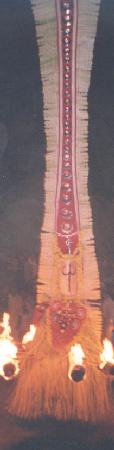
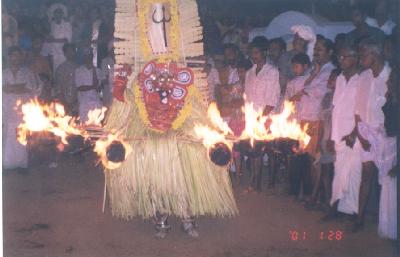
Who is this Kanthakarnan who is a theyyam? Daivam?
We are told that according to Kanthakarnan Thottam, the "theyyam is known as
Kanthakarnan since it
originated from the throat of Lord Siva and came out through his ear". Hence
"Kantha" (kazutt, neck) and "Karna"(cevi, ear) in his name.
Kanthakarnan - Theyyam Myth
Lord Siva had been performing a Thandava dance at Kailasa for two days
continuously. As Siva sat down, three bhutaganas created by him stood
in front of him: The youngest Cheerumba, the eldest Cheerumba and Dhandan.
They started playing pranks with him. They were asking for some gifts.
Without hesitating, Siva gave three measures of seeds of smallpox. The
bhootaganas were overjoyed. As they were about to descend to the earth,
they had a nagging doubt: What if the seeds did not sprout? Are these sterile?
To clarify the doubt, they threw some of the seeds on to Siva's body.
Before Siva could wipe them off, Siva's blue body was covered with smallpox
pores. Siva fell down with his body aching. As he was wondering who will
save him, someone answered from inside his body. The hero, finding his way
blocked at Siva's throat (kantha), jumped out through Siva's ears (karna).
Assuming a terrible form, he danced in front of Siva. Thousands of suns
blazed on his face. Torches blazed from his hands, body and waist. A fire
burned from his head. A trident on his hand. A stick on the other hand.
A sound of bell, shaking the whole world.
(Based on the description given in pages 102 to 103 from the book
Kolathunattile Theyyam Kathakal by Dr. R.C.Karippath,
published by Samskruti, Kannur (January 2004) Distributors: Current Books)
Translated in English by A. Purushothaman
31st August 2004
Connection of Ghantakarnan with Goddess
We note that both Ghantakarna and Kanthakarnan have close relations with
Siva. Could there be deeper relations between the two?
Some hints are provided in the
book The Cult of Draupadi. Vol. 2. On
Hindu Ritual and the Goddess , Alf Hiltebeitel, The University of
Chicago Press, 1991. We quote from the book:
chapter 7 Rituals of Battle
B. The Original Battle Formation
p.176
[19] On the successive and to some degree interchangable series of the
goddess's guardians - Ghantakarnan, Virabhadra, Bhairava, Matan, Vetalan,
Tampuran etc. -- see Tarabout 1986, 126, 163, 167-68, 175, 209, 309; also
505 on Butan and Tara.
[20] His name "bell" plus "ear", has several connotations, including
"bell-shaped ears" (cf. Kumbakarna, "Pot-Ears", brother of Ravana),
"having bells in the ears", or, a "bell with a tongue", as in the myth
where he is created from Siva's ear to lick smallpox soares off Siva's or
goddess's body (Tarabout 1986, 151 and n.4). Cf. Pota Raju-Pormannan's
tongue (Hiltebeitel 1988a, 339, 351, 363). Tarabout suggests he is a
>"personalized" (add "demonized") "form of the goddess's bell, considered
as a weapon(and the 'large tongue' as nothing more than its clapper)"
(1986, 154 n.46). The bell is one of the ritual weapons linking Draupadi
with Pormannan (Hiltebeitel 1988a, 387). Ghantakarnnan is linked with
Virabhadra as residing in the dhanumaram or "bow tree" (ibid., 126, 163,
168), another demonized ritual "weapon" (ibid., 169); cf. Arjuna's "bow
tree"; chapter 8; and identified with Yama's buffalo (ibid., 151 n.2,
166). Ghantakarnnan's altar receives the blood of tukkakkaran warriors
(ibid., 291, 293-98, 310-13).
Tarabout, Gilles 1986. Sacrifier et donner a voir en pays Malabar.
Paris: Ecole Francaise d'Extreme Orient.
Hiltebeitel 1988a The Cult of Draupadi. Vol. 1. Mythologies: From Gingee
to Kurukshetra, University of Chicago Press
Ghantakarnan idols and temples in Kerala
There is an installation of an idol of Ghantakarnan in Viliyil Komarath
House, near kozhikulangara Devi Temple, (near Chavakkad, Trichur).
Ghantakarnan at Narayanamkulangara BhadraKali temple


The myth of Ghantakarna associated with Bhadrakali and Darukavadha
The myth is retold in the malayalam book Aitihyamala (Garland of
legend) by Kottarattil Shankunni under the title The Aitihya of
Kodungallur Vasoorimala. The legend is summarized in Puranic
Encyclopedia by Vettom Mani as follows.
It is Karnakarnan!
Ghantakarna Pratistha in temples
According to Puranic Encyclopedia by Vettom Mani, Agnipurana states
as follows:
It is Ghantan and Karnan!
In response to the question, why Ghantakarnas appear as two in one
in the ritual performance Krishnattam at Guruvayur temple, retired
Asan Parameswara Panikkar said that it is because they are Ghantan and
Karnan (private communication to P. Radhakrishnan Nair, 2004). Such a twist
was a great surprise to us. Later on, in Puranic Encyclopedia of
Vettom Mani under the entry Ghantakarnan we read: Bhagavatam
Dasama Skandam states that elder brother is Ghantan and younger one is
Karnan. Sine we were pretty sure that Sanskrit Bhagavata Purana has no
mention of Ghantakarna, the mystery deepened. What is the source of Vettom
Mani?
Ghantakarna at Daksayaga
Kuncan Nambiar is an 18th century poet in Malayalam who wrote numerous poems in the "Tullal" style based on Mahabharata and Puranas.
75 Thullal kathakal - Edited by Dr. V.S.Sarma, D.C.Books, Kottayam (1976)
�
Ghantakarnas and Rabindranath Tagore
Ghantakarnas appear in a story by Rabindranath Tagore.
Pupey: "Dadamoshai, can you ever hear the sound?"
"Of course. The very other night, while reading a book, suddenly I heard
Ghantakarna moving through the deep darkness. When he rang twelve times I
couldn't restrain myself any more. Quickly laying aside the book, starting
up I rushed to bed and shoving my face into the pillow, shut my eyes and
stayed supine."
"Is Ghantakarna friends with the hare?"
"Very fast friends indeed. The hare moves through the lane of the seven
rishis�keeping his ears attuned in the direction of his sound."
"And then?"
"Then when it rings one, two, three, four, five, then the road ends."
"And then?"
"Then he reaches beyond the field of sleep to the land of light."
Translated from Bengali by Pradip Bhattacharya
Now we have come a full circle. Let us witness the encounter between
Ghantakarna and Krishna in Krishna's Play, Krishnattam.
Ghantakarnan in Krishnattam
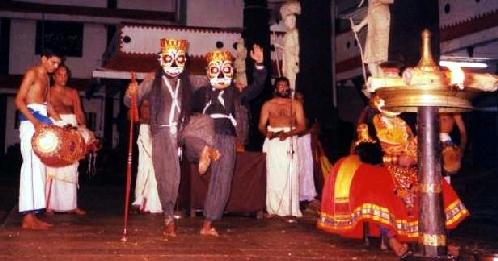
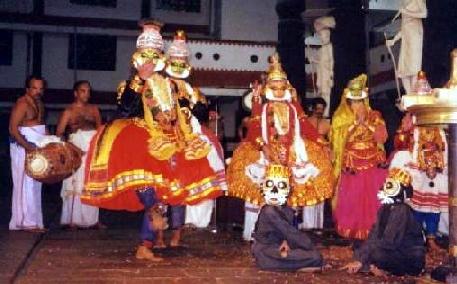
When Rukmini requested Krishna for a son equal to him, Krishna replied
that he will appease Siva, the Lord of Kailasa and then grant her wish.
On his way to Kailasa, Krishna reached Badaryasrama.
Ghantakarna and his brother, blessed with best lives, hunting and killing
wild animals, singing happily the names, Son of Nanda, Slayer of Naraka,
Hari, Krishna, Rama approached Krishna.
The best among devotees, upon seeing Krishna, they were overwhelmed with
joy.
They addressed Krishna happily.
Krishna, the friend of Siva was also pleased with their devotion and
addressed them.
( Padam-1 )
Ghantakarna:
O! Great among men ! who are you? Why did you come here? Today, my life has
become fruitful.
( Pallavam : )
O! Peaceful One! Seeing your pleasant attitude, I feel happy.
My mind gets attached to you, the best among men, as though you are the
Jewel of Yadava Race, the Great among Good Men, Sri Krishna.
O! Ornament of Pisaca Race ! I am born in Yadava Race for protecting the
earth suffering from evil kings.
To accomplish certain things, I am rushing to meet Siva, who is good to
everyone.
O! Great Devotee ! Who are you? Who is this standing by your side?
I am a servant of Siva. From the abode of Siva, I am proceeding to Dwaraka,
which bestows good, only to meet you.
In the world, we are known as Ghantakarnas. This is my younger brother. O
Lord! We are your Devotees.
Saying this, they happily danced around. Prostrating before Krishna,
they offered a piece from a Brahmin's dead body as the best offering.
Krishna was extremely pleased. He transformed them to divine men and sent
them to heaven.
Thereafter, Krishna proceeded to Kailasa and performed penance with
determined mind.
Siva came in a hurry to meet you. He was accompanied by the Gods of the
world, secondary gods, Bhootas, Ghosts (Pretas)�, Pisacas who were�
immensely pleased and highly surprised (hence appeared �tired), and
Parvati. Snakes were dangling around his neck as if they were garlands.
Siva's eyes were wide open and he put his finger on his nosetip with
astonishment. He smiled profusely. Seeing Siva, O �unconquered �One, you
were pleased and you praised him.
Many More?
Hopefully there are many more sightings of Ghantakarna ....
Compiled from many different sources by A. Harindranath and A.
Purushothaman.
Sources:
Kanthakarnan Theyyam: The information and photos of Kanthakarna Theyyam were supplied by
Shri K. T. Madhavan Nambiar of Koodali Thazhath Veedu.
Krishnattam photos taken by A. Harindranath at Guruvayur
Temple on October 10, 2003.
Last updated by A.H on August 31, 2004.


undefined 
undefined More... 
undefined [Close]


