
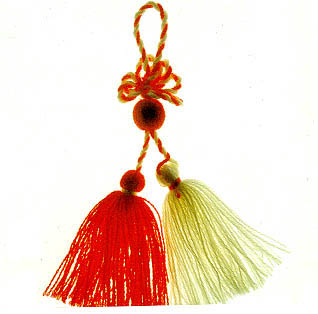

<<Martenitzi>>
There are many different legends about how did this custom started. Here are few explanations:
1. This is unique national custom known only in Bulgaria, and originating from the ancient Thracians. The first martenzi were made of white and red woollen thread to which a silver or gold coin was tied occasionally. In some regions women dress completely in red this day, and in Northeast the lady of the house tosses a red cloth over a fruit-tree, or spreads red wool onto the field for fertility. In stockbreeding areas, a white-and-red thread is tied to the cattle. The tradition today is alive as ever: every year on March 1, the Bulgarians present each other with martenitzi.
2. The month of March according to Bulgarian folk belief marks the beginning of the springtime. Therefore the first day of March is a traditional holiday associated with sending off the winter and welcoming the spring. The ancient roots of this ritual honour the God Mars, who is the God of the spring and lush vegetation and later the God of the war. Grandma Marta is an odd mythological character of the spring and of the month of March. The folk name of the month March � Grandma Marta � originated in the Old Bulgarian language and created the mythological character of the Old Woman Marta. The female origin served as the basis of this character and that is why this character is dual. Firstly she personates the female spirit that raises life and is symbol of fruitfulness and maternity. At the same time the fickle female (capriciousness) � spontaneous and destructive. Grandma Marta is sometimes jolly, sometimes grumpy. Her temper is changeable and her mood has an effect on the weather. All these beliefs and ideas gave rise to different traditions. They are meant to appease the ferocious Grandma. Early in the morning, before the sun rose on March the firs, each housewife cleaned the house, the garden, threw out the garbage in order to chase away the wickedness (misfortune) and diseases and for health. Then she wrapped up a red belt or apron or scarf or just a red thread on a fruit-tree in the orchard. This was done in order to meet the Grandma Marta �clean and red� and then she would be good and smiling.
During the day the older women stayed at home and they didn�t go outside because Grandma Marta didn�t like them. Only the girls and brides walked on the street and they had to put on some red clothes or scarves. The beauty and the youth of these women made the capricious Grandma glad and then she would warm up the weather. A decoration with �martenitza� is the most typical and unique Bulgarian tradition. �Martenitza� is a sign of Grandma Marta and symbolizes new life, conception, fertility and the spring. This holiday is for joy, health and long life.
Today on March the first all over the country there is a custom of tying up (putting on) white and red twisted threads (tassels) named �martenitzi�. This is an ancient Bulgarian tradition and nobody knows how old it is but most probably it�s more than thirteen hundred years old. In the old times, almost from the formation of the Bulgarian nationality in the six hundred eighty first year, ancient Bulgarians Khan was dressed in red and the shamans was dressed in white. They also twisted white and red threads and they wore them for protection like an amulet.
The white color symbolizes the male spirit, strength, the bright sunshine zone and later under the influence of Christianity � virginity and purity. The white color is the color of Christ. The red color is the female spirit and is symbol of blood, health, conception, birth and fruitfulness. The white and red threads must be twisted as the girls hang around the boys. The people wear this twisted tassel for protection against evil, disease and bad luck � like an amulet. To increase the power of the amulet you can add a clove of garlic to get away from the evil and disease, a cross, a blue bead against any spells and a silver coin for a rich harvest. The �martenitza� you can tie on the right hand of children, put around the neck or on the braid of the young women, on the left hand for a bride to have babies. You can also wrap it up on the fruit-tree, hang it on the horn of the domestic animals for health, fruitfulness and a good harvest.
The �martenitza� is also an odd artistic image of nature. At that period of the year nature is full of hopes and expectations. It symbolizes the purity of the white snow, that is going away and the red setting of the sun, which is becoming more and more intensive with the coming spring. These two natural resources are necessary for the life as well as the male and female spirits. �Martenitza�s� are supposed to be worn until March twenty second or twenty- fifth.
This date is related to the first appearance of the migratory birds. That means until the person seas a first stork, a swallow or some blossom out on a fruit-tree. Then �martenitza�s� are thrown onto the blooming tree. It is also an old tradition that each woman chooses a day of March to predict the future. If this day is sunny, the year will be good and happy. If it�s raining there will be some difficulties or failures. The worst case is if it�s snowing. For Grandma Marta you can find a lot of folk stories and songs. This Bulgarian tradition (ritual) is pure and bright like the colors of the �martenitza�. It shows us the necessity of harmony in nature and in people�s lives. This is the sincere message from the �martenitza�.