
SCHEMATICS
Transportation || Crew Support
Information on this page is mostly speculative: it is basically here to guess at what technology the NX-01 could have based on facts that have been previously established by interviews and other Trek series and movies. It will be updated, along with the technical specifications, as new information becomes available through episodes or publications like Star Trek: The Magazine.
Ship
Dimensions
Officially, the ship
is
230 meters long. This is consistent with my guess that it would be
about
three-quarters of the size of the 289 meter Enterprise from the
original television series. This also makes this version of the Enterprise
the smallest of the seven vessels of Star Trek fame. New information
from
the writer's bible, however, give the ship's dimensions at 190 meters.
230 seems to be the more plausible number, but the size could have been
revised at some point. The crew complement is also given as 87, jibing
with Rick Berman's original estimates. Production designer Herman
Zimmerman
stated "The Enterprise that we're watching now is going to be
much
more hands-on for the crew. Basically we're getting a lot of
information
about what's outside our [region of the] galaxy from the Vulcans." The
ship's designer, John Eaves, and later scenic artist Doug Drexler, were
confident that the technology will not outdate the TOS era of 100 years
later; he expressed the belief that the producers will make it an
introductory
ground for Kirk's Enterprise and fit well into the established
Trek
timeline.
Return
to
Top
Propulsion
Warp drive is still
relatively
new in this timeframe. As Marvin Rush stated, "Warp drive has been
around
for a while, but not very long." According to Rick Berman, the secrets
behind it are mostly hidden from Earth by the Vulcans, who feel
humanity
is not yet ready for space travel. This Enterprise is the first
Earth-constructed vessel capable of reaching Warp 5. If this warp
factor
is calculated using the scale from the original Star Trek
series,
this would be a high speed for this time period. The maximum cruising
speed
of Kirk's Enterprise from 100 years later was still Warp 6,
with
Warp 8 as the maximum safe speed. The engineering set shows what is
believed
to be a large, lozenge-shaped warp core with two power transfer
conduits
running upward. This is different from the typical vertical tube that
was
first seen in TMP, as this version doesn't appear to have any sort of
definable
dilithium crystal chamber or tunnels running from the matter and
antimatter
stores. This would suggest both fuel sources are close to the core, and
the fact the core seems to be all in one may mean the matter/antimatter
reaction is much more violent than the later ships. The core may not
even
be a matter/antimatter reactor, although this is extremely unlikely.
Many
have said that the pod at the back of the ship may contain the
engineering
section (making the entire module ejectable in emergency) but the
engineering
set might not fit within that space. Dialogue in "Broken Bow"
explicitly
states that the NX-01 uses impulse engines for its primary sublight
propulsion.
There are two modules on the aft of each side of the saucer that do
look
like impulse engines. It is safe to assume that this ship will have RCS
thrusters; the RCS system is used by the present day shuttle orbiter
and
is a feature on all subsequent Starfleet vessels up to and including
the
modern Galaxy and Sovereign classes. The navigational
deflector
is also clearly seen on the dorsal view: it is right at the forward
edge
of the saucer section.
Return
to
Top
Weapons
Phasers will
definitely
not be seen as they were not present during the early part of Kirk's
five
year mission. The primary weapons of this time will most likely be some
sort of laser, as was used during most of the Constitution
class
Enterprise's
lifetime. The personal weapons are described as phase pistols,
obviously
not phasers. The pilot, "Broken Bow" seems to suggest that the weapons
used by the ship are still laser based. A high-tech missile system will
also be installed; whether this warhead is nuclear, fusion, or any
other
type of reactant is still unknown. They are launched via at least two
forward
launchers, seen in use during "Broken Bow." According to some sources,
photon torpedoes are not developed until the outbreak of the Romulan
War,
which would be about five years after the premiere of Enterprise.
However, there are some reports that contrast this, stating Enterprise
will carry a primitive version of photon torpedoes. Several ports on
the
model could possibly be launch facilities. One interesting side note:
the
writer's bible is rumored to state that Armory Officer Malcolm Reed may
have a hand in developing technology such as phasers and photon
torpedoes.
If this is true, Reed would need to live at least a further 100 years,
as phasers did not appear on the U.S.S. Enterprise NCC-1701
until
its 2265 upgrade. According to Dr. Beverly Crusher in the TNG episode
"A
Matter of Time," surgical forcefields were not in use during the 22nd
century; this may also mean most forcefield systems were not invented
yet
or are in a very primitive stage. This explains why the ship lacks
large-scale
shield systems for protection (as confirmed in the August 24 TV Guide
and
"Broken Bow") and why the transporter, which employs forcefields, is
still
an unreliable piece of technology.
Return
to
Top
Science
Scott Bakula
confirmed the
mission of the Enterprise is exploratory rather than military
in
nature. Therefore, it most likely has advanced sensor and science
systems,
which would be expected for an exploratory vessel. The interiors of the
ship that have been seen so far (the bridge, ready room, and main
engineering)
seem to have a mix of touch panels and actual physical buttons.
Okudagram-like
displays are seen throughout those sets, and according to Rick Berman
the
bridge has 80 computer monitors displaying animated graphics. The ship
must run on computer systems other than the duotronic of the Enterprise
1701; the inventor of that technology has not even been born yet.
Communications
over long distances can only be accomplished while the ship is at warp:
apparently the carrier wave can only maintain integrity at superluminal
velocities.
Return
to
Top
Transportation
The NX-01 Enterprise
will feature transporters, albeit in a primitive stage. Director of
photography
Marvin Rush is quoted as saying this ship will be a testbed for several
new technologies, including the transporter. "Transporter technology is
also fairly new, and while it's proven, not everybody in the world
trusts
it." Illustrator John Eaves said that the Enterprise will not
have
a transporter and instead the crew will take a shuttle everywhere.
Eaves
was most likely referring to the fact that there isn't a personnel
transporter
aboard, but only a cargo version. Archer still safely uses the
transporter
during "Broken Bow" so, like the transporters of the TNG era, they can
be reset for quantum rather than molecular resolution. As far as
shuttles
are concerned, the podlike craft with deployable wings are "dropped"
from
the ship's belly. The other "bays" located on the ship's dorsal in the
port and starboard locations as well as in the aft area are apparently
cargo hatches or some type of airlock. The actual shuttlecraft itself
is
small. As with the shuttle orbiter and the later starships, this Enterprise
will no doubt need to tow or move large objects. Tractor beams don't
seem
to be in evidence, so the grappling hooks mentioned are probably an
advanced
version of the shuttle's robotic arm.
Return
to
Top
Crew
Support
Replicators and
holodecks
are definitely out for Enterprise (at least on the ship
itself):
they didn't appear until the 24th century. This Enterprise
does seem to have a very simple version of a replicator called a
protein
resequencer: it reconstitutes proteins into simple foodstuffs. More
complex
meals are prepared from scratch and served in areas such as the crew
mess
and captain's ready room. Large crew quarters such as those on the Enterprise-D
and Voyager are also a thing of the 24th century.
Spartan
crew quarters in bunk style seems to be the norm; much as with DS9's Defiant.
Dr. Phlox's sickbay will be much less advanced than McCoy's and
Crusher's;
Dr. Crusher stated in the TNG episode "A Matter of Time" that medical
technology
was extremely primitive. This is consistent with the descriptions of
sickbay
in the casting sheet and later Berman's summary in TV Guide. There
seems
to be a turboshaft terminus to the port of the bridge module, which
would
mean that there is at least a simple turboelevator system in place.
Return
to
Top
Insignia

Captains
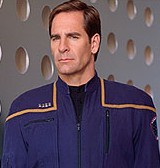
Jonathan Archer