Appetisers
- this section needs a little explanation,
I feel, as far as the Polish recipes are concerned. So far, I've
included any recipe which I feel is particularly suited towards being served
in small quantity, savoury or sweet. That's the beauty of recipes
such as knedle, potato pancakes, or pierogi - once you have the basic recipe,
you can mix & match it with any stuffing or topping you like.
I've provided a few favourites of mine. Additionally, if you like
any recipe here, feel free to bulk it right back up again and serve it,
savoury or sweet, as a main course. Many is the time I've eaten blueberry
pierogi with sugar and sour cream as a main course. If you use these
recipes as a main course, chances are you are taking the recipe back to
its roots.
Cheddar
Paste Dumplings (Pierogi: Bacon
and Cheese, Minced Pork) Eggs
Washington Onion Tart
Poor Humus Pork
Lemon Pate Potato Pancakes
Savoury Cheesecakes Strawberry
Salad
Cheddar
Paste (16)
- this is an all-purpose paste which
is good for sandwiches (spread thickly), seasoning French toasts ready
to receive juicy meats or fish (spread thinly), or served warm as a dip.
I've even used it as an emergency white sauce for a rather unusual lasagne.
The comedian Eddie Izzard once made a joke about "The English! Who
else could invent a mustard that gives you a nosebleed!", but the extraordinary
sharpness of the mustard is good with the gently aromatic Cheddar and the
hint of alcohol. A very English preparation.
500 g Cheddar cheese,
mild or mature
200 ml Bitter beer
small knob butter
1/2 to 1 tsp prepared
English mustard
1 tsp cornflour
200 ml sour cream
Cut cheese into slices and put in a pan with all other ingredients except
cornflour, cream, and a little of the beer. Heat until the cheese
melts. Remove from heat and add the cornflour as a paste in the remaining
beer. Stir and heat gently until smooth and thick. Remove from
heat and stir in sour cream until very smooth. Immediately turn into
a lidded pot or plastic container. Leave open until cool, then seal
and refrigerate.
Top
 Pierogi
(6)
Pierogi
(6)
- making pierogi ('pierogi' already
is a plural) is a morning's job if you make enough for, say, two dinner-parties
and freeze one half (Pierogi freeze very well). If you're a beginner,
it can be a depressing all-day job which leaves you hungry. I know.
But these things are so delicious it's well-worth learning how to make
them, so I've included two recipes, the first of which is an all-forgiving
one which uses a quite firm, eggy dough, hence doesn't rely on too much
experience for the stuffing routine (the rest of the stuffing can be piled
on top). The second method uses little egg, but gives a beautiful,
pearlescent dough which stretches around stuffings well and gives luxuriant,
well-packed pierogi. I thank two aunts for these recipes: both cook
dreamily well, but one enjoys cooking much more than the other. Makes
sense, eh? So take your pick of recipe.
Easy Pierogi (6)
-
makes about 30 pierogi which are firm and will need enlivening by a topping
such as the grated smoked ewe's-cheese, oscypek, and pepper fresh from
the mill. Also, don't be afraid to drizzle some melted bacon fat
over the whole thing at the end - the tastes really go together.
If you can't find oscypek and bryndza, any smoked cheese will do for the
former, and any soft salty white cheese will do instead of bryndza.
I often use Welsh goat's cheese, in which case I like to serve the pierogi
with a dab of sour cream. Lastly, I've provided pictures as a guide,
but these are of the recipe below - if it's your first time at pierogi,
don't try and over-pack them - this dough isn't as stretchy as that given
below, and pierogi honestly taste as good with some of the filling on top.
1 small potato,
boiled and mashed
400 g plain wheat
flour
3 eggs
3-4 shot glasses
warm (not hot) water
300 g streaky bacon
400 g soft crumbly
cheese such as bryndza
50 g hard aromatic
cheese such as oscypek, grated
a very little butter
for frying
salt
pepper
Cut bacon into lardons and fry, turning very occasionally, over a low heat
until very dry and crisp. Don't scrape the pan as the
Combine mash, flour and eggs in a bowl, and mix with a spatula in a folding
and cutting motion. Slowly add water until a very elastic, somewhat
sticky dough is obtained. Knead briefly on a well-floured board and
roll out to a 2-4 mm thickness. Cut into 8-10 cm rounds with a cutter
or cup. Stuff less floury side of each pierog sparsely with soft
cheese and a lardon or two of bacon, dampen the edges,  and stick over into semicircles. Seal well - you could try to crimp
the edges of the pierogi
to seal better, but it isn't strictly necessary. Meanwhile boil a
large pan of salted water and poach the pierogi for 10-15 minutes at a
gentle boil. Drain well and serve with the hard cheese and possibly
the rest of the filling heaped or poured over.
and stick over into semicircles. Seal well - you could try to crimp
the edges of the pierogi
to seal better, but it isn't strictly necessary. Meanwhile boil a
large pan of salted water and poach the pierogi for 10-15 minutes at a
gentle boil. Drain well and serve with the hard cheese and possibly
the rest of the filling heaped or poured over.
Intermediate Pierogi
(6) - gorgeous creations - more experienced pierogi makers can
get the dough almost transparent and really pack that filling in.
These pierogi are perfectly good served on their own with salt and pepper
and just a little melted butter, but I like to go the whole uh... hog,
and serve them with slow fried crispy bacon and a little sour cream on
the side. I could get tearful just thinking about them. If
you're thinking of serving them plain, season the filling well.
500 g plain wheat
flour, plus extra for rolling
1 egg yolk
boiling water
warm water
450 g lean pork
3 shallots
1 very small clove
garlic
knob butter
200 ml white wine
3 tbsp breadcrumbs
Chop the shallots and garlic and fry gently in the butter for 5 minutes.
Then add wine and pork, together with any bone, into the pan and poach
steadily until the pork is tender but not over-done. While warm,
take out any bone, put the whole lot into a food processor or mincer, and
mince as smooth as you like. Stir or beat in enough of the breadcrumbs
to return the whole to the consistency of a firm paste. Prepare the
warm water so as to be too hot to the touch, then get the egg ready, then
weigh the flour onto a large worktop or board, and then boil some
more water. Make a well in the heap of flour, and pour about 200
ml of boiling water into the well - slap it back with a spatula if it runs
out. Start to knead the whole with the spatula, adding in the salt
and the yolk when the whole thing has cooled down a little. When
the whole thing is cool enough to knead by hand, knead in the warm water,
which should be cool enough to touch by now. You'll know you've finished
when the whole has a very soft, stretchy consistency. If you don't
have a lot of room, divide the dough in half and wrap one half in a slightly
damp cloth while you work on the other. Roll out to about 2-4 mm
thickness on a fresh, floured surface and cut into 8-10 cm rounds with
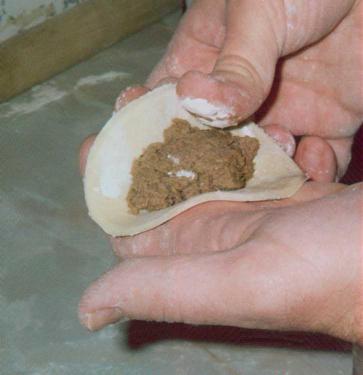
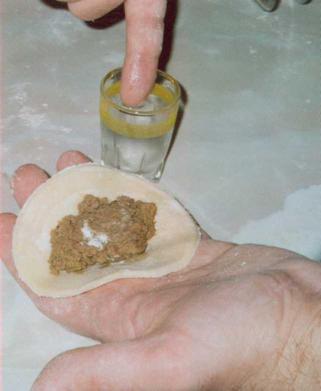
a cutter or cup. Stuff the less floury side of each pierog with at
least a teaspoon of filling and pat down with some flour (on your
thumb - I'm right-handed, so I use my right thumb .
The flour helps the filling slide over the dough when you seal it).
Keep your thumb dry, and use your little finger for dipping into water
to dampen the edges of the dough (
if, as here, you are a hairy three-fingered Disney troll, improvise, or
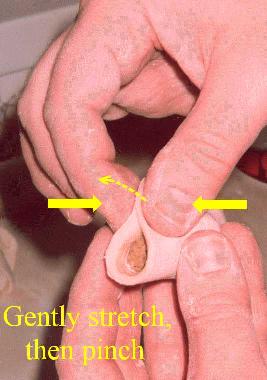
scare somebody else into lending you their pinkie). Stick the edges
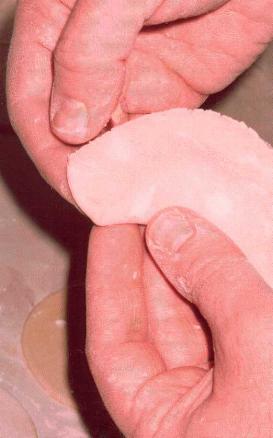
firmly together, stretching the dough gently over the filling
- don't worry if the shape isn't perfecctly semicircular .
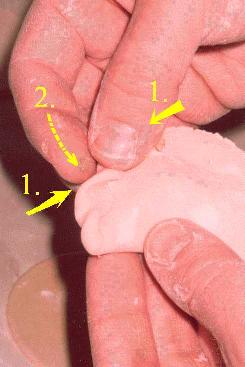
You might like to crimp the edges to help seal them. I start on the
left and use my thumb and first two fingers, pinching between thumb and
second finger, then immediately tucking the freshly-pinched part down with
the index finger
and pinching part of the fold into the next one. This gets a good
seal, irons out the flaws in shape, is nice to look at ,
and is great to eat. Lay the pierogi out, separately, on a floured
surface (or freeze them like that. Once they are frozen rock-hard,
they can be put into a plastic bag - they won't stick. Cook straight
from frozen, adding three minutes to the poaching time). To cook,
boil a large pan of salted water and poach the pierogi for 10-15 minutes
at a gentle boil, gently pushing them into the water from time to time.
Drain well and serve with salt and pepper and a little melted butter, or
however you like.
Top
Eggs
Washington (6)
- good morning! Great for
breakfast, too.
6 large or 12 medium
tomatoes
4-6 eggs
basil, preferably
fresh
cream
salt
black pepper
With a paring knife, slice tops off tomatoes and hollow them out with a
teaspoon. Put a basil leaf or pinch of dry herb into each.
Crack the eggs, and fill each tomato with egg, however takes your fancy
- white, yolk, or both. Place intto a hot oven (220 C) until the eggs
have set (about 10 minutes). Allow to cool to lukewarm, then top
with a dab of cream and plenty of salt and pepper.
Top
Onion
Tart (6)
- comes in vegetarian and 'meat'
versions, and is stupendous in both when served with a very light and slight
green salad. If I remember correctly, this is only slightly modified
from a version by Matthew Fort which appeared in the Guardian.
340 g shortcrust
pastry
400 g onions, free
of any hard outer layers
100 ml double cream
2 large eggs
several slices
prosciutto or Parma ham (optional)
75 g Gruyere cheese,
grated
50 g Parmesan cheese,
grated
tsp salt
tsp butter
tsp olive oil
1/2 tsp black pepper
Thinly slice onions and cook slowly, covered, in butter and oil until very
soft and just beginning to stick. If they stick before they are soft,
add water a teaspoon at a time to keep manageable. Let cool.
Meanwhile roll out pastry to fill a 20 cm flan dish, which grease well
with butter or chicken fat. Set oven at 190 C and line dish with
pastry. Trim, allowing at least 1 cm around the edges for shrinkage.
Prick well with a fork and place in fridge for 10 minutes and bake blind
for 10 minutes. Remove from oven and immediately line the hot pastry
with the prosciutto, if used. Let stand. Add the Gruyere, cream,
salt and pepper and mix, then add eggs and mix well again; make sure the
eggs don't cook yet. Pour into the flan dish, top with Parmesan and,
if liked, a lid made from excess pastry. Brush with milk, cream or
egg, and place in oven, reducing temperature to 150 C immediately.
Ready in about 30-40 minutes. Best eaten warm, not hot.
Top
Poor
Humus (12)
- it's only 'poor' if you want to
use vegetable oil instead of olive oil, it being otherwise rather good
and a sensible use for canned chickpeas, which are otherwise near-useless.
I like to pile it onto plates or bowls and smother it in the sesame seeds.
Great for buffets and salads, served with good fresh bread.
200 g cooked, soft
chickpeas
80 ml olive or
vegetable oil (50 ml if to be stored)
1 clove garlic
1/2 tsp black pepper
1/2 tsp salt
3 tbsp lemon juice
sesame seeds, to
garnish
Blend together very, very smoothly, chill, and garnish heavily with sesame
seeds.
Top
Pork
Lemon Pate (12)
- a really good bittersweet pate
which doesn't rely on eggs as a setting agent. It's rich, and so
goes a long way. Lots of toasts and still more lemon, in the form
of wedges for squeezing, make a great accompaniment.
tbsp butter
2 medium onions
2 cloves garlic
300 g pig's liver
500 g sliced streaky
bacon
tsp herbes de provence
1/2 tsp ground
bay leaf, or 1 whole leaf
1/2 tsp nutmeg
6 tbsp cream
5 tbsp lemon juice
lemon, tomato,
bay leaves, etc. to taste
salt
pepper
Chop the onion and saucepan fry in the butter with whole garlic cloves
until soft. Remove from fat and set aside. Add oil to pan and
then liver, sliced. Cover and heat gently until well cooked.
If necessary, remove large pieces, chop them further and fry again.
Meanwhile griddle or grill bacon, catching all juices. Chop bacon
roughly, into lardons. Blend all ingredients while warm, except lemon
juice. Quickly deglaze pans or griddles with this, and beat into
pate. Season, and turn into a buttered dish lined with thinly sliced
lemon, tomato, and/or bay leaves. Cover with stiff kitchen paper
and chill overnight.
Top
Placki
Ziemniaczane (4)
- makes about two pancakes each
and, amazingly, the base recipe is the same for both savoury and sweet
versions if the pancakes are cooked well enough for the onion to become
sweet and mild. Combine with the goulash topping,
or one of your own, or just salt and pepper.
500 g floury potatoes
1/2 medium onion
25 g wheat flour
1 tbsp potato flour
2 eggs
tsp salt
1/2 tsp ground
black pepper
pinch ground nutmeg
oil for frying
Peel the potatoes and onion. Either grate finely, or use a food processor
to grate and then blend both vegetables. Beat in seasoning and eggs
and then, slowly, both flours. Heat oil in a 15-20 cm pan, pour in
a ladleful of mixture, spread out, and fry on both sides to a golden brown.
Goulash
Topping (4)
- whaaaat? He's given goulash
a Polish flag? True, a lot of 'Polish' dishes have Hungarian origins,
but this is Polish-style goulash for Polish-style potato pancakes.
Typically Polish - OK? Is bagels with salmon and sour cream American
food? Probably. Anyway, the only thickening agent here is paprika
- lots of it. Don't smother the ppancakes with this sauce - put a
modest dollop onto each pancake with, possibly, a little dab of sour cream
and a dusting of paprika & pepper over the plate. Once you get
good at making pliable pancakes, you'll be able to fold each one into four,
with filling inside, and dab the cream onto the top of the folded whole.
Grate black pepper over the cream. Delicious.
350 g lean beef
steak
4 shallots or 1
small mild onion
a very small garlic
clove
1 1/2 tbsp butter
or good margarine
tsp salt
10 ml vinegar
about 200 ml water
2 tbsp ground sweet
paprika
5 tbsp sour cream,
plus a little more for decoration
1/2 tsp sugar
pinch hot chile
powder, or 5-10 drops of Tabasco sauce
Trim beef of fat and chop into 2 cm cubes (or smaller). Chop the
garlic and shallots as finely as practicable. Heat the butter quite
strongly in a lidded pan big enough for everything to go into, throw in
the chopped vegetables and cook on a high heat for a minute or so.
Add the beef, salt, and a splash of the water, turn the heat right down,
add vinegar, and cook gently for about an hour, or until the beef is very
tender - occasionally stir the whole and add more water if it looks dry.
Add the sugar, tomato puree, paprika, cream, chile/Tabasco and most of
the remaining water. Adjust consistency with water, season with more
of anything, and allow to cool for a few minutes before serving.
Top
Savoury Cheesecakes (4)
- serve with a small green salad.
300 ml sour cream
1 rasher bacon
2 shallots
1/4 bulb fennel
2 tbsp fresh breadcrumbs
tsp cornflour
1 tomato
50 g cheddar cheese
2 eggs
1/2 tsp salt
Thinly slice onions and fennel. Griddle or grill with bacon, reserving
juices. Meanwhile chop tomatoes and grate cheese. Put cream
in a bowl and beat in cornflour, then stir in breadcrumbs, tomatoes, cheese,
salt, warm ingredients, juices and, finally, eggs. Pour into well-buttered
ramekins and bake at 150 C for 25 minutes. Best eaten lukewarm.
Top
Strawberry Salad (4)
- shocking when I first came across
it, this has now become passe. I still think it tastes great, but
it's much more of an appetiser than a salad.
300 g strawberries
a few basil leaves
about 10 preserved
black olives
60 ml good olive
oil
dash balsamic vinegar
ground black pepper
Thinly slice strawberries and olives. Cut basil into thin strips.
Gently toss ingredients together, grate pepper over, and serve promptly.
Top
Home
Like
this page? Vote for it!
 and stick over into semicircles. Seal well - you could try to crimp
the edges of the pierogi
and stick over into semicircles. Seal well - you could try to crimp
the edges of the pierogi 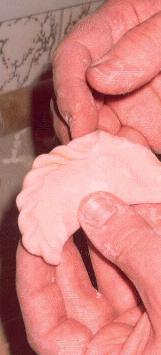 to seal better, but it isn't strictly necessary. Meanwhile boil a
large pan of salted water and poach the pierogi for 10-15 minutes at a
gentle boil. Drain well and serve with the hard cheese and possibly
the rest of the filling heaped or poured over.
to seal better, but it isn't strictly necessary. Meanwhile boil a
large pan of salted water and poach the pierogi for 10-15 minutes at a
gentle boil. Drain well and serve with the hard cheese and possibly
the rest of the filling heaped or poured over.