What is evolution?

Evolution, in a nutshell, is the act of evolving; it is often said that evolution has several different meanings and that they contradict each other, but looking at the semantics of this word, and knowing the usage to which it is applied, I know this is not the case. Evolution means, a gradual process in which something changes into a different and usually more complex or better form. The use of usually is a important part of the semantics, when a mutation occurs to the progeny of the organism in question, it is either a good mutation, or a bad mutation, if a bad mutation occurs the resulting organism is not likely to survive, however when a good mutation occurs this may bring many benefits to the survival of the organism, and therefore become a favoured attribute.

It's amazing how much change can happen to an organism with the mutation of a single chromosome, red blood cells and sickle-cells differ by a single chromosome, the 11th chromosome to be precise, this is what we'd call a bad mutation, the mutation of a single chromosome causes the red blood cell to become a sickle-cell, literally like a sickle in shape, and leads to blockages of the veins and arteries.

Such bad mutations will often lead the organism to death, a filtering effect of good mutations occurs because of this simple fact, simple cells are the perfect place for mutation to occur since they are so prone to mutation and can often lead to completely new organisms, or better versions of the current ones, simply because there is no room for a bad mutation. Mutations that are neither bad nor good, as in they bring no benefit and don't kill the organism, and also no mutation at all, can be just as fatal, as we shall later see.

This accumulation of good mutations is what gives us evolution, each new good mutation being of benefit to the survival of the organism, when such a good mutation occurs, that mutation becomes favoured due to the higher probability of survival for the organism. But don't be fooled, many species have accumulated many good mutations only to become extinct through the lack of such a mutation to the necessity of the environment and the role in which such a benefit aids survival.

Predators vs. Prey

There are more complicated scenarios in evolution than just mere mutation, the predator vs. prey scenario is a good example of one, for the predator we will imagine a hawk, and the prey, a duck. The hawk is an excellent predator, its swift wings and keen eyesight make it a formidable hunter, because the hawk is such an excellent hunter, they preys path of evolution is directly effected by the hawk itself.

Because the hawk is so well adapted for flight, it makes sense that the duck must also be well adapted for flight in order to escape the predator, a duck that is more nimble in the air than another of its species has a higher chance of survival than the unfortunate duck that just became the hawks dinner.

This co-evolution between predator and prey is a major part of natural selection, if the hawk couldn't catch ducks, it would have no way to feed itself and die, for the predators, only the most efficient hunters survive, if the duck couldn't get away, it would soon be the hawks meal, only the most efficient evaders survive.

With each generation as the need for the efficiency of the predator and the prey keeps increasing, they both directly affect each others evolution. This doesn't mean a species of mice that get hunted by birds would suddenly sprout wings and fly, the two example species are simply refining what they already have.

Why don't we see such mutations in our species, what makes us so special?

The short answer is, we do, the long answer is, our code is so complex that any mutations that occur to our chromosomes are often bad mutations, in our case such a mutation doesn't result in death, in many they do, but for us we're often able to lead long and productive lives even with such a mutation. Our code is also not subject to so much mutation because as long as the code is fine, it should present almost flawless copying.

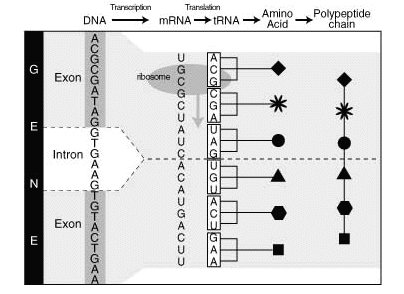
If you imagine that each cell has a 3 amino acid code attached to it, in the dna sequence, TCG can only match one particular type of cell, the one with AGC, this is important to understand as the dna code itself means nothing if there is nothing to decode it, there is no information in dna beyond the role given to it.

That isn't to say we don't have our share of good mutations of course, certain ethnic groups being immune to particular types of diseases, these immunities are good mutations, such immunity is logically beneficial to the survival or the species, and therefore becomes favoured, it only takes one individual to develop the immunity and then pass it onto the next generation to take effect.

People that can't quite imagine how a single individual's good mutation could get introduced into the population so quickly, are also the ones that don't fully realise that the common ancestor we share today was as little as 12 generations ago.

It's almost childs-play when you realise our genetic code is a case of, the square goes in the square hole, such a system doesn't seem so complex now. I hate to sound like I'm belittling this wonderful product of nature, but it's important to understand the cold thoughtless mechanical nature of evolution.

You could use almost any system to represent a particular type of amino acid, ours just happens to be this particular very metabolically stable one, DNA is not a prerequisite to complex organisms as that would require foresight on the part of nature, of which it has none. Instead, if this particular metabolically stable system happens to arise, then we're at a point where complex multicellular life is able to arise, it then becomes a prerequisite through the function it is given.

I can't believe that the (e.g eye) came about by accident

I certainly wouldn't call it an accident, when a beneficial mutation occurs that aids the survival of the organism, this mutation becomes a dominant characteristic, a small patch of light sensitive cells, as useless as they seem, can aid the organism in knowing light from dark. Such an attribute would be more beneficial than not knowing light from dark at all, there is nothing accidental about the benefit this brings to the organisms survival. We keep making the mistake of imagining this great leap from nothing to eyeball, unappreciative of the fact that a mere 1% of increase in sight increases the organisms probability of survival by more than a marginal amount, it's the usefulness of something to aid and benefit our survival that defines it as useful at all.

Most cells have a light sensitive pigment to begin with, and can aid the organism in knowing light from dark, it wouldn't be able to tell direction as there is no mechanism in which to focus the light, and the cell is either on or off as a consequence. This would be the equivalent to 1% sight, the cells didn't become light sensitive in order for the organism to see, that would require foresight, rather the mechanism for light sensitivity already existed, and the use of it for sight became it's function.

When we look at the purpose that a particular object is used for, you begin to see similarities in their form, planes look so similar, not because they've borrowed the design off each other, but because that particular design is so efficient for the purpose it's used for. When 1% sight is common among species attempting to survive, 2% sight becomes the new benefit, and such individuals become naturally selected.

"As many more individuals of each species are born than can possibly survive; and as, consequently, there is a frequently recurring struggle for existence, it follows that any being, if it vary however slightly in any manner profitable to itself, under the complex and sometimes varying conditions of life, will have a better chance of surviving, and thus be naturally selected." Charles Darwin, Origin of Species

Dogs only create dogs, and roses only create roses

Again we fail to appreciate the role of a tiny amount of variation, the ability to run faster, the ability to hear a little better, all kinds of different things which again are only useful if they work in favour of our probability of survival. If you take a wolf and take the smallest cubs of the litter, then breed them together, and take their cubs, and breed the smallest of that litter, their particular size becomes their dominant characteristic, the same applies with larger cubs.

The above example of domestication is artificial selection, where the breeder breeds a new species based entirely on a specific characteristic, in nature, these specific characteristics are the characteristics that aid the probability of survival, the usefulness of it to the benefit of survival is the hand by which nature selects and breeds.

There comes a point where so much variation has occured that what we have is an entirely new species, how we define a species is slightly more difficult, but usually the main definition is that they are no longer capable of breeding together. In the wild this can easily occur due to geographical isolation, the red squirrel is incapable of breeding with a grey squirrel, for instance.

Geographical isolation therefore becomes a major part in the role of speciation, but this is not the only factor, survival of the fittest, where fittest means best adapted to the environment, is also a major part of the equation, you can't take a polar bear, pop him in the desert, and expect its offspring to suddenly be well adapted for the desert. In all likelyhood, the polar bear will die before it has even had a chance to propagate itself within this environment, therefore it would be unfit, yet it's perfectly suited for subzero temperatures.

A tiny variation that allows something to survive just long enough to propogate makes all the difference.

Surely male and female couldn't have come about with such a system

On the contrary, asexual beings would lack the genetic diversity to adapt to the environment, therefore the existence of different sexes allowing the blending of different, slightly variated code, is entirely beneficial to the act of survival, this benefit therefore becomes a dominant characteristic of all species, since it is such a universal benefit.
Universal benefits are what would be necessary for any multi-cellular lifeform to exist, such as an autonomous nervous system, the clotting of blood, the ability to make decisions, majoritively unconciously, but in our case conciously. Such things are exactly what you'd expect to see.

The appendix plays absolutely no role in our current function, yet there it is, so it must have at some point played a function within our anatomy, it's hypothesized that it may have aided to digest tough food like bark, or to digest raw meat, something most animals do without a second thought. Given time our appendix will most likely dissappear from the human body, since it doesn't aid our survival at all.

How can you be so sure, science has got it wrong many times

If I reverse the question and say, how many times has religion got it right, does that make a difference? If they were wrong, would they put their hands up and say, "we got it wrong, sorry about that", I don't believe so. Science is about finding the truth, no matter what that truth may be, and when science gets something wrong, we put our hands up and say, "yep that's wrong, time to change it", we know that evolution is correct because there's so much overwhelming evidence that it just simply can't be, evolution is like gulliver, tied down by thousands of threads of evidence and it's literally going nowhere, opposition to it often see it as tied down by a couple of big chains which they hope to find a weak link in, but that's not that case at all.

Often things that were wrong were very sketchy to begin with, the tools weren't there to do it properly, or the subject itself was very new, people will also make you believe that the things we got wrong were being taught as if they were fact, when this is far from the case, we agreed there was a big bang, we agreed the universe was never in the constant state it's in now, but I certainly don't remember anyone ever firmly agreeing on how big the big bang was.

Show us a theory that can account for all that evidence, is repeatedly testable and can be used to make predictions, and then you're in a position to talk. We know when to say, "my one piece of evidence doesn't support the theory, and thousands of pieces of evidence do, so we need to check our one piece of evidence again", there's a big difference between saying, "it can't be done", and, "I can't figure out how it could be done".

So how did life get started?

Again, these things are very sketchy to begin with, there's barely any evidence to even form a hypothesis, and no amount of opinions will do, however, I believe that when asteroids crashed into the earth, the impact of force caused the carbon atoms to be compressed into strings of peptides. This compression method has been tested in the laboratory, as far as I remember they were trying to disprove the idea of an asteroid that carried simple organisms, as they would likely have been destroyed by the impact, they in fact showed the impact itself caused peptides to be created, so I'd go so far as to say this is a hypothesis.

Why would a cell create more of itself, only to increase competition?

Do you view your children as competition? When you have an extra mouth to feed at the table, the last thing you think is, "damn these extra units, they're causing me to have to work harder to survive", we feel a responsibility to our offspring, and that's even with our unique ability to view the world through conciousness, a cell has no such luxury to think about what it's doing, it reproduces simply because it can, and neither knows nor cares about how many resources there are. HIV doesn't care about the host, it doesn't not care either, it's just surviving, forfilling a 3.5 billion year old program to produce more of itself simply because it can, when resources run out, it still won't care, that's life for you.

------------

I'd like to end this paper on a positive note, I don't really view these facts as negative, but some believe that if we just exist to exist, then our life has no purpose, that there is no reason to care about right or wrong, or justice, or anything for that matter. Try to think of it like this, we are the result of 3.5 billion years of evolution, (it took a billion years for the first cell to arise, for those wondering), here we stand as beings capable of viewing the world with a concious mind, it almost belittles such beauty to think that we jump off some production line because some being decided to exercise its creative power. We're able to defy our genes, to choose to do things which bring absolutely no benefit to our survival, appreciate art, read books, listen to music, go out and have fun, do things which purely bring us enjoyment, we rarely see reproduction as the most important thing, and yet it defines our very existence.

Find your own purpose in life, and make it what's important, don't fear the innevitable and don't fear the truth simply because it wasn't what you wanted to hear.

If you've made it this far, thank you for reading, and remember, stultification is what people revert to when they have nothing worth saying.

Hosted by www.Geocities.ws

1