English Bulldogs are considered the Lazy Man�s Breed. Minimal exercise is all
that is needed for them to remain healthy. Although it is important to give them
a walk every day, try not to travel long distances (around the block is good)
and try not to walk the Bulldog in extreme heat and/or humidity. English
Bulldogs are very susceptible to overheating. Be sure to always have fresh water
available to them. English Bulldogs have a very small trachea (throat opening)
and because of this it is not uncommon for them to hack and cough after they run
� this is due to a build up of saliva/mucous that accumulates in their throat.
Most times they cough it out and they are okay, but if they continue to choke,
you may want to squirt a little concentrated lemon juice into their throat. The
lemon juice breaks up the mucous allowing them to breathe better. Please don�t
kennel an English bulldog. English Bulldogs are people dogs � they love the
company of humans and are happiest when sleeping near and hanging around their
master. Kenneling or caging for short periods of time (housebreaking, running to
the store, etc.) is okay � just not all the time. Treat and care for them as if
they were your own child. The more your English Bulldog is exposed to humans the
better his/her confidence and disposition will develop. You should never leave
your bulldog unattended for long periods in a backyard etc. This can be
dangerous for your dog. They could get into dangerous situations that you may
not realize until it�s too late. Also English Bulldogs are expensive making them
prime candidates for thieves.
BRUSHING
Brushing is very important in the care of your English Bulldog. This removes dust, traces of dirt or soil, and dead hair. It is recommended that they be brushed once a day. Since Bulldog�s have sensitive skin and short fur, brushing the bulldog should be done with a soft bristled brush or comb. It is preferred that using a brush with round plastic balls at the end of each bristle be used. Run the brush against your own skin � if it hurts or stings, chances are it will feel the same to your bulldog.
BATHING
Puppies can be bathed when quite young (three months old). For dogs this age, the room temperature must be 68 degrees Fahrenheit. Since English Bulldogs are usually indoor dogs, a bath once every month or two is recommended. You should bathe your English bulldog in an indoor bathtub. Avoid bathing your dog too much as this takes away the natural oils in the skin that the dog needs to regulate its body temperature. Taking away these oils makes the dog susceptible to the cold as well as parasites. It takes approximately 6 weeks for this natural oil to fully return to the skin and coat, therefore, it is wise to use special dog shampoo that contains parasite repellents. Avoid shampoo�s and toilet soaps made for humans. A PH balanced baby shampoo that does not sting the eyes is okay if used only occasionally. When bathing your bulldog avoid getting the shampoo in his/her eyes and ears. Cotton swabs in the ears can be used as a precaution. Use warm water (95 degrees F) and wet the dog from head to tail. Apply shampoo and begin washing in the neck area first and work your way to the tail (this technique prevents fleas, if any, from traveling to the head region).
Washing under the Bulldog�s tail is also important, especially if the tail is a corkscrew shape. If the dog�s tail is very tight, use a Q Tip to get under it. Washing between the dog�s toes is also very important. Dirt and/or bacteria caught between the toes can cause an infection. Rinse off the dog making sure to remove all shampoo. If necessary repeat the entire process. Once you have finished rinsing the dog, without delay take the dog out of the bathtub and dry the dog off vigorously with a warm towel. You can use a hair dryer (set to medium) to finish the drying process if you prefer. If the weather is cold, please allow the dog to remain in the house for several hours before allowing him/her to go outside. In hot weather, dry the dog as best you can and allow the dog to shake themselves off outside.
FACE
Because of the structure of the bulldog�s face, special attention must be taken. Between the folds of skin should be cleaned at least once a week. It is possible that an infection could occur between these folds if dirt filled with bacteria linger. Washing with dog soap and water on a Q Tip or cotton ball will do. Be sure to dry this area when done so that moisture is not allowed to be trapped � this can also cause an infection or irritation. If an infection becomes apparent, treat with Sudocreme or Neosporin. If it is just irritated, apply some Vaseline or better yet, Desitin.
If your Bulldog has a white or light colored face, tear stains may become a problem. This may be attributed to the red coloring in the food he�s eating but this is not always the case, some bulldogs produce red tears and some don�t, those with white faces will have these stains more than dark colored faces. Several manufacturers make solutions (for example; Crystal Clear and Diamond Eye) which can be applied using a Q tip or cotton swab to remove this staining. In my experience these products only lighten the stains and don�t ever rid the stains unless you find the main cause of the tear stains and solve that problem first, the stains only return and sometimes return worse than before. You can do one of two possibilities to completely remove the tear stains;
1) A daily wipe with "Optrex" eye lotion wash will help. Optrex may be found at your local Pharmacy or purchased through internet pharmaceutical stores. Optrex contains boric acid and witch-hazel which will break up the stain and will not harm the dogs eyes as this solution is made specifically for use in the eyes.
2) Or -- If the Optrex doesn't work, make and use this recipe;
* 2 tsp Milk Of Magnesia (white)
* 3 tsp Peroxide (Human Hair Type - 20 volume)
* 1 tsp Corn Starch
Add all the ingredients above and mix well. If you want to make the paste thicker, just add a little more corn starch but be careful not to use too much that you turn the remedy into a powder. Only make enough for one application. Clean and dry the stained area and apply this paste to the tear stains using a clean cotton swab or Q tip and avoid getting it into the dog�s eyes - let dry overnight. Wash off the paste and condition the area - dry with cloth. Lastly, apply a thin coat of one of the following: Desitin, Boric Acid Ointment or Bag Balm to prevent a possible rash. Repeat this process every day until the stains are gone. It is recommended that if the stains don�t disappear by the second application; take a 1 day break before starting treatment again. This is just to give your dog a break. Once the tear stains are removed you can limit the number of treatments down to once a week depending on how fast the tear stains may return.
3) And -- Add 1 teaspoon of Apple Cider Vinegar per quart of water to dogs water bowl. This is supposed to adjust the PH of the dog�s body and prevent staining from tears or saliva. This is also said to discourage fleas. At first you may want to start with smaller doses of vinegar and work your way up to the 1 teaspoon per quart - this adjusts the dog into accepting the water for drinking.
4) And/or-- Add Tylan (an amount equivalent to a match head) to dog�s food a few times a week. This will keep the area dry and stain free.
EARS
Use a Q Tip with antiseptic to clean the inside of the bulldog�s ears. Never use soap and water. 60% Alcohol or ether can also be used. This is important as the dog�s ears get very dirty. Only use the Q Tip in areas that you can visually see, in other words, don�t shove the Q Tip way inside the dog�s ear. This cleaning should be done at least once a week. Look for ear mites and ticks when cleaning the ears. If ear mites are present, you will need to treat the dog with Miticide. Ticks can be removed by dripping drops of alcohol on them. Visit a Veterinarian if you don�t want to remove these parasites yourself.
NOSE
Occasionally the Bulldog�s nose may dry out. To prevent this, rub a little Vaseline on his/her nose. I do this once a week whether they need it or not.
PAWS
Clean and check your dog�s paws often. Make sure there is no gravel lodged in the pad, no thorns between the toes, and no chewing gum stuck on the sole of the paw. If you see that your dog spends hours licking his/her paw, check the paw to see the problem. Remove the cause of the discomfort, or if you see a cyst and/or infection between toes, take the dog to a veterinarian.
TEETH
Check the condition of your dog�s teeth once a week. If you like, you can clean the dog�s teeth with a damp cloth soaked in baking soda solution or lemon juice. There are actual toothpastes on the market made especially for dogs. I found that you really don�t need to brush your dog�s teeth as long as you supply them with things to chew on; chew toys, steak bones, rawhide bones, etc. Their teeth will naturally cut and clean if you do this. Feeding your dog dry food also helps. If you feed your dog wet food ONLY you may want to consider brushing the dog�s teeth.
NAILS
As needed, clip the dog�s toe nails. If they are left unclipped, accidental injury to others and to the bulldog may occur when the dog plays etc. If your bulldog walks on hard surfaces, such as sidewalks every day, its nails will be worn down naturally. If your dog does not walk on hard surfaces (carpets etc.) or seldom goes for walks outside, make sure the dog�s nails do not grow to long. Clipping nails is not as simple as it sounds. There is a risk of bleeding if not done right. Be sure not to cut the quick (this is the vein that runs up inside the nail from the toe). If your dog has white nails, the quick is easy to see and you can trim the nails with clippers. Cut the nail approximately 2 millimeters above the quick.
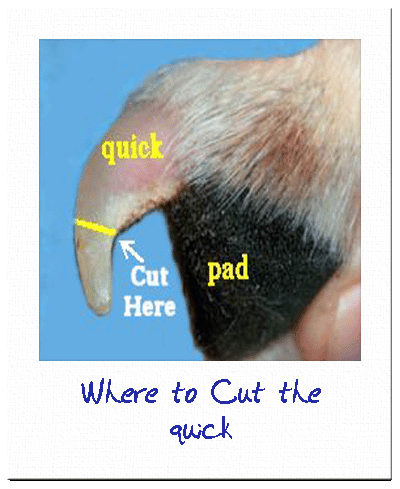
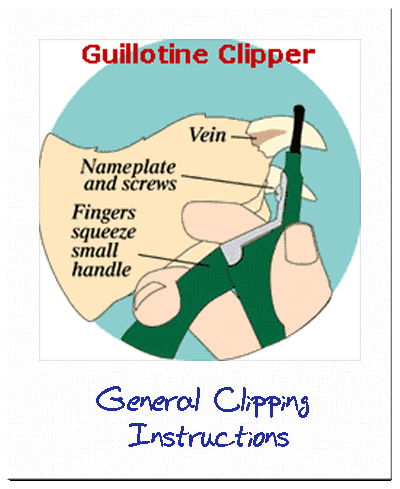
If your dog�s nails are dark, seeing the quick will be difficult, therefore, make several small cuts until you see a small black spot appear in the center of the nail and then stop cutting. If by chance you accidentally cut the quick you can use silver nitrate to stop the bleeding. Take your bulldog to a Dog Groomer or Veterinarian if you are uncomfortable doing this task yourself. If the dog�s nails are grown curling past the pads of the toes, then they need to be clipped. Be sure to always check the Dew Claw as this nail never actually touches the ground; therefore, this nail always needs to be cut at some point. If you are using a guillotine type clipper always clip the nail with the cutting blade facing away from the paw and the nameplate and screw toward the paw. Place your bulldog on a table to clip his/her nails. Dogs tend not to struggle in this situation, making the clipping process much easier.
Many medications can be administered by you at home. Just be sure that all medications are cleared by your vet and that you provide the correct doses. To administer pills to your Bulldog, put your hand under the Bulldog�s chin and place your index finger and your thumb on opposite sides of his/her mouth. Firmly press the dog�s lips against the teeth. This technique will force the dog to open its mouth. Once the mouth is open, place the pill on the back of the tongue and then quickly close the dog�s mouth. Hold the mouth shut and massage the bulldog�s neck. This helps to ensure the pill gets swallowed. I find it easier to just wrap a morsel of meat or processed cheese around the pill and let the bulldog eat it on his/her own. To administer liquid medications, the same technique above is used with the exception that the liquid should be squirted on the tongue by use of a syringe (without needle of course).
DE-WORMING
Your dog can be infected with worms. Some worms you may visually see in your dog�s feces. The most common are Hookworms and Roundworms. Others you may not see such as Heartworms and Tapeworms. It is important to rid and/or protect your dog from these worms. There are several worming medications on the market that will take care of all these worms. Of all the worms, Heartworms are the most dangerous to your dog. Heartworms wrap themselves around the dog�s heart and can eventually cause death. Heartworm medication must be prescribed by a veterinarian. The easiest thing to do is to get the medication that will not only destroy and prevent Heartworms but all the worms. Be sure to give your bulldog this worming medication as prescribed all year round for the life of your dog.
FLEAS AND TICKS
Fleas and ticks are one of the most common of parasites that can hurt your dog. Both fleas and ticks are blood suckers and depending on the size of your dog a large infestation of one or both of these parasites can make your dog ill and even cause death. Your veterinarian can provide you with medication that can rid and/or prevent your dog of fleas and ticks. Pet shops and stores selling pet supplies also sell over the counter flea and tick products � collars, liquids and sprays. Although some of these work well, they tend not to last very long so you may want to consider what type of product or medication you may want to use.
Brewers Yeast with garlic is also a deterrent. These tablets tend to ward off fleas and ticks because of the garlic in the blood stream. The Brewers yeast is good for the dog's coat. Most dogs love the taste of them and will eat the tablets without a problem. Give 1 tablet per 10 pounds of body weight per day. Brewers Yeast tablets are safe and can be used in conjunction with any other flea medication or repellent you are using.
VITAMINS
Giving your bulldog vitamins is important. There are several manufacturers that provide a variety of vitamins for your dog. There are skin and coat supplements as well as weight loss tablets. Find the type you need or like best and use them daily. I like to use the product called �Vita Dog�. This vitamin is in paste form and all my bulldogs love the taste so squirting a little on the tongue is easily done.
DIARRHEA
Your bulldog may experience diarrhea. Diarrhea is not a disease but possibly a symptom of many other diseases. Most of the time diarrhea is not serious. Usually diarrhea is brought on by eating garbage or some other nasty morsel. Other minor causes are stomach or intestinal viruses. You can usually treat your pet at home for this type of diarrhea. Time is usually the best cure, but you can give your dog a medicine such as Kaopectate. Give your dog 0.5 to 1.0 ml per pound of body weight every 2 to 6 hours. You will need to make sure that your bulldog does not get dehydrated. You can give him/her a sports drink in his water dish to guard against loss of nutrients. Do not feed your dog any table scraps or treats while he/she is suffering from diarrhea.
Your dog�s diarrhea may be serious if any of the following additional symptoms are present.
* Vomiting
* Dehydration
* Loss of appetite * Abdominal pain
* Bloody diarrhea * Watery diarrhea
If the diarrhea is occurring in conjunction with one or more of the symptoms above, you should bring your bulldog to your veterinarian for a diagnosis.
At first, your dog will not like being washed, Q tipped, nail clipped, and medicated, but if you stick to a schedule and do these things often, your dog will grow to accept these as his daily life and you will not have a problem with him/her.
ITCHY SKIN
Probably an allergy, possibly the food you are feeding - If this cannot be controlled by diet then you may need to see your vet.
CHERRY EYE
Where the gland under the third eyelid protrudes and looks rather like a cherry in the corner of the eye. Your vet will need to remove the gland (some prefer to tuck). Occasionally removal of the gland causes dry eye. However, most vets today can remove the cherry eye leaving just a small section of the tear gland to prevent the dry eye from
occurring. This small tear gland usually creates more tears to compensate thus never causing the dry eye. Other than the antibiotic cream given to you by the vet after removal , do not apply drops of saline thinking you are helping the dog from getting dry eye. In actuality you may be driving the eye to dependency of the drops and you will have to give the drops for the rest of the dogs life. Allow the small tear gland that is left to compensate. I recommend the removal of the cherry eye rather than tucking (tucking is basically where the cherry eye is stitched behind the
eyelid). My experience is that 75% of all tucking becomes unstitched during play etc thus bringing the cherry back out.
ENTROPIAN
Where the eyelashes have turned inwards and are rubbing against the eye, again surgery may be required. Don�t confuse this with stray eyelashes that are just growing astray, these can be plucked with tweezers (you may prefer your vet to do this). E>ntropian needs surgery - if left the in-turned lashes will scratch the cornea and the result will be a severely damaged eye, at worst blindness or loss of eye.
CONJUNTIVITIS
You will need to obtain a cream from your vet to apply to the affected eye, repeated bouts of conjunctivitis can cause the dog to retract the eyeball which in severe cases can lead to
entropion.
HEAD SHAKES
Something like a fit, but effecting just the head, which will involuntary shake from side to side, sometimes violently enough to cause their lips to flap. This can be linked to stress which may cause the blood sugar level to drop enough to trigger the head shake. Giving some glucose or honey to bring the blood sugar level back up should help although distraction often stops the shaking. If you are unable to link the attack to a specific stressful incident then your bulldog may be suffering and is advisable that you get your vet to check him over. Note, many vets are unfamiliar with this breeds specific condition and some breeders attribute them to a lack of calcium as they are common in the pregnant or nursing bitch. However please do not give calcium under normal circumstances as this could effect the bone formation of your puppy.
DEVELOPMENT PROBLEMS
Because of the bulldog�s rapid growth it is very important that you keep play and exercise properly managed in the first 9 months, early joint damage could be permanent and may lead to osteoarthritis, irregular growth in the bones could lead to joint deformities. Hip/elbow displaysia is genetic but can be encouraged via environmental factors (ie: slidey floors, jumping etc). Fairly often puppy limping will disappear at maturity and is usually due to the rapid growth spurts or an incorrect diet.
Diet plays a large role in bone development, because of the rapid growth of the bulldog it is wise to feed your puppy adult food (mini chunks) to lower the
protein intake. Many dog food manufacturers recommend that puppy stays on the puppy mix for the first year, but the bulldogs bones don't need such a high protein intake as it speeds up an already rapid growth and can lead to development deformities in some cases. The same applies to calcium, don't give puppy any extra calcium - find a good well balanced dog food and stick to it.
You can help your dog through his puppy limping or Arthritis with a natural product called "SeaTone" (Extract of Green Lipped Mussel). These can be bought at any Pharmacy. Buy the super strength and give 1 or 2 capsules per day depending on the severity of the limping, you can either hide the capsule in a treat or sprinkle over their food (it smells fishy, so they love it). SeaTone is a natural anti-inflammatory and will help rebuild any defects in the bone. We give this product to our adult arthritic dogs and have never had the need to use a prescribed arthritis drug yet. We have also given it to young pups going through their "stiff" stages and always give it to any dog that is recovering from joint surgery (ie: *Ruptured Cruciate Ligament). Remember though, that any form of limping should be checked out by your vet, there are many many things that can cause limping (see above) although in most cases "SeaTone" will help.
ELONGATED SOFT PALATE AND OTHER AIRWAY DISORDERS
Every bulldog has an elongated soft palate, this is because of the shape of their heads (ie: brachycephalic - short nosed). In most cases this causes nothing more than snoring, but in severe cases will cause your bulldog difficulty in breathing. Heat and exercise will cause loud, gurgly breathing, (commonly known as "roaring") and your bulldog may appear to be "lazy". The severity can range from loud breathing when excited, during/after exercise to total exercise intolerance, regurgitation of food to permanent breathing difficulties. The condition can be corrected with surgery and you need to be sure that the vet you chose to carry out this surgery totally understand brachycephalic breeds.
MANGE
THERE ARE TWO TYPES OF MANGE
DEMODECTIC MANGE (also called "Red Mange") is caused by a microscopic mite called Demodex canis. All dogs raised normally by their mothers possess this mite as mites are transferred from mother to pup via cuddling during the first few days of life. (After the pup is older it is unable to pick up demodex mites. Puppies raised by hand, do not ever get demodex mites.) For some reason, conditions change in certain dogs to allow demodex mites to "gain the upper hand;" the mites proliferate and can cause serious skin disease. Mites are not transmitted to people or other dogs except from mother dog to pup as described. Demodectic mange (unlike Sarcoptic mange) is not contagious.Mites live inside hair follicles - a difficult place for miticides (chemicals that kill mites) to reach. Mites are a normal residents of dog skin; it is only in some individual dogs that mites cause problems . DEMODICOSIS -- THE DISEASE ITSELF
Demodectic mange -- also called "demodicosis"-- has three forms:
FORM #1: LOCALIZED
Usually a red, scaly, well-circumscribed lesion on the face or forelegs is present. It generally goes away on its own. Goodwinol ointment, an insecticide, may be used daily to control localized demodicosis. Hair regrowth should be evident after about a month of treatment; however, some localized cases appear "destined" to become generalized and no treatment will prevent this from occurring.
When ointment is used, rubbing the medication on the area may break off the weaker hairs at the margin of the lesion. The lesion may thus appear to get larger at first. Antibacterial gels are also used against localized demodicosis and associated skin infections. Often it is best not to treat this condition and to simply allow it to resolve on its own
FORM #2: GENERALIZED
The entire dog is affected with patchy fur, skin infections, bald, scaly skin. Most generalized demodicosis starts as localized demodicosis.
* ADULT ONSET-- Most demodicosis occurs in young dogs. An older dog should not
get deodicosis unless it has an underlying problem with its immune system, possibly even cancer. A veterinarian should be consulted regarding possible primary diseases.
* JUVENILE ONSET -- 30-50% of dogs under age 1 year recover spontaneously from generalized demodicosis without any form of treatment. Usually treatment is recommended, though, to facilitate recovery.
FORM #3: DEMODECTIC PODODERMATITIS
This condition represents demodectic mange confined to the paws. Bacterial infectious usually accompany this condition. Often as generalized demodicosis is treated, the foot is the last stronghold of the mite. Old English Sheepdogs and Shar-peis tend to get severe forms of this condition. The infection can be so deep that biopsy is needed to find the mites and make the diagnosis.
STRESS AND GENERALIZED DEMODECTIC MANGE
Physiological stress is an important factor determining the degree of severity of demodectic mange.
1. Females should be spayed as soon as the disease is controlled. Coming into heat, hormone fluxes, and pregnancy are very stressful. Also, predisposition to demodicosis is hereditary and should not be passed on.
2. The dog should be fed a reputable brand of dog food so as to avoid any nutritionally related problems.
3. Keep the pet parasite-free. Worms are irritants that the pet need not deal with and fleas may exacerbate the itchiness and skin infection.
4. Keep up the pet's vaccinations.
5. The mites themselves cause suppression of the immune system so the pet needs every advantage to stay healthy.
PROGNOSIS
The younger the dog, the better the chance of cure. In many cases of adult-onset demodicosis, the disease is controlled by dips and baths but cure is not always possible. Some cases can never be controlled.
TREATMENT OF CHOICE -- IVERMECTIN
Ivermectin is a broad spectrum anti-parasite medication generally used for food animals and horses. It is licensed for use in dogs and cats as a heartworm preventive and as a topical ear mite therapy at this time thus the use of this medication to treat demodicosis is not approved by the FDA. When ivermectin was a new drug it was hoped that it could be used against demodectic mange mites. At first it was found ineffective but later it was determined that daily doses are needed (most other parasites can be controlled with wormings spaced several weeks apart.) Ivermectin is inexpensive relative to Milbemycin and involves no labor intensive bathing. It DOES, however, taste terrible if given orally (it may be necessary for the owner to learn how to give ivermectin as an injectable treatment.)
SARCOPTIC MANGE (also called "Scabies") is the name for the skin disease caused by infection with the Sarcoptes scabei mite. Mites are not insects; instead they are more closely related to spiders. They are microscopic and cannot be seen with the naked eye.
Adult Sarcoptes scabei mites live 3-4 weeks in the host�s skin. After mating, the female burrows into the skin depositing 3-4 eggs in the tunnel behind her. The eggs hatch in 3-10 days producing a larva which, in turn, moves about on the skin surface eventually molting into a "nymphal" stage and finally into an adult. The adults move on the surface of the skin where they mate and the cycle begins again with the female burrowing and laying eggs.
The motion of the mite in and on the skin is extremely itchy. Further, the presence of mites and their eggs generates a massive allergic response in the skin which is even more itchy. Mites prefer hairless skin thus leaving the ear flaps, elbows and abdomen at highest risk for the red, scaley itchy skin that characterizes sarcoptic mange. It should be noted that this pattern of itching is similar to that found with airborne allergies (atopy) as well as with food allergies. Frequently, before attempting to sort out allergies, a veterinarian will simply treat a patient for sarcoptic mange as a precaution. It is very easy to be led down the wrong path (pursuing allergy aggressively) if one considers sarcoptic mange an unusual or unlikely possibility.
As the infection progresses, eventually most of the dog's body will be involved. Classically, though, the picture begins on the ears (especially the ear margins), the elbows, and abdomen.
The term "Scabies" refers to mite infestations by either Sarcoptes scabei or other mite species closely related to Sarcoptes scabei. While Sarcoptes scabei can infect humans and cats, it tends not to persist on these hosts.
DIAGNOSIS
When an animal with sarcoptic mange scratches itself, it breaks open the tunnels that the mites have burrowed into and the mites are killed (though the itch persists due to toxins in the skin). The result is that the mites can be very difficult to confirm by skin scraping tests. (Probably mites are confirmed in 50% or fewer of sarcoptic mange cases).
Since negative test results do not rule out mite infection, a "Maybe Mange" test is frequently performed. This consists simply of treating for sarcoptic mange and observing for resolution of the signs within 2-4 weeks.
Of course, if mite presence is confirmed by skin scraping, then one knows immediately the cause of the itching and need not be concerned about allergy possibilities or other diseases and the condition can be addressed with confidence.
BIOPSY - Mange mites are rarely seen on a skin biopsy sample, though, if the sample is read out by a pathologist who specializes in skin, the type of inflammation seen in the sample can be highly suggestive of sarcoptic mange. This is an example of a skin disease where it makes a difference whether the pathologist reading the sample specializes in reading skin samples
TREATMENT
While sarcoptic mange is difficult to diagnose definitively, it is fairly easy to treat and a number of choices are available.
DIPPING - Anti-bacterial or anti-itch shampoos precede one of several anti-mite dips. Paramite dip (an organophosphate), Mitaban dip (Amitraz), and Lime-Sulfur dips given weekly are usually effective. Disease typically resolves within one month. Dips are often used in combination with one of the other treatments listed below.
IVERMECTIN - This is one of the most effective treatments against Sarcoptes scabei yet is is off-label as far as the FDA is concerned. There are several protocols due to the very long activity of this drug in the body. Typically an injection is given either weekly or every two weeks in 1-4 doses. In most cases this treatment is safe and effective but some individuals have a mutation which makes ivermectin very toxic at the doses used to kill mites. These individuals are usually of the Collie family: Collies, Shetland Sheepdogs, and Australian Shepherds are classically affected. There is now a test that can determine if any dog has the mutation that makes ivermectin use dangerous. Selamectin is an ivermectin derivative recently marketed for the control of fleas, roundworms, hookworms, ticks, ear mites and sarcoptic mange mites. Normal monthly use of this product should prevent a sarcoptic mange problem but to clear an actual infection studies show an extra dose is usually needed after 2 weeks for reliable results.
GAS
You can sometimes avoid this with diet. Nutro food has almost totally eliminated the gas problem, but each dog is different. Charcoal Bonio biscuits are great for a windy dog as the charcoal will help soak up the internal gasses.
Veterinarians
Please try to find a vet that understands the bulldog, this breed is a hard breed to
anaesthetize, so be sure that the vet you have chosen is aware of this fact and try to only have your bulldog put under when absolutely necessary. Bulldogs also have very shallow joint sockets and a vet that is unfamiliar with the breed may misdiagnose these as joint problems. Almost every Bulldog will have a slightly elongated soft palate which is why they snore, this is because of the shape of their heads and because the entire throat is being stuffed into a space that is too small in comparison to other breeds - in severe cases it will restrict your
bulldogs ability to breathe and will need surgery (see above ailments) , but if your dog is comfortable then it�s best to leave it be, so be aware - if your vet informs you that he needs to resection the soft palate this may not be the case at all. Bulldogs with severe soft palate problems will overheat easily, find it very difficult to cope with any form of exercise and may regurgitate their food. If there are other bulldog owners in your area ask them who they go to and at least ask your vet what his/her bulldog experience is.
BASIC TRAINING
When dogs are in the wild, they live in a den. This
makes them feel safe and secure. In your home, his crate is his den. Crate training
should start as soon as you bring your puppy home. He should be encouraged to sleep
and rest in the crate. He should be coaxed in, not forced. A small treat can be used,
and always give him lots of praise. At first, he may try to back out, or become very
timid. This is normal. Just give him time, and he'll go in on his own. In the
beginning, don't close the door. Let him go in and out as he pleases, until he's
comfortable with this situation. Once he is comfortable, restrain him with your hand
in the doorway. Eventually, he will feel comfortable enough to have the door closed.
A puppy should be kept in his crate whenever not supervised.
A puppy instinctively knows not to "mess" in his crate, but he does need to go out
every 2-4 hours when he's young. Make sure you take him out frequently, and get him
on a schedule. He will not be able to destroy things, by chewing on them, when he is
in his crate. Leave an approved chew toy in the crate with him, so that he can
satisfy his need to chew. Eventually, as the puppy grows into a full grown dog, he
will use his crate, with the door open, as his own little den.
Crate Training
Housetraining
Leash Training
One of the first things you should do is to begin crate training your dog. By having
a dog crate available, you have a place to keep your dog when you are away from home.
This protects your dog and your house from unwanted destruction. It also greatly
helps with housetraining the puppy.
Get a dog crate that matches the adult size of your dog, not the puppy size. Place a
towel or rug inside the crate along with a bowl of water. Introduce your dog to the
crate by placing food in the crate and allowing the dog to enter and leave as it
pleases. This will help him feel comfortable. Never just lock a puppy in the crate.
This will cause him to panic and the crate training process will be set back months.
As the puppy becomes more comfortable with the crate, begin closing the door when he
goes in. Do this for short periods of time and praise him while he is in there. As
soon as he begins to look agitated, open the door and let him leave.
If a dog feels comfortable with the crate, he will think of it as his den and will
prefer to go there to lay down and sleep.
Housetraining is a dreaded but necessary part of having a puppy. The best way to do
this is with a crate. Place your puppy in the crate whenever you cannot physically be
with your puppy and watch him constantly. This includes when you sleep or are busy
doing something in the house. Dogs have a natural instict keeps them from wanting to
soil there den(crate). They will soil there crate, however, if you do not provide
frequent chances for the puppy to relieve himself. As soon as you remove the puppy
from the crate, carry him directly outside to the place he is supposed to relieve
himself. Watch him very carefully. As soon as he looks like he is about to go, give a
command like "Go" or "Do it" or whatever you choose. Only say this command when it
looks like he is going to go so that he can associate this command with relieving
himself. After the puppy goes outside, bring him in and allow a short play time. Try
to keep a record of each time the puppy relieves himself. Whenever it is within
thirty minutes of the next scheduled time to go, place the puppy back in the crate.
This will help teach the puppy to hold it until he can go outside.
If your puppy has an accident in the house, and he will, do not punish him unless you
catch him in the act. If you do catch him in the act, run to him, grab him by the
back of the neck and say "NO!" forcefully. Then take him immediately outside to his
designated spot. The point is to scare him, not hurt him. If you do not catch him in
the act, simply put the puppy in the crate until the next scheduled time to go
outside, then clean up the mess.
Place a collar on the puppy as soon as you bring him home. He will probably scratch
and bite at it for a day or two, but don't remove it. He will eventually get used to
it and calm down.
Once he is used to the collar, place a leash on him and let him drag it around the
house for a few days. When he seems to be comfortable with the leash, pick up the
other end and just follow him around for a while. After a few days, hold the leash
and try to get him to follow you around for a while. When he is comfortable with
this, you should begin teaching the "heel" command.