Hi PDO Astronerds! Would like to exchange experiences with any
of you who have treaded this path before. If you have, please give me a
call. Here are some of my puny attempts with an 8" Celestron Ultima 2000
SCT and Fuji 800 colour print film, taken at home in Ras al Hamra. All
photos below simply scanned from prints made by Photocenter at CCC. Not
exactly hi-tec. I found that my main headache was mirror flap when using
a Canon EOS camera; lost my entire first roll of film through camera shake.
Switched to a different camera (an old, cheap Konica SLR). Anyone had better
success with Canon EOS's? Mine does not have a mirror pre-release. Neither
does the Konica, but it's much more compact and lighter.
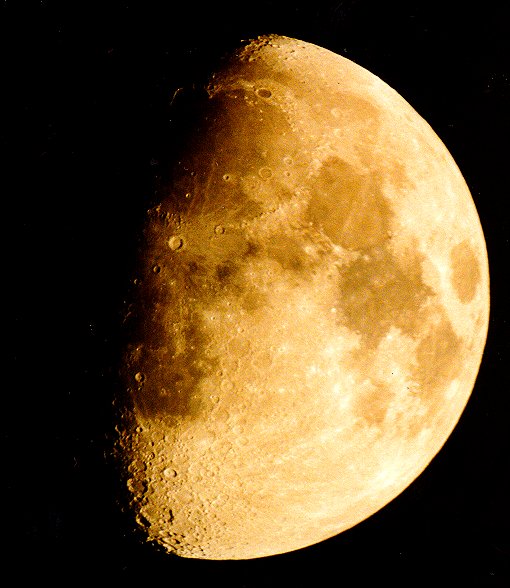 Moon
taken at prime focus (f/10, focal length 2030 mm)
Moon
taken at prime focus (f/10, focal length 2030 mm)
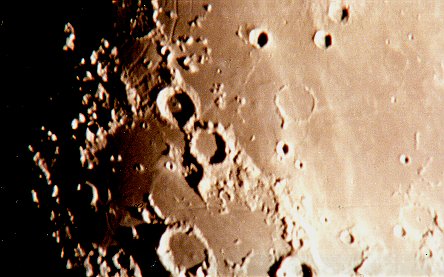
Photos below taken using eyepiece projection (7mm Nagler). @ f/121,
equivalent focal length 24100 mm!). Camera shake becomes serious business!
In fact I could not use the camera shutter at all and had to resort
to "hat trick" method. I found that this magnification has reached both
the resolution limit of my scope and is at the seeing limit for most nights
at Ras al Hamra. Simply too much shimmer. Shimmer can be clearly seen on
video shots I made. Still waiting for that clear, still night! Since exposure
using a hat (actually I was using a tray) can't be much shorter than a
second or so, seeing conditions become very critical. To appreciate the
magnification, photos below were taken immediately after the one above.
See if you can find the locations on the big photo.
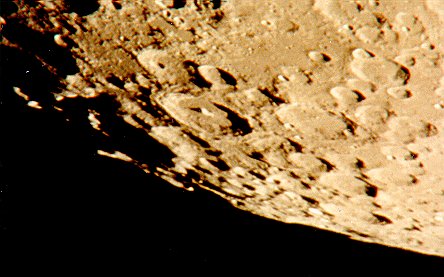
The picture below is the same as the previous image above, but rotated
so that mountains are right-side up, as we are normally used to.
Notice the strange psychology of upside-down mountains in the previous
image. Now you know why Australians talk differently!
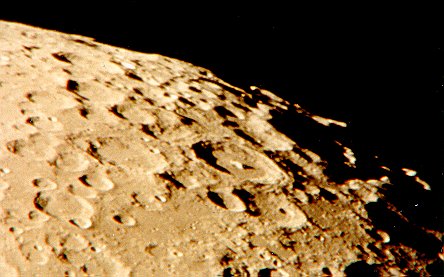
For the same reason, next photo is rotated. The location is actually
near the bottom of the large Moon photo, i.e. region with upside-down mountains.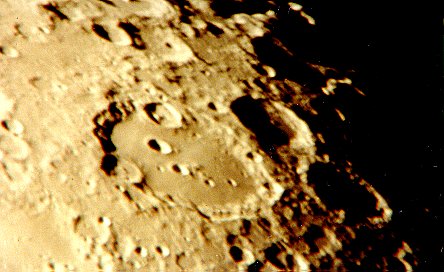
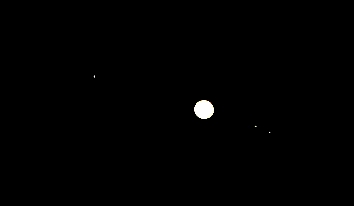
Jupiter with 3 moons visible, taken at f/33 (equivalent
focal length of 6500 mm)
Jupiter taken at f/121 (equivalent focal length
of 24100 mm)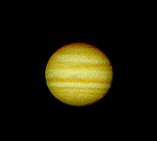
Saturn taken at f/121 (equivalent focal length
of 24100 mm) 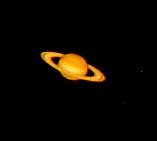
Notice you can just about make out the Cassini Division. While one
can see it fairly clearly visually though the scope, with all the atmospheric
shimmer and the 2 second exposure required, it's tough to capture it sharply
on film. Again, also at the resolution limit of my scope. Anybody had success
with using a video camera? I tried it out but it's rather difficult to
hold the thing and image steady. So I am still a very long way from making
better prints from video freeze frames. Another headache I had was to get
prints of the right density from the chap at Photocenter. Only way was
to ask him to print each photo at 4 densities and choose the best.
Also interested in hearing from anybody who has tried deep sky photography,
with the long exposures and guiding. Perhaps somebody has tried out some
fast CCD? Celestron advertises this clever Fastar device to convert my
scope to f/1.95 and with a CCD, deep sky should be doable in less than
a minute! At least that's the advert. Any experience with that?
The
Grandeur of Orion
Our home page |
Britt & Marijne |
Noorwegen 1998
Oman: PDO |
Faces of Oman |
Diving |
Stars |
Wahiba Sands |
Salalah trip
Sinterklaas 1998 |
Sport hal |
Kruyschrackers