 |
|
|
|
|
|
|
|
|
|
|
|
|
|
|
|
|
|
|
|
|
|
|
|
|
|
|
HISTORY |
|
|
|
The first part of this narrative is based on the output of a workshop held on April 21, 1994 to discuss an organizational direction for U. P. Kappa Phi Sigma. The discussion was attended by Noel Duhaylungsod (Dynamics �69) , Delfin Suministrado (Sarimanok �74), Bing Mabesa-Dayan (Martial Law �73), Lizette Tuason (Secret Marshalls �84), Au Tilde-Mooney (Concom, 1986), Alice Dakila-Bergonia (People Power, 1986) and Joseph Bergonia (Vigilante, 1987).
This narrative, however, is lacking in that there were no input from Kappans from the early 60s or from 1976-1983. Additional information will be greatly appreciated to augment our historical documentation. |
|
|
|
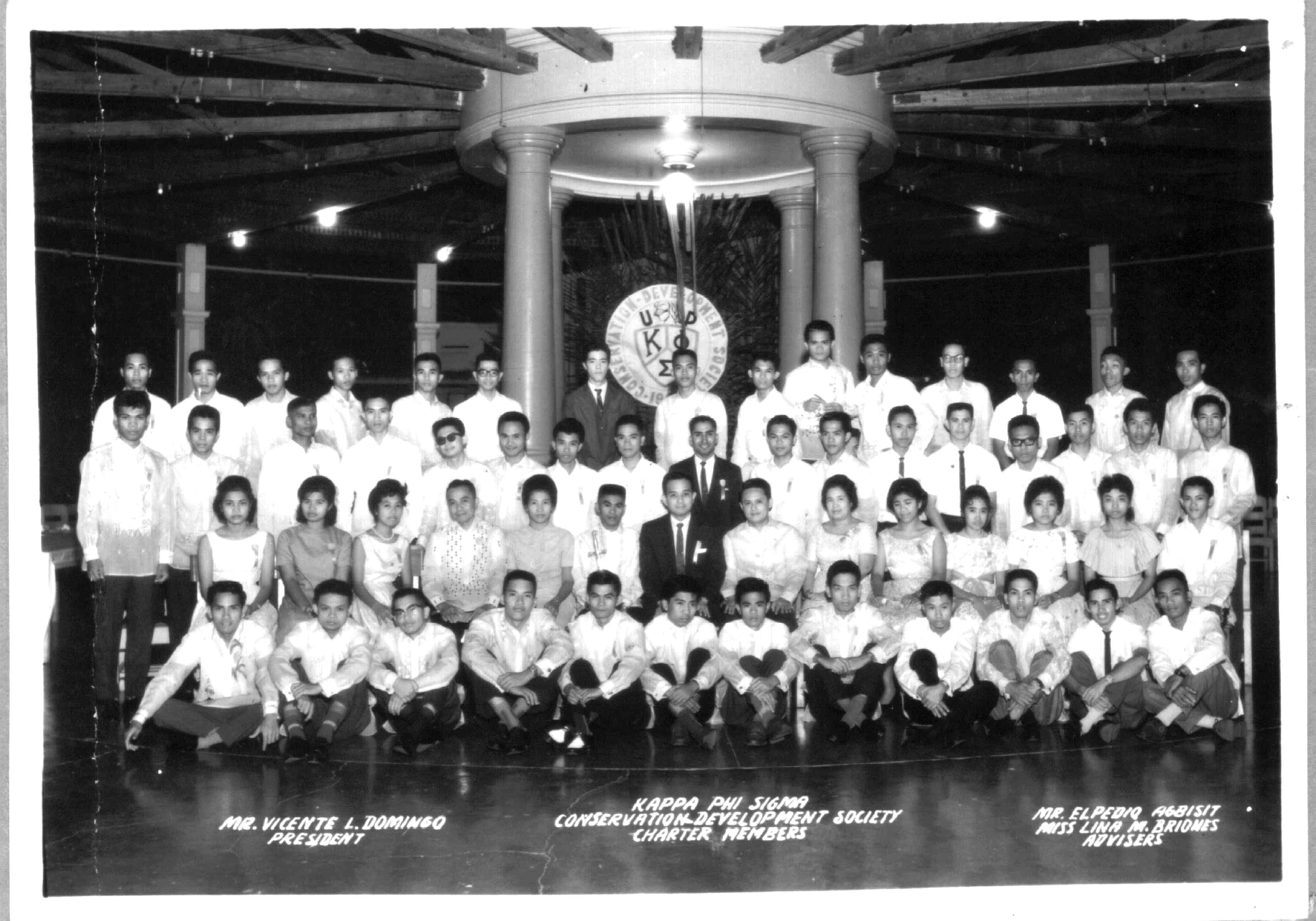
U.P. Kappa Phi Sigma was initially founded as a conservation society (U.P. Kappa Phi Sigma - Conservation Development Society). In the late �60s (1969), when student activism was at its peak, the relevance of UPKPS-CDS as a conservation society was questioned in the context of current Philippine situation.
UPKPS-CDS went beyond issues of natural resources conservation to socio-political issues. |
|
|
|
 |
|
|
|
|
|
The imposition of Martial law precipitated the transformation of UPKPS-CDS into a socio-cultural organization using theater as medium to espouse the organization�s views. There was no formal decision, however, to disclaim the organization�s roots as a conservation society. This can be seen in later activities that also tackled conservation/environmental issues but with a socio-political angle. |
|
|
|
In the late �70s (1976-1980), UPKPS-CDS still produced theater plays but not as solo productions. Theater productions were usually cooperative projects by several organizations.
From 1984, the theater/stage involvement of UPKPS-CDS was limited only to participation in activities sponsored by other organizations (e.g., Himigsikan, Poknatan, Isko�t Iska).
In the same manner that the relevance of UPKPS-CDS was questioned in the late 60s, resident members in 1985 decided that UPKPS-CDS cannot fulfill its role as a socio-cultural organization. UPKPS-CDS lacked the expertise to compete with theater groups. The members decided that the theater was not a valid medium for the organization anymore. |
|
|
|
On deciding what issues to carry, the members resolved not to go with the norm for socio-cultural organizations�which was to tackle every political issue that came up. Part of the resolution was for UPKPS-CDS to follow a specific direction dictated by its nature and principles.Several meetings were held to discuss and deliberate on the history of UPKPS-CDS from 1961 to 1985�nature of activities, changes in orientation, etc. As a result of these discussions, the resident members formally decided to focus on environmental issues. The multidisciplinary nature of environmental issues was ideal for UPKPS-CDS whose members come from different colleges. |
|
|
|
In 1985, UPKPS-CDS consolidated its members and efforts to reestablish itself as an environmental group. From 1986 to 1988, the activities sponsored by UPKPS-CDS revolved around environmental issues. Initially starting with symposia (the Calauit Project, 1987), UPKPS-CDS sponsored the first Environmental Week in campus in 1988 focusing on the issue of sustainable development. In between, UPKPS-CDS came out with its bimonthly periodikit, �Ang Kappaligiran,� which discussed environmental issues in a humorous vein. Efforts were also spent to consolidate an umbrella organization of all environmentally-oriented student organization under the guidance of the Philippine Federation for Environmental Concern, but this activity was not successfully concluded. |
|
|
|
The change in the issues carried by UPKPS-CDS from bluntly political to environmental was criticized at that time by most fellow socio-cultural (�political�) organizations as shallow and reactionary. However, it was a decision that UPKPS-CDS upheld and will continue to do so. Environmental issues are, at the same time, social, political and economic issues. The specificity of environmental issues made them more practical and sensible to carry than the largely ideological issues carried at large by most socio-cultural organizations at that time.
Although UPKPS-CDS succeeded in redirecting its vision, it had no significant effect in increasing recruitment rates. Coupled to the early unpopularity of environmental issues, UPKPS-CDS had to attract students who were not interested in an organization with a well established reputation of being an �S.U. aktibista org.� Suffering the same fate as its contemporary organizations, membership dwindled to a few. UPKPS-CDS was last recognized by the Office of Student Affairs in 1989. |
|
|
|
 |
|
|
 |
|
|
|
|
|
Alumni members still met in reunion gatherings in 1994 and 1996. Within this period, there were occasional small group meetings to discuss organizing the alumni members or reestablishing UPKPS-CDS in campus. Several alumni members founded the Conservation and Development Specialists Foundation, Inc. on January 25, 1997. Up to this time, there were still no concrete results for the plan to reestablish UPKPS-CDS. A primary problem was how to begin organizing students.
|
|
|
|
|
 |
|
|
|
|
 |
|
|
|
|
|
|
|
|
|
A breakthrough came in 1998 when several ecology major students of the Institute of Biological Sciences expressed their plan to form a group that would focus on environmental issues. Zeny Sierra (Gems �64) and Au Tilde-Mooney (Concom �86) invited these students to become part of the group that would reestablish the UPKPS-CDS in campus. Several orientations were held to extend this invitation to other interested students. Finally, alumni members were invited to a reunion on August 1, 1998 that also marked the induction of the 28 young idealists who made up the revival batch�Muling Pagsibol �98.
From its foundation up to the present, UPKPS-CDS has retained its fundamental nature as an environmental group even through the political turmoil of the late 60s to the early 80s. The sometimes drastic transformations, that the organization makes, reflect how responsive UPKPS-CDS is to changes in society. No other UPLB student organization possesses such a dynamic history. UPKPS-CDS was the first student environmental group that explored the multidimensional facets of environmental issues and dared to present them as more than just biological or physical concerns.
August 13, 2000 |
|