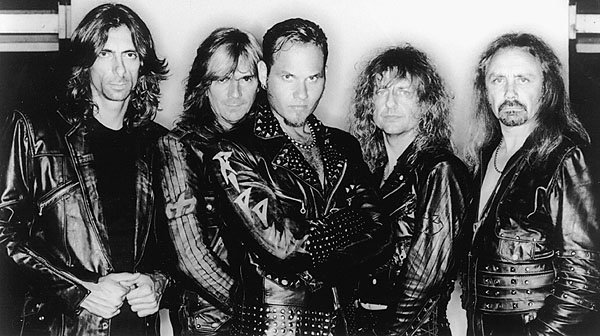

I thought I would offer this rationalization for why I continue to believe that JUDAS PRIEST is the ultimate rock and roll band.
First, a question of definition. What exactly is heavy metal? Obviously, there is no set answer, and the one given here is purely my own. The term was originally coined to describe a particularly grinding, slow kind of rock, although recently the term is more often applied to music with very fast riffs (even to the point of a sub-genre of speed metal). The common denominator? I believe that it is fair to say that in a way heavy metal takes rock to a logical extreme: in practically any rock band, the drummer and bass player, while absolutely necessary, are not the focus, which is squarely on the guitar player(s) and vocalist. Heavy metal virtually takes the singer out of the picture and makes the whole act guitar driven. A "good" heavy metal singer is one who can scream loud enough and long enough to compete with the guitars: nothing more is required or desirable from him. Also, it is a component of rock that it is less about melody than other music is: heavy metal (and rap, a contemporary cousin of metal) virtually eliminates melody. There is not a single whistleable tune in all of heavy metal.
Further implications of the genre. First, heavy metal is not all devil worshiping music. While I thought Christian heavy metal bands like Stryper were pretty much jokes, most groups sing about the same things people have always sung about: sex and death. Again, heavy metal's contribution has been to take things to an extreme, in this case favoring death heavily over sex. Heavy metal's attraction has always been its energy and anger, which also explains its demographics: its appeal has always been almost exclusively confined to young white males, who have always had a lot of excess energy and anger and a need for some outlet.
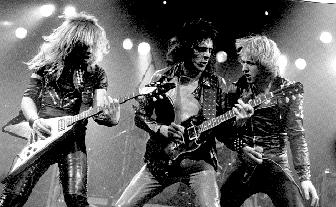
Now, within this genre, what makes Judas Priest special? First, their musical contributions. They added the use of two guitarists trading off manic dueling guitar solos (what one unusually literate review aptly called "double-axe histrionics"), which in the guitar driven genre seems to me an obvious, but still important innovation. Secondly, they pioneered the studded-leather look that has since been a staple of every heavy metal band. (On this point, Kiss deserves some credit as well, though they are more identified with the make-up and with pyrotechnics, which both had influence on many bands. It is significant that Judas Priest played warm-up for Kiss in 1979: it was the beginning of their breakthrough in the American market.) Beyond these innovations, it should be noted that both their singers, the legendary Rob Halford and new front man Tim "Ripper" Owens, both have the chords and lungs to compete with the guitars, a not unimpressive feat.
But Judas Priest has also had impact on the larger social fabric, both because of their roots and by their involvement in two important controversies. Let it first be noted that these guys are not U2: their nickname is the "bashers from Birmingham," and probably the furthest thing from their minds was ever effecting social change. All they have wanted to do for 25 years is play really loud, aggression-filled music, but social relevance has been thrust on them in spite of themselves. First, the band is SO blue-collar: they're uneducated men from a steel town, and like many more talented artists, I believe they have effectively captured the anger and frustration of the working class: imagine Springsteen with a really bad attitude. Secondly, in 1990 the band was accused in Nevada court of having caused the suicide and attempted suicide of two teenagers who had been listening to their music. The judge eventually found that the band was in no way responsible for this tragedy, but Judas Priest had unwillingly become a focal point for controversy over free speech. Finally, earlier this year former singer Halford came out of the closet and revealed that he was gay. (This was common knowledge for years - just think of the leather look mentioned earlier - but never publically admitted.) The painfulness of being gay in a straight world was brought home to me when I read an interview with Halford, in which he described how during the 80's - at the height of his career - the rest of the band would go out for drugs and sex after each concert, while he would go back to the hotel and watch the Tonight Show while drinking until he passed out. Whatever one's feelings about homosexuality, the image of a man at the height of his talent and fame having to keep such a central part of his life a shameful secret while anesthetizing his loneliness is to me just sad.
On February 7, 1998 I finally saw Judas Priest in concert, and it was without a doubt the most amazing thing I have ever seen besides the birth of my children. I was 20 feet from Glenn Tipton, immersed for 3 hours in a crowd of drunken, leather-clad men, singing along with them to every song. I was ten feet from a speaker about the size of a sofa, and the ringing in my ears did not go away until Monday morning: I feared that the Priest had done permanent bodily harm to me, which, although it would have been an honor, it is one I can thankfully do without. I will never forget this experience. The set list follows: