|
ABSTRACT
A study is
made on the emissions of oxides of nitrogen (NOx) from power plants in the
country in order to:
(i) Assess the
impact of coal based units on the environment
and
(ii) Gauge the
utility of NOx reduction technologies that are currently in vogue.
86 percent
of 5.5 million tons of NOx emitted during the year 1999 came from exclusively
coal-based units. Such emissions ranged
from 0.12 lbs/mmBtu to 1.8 lbs/mmBtu in sharp contrast to oil and gas fired
units that had a shorter range. 419
coal-based units equipped with NOx control measures emitted 2.14 million tons
(0.4 lbs/mmBtu on average) compared to 2.64 million tons (0.58 lbs/mmBtu on
average) from 634 units that had no control.
Most of
the coal-based units having controls acquired them during the years
1995-1999. A comparison of NOx
emissions from them before and after the retrofit has brought out some interesting
observations. The extent of reduction
achieved with the same technology in similar units has varied
considerably. Not only in many of the
installations has the reduction fallen short of expectations but also in
several of them the result is even negative.
A significant number of coal-fired units without any control had NOx
levels equal to or lower than the median values of similar units with controls
imposed. The impact of the operating technologies can therefore, be only
considered as unit specific. These
anomalies might have arisen due to incompatibility of the system design to the
fuel characteristics - both physics and chemistry.
Eventually
it may be necessary to reduce NOx to below 0.1 lbs/mmBtu. For this purpose a combination of technologies
may be required involving Selective Catalytic Reduction (SCR), Coal Reburn (CR)
and some others unique to each case. A
better understanding of the relation between system design and fuel
characteristics could minimize the number of technologies needed.
________________
Emission
of oxides of nitrogen (NOx) from fossil fuel utilities is a major environmental
concern. The Environmental Protection
Agency (EPA) has therefore been steadily reducing the regulatory standards on
allowable NOx in the exit flue gases from power stations. It is only a matter of time that power
producers may be bound to control NOx levels below 0.1 lbs/mmBtu. Against this near ideal scenario, what is
the present status? What are the
available technology options to achieve such a desired shift?
Formation
of NOx during combustion of fossil fuels is a complex process that is yet to be
fully understood. Experience to-date
shows that NOx level in flue gases is linked to many factors like the type of
boiler, level of oxygen, design and arrangement of burners, physics and
chemistry of fuel burnt and the implicit temperature profile with in the
system. However, a quantitative
relationship of these factors to predict its concentration under a given set of
conditions is not yet possible.
Notwithstanding this limitation, efforts are continuously under way to
reduce NOx emission from utilities run on fossil fuels. As a result more units are employing one or
a combination of several contemporary technologies available for the
purpose. An analysis is carried out to
assess the impact of such technologies commercially in use to measure the
extent of their success.
The EPA is
regularly monitoring all the utilities in the country for NOx emissions. 2036 operating units for which data is
available emitted around 5.5 million tones of NOx during the year 1999. 86% of
this emission came from 1053 units run exclusively on coal. A total of 804 units are equipped with NOx
control measures of which 419 are coal based.
419 coal-based units with control emitted 2.14 million tons (with an
average emission of 0.4 lbs/mmBtu) compared to 2.64 million tons (with an
average emission of 0.58 lbs/mmBtu) from 634 units without any control. Therefore, any technological success in
reducing NOx will have to be measured in terms of its impact on coal-based
utilities.
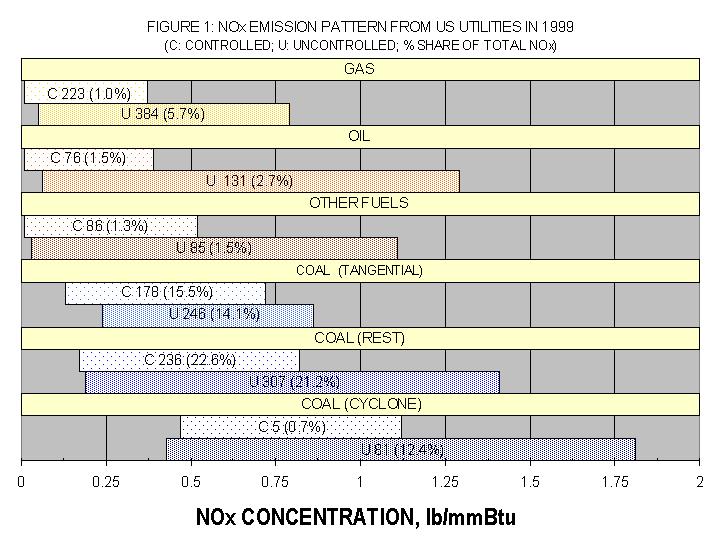
Figure 1 gives the range of
NOx generated in lbs/mmBtu from these units classified into different
categories. Coal based units are
sub-divided under three classes of (i) Tangential fired units (T), (ii) Cyclone
units (C) and (iii) other pulverized coal based (mostly wall fired) units
(W). To reflect the effect of NOx
control measures, the range of NOx for each class is shown separately for the
untis with and without NOx control. The
number of units encountered in each class and relative share of NOx generated
is indicated in the figure. This analysis
is based on the information reported by EPA1. The range-bars in the figure are divided at
the respective median values. The average NOx emissions for gas, oil and coal
based utilities were 0.23, 0.30 and 0.60 lbs/mmBtu respectively. The average
values were observed to be very close to the respective median values.
Perceived
shift in the median value of NOx due to control is 62 percent for gas, 35
percent for oil and 10 percent for tangentially fired coal-based units. For others (mostly wall fired units) the
effect is 28 percent. For the small
number of cyclone furnaces operating with control measures, this shift is 16
percent. Reduction in NOx level for all
units taken together in each class is 54.5% for gas, 38.8% for other fuels
(includes diesel and mixed fuels), 31.4% for oil, 31.1% for rest (mostly
wall-fired units), 17.8% for cyclone and 10% for tangential units. It is also
significant that a number of units with no control (17 of 81 cyclones, 90 of
246 tangential and 74 of 307 others) had NOx equal to or lower than the
respective median values with controls enforced. All these facts imply that the effect of NOx control technologies
have had much less impact on coal based units.
Almost
all, 353 out of 419 units operating now with NOx control measures acquired them
during the years 1995 - 1999. The available information on the annual average
emission before and after the addition of the control measure has been analyzed
to assess the impact of the technologies employed on their efficacy to contain
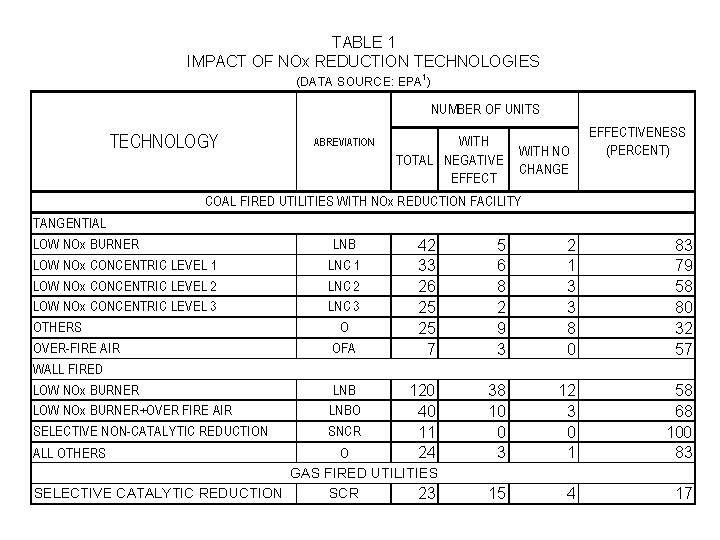
NOx emissions. A list of technologies
that are applied to reduce NOx in different systems is given in Table 1. Effectiveness of these technologies as
observed to reduce from a given uncontrolled level to a lower value is shown in
Figures 2, 3 and 4. Solid lines (and solid squares for SCR in Figure 3) in these figures
represent the expected behavior. Data for this representation of expected
behavior is obtained from Cost Tool provided by EPA and available on their
Website 2.
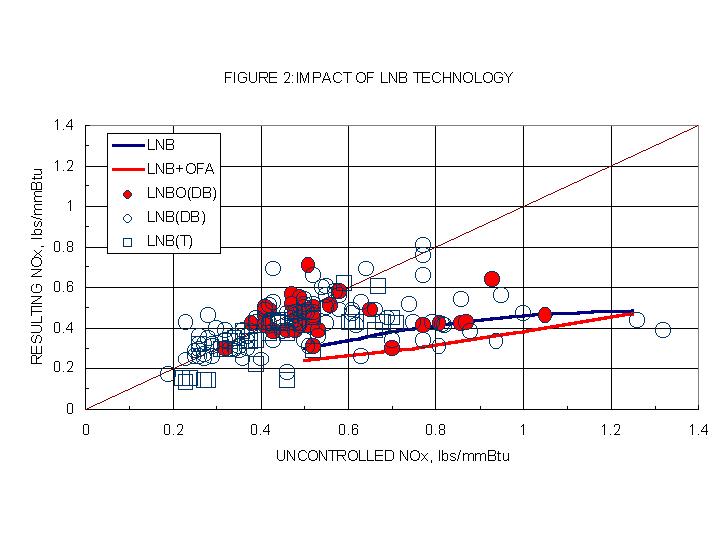
Low NOx
Burners (LNB is the widely used technology as it covers a total of 162
units. Figure 2 shows the effect
of employing LNB. LNB is found to be
effective in 83 percent of tangentially fired units whereas for wall-fired
units the effectiveness was 58 percent.
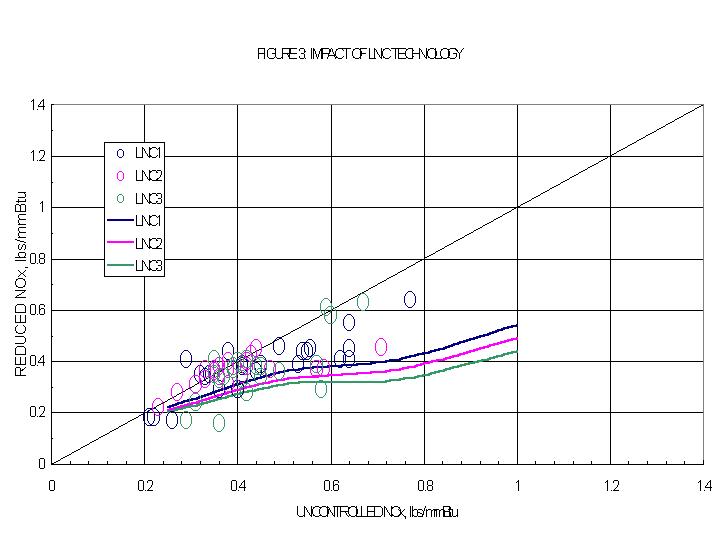
Figure 3 shows the effect
of Low NOx Concentric Burners (LNC's) developed for tangential furnaces, the
second widely used technology covering 84 units. The effectiveness of LNC's has varied considerably from 58
percent to 80 percent depending on the configuration with LNC2 being the least
effective.
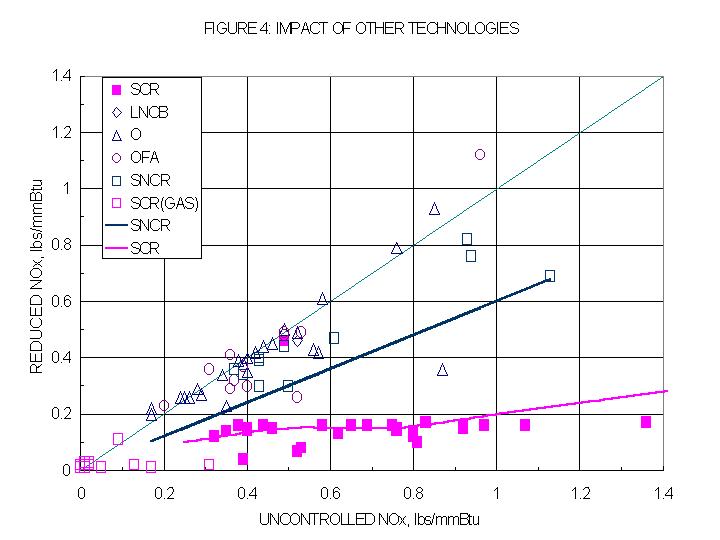
Figure 4 gives all other
technologies used to a lesser extent, including chemical methods. The results of Selective Catalytic Reduction
(SCR) as observed with gas based units are considered for comparison since
widespread use of the technology is not known with coal-based units. However, the results of large- scale
demonstration of SCR in coal-fired units (solid squares) are also included3.
As far as
SCR is concerned, the effect is expected to be independent of fuel since it is
used to remove NOx from flue gases after formation. A statistical analysis of the effectiveness of the commercially
used technologies shown in figures 2 to 4 is also given in Table 1.
Majority
of the units responded positively to the technologies adopted, with an
exception for SCR applied to gas fired units. However, the extent to which NOx
reduction took place varied considerably.
The cluster of points above the diagonal in these figures reflects the
lack of effectiveness of these technologies. Invariably all technologies except
SNCR, have to an extent failed in their purpose when used commercially.
REBURN
TECHNOLOGY: Partial use of the same or
an alternative fuel (coal, oil or gas) - in staged combustion is yet another
technology considered to be effective in NOx reduction. Even though this technology is yet to be
commercially used, large-scale demonstration has been conducted as part of the
Department of Energy (DOE) sponsored nationwide Clean Coal Technology
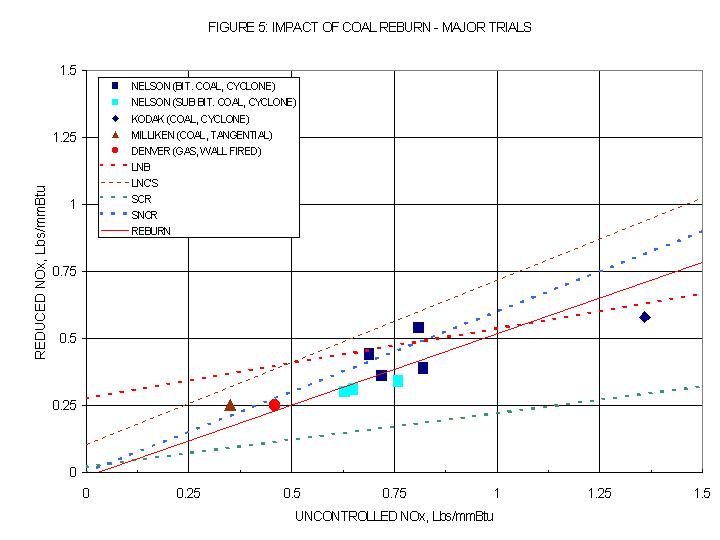
program. The results of these four demonstration
projects4 are shown in Figure 5. Two of these involved cyclone furnaces at
Nelson-Dewey (110 MW)5 and Kodak (50 MW)6, one
tangentially fired at Milliken (150 MW)6 and another wall-fired unit
with gas in Denver (158 MW)7. The dotted lines in this figure show
the trend of effectiveness of technologies shown in Figures 2,3 and 4. Limited results available on coal or gas
reburn indicate that this could be as effective as other technologies except
SCR.
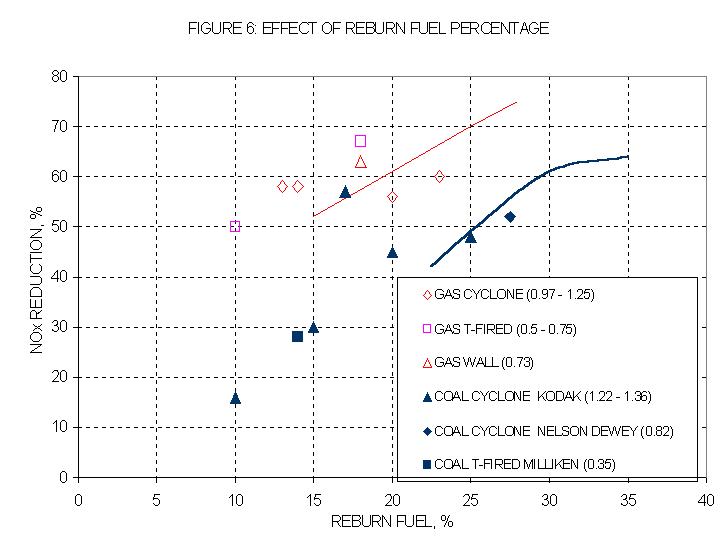
While a
50% reduction in the uncontrolled NOx level is possible, actual reduction
obtained is dependent on the percentage of heat going in the reburn fuel. For coal-fired units up to 30 percent of the
heat needs to be diverted in the reburn stream for maximum reduction. The effect of reburn fuel percentage on the
reduction achieved during the four demonstration projects is shown in Figure 6. Solid lines in the figure show the predicted
behavior based on model studies carried out by McDermott Technology Institute8. The effect of percentage heat in reburn
stream is fully not understood since the range of this variable studied in the
demonstration projects was restricted to keep the percentage of un-burnt carbon
in fly ash within limits.
To
summarize the status of NOx reduction practices in coal fired utility boilers
the following can be said:
q
The uncontrolled NOx emission in coal-based utilities has a range
of 0.1 lbs/mmBtu to 1.8 lbs/mmBtu. This
is wider than the range observed for oil or gas based units.
q
Impact of NOx reduction technologies is unit specific. In many instances the expected results are
not achieved. Several examples of
negative results are seen for all the technologies in use with the exception of
SNCR. This is also true for SCR applied
to gas based units.
q
Commercially used technologies on exclusively coal-based
units have had less impact in reducing NOx when seen in comparison with units
run on other fuels.
q
A significant number of coal-fired units without any control
had NOx levels equal to or lower than the median values of similar units with
controls imposed.
q
All these anomalies in exclusively coal-fired units viz.,
(a) wide range of NOx concentrations in units without any control (b) varying
extent of reduction in NOx for the same technology in similar type of boilers
and (c) significant number of units without any control having comparable or
lower NOx concentrations of other similar units having controls, suggest that
the fuel characteristics - both physics and chemistry -may play an overriding
role.
q
Reburn technology, though not commercially used, may be as
effective as any other technology.
These
observations indicate that none of the technologies so far known, either alone
or in combination, can be definitive in meeting the ultimate limit of 0.1 lb
NOx/mmBtu. Systems that are amenable to
NOx reduction will definitely require SCR if the uncontrolled NOx is below 0.3
lbs/mmBtu. If the uncontrolled NOx
level is higher than 0.3 lbs/mmBtu, a combination of technology with SCR will
be necessary. If the trends shown in Figure 5 are any indication
of realizing a 50% reduction in NOx level, coal reburn followed by SCR can be
effective up to 0.6 lbs/mmBtu of uncontrolled NOx. For higher uncontrolled NOx
levels added measures, like a burner technology may be needed. Thus NOx
reduction program becomes a multi-stage operation with a number of technologies
depending on the uncontrolled level of NOx.
However, if the compatibility of system design with fuel characteristics
is the key in achieving low NOx levels without any control it may be possible
to reduce the number of technologies required to achieve the desired
results. For this a further detailed
investigation to delineate the reasons for varying success with a given
technology on the extent of reduction obtained in different units.
REFERENCES:
5. www.lanl.gov/projects/cctc/resources/pdfs/eerco/00000071.pdf
6. www.lanl.gov/projects/cctc/resources/pdfs/colrb/00000086.pdf
7. www.lanl.gov/projects/cctc/resources/pdfs/milkn/mcrfinal.pdf
8. www.mtiresearch.com/expernce.html
About the Author: Dr. Kotur S. Narasimhan was the Director of Central Fuel Research Institute (CFRI), Dhanbad, India during 1992 - 1998. Earlier, He was a scientist at the Regional Research Laboratory, Bhubaneswar (RRL-B), India. Both CFRI and RRL-B are the constituent laboratories of the Council of scientific & Industrial Research, Government of India. He has more than 100 research publications to his credit and edited several monographs and symposium proceedings. His current interests are Energy, Environment and Economics applied to use of coal and mineral resources.