
By Ed Weinberg
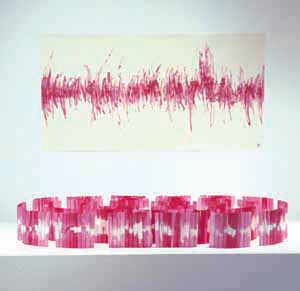
Approximately seventy steps later, I saw Okada�fs twin contributions to the group show and was struck. The goose pimples came on slowly and with diligence.
I looked at the first work and felt its violence. In fact, the word "violent" came to mind early and often in my inspection. The piece, The Sky of Sublimation, is a sheet of handmade Japanese paper with vertical red strokes covering its width, resembling a lifeline. The red is deeper toward the middle of the thick horizontal result, with sudden violent spikes coming off, as though the brush stroke is animated.
Yet it is the extreme contrast between the pieces to which I attribute the goose pimples. As I looked from one work to the other, the same strong feelings would grip me. I realized that this was a very primal conflict, one of history versus art, and that it serves as the stage on which Okada�fs lines perform their dance. Canon�fs rice papers are transparent, suggesting a fluidity and transience of the past and future. These notions of time are, however, subservient to Sky�fs static template, fixed at four corners, incapable of the whimsy in three dimensions that Canon�fs scrolls allow the viewer to indulge in. The construction of Canon allows each paper a strength, and independent growth; however, each roll�fs ink expresses less freedom, perhaps hinting toward the guiding pattern which Sky�fs wild ink scrawls express. A question naturally arises: "Is art free, or must it follow the rules of the world it seeks to illuminate?" This is a paradox that Okada�fs artwork does not avoid nor, wisely, does it answer.