| About Russians |
| The Tartars ruled southern Russia as part of a vast empire, known as the Golden Horde for more than two centuries. Thus began an era of Russian isolation from the West. At the same time however, trade routes with the Middle East and China were established. Smaller boned, shorthaired cats of southern climates were able to follow the trade routes and intermingle with the wild cats of Russia. Over centuries, these cats adapted to their frigid environment; the result was the origin of their short, thick coat that carried a mutation of wild gray, reminiscent of the ticking of a wild gray rabbit or the Russian silver fox. The origin of the Russian Blue has long been debated. Its history will most likely continue to elicit the imaginations of its admirers however it is likely that the first blue, or dilute, mutation did indeed occur in Russia. That this colour would define the breed is an oversight due its early discovery. The natural breed would undeniably have included black and tabby, two genetic variables necessary in the development of the Russian Blue we see today. The Russian of generations past must also include a white variety, as white Russians were common to many and rumoured to dwell amongst seemingly barren snowfields. It is not surprising that the first Russian cats to appear in breeding programs of other countries were blue. Blue was rare and is considered a "Lucky" cat colour in Russia and throughout the world. "Lucky" cats were given as gifts, traded and welcomed on ships headed to other countries. When other Russian colours are absent blue mated to blue always resulted in blue progeny and blue populations becoming separate of their dominant breed variations could not display their natural colour variety. In the lack of later scientific knowledge early naturalists and cat enthusiasts mistook the blue recessive inability of colour expression as purity. Early Western interests singled out the Russian Blue as a breed by virtue of this "purity". As the social and political divisions between the West and the breed's native Russia grew the Russian breed and it's variety of colour was lost but to isolated villages in its homeland. |
 |
 |
| Brief History Of The Russian Breed |
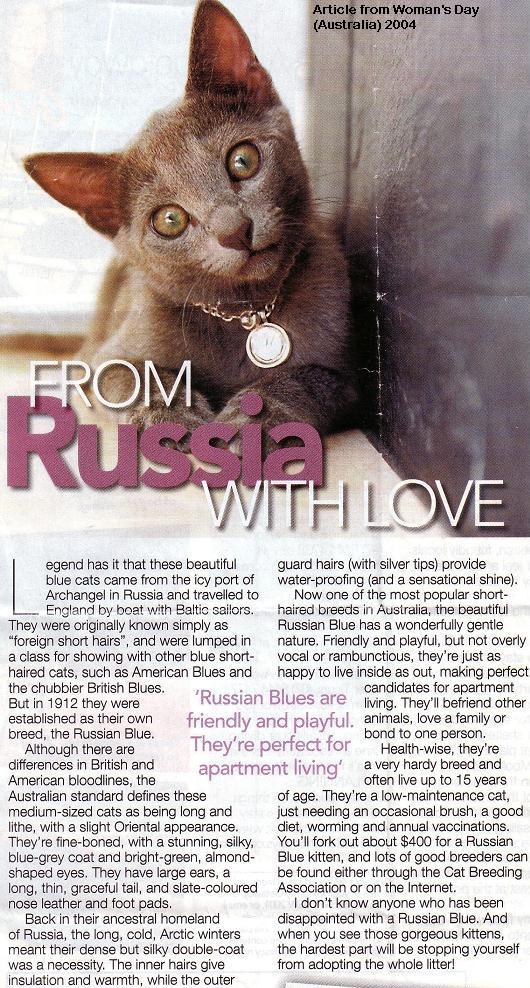
| In the 60's, Mavis and Richard Jones, Myemgay Cattery, Sydney, Australia, learned of the Russian White. They have been credited with the first import of a Russian White however this original cat is often referred to simply as a domestic or "Siberian", (Siberian is also the name given to a different Russian breed), inviting misrepresentation. This cat was indeed imported from Russia via a government official but was not registered and therefore documented only as "domestic". This original import displayed the Russian phenotype necessary and was initially taken as a pet from Russia due its local credibility. Those interested in the reintroduction of the Russian White colour to the Western Russian Blue gene pool understood the white allele, W, is dominant and produces a translucent all white coat. The non-white allele, w, is recessive and allows full expression of coat, colour, and pattern. It was fortunate that the first Russian White import masked the dominant Agouti allele (expressible as Tabby) and the dominant Maltesing allele (expressible as Black). With only one outcross the Russian Tabby and all four natural Russian colours could be realised. Under a four generation program supervised by the RAS of NSW, the Jones' white female was mated with a blue stud, and the best progeny subsequently mated to different blues. White Russians were accepted for registration in 1975. Black and Tabby Russians appeared as a natural evolution in the breeding program. Science and history embraced the validity of the Russian Black and Tabby when Australia completed the redevelopment of the natural Russian breed and recognised the Russian Group of four colours. |
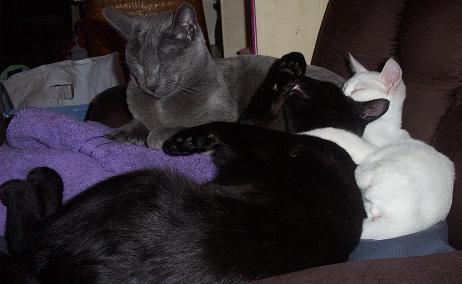 |
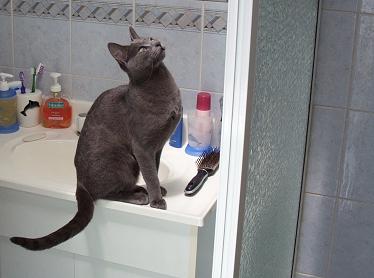
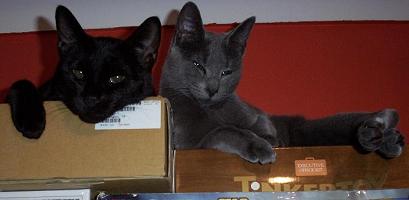
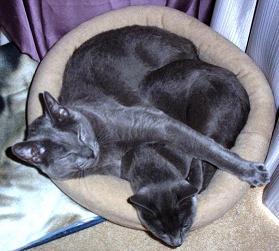
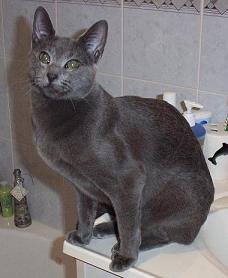
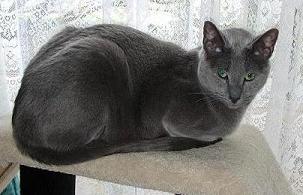
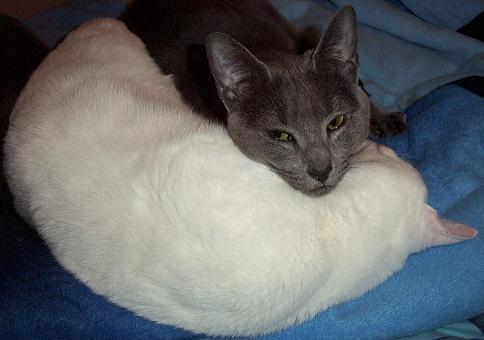
| The Russian Blues are elegant, unique and distinguished cats. While the Russian Blue may at first glance look like any other grey cat, a more careful look will show them to have a special appearance that is all their own. They have been said to look as if they are smiling and that the reason for that smile is known only to themselves. The fur is short and plush with a double coat. Unique in feel, this double coat is described by many breeders as the defining feature of the breed. The colour is an even, bright blue with each hair appearing to be dipped in silver. The tipping is actually clear but gives the Russian a silvery sheen and lustrous appearance that can best be appreciated in natural light. The density of the coat causes it to stand out from the body and allows patterns to be traced in the coat which remain until you smooth them away. The coat colour must be solid with no tabby markings (unless it is a kitten). Petting a Russian feels like running a silk scarf through your hands. In lovely contrast to the blue coat, the Russian Blue has large, rounded, wide-set eyes that are a vivid green. The eyes at full maturity should be a deep emerald green. This may take 18 months or longer to develop. As a kitten the eyes start out a yellowish colour, and then develop a green ring around the pupil which slowly spreads outwards. The shape of the eye varies from round to almond shaped. The head of a Russian has seven straight planes to it & is sometimes described as cobra-like which aptly describes the broad, medium wedge and flat profiles. The large, pointed ears are wide at the base and sit upright. The tail should be long and slender, tapering to a point at the tip. The cats are medium sized and the body of the Russian Blue is fine-boned, long, and firmly muscled. The clean lines and graceful carriage of the Russian Blue give it a regal appearance all its own. Many owners say they exude elegance as they move. |
| Russian Blue |
| Russian White |
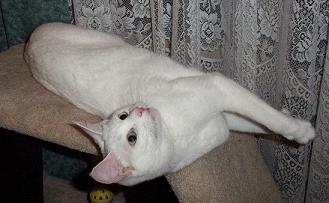
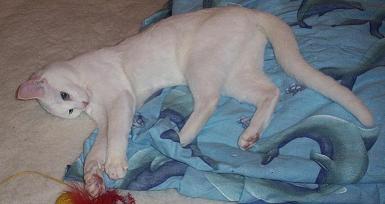
| The characteristics of Russian Whites are identical to those of the Russian Blues, the only exception being for coat colour. Their coat is a brilliant, dazzling, pure white and soft as silk, with no hint of any discolouration. The Russian White coat also has the clear tipping giving the coat an overall lustrous sheen. The Russian Whites have beautiful soft silky plush coats with an abundance of fine downy undercoat that is unique to the Russian cat. Their body is long and elegant and their eyes are almond shaped and brilliant green with a depth of expression. As with the Russian Blue, the whisker pads are prominent and the Russian can "puff" their pads like no other cat. Their ears are upright and large, giving them a very alert expression. When a white kitten is born, it usually carries a smudge of colour between its ears, which indicates the true colour hidden under the white coat. Breeders also look for this as a reliable sign of good hearing. This little patch of colour disappears as the kitten matures to adulthood. |
| Russian Black |
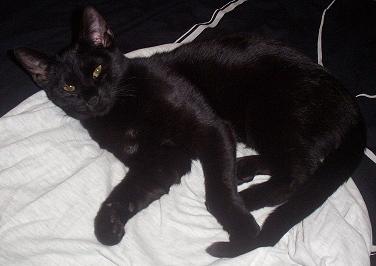
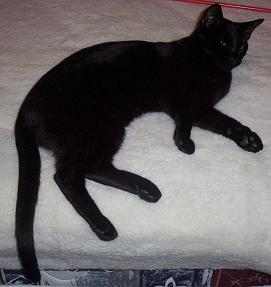
| The Russian Black is an ebony beauty that is breathtaking to behold. The Russian Blacks are a stunning breed and are most prized for their soft, luxurious coat and brilliant emerald eyes. Their coat is lustrous, plush and dense with the same clear tipping as the Blues and Whites. The head of the Russian Black is broad and wedge shaped. The vivid green eyes are round and wide set. Their profile is relatively flat. Like the Russian Blues and Whites, the Russian Blacks also have the prominent whisker pads that give them the appearance of smiling. Their body is firmly muscled, but maintains much grace, as they are finely boned. Their graceful carriage and clean lines add to the already regal appearance of this stunning breed. The Russian Blue could not exist without the genetic contribution of the Russian Black. In all ways a Russian Blue is a Russian Black with only one variable, a gene which dilutes and disperses its black pigment. In other words the Russian Black is a Russian Blue with a denser pigment distribution. Its sheer black coat plays upon the type and structure of the breed's lesser recognised characteristics, heightening the visibility and shine of its silk coat, emerald eyes and overall refinement. |
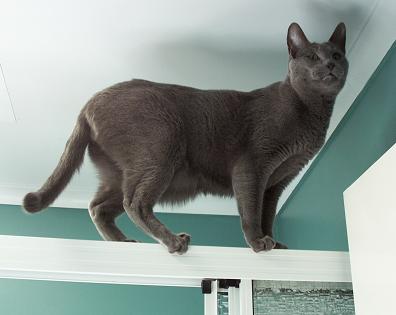
| Those attracted by the physical beauty of the Russians find the disposition of these unassuming cats equally appealing. The Russians are a gentle, affectionate cat easily distinguished from other breeds. Their unique personality sets them apart from other cats and makes them an interesting, entertaining and affectionate companion to their owners and friends. Russians are intelligent, quiet, and sensitive. They love to play with small toys around the house, and they enjoy jumping and climbing, but unlike some other playful breeds Russians are rarely destructive. Their intelligence is something you have to see to believe. They can be "trained" to fetch, and can teach themselves to open doors, closets, and drawers. They can also train their people to perform simple tasks such as throwing toys so that the Russians can retrieve them. They are agile, light-footed cats that may seem to fly around the house with the grace of a dancer. Our Russians all enjoy sitting in places that are up high...the higher the better. Our Russians jump up onto the tops of our bookshelves, which are about 2 metres in height. They even jump up onto the tops of our doors and the shower and balance there quite easily. Russians easily bond with their people and are loyal to those who love them, frequently following them from room to room to be near them. Russians show their affection in a variety of ways. Some enjoy leaping onto the shoulder of their person and riding there. Other Russians are eager to butt heads with their person. These sensitive cats seem genuinely hurt when they come to their people to show affection and are put aside. All of our Russians are very affectionate and love to jump up into our arms. Orion, Alexandra and Dante like to ride around on our shoulders. Because the basic temperament of Russians range from slightly reserved to quietly shy, they may be cautious or nervous around strangers. Russians prefer to take their time to investigate new people. In addition, although they are basically gentle cats, neglected or stressed Russians may become fearful and temperamental. Russians will usually form a bond with one particular person. It pays off to put time into developing an affectionate relationship with a Russian. People who have known other breeds often remark on the special close and deep bonding that they feel with their Russians. Sensitive to the mood of the house, Russians will �clown� to quiet a crying baby or sit patting your face to chase away the blues. Russians are clever and extremely agile. They love small spaces and can fit themselves into areas that you would not believe could make a cat feel comfortable. They are not known to "talk" much, and even when they do, they are not loud. |
| Personality and Temperament |
| Maintenance |
| The Russians are a very low maintenance cat and require no special care or diet. A Russian's coat is easy to care for. Grooming them by patting them is enough and if you like, an occasional grooming with a soft brush is ok. The less they are brushed the more radiant the coat becomes. There is no need to use a brush too often because you may affect their beautiful double coat. That makes them a very easy care kitty! Our Russians really enjoy nice firm pats down their spine and then all over, especially Orion. Like all cats a Russian will shed hair, however you will find that they don't shed much at all if fed a healthy balanced diet. They may shed a little in the seasons when their coat changes (Spring and Autumn), but compared to other breeds they shed little hair. Handling a Russian coat feels like running a silk scarf through your hands. You can also use your fingers to trace patterns in the fur and the designs stay in place until you smooth them over. At cat shows I encourage people to pat our Russians and feel the beautiful coats for themselves. Our Russians enjoy coming out of their cages and being held while they get all this attention and petting. Draco is the biggest "ham", casually lying in my arms whilst he laps up all this adoration and attention! A Russian is a good choice for the modern home because their undemanding nature fits perfectly into today�s busy schedules. They will entertain themselves if left alone for the day and be a contented companion upon your return. There are very few situations that will not suit a Russian. The breed is happy to live inside or outside and will also suit apartment life. They do quite well as indoor only cats. They enjoy the companionship of another cat, but also are content without one. When Orion was our only cat he seemed happy enough to spend the days alone whilst we were at work. He had plenty of toys and things to keep him occupied. Each day when we arrived home though he would greet us at the door and jump up into our arms, so he was always very happy to have us home again. Owners have found that Russians will tolerate children as well as dogs and other animals, making them great for families. Sudden movement or noise can cause them to run and hide, so young children could take some time to adjust to. All of our Russians are happy to walk on harnesses and took hardly any time at all to adjust to the idea. At first they would just sit down and not want to walk, but they soon figured out how it all worked. Most of the time they will walk where they like only, but this is ok because we just do it to enjoy the fresh air and sunshine together. We also have an outdoor run for our Russians so that they can spend more time outside in safety. |
| Health and Lifespan |
| Typically, Russians are hearty, healthy cats, and with proper diet, exercise, veterinary care, and affection, they are capable of living well into their teens and beyond. There are no genetic problems associated specifically with the Russian, and as a breed they are not prone to any particular illnesses, but, as with any breed, some lines may be prone to certain health problems. Russians are good eaters, and therefore it is easy for them to gain weight and become much too heavy; it may be advisable to measure and limit the food intake of adult Russians. |
| Russian Genetics |
| Russian cats have similar genetics to all other cats. In the Russian Blue there are a number of masked and diluted colour genes which result in the typical soft silvery grey which breeders call "blue". The absence of some or all of those genes leads to the unmasking of other colours. Wor w White gene: This is dominant and will mask all other colours and markings. It is therefore possible to have a black cat "hiding" under a white coat. A or a The "agouti" gene: Controls tabby markings. In Russian cats the aa condition suppresses the tabby markings though these can often be seen in kittens as "ghost" markings. The Russian Tabby has at least one "A" gene. B or b Black gene: In Russian breeding no evidence of a "b" recessive has been seen. This leads to the conclusion that all Russian cats only carry the "B" dominant black gene. D or d Dilute gene: The recessive gene causes dilution of the black colour gene giving a grey/blue coat colour. In affect all Russian Blues are in fact black and have their colour diluted by this gene. Russian Blue colour genes: wwaaBBdd The Russian Blue is the end of the line in colour and markings selection. The effect of the ww, aa and dd recessives mean that Blue to Blue should always breed blues. Blues bred to blacks show a 50/50 blue black result and the resulting blues will again only breed blue cats bred to another blue. Russian White colour genes: WWaaBBdd or WwaaBBdd The Russian White carries a dominant white gene which masks all other colours. Therefore, under the white coat can be any other Russian colour: Blue, Tabby or Black. In white breeding 50% of the progency can be expected to be white. Russian Black colour genes: wwaaBBDD or wwaaBBDd The Russian black carries a dominant dilution gene 'D' (ie no dilution). Russian blacks bred to blues produce only blues or blacks. In the rare event a black carries only DD genes then all progency would be black. Russian Tabby colour genes: wwAABBdd or wwAaBBdd Russian Tabby cats are either blue or black cats with tabby markings. A white cat can be a blue or black (brown) tabby cat underneath the white coat. A blue tabby mated to blue will produce only blue or blue tabby offspring, however when a brown tabby or black is introduced there is always a possibility of a black coming from a brown tabby/blue mating or a blue coming from a brown tabby/black mating (very low probability). |
 |
 |
 |

 |
 |
 |
 |
 |
 |
 |
 |
 |