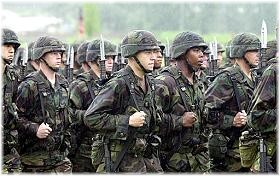
Mock battle in Southern California and Nevada to test military technology
July 24, 2002 - August 15, 2002
Mock battle in SoCal and Nevada to test battle technology
By SETH HETTENA Associated Press Writer
Published 3:10 p.m. PDT Thursday, July 18, 2002
SAN DIEGO (AP) - Preparations are underway in Southern California and Nevada for the largest military experiment in U.S. history.
The Millennium Challenge 2002, which begins next week, was mandated by Congress to help U.S. forces prepare for future wars.
About 13,500 troops from the Army, Navy, Air Force and Marines will use the latest in military hardware in a simulation of what planners believe the battlefield could look like in five years.
Over three weeks, troops will play out a scenario that echoes real-world events involving simulated weapons of mass destruction, urban warfare, the United Nations and humanitarian relief.
The Joint Forces Command, operating in Suffolk, Va., is coordinating the experiments from July 24 through Aug. 15 off the coast of San Diego and at bases in Southern California and Nevada.
Top military brass, including the chairman of the Joint Chiefs of Staff and the chief of Naval operations, will attend.
The experiments are the fruits of a drive to transform the military from a heavy, mechanized force designed to fight the Soviet Union into mobile, high-tech troops that can deliver swift hammer blows to a different kind of enemy.
"In the Persian Gulf, it took us months and months to stage forces and stockpile logistics," said Tony Billings, a spokesman for Joint Forces Command.
"New concepts are designed to cut down on that preparation time dramatically and position U.S. forces so that they're capable of rapidly and decisively striking at the enemy's center of gravity."
Just as remarkable is the fact that all four branches of the military - often riven by intraservice rivalries - are working on the same page.
"It's like you're playing baseball all these years but the infield never worked with the outfield," said Dan Goure of the Lexington Institute in Arlington, Va., who specializes in transformation issues.
"Now you've got them all in the field trying to go through a couple of innings."
Two years of planning have gone into the experiment to test how the U.S. military can respond to an international incident that can rapidly spin out-of-control into all-out warfare.
"The question for us is how do we bring all our resources to bear to prevent that from occurring," said Cmdr. Jack
Hanzlik, spokesman for the Navy's Third Fleet based in Coronado.
The hypothetical scenario begins with a military coup in a country stricken by a massive earthquake.
At the same time, a decision by the World Court over disputed territory outrage the coup leaders and prompts a military buildup and a shipping blockade.
In response, the United Nations votes to impose sanctions.
As part of the simulation, parts of which are classified, the U.S. Marines and special forces will destroy a hypothetical weapons of mass destruction site at the former George Air Force Base in Victorville.
That will be followed by a 96-hour urban combat exercise that shifts Marines between all-out fighting and peacekeeping.
Off-the-shelf technologies will be tested including Dragon Eye, a five-pound unmanned aerial vehicle that troops in the field can use to scout terrain over surrounding hills.
The Navy will test a high-speed vessel capable of maximum speeds of 55 miles per hour.
---
On the Net: http://www.jfcom.mil/about/experiments/mc02.htm
copied from The Sacramento Bee
Mock battle in Southern California and Nevada to test military technology
By Seth Hettena
ASSOCIATED PRESS
July 18, 2002
SAN DIEGO – Preparations are underway in Southern California and Nevada for one of the largest military experiment in U.S. history designed to help troops prepare for future wars.
Beginning next week, about 13,500 troops from the Army, Navy, Air Force and Marines will use the latest in military hardware in a simulation of what planners believe the battlefield could look like in five years.
The troops will play out scenario involving simulated weapons of mass destruction, urban warfare, the United Nations and humanitarian relief over three weeks during the so-called Millennium Challenge 2002.
The Joint Forces Command, operating in Suffolk, Va., is coordinating the experiments off the coast of San Diego and at bases in Southern California and Nevada.
The experiments are the fruits of a drive to transform the military from a heavy, mechanized force designed to fight the Soviet Union into mobile, high-tech troops that can deliver swift hammer blows to a different kind of enemy.
"In the Persian Gulf, it took us months and months to stage forces and stockpile logistics," said Tony Billings, a spokesman for Joint Forces Command.
"New concepts are designed to cut down on that preparation time dramatically and position U.S. forces so that they're capable of rapidly and decisively striking at the enemy's center of gravity."
On the Net: www.jfcom.mil/about/experiments/mc02.htm
copied from SignOnSanDiego
Tuesday July 23, 12:37 PM
US army to engage in largest military simulation exercise yet
Some 13,500 people in 26 locations across the United States will take part in one of the largest US Army exercises in history beginning Wednesday and lasting three weeks.
The "Millennium Challenge 2002" will combine computer simulations and live military exercises with two headquarters, one in Suffolk, Virginia, and the other in San Diego, California.
The scenario, which is secret, will "cover the whole spectrum, everything from terrorism to potentially a major theater of war and the threats that loom in between there," said General William
Kernan, commander in chief of the Joint Forces Command, which coordinates air, sea and land military forces.
One of the keys to future supremacy is "interoperability" between different government departments.
Such cooperation has already been seen in Afghanistan, for example US Navy planes dropped bombs on targets "painted" by commando units on the ground.
The details of Operation Enduring Freedom in Afghanistan which fought the Taliban and
al-Qaeda after the September 11 attacks, were largely taken from a scenario examined by Central Command in May 2001, Kernan said.
The challenge, which will cost about 250 million dollars, will incorporate "lessons learned" from the Afghanistan campaign, and will concentrate on minimizing the risks of "friendly fire" against allied or civilian forces, Kernan said.
Mastering the tools of war and information, should, according to the Pentagon, "maintain knowledge superiority," over a multi-pronged adversary who is often very knowledgeable about US vulnerabilities in this Internet age.
"Approximately 80 percent of the experiment is being conducted through the largest computer simulation confederation ever built.
MC'02 is the largest and most complex military experiment of its kind in history.
"We will provide our military planners and those who execute the plan with an improved view of our adversary, the battle space and possible solution to the crisis," including preventative strikes, Kernan said.
As part of the exercise, hackers from the "opposition force" will try to crack military computers, drones -- unmanned aircraft -- will watch marines on an amphibious assault or an extraction of soldiers using a new high-speed vessel, or even the destruction of a missile silo or other weapons of mass destruction site.
The Pentagon is also aware that it is essential to balance military might with diplomatic and economic action.
It is essential, for example, to know an enemy's culture, their personality, and how they might react, said the general.
To help with this the US Departments of State, Treasury, Energy and others such as the CIA will also take part in the exercise.
While the challenge is strictly a US exercise, similar maneuvers have been planned for February on the Atlantic coast, and even more ambitious war games are envisioned for two years time both involving allies.
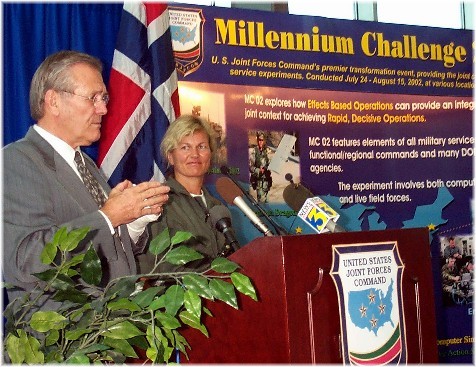
Secretary of Defense Donald H. Rumsfeld and Norwegian Minister of Defense Kristin Krohn Devold
hold a press conference at the Joint Forces Command's Millennium Challenge 2002 experiment in Suffolk, Va.
Photo by Jim Garamone.
Rumsfeld Visits Millennium Challenge Experiment
By Jim Garamone
American Forces Press Service
SUFFOLK, Va., July 29, 2002 -- Defense Secretary Donald Rumsfeld got a glimpse of how the military of tomorrow will work during a tour of the Millennium Challenge 2002 experiment here today.
Rumsfeld said he was pleased with the way the experiment is progressing. Millennium Challenge 2002 is the largest joint experiment in U.S. history.
More than 13,500 troops from all services are participating. The experiment also has the largest computer simulation "federation" ever put together.
"This exercise will test the forces and equipment that will help us judge and define both near-term and future capabilities," he said during a press conference.
"It will not only test the effectiveness of the force, but also the progress we have made thus far in transforming (the military) to produce the combat capability necessary to meet the threats and the challenges of the 21st century."
The U.S. Joint Forces Command is running the experiment. The command has been leading the transformation effort, Rumsfeld said.
Millennium Challenge will test a number of concepts. The most important of these is effects-based operations, a concept where the entire power of the United States is concentrated against an enemy.
As the United States has done in Operation Enduring Freedom, an effects- based operation would concentrate military, diplomatic, financial, law enforcement and other assets against a foe.
The experiment tests concepts used in asymmetrical warfare. In most cases, asymmetrical warfare is what the enemy can do.
But Rumsfeld pointed out that the United States has asymmetrical advantages of its own.
Experiments like Millennium Challenge allows the United States to define the doctrine needed to fight the conflicts of the 21st century, man the forces appropriately, test the technologies that seem most helpful and then continue the processes.
"Transformation is not a destination," said one Joint Forces Command official.
"We'll stop transforming only if the bad guys stop morphing, and that doesn't look like it's going to happen anytime soon."
Joint Forces Command has already provided many concepts being used in Operation Enduring Freedom.
Rumsfeld said the command envisioned many processes being used today in the war on terrorism.
"That's why experiments like Millennium Challenge are so important to future battlefield successes," he said.
"It will help us create a force that is not only interoperable, responsive, agile and lethal, but one that is capable of capitalizing on the information revolution and the advanced technologies that are available today."
Rumsfeld said one important aspect is for service members to think "joint."
He said Millennium Challenge is taking thousands of people across the services and placing them in a situation "where they are required to connect with each other, talk to each other, to be interoperable, to be joint, to think joint and to focus on goals that are not service-centric but nation-centric."
He said one of the most difficult jobs in the Defense Department is to get the services to make decisions jointly.
In the past working in a joint environment meant the services taking separate pieces of the action – the Navy stays on the water; the Army on land; the Air Force handles bombardment in this area; and the Marines engage in another area.
"Those days are gone," Rumsfeld said. He said combatant commanders don't care who provides the combat power, just that the targets get hit.
Rumsfeld said the U.S. military has to find ways to get more people thinking about joint matters earlier.
"We cannot allow each service to come up with their own weapon systems that have not been thought through in the context of how we're going to use them on the battlefield," he said.
copied from DefenseLINK
Largest military experiment ends
The live phase of a joint service experiment aimed at evaluating and validating several warfighting concepts has ended. Now, military leaders need to look at what they learned from the Joint Forces Command-sponsored Millennium Challenge 2002 and implement change that will impact the force of the future.
by USJFCOM Public Affairs
(NORFOLK, Va. -- Aug. 15, 2002) - Hundreds of military leaders are beginning to evaluate and analyze various warfighting concepts and technologies tested during the largest military experiment in history, which wrapped up today after three weeks of war games.
Military units across the country conducted the evaluations during the U.S. Joint Forces Command (USJFCOM)-sponsored Millennium Challenge 2002 (MC02) experiment using a unique mix of computer-simulated and live forces.
The analysis of MC02 experiments may lead to recommendations to decision makers that should result in near-term technologies and doctrine changes along with a long-term map on how military forces will fight and what tools they will use on future battlefields, many defense leaders say.
"What we're going to learn from this and the outcome and the impact on our doctrine, organization training and some of the things we want to acquire, are going to be impacted by this experiment like nothing else we've ever done," said Chairman of the Joint Chiefs of Staff, Air Force Gen. Richard Myers July 26 at the USJFCOM training facility which coordinated MC02.
The experiment, which was the culmination of almost two years of work, was aimed at testing and validating several joint and service-specific experimental warfighting concepts that may define future U.S. military methods of fighting.
MC02's war games - which involved over 13,500 military personnel and the largest computer simulation federation ever built - ended in a "win" for the U.S. forces playing in MC02.
Some of the major operational points evaluated during the experiment include:
• Improving the "ad-hoc" nature of setting up a joint task force headquarters by establishing a first-ever Standing Joint Force Headquarters (SJFHQ), which would be a permanent command and control element within each regional unified command.
• Establishing and maintaining information/knowledge superiority through a collaborative environment.
• Turning raw intelligence and other information into usable knowledge for a wartime commander to use in determining the desired effect on the enemy and the proper action to accomplish those effects - whether it is an asymmetrical or military strike.
• Establishing joint command and control functions as well as joint intelligence surveillance and reconnaissance capabilities that could provide commanders real-time, relevant pictures of the entire battlefield.
• Developing better ways to conduct future joint military training and experimentation efforts and paving the way for future transformational efforts.
The individual services also folded their specific experiments into MC02 where they evaluated a number of developmental technologies and methods of fighting.
A series of reports and recommendations based on MC02 lie in the near future, with a culmination report due to the secretary of defense who will in turn give it to Congress.
Congress directed the military in 2001 to conduct the experiment in order to explore critical war fighting challenges at the operational level that may confront U.S. military forces in the future.
"[MC02] is going to help us go into the 21st Century as a truly 21st Century armed forces that can take on the threat of the 21st Century, whether it's a conventional threat of last century or an asymmetrical threat as we now understand so clearly of the type we saw Sept. 11th," Myers said.
The final MC02 report is expected to be out this fall.
U.S. Special Operations Command, most functional and regional commands, and various Department of Defense and federal agencies took part in MC02, which ran from July 24 - Aug. 15 at various facilities and training sites across the United States.
"Experiments like Millennium Challenge are very important to future battlefield successes.
It will help us create a force that is not only interoperable, responsive, agile and lethal, but also one that is able of capitalizing on the information revolution and the advancements in technology that are available today," said Secretary of Defense Donald Rumsfeld said during a press briefing at USJFCOM July 29.
copied from United States Joint Forces Command