


Lion Dance: a comparison of Japan's Kaga Jishi and Cantonese traditions
By D. Lee
Let me start
with a confession: I love the excitement, showmanship and culture of the lion
dance. Gwandong’s southern lion is a big part of the spring festival in
Chinatowns throughout Australia, with the acrobatics of the lion and laughing Buddha,
the chimes of the gong and beat of the drum, and the smell of crackers all
being familiar for wahkiu across the world. The following article is about Kaga
Jishi (Kaga region ? present-day Ishikawa prefecture ? lion dance) and
comparisons with southern Chinese lion dance.
Historically, there never were any lions in China or Japan.. They were, however, introduced by Persian traders to the emperor of China in the opening of the Silk Road. The Lion has, since this time, been revered as a mystical animal that both brings in the good luck and repels back luck.
Shifting scenes, I first started training in Japanese martial arts in primary school in Australia. Around 20 years on, I’m studying some of Japan’s oldest traditions in order to master something most Japanese don’t even know still exists, much less interest them enough to warrant study.
So there you have it. I have an inherent interest in the lion dance, old martial arts and am fascinated by Ishikawa Prefecture’s pride in its traditional culture. Imagine my excitement at discovering lion dance being preserved in Ishikawa as a folk performance art.
Chinese
lions
are synonymous
with Lion Dance, as well as the stone guardian lions that protect China’s
temples, palaces and mansions. Conversely, Japanese lions are found in lion
dance (with some physical similarities to China’s Northern Lion Dance),
although a similar beast known as a Lion Dog (etymologically referring to dogs
of Koryo - a nation in feudal Korea - introduced to Japan during the Heian
period [794 - 1185]) protect shrines. These mythical animals have exactly the
same roles as the lions placed before Chinese gates (warding off evil spirits ?
a common theme also seen in the depiction of lions in Indian and Persian art),
but also come in a surprising variety of forms (including monkeys, birds,
mythical kappa, raccoons, foxes etc).
Origins of
the ‘Lion’
According to
legend, the roots of the ‘lion’ can be found with the appearance of a best
never before seen by the Tang Emperor (618 - 906AD). Consulting a minister, he
came to know the beast was a Lion found in the Middle East. From this time on
the Lion has been the popular symbol of the authority of the Emperor and of
Buddhism, and has been embraced by the public as a bringer of good luck. The
emperor’s palace was from then on cleaned physically and spiritually (with 12
animal characters passing through the palace three times to purify it). There
are many other legends.
The origins of the lion dance appear to have religious roots. Today’s lion dance, however, is carried on as a form of folk performance art, and enjoyed by all as an attraction at festivals.
Kaga Jishi
Is an elaborate
folk performance art comprised of a huge lion, bo-furi (martial performance)
taking in classical martial arts movement, and traditional musical accompaniment.
What lions
are made of..
The Kaga Jishi
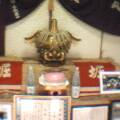
Lion’s head is made of lightweight wood, and features delightful wood carvings
and fresh, vibrant colours of a level representative of Ishikawa’s traditional
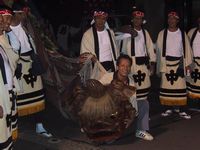
crafts. The ‘Kaya’, or trunk of the lion is made of bamboo and dyed cloth, and
is of an extremely large scale even for Japan. Both of these are often
inherited generation after another.
The Cantonese lion, by comparison, has a head made of bamboo, paper and fur, in recent years even being lightened through the use of plastic piping. Resultantly, the Cantonese lion perishes faster, meaning dragon/lion dance teams must replace them after several years.
Passing on the heritage of the lion in two countries..
In Kaga Jishi, musicians, bo-furi (martial performers) and lion performers
are all trained separately from the start of their careers. Interestingly,
lion dance is in stark comparison with other performance arts in that instruction
is not carried on from master to pupil, but from the elder generation to
younger generation in a given area. Within Cantonese lion dance, body type
must be taken into consideration, but junior students (yupmun daigee) are
often relegated music performance, whereas the two-person lion dance, requiring
a conditioned and trained body, is given to the senior students (yupsut
daigee) to perform.
Classical regional martial arts publically practiced in Ishikawa today have dwindled to Nagao-ryu Taijutsu, Nagao Shinkai-ryu Kodachi and Shinkyo-ryu Kusaritama. Until recently Shinden-ryu spear, Muhyoshi-ryu jujutsu and Yamada-ryu Kusarigama were also found here, but have doubtlessly disappeared amidst the popularity of modern Western sports.
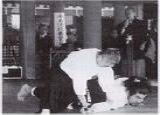
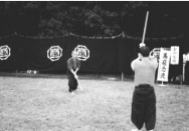
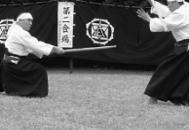
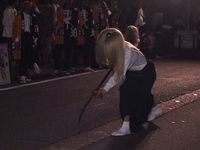
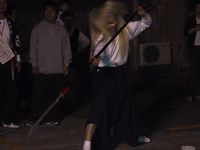
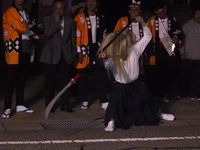
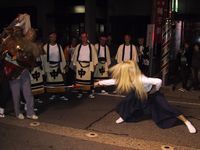
Bo-furi (Kaga Jishi’s martial performance) can be divided into two major schools according to the Kanazawa Municipal BOE/Kaga Jishi Preservation Society’s ‘Kaga Jishi Guidebook’. The Hijikata-ryu (taking in kenjutsu, bojutsu, naginata etc) to the north of Kanazawa’s Asanogawa river was founded by masterless samurai Hijikata Takegoro, while the Hanbei-ryu (bojutsu, naginata, batto and kusarigama) founded by Machida Hanbei Hisasada was to the south of the Sai river. In total, 16 schools sprang from these, and catered to public interest in the martial arts and gekken sword contests prevailent around the time of the Meiji restoration.
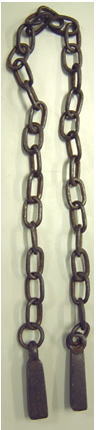
Kaga Jishi displays a richness and variety of performance not commonly found in many martial systems, which reflects the history of Kaga region martial arts. Presently, Kaga Jishi includes ichinin-bo (single performance: bo (staff), naginata (halberd), tachi (sword), nito (twin sword), mitsuken (three bladed weapon), yari (spear), kama (sickle), shakuhachi (flute), jutte (pronged truncheon), chigiriki (chained staff) etc) ninin-bo (twin performance: tachi/naginata, tachi/bo, bo/bo, tachi/kusarigama (chained sickle), naginata/naginata, naginata/chigiriki etc) and also includes up to five performers demonstrating together, centering on martial performance. The jutte, for example, is today preserved by only around 10 martial arts traditions, the kama by around five, and I have still to see a performance of naginata/chigiriki, mitsuken etc in martial arts today. Kaga Jishi preserves a truly rich heritage. The bo-furi performance centers on the qwelling on the Lion, making bo-furi a key feature of Kaga Jishi.
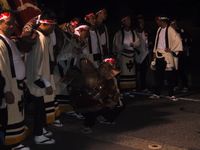
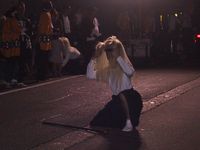
Cantonese lion dance is preserved by martial arts schools such as Choilifut, Hungmun, Bakhok, Tonglong etc, and, as with Kaga Jishi, is transmitted from one generation to another, rather than master to student. The performance centers on a pair of students who control a light, compact lion in a more acrobatic way. Throwing the lions head high in the air, controlling the lion’s face to display eight key emotions, as well as performance of martial arts footwork, are all keys to the Cantonese lion’s movement. The performance itself features the lion (sometimes lead by a lucky Buddha) and its surpassing various obstacles (posts, iron wires, etc). The obstacles represent various challenges: performance on posts eludes to climbing mountains, while walking iron wires represents crossing bridges. Restaurants prepare a gratuity wrapped in greens in front of their shopfronts for the Lion to claim after blessing the shop. The Cantonese lion performance and the manipulation of the head have strong martial arts influence, differing from school to school.
In this way Kaga and Cantonese lion dance are preserved in very similar ways, but have differing martial influences. Kaga Jishi contains musical performance, a giant lion, and bo-furi martial performance, all keys which contribute to the much-loved performances enjoyed by many.