
Photo Essay, 1999 and 1998 Upland Seasons
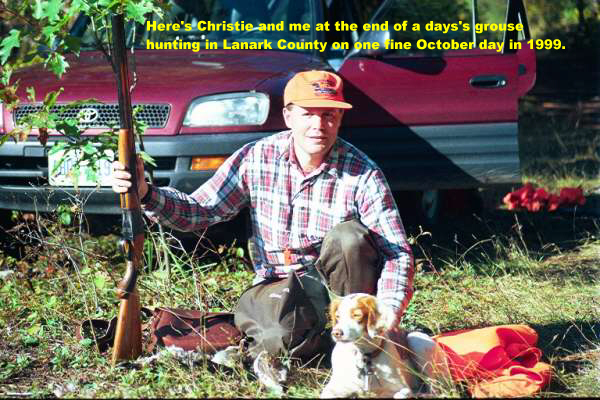
By way of a few opening remarks, let me note that I have been hunting in the Marlborough Forest since the mid 1970's. In the 1970's, the Marlborough was known as the Ottawa-Carleton Forest. I got my first hunting license in 1976 when I was at the tender age of fifteen. My first opening day experience took place on a beaver pond in the Marlborough. I spent several seasons thereafter learning through trial and a good deal of error how to find grouse and woodcock without a dog. Christie was my first dog. I brought her home in April 1994 when she was between six and seven weeks old. She grew into a keen and competent little huntress in the years that followed. Together, Christie and I were a great team in finding and shooting a wide variety of upland birds. In the paragraphs and photos that follow, I hope to share with you some of my memories of great days afield together with Christie and my hunting partners.
Christie and I had a great season both on our own and in the company of my hunting partners in 1999. The 1998 season was great as well. A lot of time and effort was spent throughout the year in preparing for the Autumn hunting seasons. The Spring and Summer months were spent in training with Christie, and scouting out familiar and especially new hunting grounds.
K & D's Hunting Preserve, September 1999
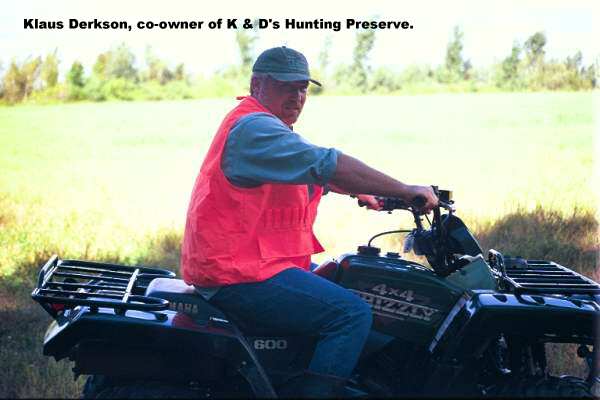
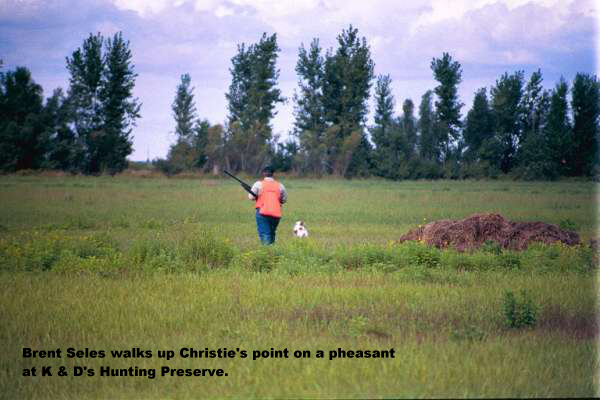
The 1999 season for Christie and me was preceded by a visit to K & D's Hunting Preserve where, in the company of Brent Seles and Justin, his Golden Retriever, we went hunting for pheasant and chukar partridge. K & D's Hunting Preserve was located in Osgoode Township near Metcalfe. It was a very brief drive from the city to reach the preserve. Sadly, this turned out to be our last hunt at K & D's Hunting Preserve as Klaus and Diane closed the preserve as of March 2000. The closure of what was a very well run hunting preserve is due to the encroachment of the city of Ottawa onto the surrounding countryside. Osgoode Township is about to be swallowed up by the new Megacity of Ottawa. When this happens, a ban on the discharge of firearms will be imposed. This effectively makes the continued operation of a hunting preserve impossible.
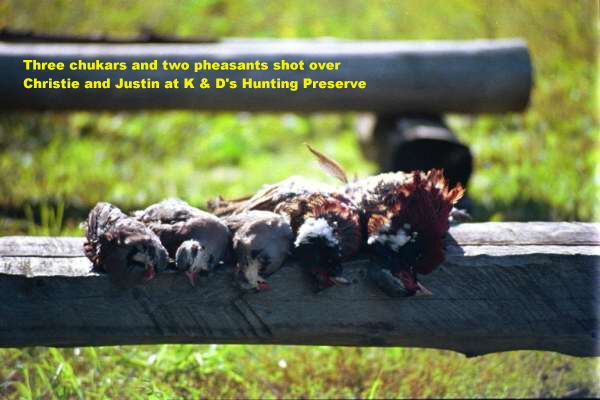
Nevertheless, it was a great day for the hunt, and the dogs were ready and raring to go. We arrived at about 9:00 AM, and checked in with Klaus. We had arranged to have four pheasants and six chukars released for the day's hunt. After checking in with Klaus, we moved on to the camp area Klaus has set up next to the hunting grounds. We waited there while the dogs had a chance to run off some ot their excitement, and Klaus set about releasing the birds. In due course we got under way. The strategy was simple: Christie would range ahead in search of the birds, while Brent kept Justin close. We discovered during the 1998 season that we could run the two dogs together without too many problems. Justin is generally pretty good about honouring Christie's points. When a bird is shot, Justin is employed to retrieve it as Christie is more inclined to point dead than retrieve downed birds. This likely sounds very simple to those who have never tried it for themselves, but it is quite challenging. Despite being pen raised, the pheasants and chukars provided by Klaus were very hardy and strong flyers. Typically, we could spend a full day hunting the birds Klaus had released for us. In addition, we were free to hunt any birds left over from previous hunts.
Brent and I are both Browning men. Brent shoots very well with his Browning Auto 5, 12 gauge, 28 inch barrel and a selection of chokes. For pheasant and chukar hunting, he uses the improved cylinder choke. I use my Browning Skeet Gun, over and under, 12 gauge, 26 inch barrels and choked skeet and skeet for gunning in the grouse and woodcock covers. For hunting pheasant and chukar, however, I use my Ruko Lanber Model 85, over and under, 12 gauge, 28 inch barrels, and a choke combination of improved cylinder and improved modified. Brent and I have found that the Winchester Heavy Game Load loaded with 1 1/8 ounces of No. 6 shot is adequate for shooting pen raised pheasants and chukars. I use this same gun, only loaded with the Winchester Duck and Pheasant Load with 1 1/4 ounces of No. 6 shot, when hunting sharptailed grouse and wild pheasants. With these respective choke combinations and cartridges, we get clean kills consistently.
In the course of the days hunting, Christie made several points. Every point is carefully walked up, but you never know for certain if there is a bird, or if it is just an old scent. This ensures that the thrill of the hunt is ever present. I find it most pleasing that the anticipation of the flush is as great as it ever was before I started hunting with a dog. Brent and I took turns walking up Christie's points. There were some great flushes and birds killed cleanly. There were some spectacular misses on the part of both Brent and myself. There was one very lively cripple, a pheasant, which Justin ran down and retrieved very nicely. In the end, five of the birds succeeded in eluding us.
The opening day of grouse season in Eastern Ontario comes five days ahead of the opening day of the waterfowl and woodcock seasons. With that knowledge in mind, Brent and I set out for the Larose Forest with the dogs in hopes of turning up some grouse in a cover we named "Ridges" during the 1998 season. Ridges had proven to be a fairly productive grouse cover for us in an era when grouse numbers have been very low. In addition, there are portions of Ridges which held woodcock during the 1998 season. Ridges is composed of a logging road that runs by a series of ridges which have varied types of habitat. There are portions of the plantation style rows of Red Pine which were planted by the Ministry of Natural Resources many years ago. These are typically quite barren save for the occasional red squirrel. The better portions of habitat in Ridges consist of a young growth of birch, aspen, choke cherry, sumac, brambles, crab apple and conifers such as spruce and cedar. There are streams cutting across the trail in parts, and numerous beaver ponds and swamps on either side of the trail. The trail itself runs for several miles.
It was a great day for grouse hunting. The sun was out, there was no wind to speak of, and the temperature was moderate. The dogs were raring to go, as were Brent and I. Before setting out, we made certain that Brent's wife Diana knew where we were going and when we expected to be back. We made sure that I had packed the first aid kit, compass, coffee, snacks, and a good supply of fresh clean water. For this occasion I was using my Browning Skeet Gun, while Brent decided to try out my Stevens side by side double, 16 gauge, with 28 inch barrels and choked improved cylinder and modified. As ruffed grouse were our only quarry for this hunt, I loaded my Browning with Winchester Heavy Game Load with 1 1/8 ounces of No. 7 1/2 shot. Brent loaded the Stevens with Winchester Duck and Pheasant Load, 16 gauge, with 1 1/8 ounces of No. 6 shot. With this combination of shotgun, chokes, and cartridges, experience had shown that we could expect to shoot and kill ruffed grouse cleanly over Christie's points. My hunting partners and I prefer a cleanly hit bird over a lively cripple any day.
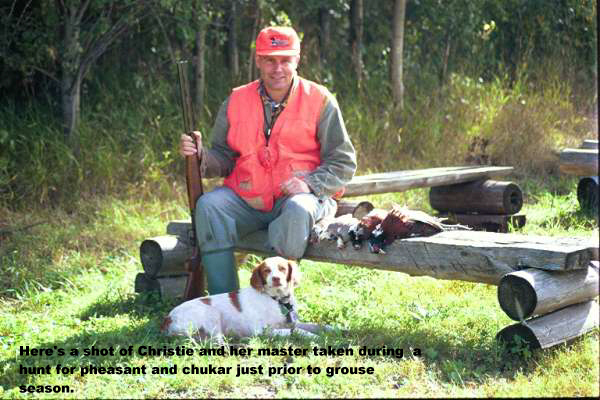
Brent and I are very safety conscious when we are out hunting. You will notice in the photos that accompany this story that Brent and I are wearing blaze orange vests and caps. We make sure that we can be seen easily when we are gunning for grouse and woodcock. This is especially important during the early season when there are still lots of leaves on the trees and shrubs in the grouse and woodcock covers. Along with the blaze orange clothing, we wear shooting glasses. There is nothing quite like getting "twigged" when you are working a grouse and woodcock cover. While we are out hunting, we keep close together. When Christie goes on point, Brent steadies Justin, and then we work our way toward her. We take turns walking up her points, the one walking up the point is designated as the primary shooter. The other stands behind, but stands ready in case the bird comes his way. Shots are passed up if we have any doubts as to the whereabouts of the other, or if shooting would be in the direction of buildings or a road. In addition, we are careful to observe the proper etiquette when we are out hunting. We never lose sight of the fact that there are other people out in the forest. Whenever we encounter other people in the fields and marshes we hunt, we make certain to unload our firearms and leave the actions open. This practice is very important, because you typically encounter many people on crown, i.e., public, lands. It is common to meet other hunters, but it is just as likely to meet people who are not hunters. The sight of men armed with shotguns and rifles can be frightening to people who are not overly familiar with firearms. Similarly, when we pause for coffee or lunch breaks, the first thing we do is unload our firearms. In this way, Brent and I have made our hunts together safe, productive, and above all else, very enjoyable.
I was up at 0600 to take Christie for a run at one of our favourite training grounds. This particular training ground is located within the city limits. It is a large patch of parkland close to the Ottawa International Airport. Interestingly enough, to reach this parkland, I travel along Hunt Club Road, and park on Uplands Drive. I really like working Christie on this training ground because it encompasses various types of upland habitat. There is a wooded area at one end which is composed of maple, poplar, hawthorn, choke cherry, birch and sumac to name a few. There are foot paths running through this wooded area. It is home to a myriad of species of songbird including: cedar waxwings, yellow warblers, eastern king birds, robins, wood thrushes, cardinals, bluejays, grackles, phoebes, and many others. Squirrels and varying hares can be found too.
The bulk of the parkland consists of grassy meadows interspersed with hedgerows and small clumps of shrubs. The hedgerows are made up of sumac, crab apple, hawthorn, birch and even a couple of wild plum trees. There is a stream, bordered with birch, hawthorn and choke cherry, running through one end of the meadow. The grassy meadows have a variety of wild flowers, goldenrod and a few wild raspberry canes. The meadows are home to meadowlarks and appreciable numbers of Hungarian partridge. During the Spring migration, we can expect to turn up woodcock and Wilson's snipe at the edges of the stream. It was during a visit to this training ground in late March that I heard for the first time male woodcock on their singing grounds. Puddle ducks, most commonly blacks and mallards, can be found in the temporary ponds created by the melting snow. However, it is the Hungarian partridge that Christie and I come for.
The Huns, as my friends and I refer to them, are great for training Christie between seasons. The Huns that frequent these fields come into contact with a great many dogs, some working gun dogs like Christie, and some just house pets. They are very wary and often prefer to run ahead of her. Christie has learned approach them carefully. She has become quite adept at working running Huns without bumping them. On this outing, we had nineteen flushes. Fifteen of these were over Christie's points. In all, we flushed sixteen Huns and three Wilson's snipe. The experience Christie has gained in working these cunning running Huns has really helped her in finding and pointing the local ruffed grouse, and the wild pheasants we hunt. Ruffed grouse in eastern Ontario are very skittish. You can count on having them run ahead of your dog, and wild flushes are common.
This was our last outing to the training ground until September. We stop training in this area from May on in order to let the Huns get on with the business of nesting in peace. That way, we can be sure of finding healthy populations of Huns in the eary Autumn to train on just prior to the opening of the upland seasons.