The following text and photographs have been extracted from the book "KOONORIGAN" (21,000 words, 100 photographs, 56 pages). For a copy contact the author Michael Smith at
During the Second World War some Italian prisoners of war (POW) who were considered a low security risk were allowed out of detention to work on farms. Wallace Jackson of Koonorigan was notified that he had been allocated 2 POWs. When he went to the railway station to pick them up he found that there were three waiting for him. Two of them claimed to be brothers and the third a cousin. Wallace formed the opinion that they were just friends who wanted to stick together. He took them back to his dairy farm where they were housed in a barn. The POWs soon built a cookhouse and settled down for a two-year stay. Their main job was clearing lantana; there were no sprays in those days.

Wallace (who they called 'mistair') paid each prisoner one pound a week and provided accommodation and meals. The Italian government also chipped in two shillings and sixpence per week and a supply of tobacco. A source of spaghetti was found in Lismore, and a flagon of wine was issued each week. The bread baker came 3 times a week. The Italians ate their bread in chunks. Phyllis Jackson, married to Wallace only a few years, remembers getting in big tins of tomatoes that were kept in the fridge and doled out. Geoff Jackson was born when the POWs were there. They said that they hoped the baby was going to be a girl because if it were a boy he would have to go to war.

A canteen truck from the Control Centre in Lismore visited the
POWs every few weeks, so they could spend their money on a few
personal necessities. The Australian army visited once a month
to provide clothes and boots. Joe, whose real name was Giuseppe,
soon realised that if he asked the local farmers for their worn
out boots he could trade them in, as his own, and get a new pair.
He then sold them back to the farmers. The POWs had Sunday off
and were free to leave the farm. At such times they had to wear
a uniform that was dyed magenta.
Joe would often go off on horseback to visit other POWs. Another
farm along Cox Road was the Osbourne's, and they had one Italian
POW who lived in the house, and ate with the family. Joe would
sometimes ride down to Coffee Camp to visit some Italians there.
He was caught in action in the Middle East and after the war
Joe wrote to the Jacksons expressing his wish to visit Australia
again.
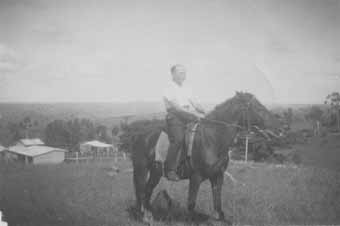
The Turners had an Italian POW during the Second World War. His
name was Rocco Spinelli and when the government supply truck
came around he would give his lollies to the children. Rocco
started off living in a shed but in time he moved into the house
with the family. He would take off on Saturday night and report
for duty by Monday morning. The children remember having a swing
in a wattle tree and Rocco would swing them really high.
Walter Seccombe got 3 Italian POWs who were caught in Tunisia
but hated being drafted into the army. Walter's son Norman grew
up with them as a child and remembers them as nice blokes, polite,
sang beautifully and were good workers. They did not milk the
cows but helped with fencing and clearing lantana. They seemed
happy and were glad not to be fighting. They were housed in a
shed and did their own cooking, the food being supplied and an
allowance paid. They always managed to get hold of wine (or make
it). They were remote souls, they talked about home (northern
part of Italy), two of their names were Mario and Tony. They
were not expected to work hard. One of these POWs would make
rings for the local ladies by filing down a two-shilling piece.
Bracelets were also made from three-penny bits. John McIntyre
was the local cream and livestock carrier at the time and he
would borrow Seccombe's POW's to help load bags of wheat which
he picked up in Lismore and delivered to various Koonorigan farmers
to be used for pig food. The trucks were too small in those days
and the job would require 3 return trips.
The Brown's farm had the services of 2 Italian prisoners of war
in 1942. They worked in the banana plantation for 18 months.
They were thought of as good workers and no trouble. The POWs
lived in a 2 room separate house. Beryl's mother cooked their
meals, which were taken to the POWs' house to be eaten. In those
days light was by hurricane lamp, mains power did not arrive
in Koonorigan until about 1934.
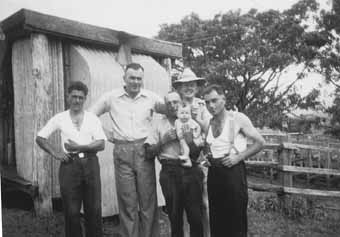
Front row Italian POWs holding Wendi Jackson, 1944.
Earnest Haynes got one Italian POW, Hugo. The story was that
back in Italy Mussolini forced men to join the army. These reluctant
soldiers, once in service surrendered to the Australian troops
and were sent to Australia as prisoners of war. Hugo lived in
a barn and ate with the family. He was there for about 2 years,
helping with the milking, feeding the pigs and working the paddocks.
For the Haynes it was useful to have another man around the house,
as the 6 oldest children were all girls. Hugo was not expected
to work very hard and he was free to visit the other POWs after
work and have a good time. Whatever they got up to, he never
came home drunk.
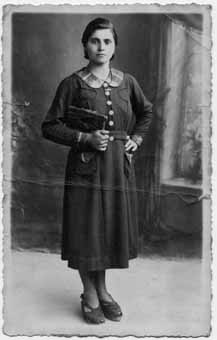
Wallace Jackson wondered if his POWs had family back in Italy, so he asked them and was shown these 2 photographs.
 |
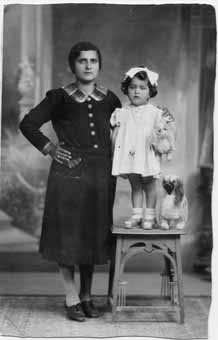 |
On the reverse of one photograph was a message in Italian which said ...
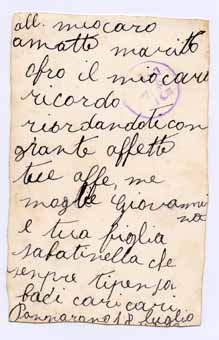 |
"To my darling husband. I remember you, my love. I remember you with great affection. Your darling wife Giovannina. And your child, Sabatinella is always thinking of you. Love and Kisses, Pannarano 18 July." |