Are you prepared for this?
There are many ways to die on a farm and a tractor accident looms
as the most likely. Up here in Koonorigan at least 2 people have
been killed in tractor accidents. Could have been number 3 today.
I was pulling lantana in the back paddock, by wrapping a chain
around a clump and yanking it out with the tractor. An hour into
this arduous and scratchy job something unexpected happened.
A few seconds into a pull I saw the tractor rise up in front
of me, flip over and generally menace my well-being. I reached
for the kill button and sat in merciful silence, amazed that
I was not dead.
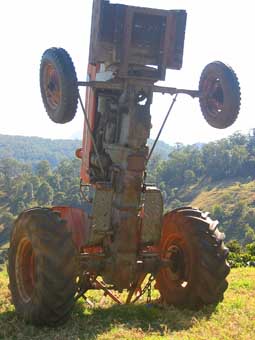
The front of the Massey-Ferguson 35 was 3 metres above me and
the box of goodies mounted up there was showering its contents
over me. I worried about bloody big bits of metal (power take-off
shafts, chains, hammers etc) stoving in my head. The human body
seems very fragile when being menaced by two tonnes of flailing
metal.
Fortunately the tractor did not flip right over backwards. It
was not the rollover protection system that contacted the ground
but a jib (a type of crane) that dug in. I had selected this
attachment for this very reason. I walked away. You usually get
some warning when the front starts to rear up, if you happen
to be looking ahead, and can push in the clutch. I was looking
behind.
If I have any advice to my fellow farmers it would be to lead
a moral and blameless life because you never know when you will
be meeting your creator.
Passing through.
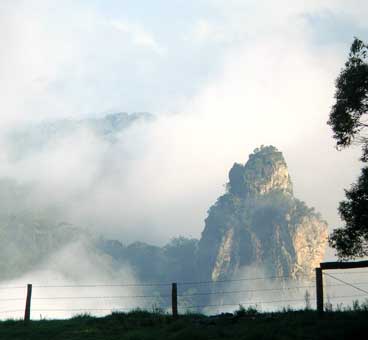
I live with my wife, and 8 cows and calves, on top of the Koonorigan
Range overlooking Nimbin Rocks. We own the land in as much as
there is a piece of paper in the Land Titles Office bearing both
our names and describing the aforementioned 24 acres. I have
heard it said, more than once, because of things that happened
a couple of hundred years ago, we are living on stolen land.
I can assure you that we went into virtual slavery for a few
decades to earn the money to buy said piece of The Rainbow Region.
We own this place to the extent that when we decide to do something
else with our lives, we can sell it for what we can get for it.
Someone else will move in and the farm will change a bit more
under their tenure. We are the temporary caretakers of Lot 2.
We bought the place from a German couple, who, being in their
70s, found it a handful to mow and maintain. We had an exciting
time quizzing them about carrying capacity, names of neighbors
and species of trees that were planted about. I needed to know
the location of kilometres of underground poly piping and how
to start, prime and maintain the 'bulldozer' pump that sends
water from the spring dam to the tanks around the house. They
moved on and we moved in. I soon learnt how to drive a tractor
and drag various implements about. Years of reading the library
copies of "Grass Roots" and "Earth Garden"
had prepared me for a crack at self-sufficiency. More than half
of what we eat comes from these acres. The freezer is crammed
full with hundreds of kilos of seasonal excess. When bird flu
jumps the species gap to humans and we have to shut the farm
gate for 3 months of isolation, it might be possible to live
on what the trees, garden and animals provide. Of course, the
birds live here too.
Birds are born in their little cup nests and, at the end of their
time, drop to the ground dead. It is their farm too. They take
their share of grapes, bananas, mangoes, mulberries, figs, paw
paw and persimmons. The bats have all this and more, taking up
to 90% of some crops. They are born elsewhere and are protected.
Wallabies have been here for thousands of years and are entitled
to whatever they need. Their worst habit is eating all the new
buds and leaves of my Isabella grapes. You get the picture; those
who have this as their home come and take what they need to survive.
Goannas, echidnas, water dragons, pythons, venomous snakes, green
tree frogs, water rats, antechinus and scrub turkey all live
here happily. They give us pleasure by being around.
I managed to track down more previous owners. A Slovakian couple
lived here when it was 75 acres. To remind them of home they
planted lots of pine trees (something about the sound of the
wind through the needles and cones). Their legacy is also a line
of poplar trees, English oaks and the first house, still standing
and used. She came back for a look once and had a big sob.
The oldest link with the place was a man who grew up here when
it was a 300 acre dairy farm. I invited him out and he told me
lots about the place. I asked him about aboriginal stone axes,
I had found one. He said they were common but were thought of
no value and so not kept. There were lots of axes because native
beehives were everywhere. We found his 40 year old, hand made
drinking troughs, and lots of fence posts that his father had
split and augured. He told me how his grandfather had cleared
the land, 700 acres, in 1909. In those years a settler could
select land on condition that the land had to be cleared and
a crop harvested within 2 years. Starting at the bottom of the
hill, trees would be cut most of the way through. A big tree
felled at the top of the hill would bring the whole lot down.
A team of local 'Hindus' would scramble among the fallen timber
and dig holes to put corn seed in. Very soon a crop could be
harvested and the government satisfied. It was then the farmer's
job to burn the timber and grub out the stumps and roots.
Before that, timber cutters would have been through, first cutting
the cedar, and then the other valuable rainforest species, and
lastly the quality hardwoods. Their snigging tracks can be seen
on the slopes still. Even further back, my precious acres were
part of the Big Scrub and the undisputed domain of the Wiyabal
mob. I am looking after the place as best I can. The axe head
is back where I found it.
An Antechinus for Christmas.
I keep a bucket of water in the shed to put out fires. It is
usually me that is on fire, a result of welding or grinding steel.
Back in early November I found a ghastly sight, something furry
had drowned in the bucket. I turned it over. It was an antechinus
with eight babies in the pouch, a tragedy. The antechinus is
a native marsupial mouse that sometimes likes to live in our
buildings. They cause a bit of untidiness by dragging about what
they consider nesting materials, leaves, paper and the undies
you left on the floor. In return they rid your living spaces
of cockroaches, moths , spiders and other insects, which they
convert into scats, which are left in their place. There may
be some advantage in having an antechinus living in the house.
They are known to be able to pounce on a house mouse and crush
its skull or neck with a bite. It will then eat the mouse, leaving
its skin turned inside out. With Christmas, and some visitors
expected, I did not want to give the impression that I lived
in a rat-infested hovel. They might tell my mother, who would
come up here and lead me back home, by the ear. The marsupials
would have to live in the bush for a while.
In a former life I was a licensed animal trapper and still had
my traps. With the lure of some peanut butter and oats, my little
aluminium boxes were snapping shut in the wee small hours. There
is something you must know about the antechinus. In mid July
all the males develop impressively-sized 'wedding tackle' and
become sexually active, trying to mate with as many females as
possible in the few weeks they have left. Mating sessions can
take as long as 12 hours. The males stop eating and die a reasonably
hideous death, aged exactly 11 months and 3 weeks. This happens
about mid-August, leaving pregnant females to carry on the line.
So all my captives were ladies, with babies. Most mums had up
to eight small pink 'peanuts' in the pouch. Each family was taken
down to my scrubby back paddock, antechinus heaven, a boulder-infested
forest of everything that lives.
The last domestic antechinus that I caught in late November had
an empty pouch. The babies were stashed in a nest somewhere.
I imagined them curled up behind a wall, comforted by a pile
of torn up telecom bills and discarded underdacks. If I took
their mum from them now, all the babies would die. It was a strange
moment for me, I let her go in the house.
I waited a month and caught her again. Her babies, hopefully,
were big enough to be independent. She joined her tribe in the
back paddock. For the next few days I waited for the smell of
death. It did not come. Perhaps they really were big enough to
survive on their own. Four days later I discovered a little pile
of furry things curled up asleep on the floor. I was really glad
to see them. They had made a temporary camp, on the floor, in
the space below a door and the door frame. I gathered them up,
before the python found them, and put them in a plastic bucket
to sleep the day off.
My only girl-child, a woman of 22 summers, was arriving later
that day to spend Christmas with her doting dad. By way of a
bit of mischief, I gift wrapped the bucket as a Christmas present
for her, with the additional instruction that it be opened that
day, before sunset. Knowing how challenging her father likes
to be, she slowly and carefully peeked in the package, guessing
that something live was within. In Asia you can buy a bird in
a cage, to set free, here was the Aussie equivalent. We had an
entertaining day watching them sleep. They would be completely
immobile for 20 minutes, then start twitching and jerking about
like dogs do when they are asleep. They would crawl about a bit
and find a new comfortable position amongst their brothers and
sisters.
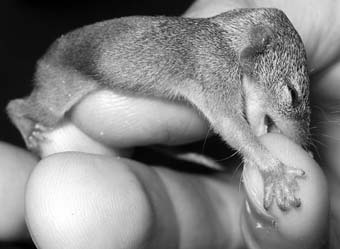
Their heads seemed too big, their limbs so long, their young
bodies lean. They were babies, but ready for life's challenges.
The boys were already a third into their allotted life span.
Our moment of quality time arrived at sundown. We picked them
up and let them have a bite of our finger, just before letting
them go in the back paddock. Would they recognise their mother
if they saw her again?
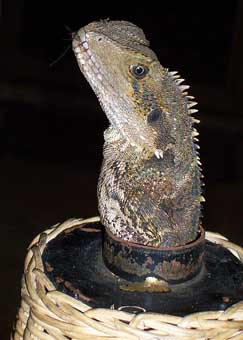
Spiky in a jam.
I got a phone call from a neighbour the other day. She lives
alone and asked for some help to remove a lizard from a pipe.
A light stand had been knocked over on the verandah and an unfortunate
water dragon had wandered in and become very stuck. She stood
the stand up to keep the cat from worrying the trussed reptile.
Nevertheless he (lets call him Spiky) had a mouth full of cat
fur. Spiky looked so vulnerable with his arms pinned firmly to
his side by a steel ring. There was no apparent panic, he just
resorted to his main form of defence, that of not moving at all,
hoping to be invisible. I gave Spiky a sponge bath with extra
virgin olive oil to help with his transition. Ever-so-gentle
pushing down from the top and pulling from below eventually did
the trick. Throughout all this Spiky was gracious, not biting
me, not struggling, even seeming to drift off into a slumber
at times. Once free he shot off to join his bush mates.
On the farm
History of a photograph
Back in the mid-1970's I was at a photography
exhibition and saw for the first time a sequence of photographs
showing the birth of a human being. I was shocked and moved.
Here is a similar photograph, and its story.
When my first child was being born I was shown a waiting room
where I was expected to wait for an expected 6-18 hours. This
was how it was done in 1977. The maternity ward was ruled by
huge, gruff women. At best you would be allowed a quick visit
every few hours. The rest of the time was to be spent on a vinyl
chair next to a pile of 'Womans Weeklies' in the waiting room.
I am not a patient man. My wife took pity and said I could go
home. To her great disappointment I did. Six hours later I was
summoned back to the hospital to view Adam, not the red reptilian
thing I had been expecting but a handsome boy. That first sight
of him was one of the great moments of my life.
More baby-making followed and by 1979 it had become an accepted
thing for the 'significant other' to be present for the whole
duration of labour and birth. Not so accepted was the intrusion
of a camera. I was not allowed to take any photographs until
the cord was cut. Thus Brett came into the world. He was to grow
to become, in the words of Men at Work, 'six foot four and full
of muscle'.
I had one last chance, in 1982, to photograph the whole labour
and birth. So that I would not be prevented, I had letters of
approval from the hospital directors, the matron and the obstetrician.
I took two 35mm cameras loaded with black and white 'tri-X' high
speed film, no flash. At times you have to decide whether to
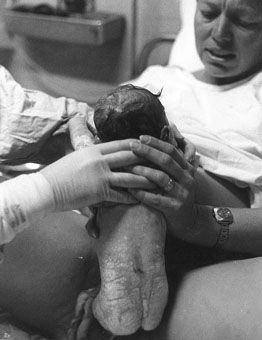
enjoy the moment, or get the photograph. The picture shows my
wife assisting Kate into the world.