 |
|
|
|
|
|
|
|
|
|
|
|
|
|
|
|
|
|
|
|
|
|
|
|
|
|
|
|
|
|
|
|
|
|
|
|
|
|
|
|
|
|
|
|
|
|
|
|
|
|
|
|
|
|
|
|
|
|
|
|
|
|
|
|
|
|
|
|
|
|
|
|
|
|
|
|
|
|
|
|
|
|
|
|
|
| Instruction in Kong Su Do |
|
|
 |
 |
|
|
|
 |
|
|
Email |
|
|
|
|
|
Main Site |
|
|
|
|
|
Profile |
|
|
|
|
|
|
Fundamentals of Kicking Lesson 1--Staying Upright |
|
|
|
|
|
|
|
|
|
|
 |
|
|
|
by |
|
|
|
|
|
|
|
|
|
The purpose of this lesson is to show you that the height you can kick is not the same as the distance you can stretch. Thinking that the distance you can stretch is the same as the height you can kick with good balance is not true. (But it is a common mistake in thinking made by both beginning and advanced students). The first thing you must learn about kicking is that your supporting leg must be vertical when you kick.
The lesson will show you two very important things evry student should know : (1) how to determine how far you must be able to stretch if you want to kick at a certain height with your supporting leg vertical; (2) if you know how far you can stretch, how to determine the highest you can kick while keeping your supporting leg vertical.
There's a little math involved, but don't worry if it's a little beyond you. It's just here to show you that what I am telling you is based on science. It might be a good idea for you to have the theories and the math proofs reviewed by a qualified person to convince you they are valid! There are other factors involved in good kicking (static equilibrium, dynamic equilibrium, etc.) which I will discuss in future lessons.
|
|
|
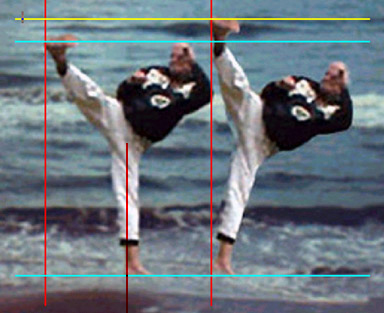
O.K. On with the lesson. Look at the picture to the right (Fig.1) with the two men kicking. Which one looks like he knows what he's doing and which one looks like he's gonna fall on his butt? Keep in mind that both men in the picture are exactly the same size and they both have the same distance between their heels (equal stretch distance). Also notice that the red lines are vertical lines and the blue lines are horizontal ones.
Look closely at the two men. The man on the left is kicking correctly: his supporting foot is flat on the ground; his supporting leg is vertical; his weight is in the direction of his kick; and his head is in a vertical position. This is the proper way to kick.
But the man on the right is doing everything wrong. While he is kicking a little higher (see the yellow line?), he is up on his toes, his supporting leg is not vertical, he is leaning away from the direction he is kicking, and his head is not in a vertical position. Not only will his kick lack force, but he is going to end up on his butt. He is kicking this way because he thinks he can kick the same height as he can stretch. You do not want to kick this way! |
|
|
 |
|
|
|
Fig. 1 |
|
|
|
|
 |
|
|
|
Here's what you need to know!! |
|
|
|
Where:
(L) is the length of the leg
(H) is the height of the kick
(S) is the distance of the stretch |
|
| If you know the distance of your stretch, then this is the highest you can kick keeping your supporting leg vertical: |
|
|
|
 |
|
|
|
|
|
|
| If you know how high you want to kick with your supporting leg vertical, then you must be able to stretch this distance: |
|
|
|
 |
|
|
|
|
|
|
|
|
|
|
 |
|
|
The Mathematical Proof |
|
|
|
First, you must determine the length of your Leg |
|
|
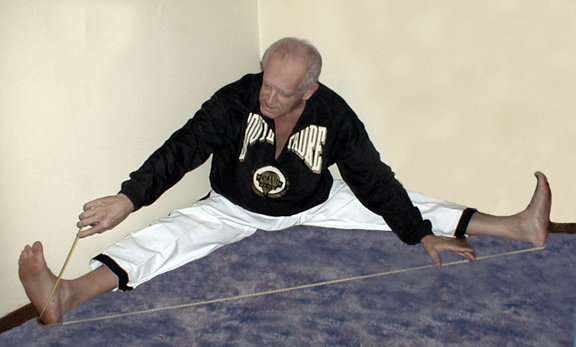
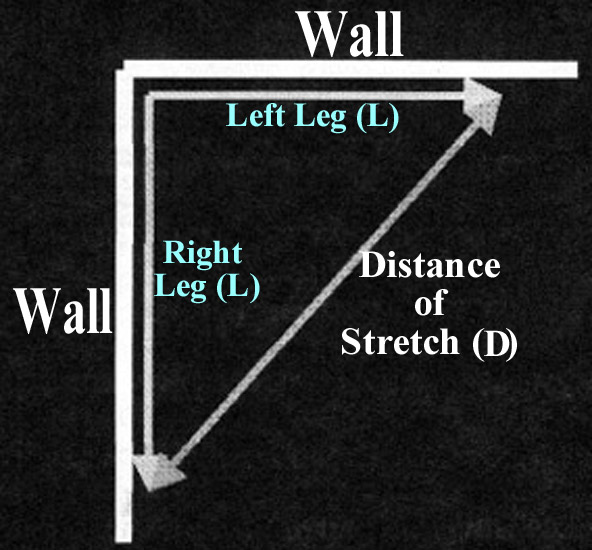
Sit in a corner with your back straight and the outside of each leg touching a wall. While you are in this position, measure the distance between your heels (Fig.2). Then apply the Pythagorean Theorem to determine the length of your leg (L) (Fig. 3). |
|
|
|
|
Fig. 2 |
|
|
|
|
|
|
Note: By definition, the length of your leg is equal to the height of your horizontal kick! |
|
 |
|
|
|
|
Applying the Pythagorean Theorem: |
|
|
 |
|
|
|
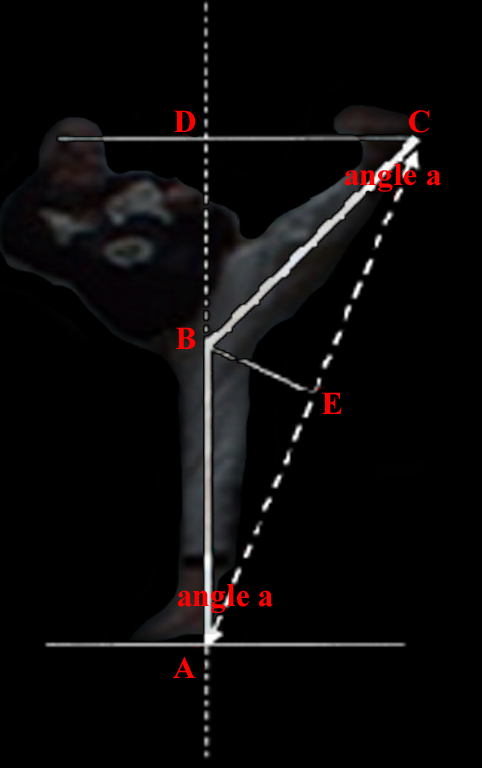
Consider: (Fig. 4) |
|
|
Fig. 3 |
|
|
|
|
|
|
AB is the vertical supporting leg (L) |
|
|
|
BC is the kicking leg (L) |
|
|
|
|
 |
|
|
|
|
|
|
Therefore AB = BC = (L) |
|
|
|
|
|
AC is the distance of the stretch (S) |
|
|
|
|
|
AD is the height of the kick (H) |
|
|
|
|
|
Given: |
|
| Fig. 4 |
|
|
|
|
|
|
|
|
|
(1) |
|
|
|
|
Triangle ABC is an isosceles triangle AB = BC |
|
|
|
(2) |
|
|
|
Therefore triangle ABE = triangle CBE and angle a = angle a |
|
|
|
|
|
(3) |
|
|
|
|
Therefore AE = EC = S/2 |
|
|
|
|
|
|
|
|
Solving for S: |
|
|
|
We seek to determine (H) (the height of the kick) |
|
|
|
|
|
|
|
|
(1) |
|
|
|
|
|
|
|
|
|
|
|
 |
|
|
|
(2) |
|
|
|
|
(1) |
|
|
|
|
|
|
cos angle a = (S/2)/L = S/2L |
|
|
|
|
|
|
|
|
|
|
|
|
|
|
|
|
|
|
|
(2) |
|
|
|
|
|
(3) |
|
|
|
|
|
H = (cos angle a) (S) |
|
|
|
|
|
|
|
|
|
(3) |
|
|
|
|
|
|
|
|
|
|
H = (S/2L) (S) |
|
|
|
|
|
|
|
|
|
|
|
|
|
|
|
(4) |
|
|
|
|
|
|
  |
|
|
|
|
|
|
|
|
|
|