This page shows a design for an "axial design" motor that can run on power from an AC signal
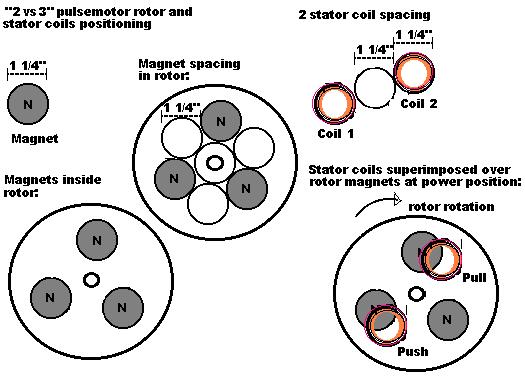
Note that an AC sinewave to input power to the rotor will "pull-push" the EDGES of the magnets in order to spin the rotor.
And the speed in RPMs of the rotor will be determined by the freqeuncy of this AC signal.
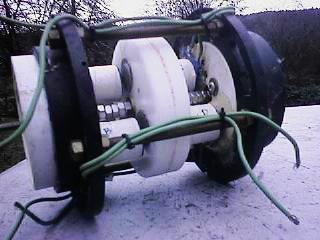
Here is small motor protoytpe, which happens to have two coils on each side of 3 magnet rotor which will run on AC signal; this is a "2vs3" design:
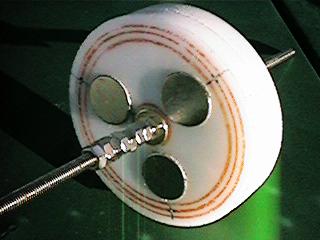
Here is photo 3 evenly space neobydimium magnets imbedded in a delron-plastic rotor.
Other simple stator (stationary) coil configurations designs cna be used.
for example; 3 or 6 coils on each side of rotir spaced at 120 degrees, or 4 coils spaced at 90 degrees are some other ways to construct an axial AC (or DC powered) motor.
Actually any number of coils can be used, even "aircoils" with no cores at all.
Some coils can be "power" coils, some can be pure "generator" coils.
Generator coils would recieve no power input but would create power themselves from the rotor of magnets spinning next to them. (pulse out these coils to resistive load BETWEEN mtoor coil pulses!)
Also the magnets can be oriented N-S too for better AC signal produced from any generator coils on the stator plates.
Rotational latch will be less with "odd vs even" design with ferrous core material, although then all the coils phasing will not be in synch, so each coil would need its own swtihcng and backemf recovery circuit this way.
See circuit diagrams link and also constructing a permanent magnet rotor too here on this site.