| |||
|
|||
|
|
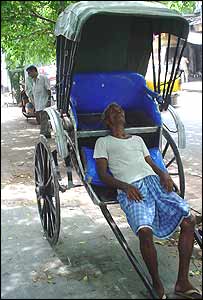
Rickshaw is one of the oldest vehicles of Kolkata. It may be a matter of surprise that the city manages to retain the hackneyed rickshaw along with the present day transport systems like the metro railway. The long parallel bars and colourful seats with the ‘tung tang’ rhythm of the bells, make Rickshaw an emblem of Kolkata tradition.
The vehicle is marked as the most convenient and cheap transport. There are rickshaw pullers who are kept on monthly basis to give a regular trip to the schools. Moreover they are very dutiful and humble. One will have to spend a minimum of five rupees to take a small trip. Before Independence the minimum charge was 1 anna only.
The image the rickshaw pullers – of man pulling man – has always been an uncomfortable one for cosmopolitan, educated Indians. Until now, this discomfort has been balanced by the desire to allow each Indian to maintain a livelihood, no matter how humble.
Rickshaw has inspired poets, artists, novelists and even filmmakers. The most controversial cinema ‘City of Joy’ was based on the traumatised life of a rickshaw puller (cast by Om Puri) and his wife (cast by Shabana Azmi). It is high time to think about the hand pullers. They should have a fixed rate chart, proper trade association to safeguard their interest and health. Kolkata is the city of life, love and humanity – hand driven rickshaws are really tragedies. It reminds us of Ray’s last film ‘Agantuk’ (stranger) – “After 36 years of world tour, coming to Calcutta, I find my city is standing in the same position, man is pulling rickshaw…” Originally brought to India by Chinese immigrants, rickshaws were a major technological advance over the sedan chair, or palanquin, found in 19th century Europe and Asia. Invented in Japan in the 1860s, the jin riki sha required only one puller, compared with the two to four footmen required to carry a single person on a palanquin. Rickshaws became the favored form of transport for the middle and upper classes, not just in India, but across Europe as well. While the hand-pulled rickshaw gave way to the automobile in much of Europe by the turn of the century, and bicycle-powered rickshaws across the rest of the Indian subcontinent, they have stubbornly held their own in the job-hungry streets of Kolkata, long an economic powerhouse and home of good factory jobs, but now merely a magnet for cheap labor from Bihar, Bangladesh, and beyond. |
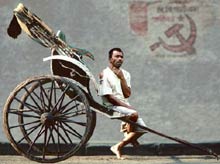 In India, hand-pulled rickshaws are only seen in this city. It doesn’t mean that latest technologies are not welcome in this city. Most of the places in Kolkata have cycle rickshaw and auto rickshaw facility. There are an estimated 24,000 rickshaw pullers in Kolkata. But hand-pulled rickshaws are mostly confined to the traditional localities of this city. Bowbazar, College Street, Hogg Market, Bhowanipur, Kalighat, Shyambazar, Amherst Street, Ballygunge are the localities of ‘Rickshaw Communities’.
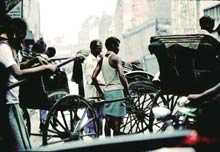 Laxman Ray stands at a crossroads, eyeing four lanes of oncoming traffic. His hair is gray, his feet are bare on the hot asphalt, and his well-muscled arms are balancing the tool of his trade: a hand-pulled rickshaw. Then he makes his dash, banging a bell and pulling a semi-terrified passenger from the mad, honking thoroughfare into a quiet, shop-filled lane.