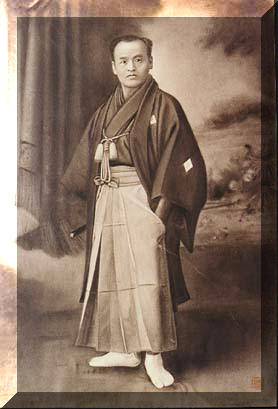
Takeda Sokaku
A young person of 17 years, cries on the tomb of his family and her friends who were exterminated in Aizu. One is Takeda Sokaku Minamoto Masayoshi, that during the war was in Tokyo learning Ju-Jitsu. She was a student of the school Daito Ryu Aiki Jitsu, of the Genji family. Being the last representative of this school and expert in this art, seppuku cannot become (suicide), that must have made not die with his. So by respect to its teacher it must look for a worthy successor and take revenge the death of its family and friends, killing to the officers in charge for the slaughter of Aizu. For it it intensifies its training until becoming a terrible machine to kill. The new one was Meiji was not own of samurai, since the emperor had prohibited the bearing of arms by the street. But Takeda Sokaku was very capable and it fixes them to continue being samurai without exposing itself to being stopped. Despising the European clothes in fashion, its clothes consisted of keikogui (I brought of training) scenery with the standards of its family. Under that comfortable suit it took a camuflajeado arsenal, that consisted somewhat of (dagger) of the waist and another one in pantorrilla, a fan made of filosas sharp laminae and acierated ends, and a metallic cane with a sharpened end and the other with heavy pomo of silver. Sometimes this caused to controversy in its time causing problems. It is said that in an occasion, the Takeda teacher walked by a footpath and found a group of workers who worked in a route, these when seeing it, intercepted it by his traditional clothes that obvious was not in fashion. In that one time the workers were old delinquents or gangster without clan, thus the aggressiveness of these was evident and reacted violently to any provocation. Nevertheless this one reason did not matter to him to the Takeda Sokaku that defended its honor and it faced against all the workers, who were around 50; then all jumped against him, armed of hooks fixed to long woods, iron bars and ends of yari. The first jump,le served to kill with its saber several maleantes, and when it lost its sword in the combat was armed of the utencilios of the workers and continued hurting and killing its enemies; in the end Takeda won.
With the appearance of a calm citizen, it begins to execute to each one of the main officials of the battle of Aizu. Its way to act simple and anonymous era. It followed an official until knowing his habits and daily customs and suddenly, in some solitary way it killed them. To the following morning the police found to the dislocated and bled body. There was other argument that demonstrated the extraordinary ability of Takeda. It says that in an occasion, when passed by the province of Kunamoto, in the island of Kyushu, were with karateka okinawense, this one attacked it with its favorite technique of foot wanting to aim a powerful kick in Takeda, who calmly avoided and blocked with its "tegatana", this one returned to attack with the tibia and Sogaku counterattacked with a blow to the lateral nervous zone of the thorax, between the ribs. Karateka could not morally control the pain that caused such impact to him and withdrew from the defeated battle physical and. In another occasion one ran into in its way with two very well armed bandits, whom they loved to prevent the passage to Takeda, the bandits were hidden strategically; this one approached without perturbing and raised its right foot as if it go to take a step to the other side of one of the bandits who were tended; but at a moment it stepped on strong in the flank breaking to him the ribs (one says that denko used a called technique not satsu) in a fast and clean execution. It took the arc from one of his enemies and shot an arrow that entered just between the eyes (in the Uto point), later volume to one of the bandits and beat to him suddenly in the Kasumi point and with that it finished with the attackers. It was really a machine to kill, that seemed to act without failures. The fact that Takeda never rejected a duel and the custom Kirisute Gomen (to kill any person which it acted against the moral of the Bushido, that is to say, that it needed the respect him or to others) brought many problems to him in its life. For example, it is said that when there was near his way some gang of bandits, instead of moving away, turned aside itself to put in order to the maleantes, thus, Takeda Sokaku felt like person in charge, being samurai, to protect to the humble classes of the near towns. They tell that also it made flee to a whole clan of Yakuzas, by this, whenever Takeda arrived at some town two gifts hoped to him, one of the local police, because they knew that the population would be in calm in its presence, and another one of the Yakuza of the town to avoid any anger of Takeda. They nicknamed the "small demon of Aizu" or "Tengu (demon of short stature and narizón) of Aizu" to be samurai, Takeda could not gain the life more than fighting (it had prohibited to make any other thing by the Bushido code). It taught the Art of the Daito Ryu Aiki Jitsu, and thus besides to gain the life teaching, looked for a worthy successor between its friendships, that were in discord with the new time, and they helped him in its alibis when they suspected him. The government did not take long time in realizing action of Takeda Sokaku, but by lack of tests, they decide to kill it discreetly.
Thus it begins to have many attacks against this that, obvious, are insolvent, thanks to the ideology of Takeda, that was to distrust of everything. It left disarmed, nor never it gave the espalada one him to the crowd; it doubled the corners with care; when he was guest to some place, first it reviewed the gardens and all the sites and hidden entrances that were, until it took its own food. They never surprised it; finally they leave it peacefully, since the hunters of this, often were the hunted ones. Thus one retires to a distant farm taken care of by its followers. It follows "Morihei Ueshiba"
MORIHEI UESHIBA And SOKAKU TAKEDA
MORIHEI UESHIBA and SOKAKU TAKEDA by Stanley To Pranin. (Translated of the magazine Aiki News, Num.94, pags. 39 and 40)
Few people have investigated so thoroughly the origins of the aikido one like the publisher of Aiki News Stanley Pranin. In this new series originally written for publication in the Japanese magazine Wushu, Pranin comments some of the important moments but of the race of the founder of the aikido one, Morihei Ueshiba, through its association with its teachers and their main students. This first chapter analyzes the important one but little understood relation between Morihei Ueshiba and its teacher Sokaku Takeda.
Permítanme to begin to make the categorical affirmation of which the greater technical influence in the development of the aikido one is jujutsu Daito-ryu. This art, of which it is said that it is a continuation of the martial tradition of the Aizu clan, that dates several hundreds from years, was propagated in many zones of Japan during the Meiji periods, Taisho and the principle of the Showa by the famous martial artist Sokaku Takeda. Known as much by its capacity in the martial arts like by the severity of its character, Takeda had but of an occasion to use its techniques in encounter of life or death. Takeda was fifty and four years old when Morihei Ueshiba knew him for the first time in the inn of Hisada in Engaru, Hokkaido towards end of February 1915. This one encounter marked the principle of a long, stormy association but, in last productive instance that would last but of twenty years. The initial exhibition of Ueshiba to the practice of Daito-ryu included three seminaries, of ten days of duration each one, that concluded the 4 of April of the same year. The annals of the Daito-ryu show that it participated in other three seminaries of Takeda in 1916. Ueshiba also invited to Takeda to its house where it received deprived instruction of intensive form in the technical refined ones of Daito-ryu. Unfortunately few details are known on these studies and their duration. Ueshiba marched Hokkaido in December of 1919 as a result of a telegram definitively in which it inquired to him that the health of its father was in critical state. It left his house, a modest wood structure, to Takeda and returned to his native city of Tanabe. During the way it made a shutdown in Ayabe, the center of the Omoto religion, to say by the improvement of his father. Fué there where it knew Onisaburo Deguchi, another great influence on its life. When it arrived at his home to find his father already passed away, Ueshiba decided to change its family, who then was composed by her woman, her mother and two children, to Ayabe where they would fix his residence as of spring of 1920. At the request of Deguchi, Ueshiba opened its first dojo in its house, known like the Juku Ueshiba, and gave to classes of Daito-ryu to students members, in its majority, of the Omoto religion. Two years but late in April, Sokaku Takeda appeared in Ayabe with its woman, a daughter, and her son of six years, Tokimune, the present director of the Daito-ryu. The question of if Takeda car were invited or if it came at the request of to Ayabe Ueshiba seems at the moment of difficult resolution and the official versions of the schools of Daito-ryu and Aikido differ considerably. What if we know it is that Takeda remained in Ayabe during five months instructing to the students of dojo Juku Ueshiba. During this Ueshiba period dairi was decorated with the certificate kyoju that conferred the official status to him of instructor of Daito-ryu. It seems to be, and he is not surprising, which Takeda and the spiritual Deguchi did not get along the one with the other, although the leader of the Omoto religion if a picture painted like goodbye gift presented/displayed to Sokaku a saber by hand. In any case all the indications exist of which the relation between the tiny but intrepid Sokaku and its but famous student, Morihei Ueshiba, was full of tensions during the period of Ayabe. After the march of Takeda in September of 1922, both they seem to have found of infrequent form although Takeda if it visited Ueshiba in several occasions in dojo of this one last one in Tokyo. Ueshiba would be gotten to establish like a masterful well-known of jujutsu in Tokyo whereas Takeda mainly continued traveling by all Japan giving seminaries to prominent people like judges, military officials of police, officials, etc. Although Ueshiba and Takeda had little direct bonding during this one time, if they maintained correspondence. Ueshiba, at that time masterful crediting of Daito-ryu, gave degree certificates as late to its direct students as 1937. Between the students who received diplomas of Daito-ryu de Ueshiba are Kenji Tomiki, Minoru Mochizuki, Rinjiro Shirata and Gozo Shioda. In terms of modern psychology, the association between Morihei Ueshiba and Sokaku Takeda "love-hatred" could be characterized like a relation. It is difficult to find too many facts historical since surviving witnesses of these encounter practically do not exist. They exist, even now, many loaded of emotion and net contradictory explanations on the part of the successors of Takeda and Ueshiba. It is clear that Ueshiba also professed a great respect by the technical ability of Takeda and that this one last one considered to the founder of the aikido one like one of its promising students but. I suspect that the root of the problems between these two personages was based in the demanding personality of Sokaku, the independent and spiritual attitude of Ueshiba and the vague economic agreements concerning the obligations of Morihei like credited instructor of Daito-ryu. The page of eimeroku of dated Daito-ryu 15 of September, 1922, in that the certification of kyoju is conferred to him to Ueshiba dairi affirms clearly that this one would have the obligation to pay the three amount of yen to Sokaku by each student who registered in his dojo. But late there would be mutual recriminaciones on impropiedades in financial subjects and the information on their last meetings keep awake that these agreements never got to be solved. But Takeda conferred the status of kyoju dairi to a good number of individuals, including Tasiso Horikawa, Yukiyoshi Sagawa, Kotaro Yoshida, Kotaro (Kodo) Horikawa, and Takuma Hissa (Kiyoshi Watatani lists a total of twenty-nine in its Bugei Ryuha Dai Jiten), and obviously, all these had had the responsibility to pay the same amount to Sokaku whenever they taught Daito-ryu. I consider very doubtful that Ueshiba was the unique one in having difficulties with Takeda as for economic subjects. In conclusion, I would like to mention some of the positive consequences of the connection between these two prestigious personages of the budo of century twenty. First, the technical debt of the aikido one to the Daito-ryu is immense. It is difficult to find a movement of aikido that it does not originate in the Takeda form of jujutsu. On the other hand the survival, dissemination and future projection of the Daito-ryu as a Japanese traditional martial art virtually has been guaranteed by the tremendous international success of the modern aikido one. It is but: Often I have heard medical instructors of Daito-ryu call "aikido", of generic form, to its own art! In any case, and from an historical perspective, the two martial arts irrevocably are interlaced and being malentendidos, optical partisan and recriminaciones will continue it in spite of that have been perpetuated until the present moment. With time, and according to our understanding of passed facts is increased, believes that it will be possible to contemplate the relation between aikido and jujutsu Daito-ryu of an objective form but and which the mutual debt contracted by these arts will be perceived but easily.
ART. EXTRAIDO OF INTERNET
BACK