

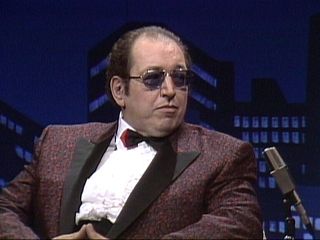
1937-1999

The 6-foot-6, 400-pound Marella turned to the
pro wrestling game in 1960
when a promoter offered him $500 per week
to don the tights. As Gorilla Monsoon, Marella soon shared world tag-team
titles with Walter "Killer" Kowalski and "Cowboy" Bill Watts. Playing a
villain's role at the time, Marella gained notoriety for his feud with
longtime champ Bruno Sammartino.
Marella's career in the ring lasted until the
early 1980s, when he became
one of the World Wrestling Federation's top
ringside television announcers.
He co-hosted WWF telecasts at a time when
the high-flying entertainment
genre was booming in popularity. Marella frequently
shared the microphone with former wrestler Jesse "The Body" Ventura, with
whom he often argued over the importance of fair play in the ring. Ventura
now is governor of Minnesota.
The younger generation of wrestlers was honored
to have the rotund Marella
analyze their moves and holds, said fellow
pro wrestler King Kong Bundy.
"He was somebody who knew the business," Bundy
said. "A great guy, a real class act all the way." Marella also wrote a
weekly pro wrestling column for the now-defunct Philadelphia Bulletin.
A son, Joey Marella, became a WWF referee in
the 1980s. He died in an auto
accident in Burlington in 1994. Thereafter,
Robert Marella appeared on
television less frequently. "When his son
got killed in a car accident, I think that took a lot out of him," King
Kong Bundy said.
Marella did serve as interim president of the
WWF in 1997 -- at a time when
the industry admitted openly that the outcomes
of its matches are scripted.
Heart problems forced Marella to scale back
his work with the WWF. He also
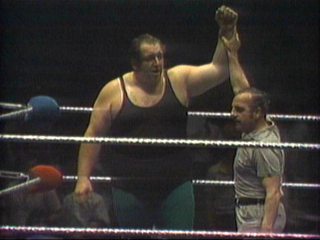
suffered from diabetes in recent years. Below
is a picture of Gorilla being declared the winner of a match.
_______________________
He was one of the early villains of the wrestling
ring, a huge man with such
a fearsome visage that even had fans quaking
at the sight of him. "No one in the audience laughed at his gimmick," said
a wrestling magazine editor. "They were actually both afraid and respectful."
But under the ferocious mien he presented to wrestling fans and opponents,
Gorilla Monsoon was a pussycat, a family man who wound up his career in
the wrestling field as an announcer and writer.
WOW Magazine editor Bill Apter described the 350-pound giant as an excellent "heel" in the wrestling ring. "He was so 'over' in the early '60s," Apter said. "His fierce growl and full beard persuaded people to take his 'gorilla' persona very seriously. "Unlike the heels of today, the Gorilla Monsoon image was genuinely frightening." He was a huge, flamboyant presence in the ring, and his feuds with World Wrestling Federation champion Bruno Sammartino are the stuff of legend. At one point, he bodyslammed boxing champ Muhammad Ali, feeding the bad-boy image he had fashioned for himself.
A native of Buffalo, N.Y., the 6-foot-4 Gorilla
became a major wrestling
star almost as soon as he first entered the
ring in 1960. His character was billed as coming from Outer Mongolia, and
it was a sensation. Even as a raw rookie, he stunned audiences with his
ponderous bulk and bad attitude.
Wrestling expert Georgiann Makropoulis, a
longtime friend of the Marella
family, cites two matches as Gorilla's best.
There was a May 11, 1964, Madison Square Garden
main event against
Sammartino that went to an 1 hour, 20-minute
draw, ended only by a curfew.
And in Jersey City, N.J., on Oct. 4, 1963,
Monsoon actually defeated
Sammartino, but as the decision was a disqualification
due to excessive
bleeding, Monsoon did not win the WWF championship.
Monsoon never held many singles titles, but two reigns as a WWF U.S. tag-team
champion stick out. With Walter "Killer" Kowalski he was champion from
November to December 1963, and with Cowboy Bill Watts, he held the belts
from April to July 1965. He later doubled as an agent/coordinator for WWF
tours. But according to Apter it wasn't the same for the Gorilla.
"As the business progressed, the heels of pro
wrestling became more of a
laughing matter to many fans," said Apter.
"What Monsoon brought to the
table was no longer to be." His character
was a classic one. His feuds with Sammartino drew huge gates, and their
matches were always the kind that kept audiences panting for more. "You
had no doubt in your mind that wrestling was real when these two battled
each other. It was 'work' at the finest level."
After his ring career ended in 1980, Monsoon
became a top wrestling
broadcasting commentator. He helped
break in ex-wrestler Jesse "The Body" Ventura, now the governor of Minnesota,
behind the microphone.
Monsoon and Ventura became a memorable team.
They announced the first
Wrestlemania in 1985, and they went on to
do several more "Manias" as the
World Wrestling Federation's lead announcing
team.
Monsoon voiced countless WWF shows at arenas like Madison Square Garden in New York and the Spectrum, where he worked with local announcer Dick Graham on cards that were broadcast on PRISM.
He will always be remembered as to how extremely helpful and encouraging Monsoon was. He made difficult situations easy to master.
While Monsoon was an announcer, he also became
a wrestling journalist. In
the late '70s, until the paper folded in December
1981, Monsoon wrote a
weekly column about pro wrestling for the
Philadelphia Journal. He was named to the WWF Hall of Fame in 1994, the
Hall's second year of existence. During the '90s Monsoon acted as the WWF
president on its TV
shows for much of the decade.
Monsoon's son, Joey Marella, became the lead referee for the WWF during the '80s and '90s. Joey died in an auto accident in Burlington, N.J., on July 4, 1994.
Gorilla was also a former schoolteacher from Rochester, N.Y.,
"He was an amazing guy," Sammartino said yesterday. "We once wrestled for one hour and 30 minutes at Madison Square Garden, and he weighed more than 400 pounds at the time. This guy, for his size, was quick and had great moves." Their famous 90-minute bout ended in a draw. Sammartino and Mr. Marella collided in the ring dozens of other times.
Mr. Marella, called "Gino" by fellow wrestlers,
continued to wrestle until
the early 1980s, when he became one of the
World Wrestling Federation's top
ringside television announcers. His trademark
line when calling a match was: "It's pandemonium here in the World Wrestling
Federation."
Sammartino remembered that Mr. Marella was
diagnosed with diabetes while in
his late 30s, yet he continued to work the
WWF circuit, then mainly confined
to the Northeast.
He said Mr. Marella's emotional state was wrecked
when his son, Joey, died
in an automobile accident in 1994. He retreated
after that, appearing less
frequently on television, and at pay-per-view
events and arena shows.
"Let's just say the diabetes may have helped
kill Gino, but the death of his
son absolutely destroyed him," Sammartino
said. "He could not accept it."
Despite his bulk and fearsome ring name, Mr.
Marella's neighbors in
Willingboro, N.J., remembered him as a loving
father who prided himself on
his lasagna. He even liked to play Santa Claus.
"He was the kindest, gentlest person you would ever want to meet," said
Willingboro Solicitor William Kearns. "I know he was a good husband and
he was a darned good guy," Sammartino, said.
Mr. Marella was a "good guy" in the early years
of his pro wrestling career
but didn't hit it big until his Gorilla Monsoon
gimmick began in 1963. The
story line said he was born on an isolated
farm in Manchuria, earned his
keep with a gypsy caravan wrestling bears,
arrived in America speaking no
English, and ate raw meat washed down with
the blood of his victims. "In short, I was a guy the fans loved to hate,"
he said.
Mr. Marella wrestled at Madison Square Garden
"hundreds of times," including dozens of main events, often classics against
popular world champion Bruno Sammartino.
For being such a convincing bad guy in the
ring, Mr. Marella often paid a
price. He once said, "I've been stabbed, jabbed,
poked and spat upon. One
night in Puerto Rico, I got nailed in the
head by a flying brick. But nothing hurts quite as much as having somebody
use your back to snuff out a big fat burning cigar."
Mr. Marella's most publicized fling in the
ring was a confrontation with
Muhammad Ali in the summer of 1976 in Philadelphia.
It made newspapers and TV news reports around the world. "Ali was trying
to get pubicity for an upcoming gimmick fight for a fortune against a Japanese
wrestler (Antonio Inoki) and he apparently wanted to use me as a warmup
for publicity," Mr. Marella recalled. "I was in the ring, waiting for my
regular match, when Ali jumped through the ropes, kicked off his shoes,
tore off his shirt and began screaming at me. I picked him up and tossed
him to the mat with a Giant Swing. But I gave him a break and didn't use
y Manchurian Splash." Mr. Marella insisted the episode was not contrived:
"I never saw him (Ali)
before and haven't seen him since."
A shrewd businessman, Mr. Marella 20 years
ago predicted that pro wrestling
would someday enjoy a mammoth revival on cable
TV. He was a major player in hat becoming a reality as a minor partner
and confidant of WWF boss Vince cMahon Jr.
Mr. Marella often visited his parents and other
relatives in Rochester and
was proud of his part in building up his hometown.
"In my college years, I worked heavy construction in Rochester," he said.
"I helped put up buildings at Kodak, RIT and the University of Rochester.
That's my lasting contribution."
THE REAL GORILLA MONSOON
(Philadelphia Inquirer, Oct. 9, 1999)
By Bill Lyon
He was the better part of 400 pounds when he
slid, with surprising agility,
into the diner booth. The waitress braced
for his order, wondering if she
had enough paper. "Toast, dry," he said. "Two
eggs, lightly scrambled. Cup of hot tea, lemon on the side. Please." She
waited for Page 2. "No, that's it," he said. And he smiled. "My tights
are getting too tight," he said.
His name was Gorilla Monsoon, and he had just
finished his evening's work,
which consisted of picking up other large
men and helicoptering them over
his head and then depositing them on the canvas
with gleeful force, laughing
fiendishly as they writhed about in apparent
death throes.
He would gouge eyes, kick groins, throttle
windpipes, and commit assorted
other physical indignities. And then he would
shower and change clothes and
change into Robert Marella of Willingboro,
N.J., a gentleman and a good and gentle man.
He was roughly the size of a Clydesdale, so
it was always something of a
shock to people who were introduced to him
to find out how approachable he
was, how considerate and accessible, how genuinely
appreciative that they
had come to watch him.
Some of the recalcitrant little boors who make
money by the bale in the
allegedly legitimate sports and who have no
time for the people who make
their wealth possible could have learned from
Gorilla Monsoon's example.
Perhaps it is strange, recommending a professional
'rassler as someone
worthy of emulation, but the fact is that
Gorilla Monsoon had an abiding
respect for his craft, took pride in his performance,
never shortchanged the
paying public, treated people with courtesy,
and played hurt almost all the
time. Isn't that supposed to be pretty much
the essence of sport?
Bob Marella will be laid to rest today. He
died, at his home, gone much too
soon at 62. He wrestled for more than
20 years, and, by his accounting, had
more than 8,000 matches. Even with scripts
and even though he and his foes
were as much thespians as athletes, that amounted
to an impressive pile of
punishment, of body slams both administered
and received.
"I always tell people who think what we do
is all fake that, when I try to
get out of bed the next morning, those aches
and bumps sure do feel real,"
he said.
He was the villain most of the time, which
was most assuredly not
typecasting. But he was credible -- at least
in the eyes of those wrestling
loyalists who are willing to suspend belief
and who booed and hissed him.
And working the audience into a proper froth
is the villain's job.
"You know you've done your job when the little
old ladies want to stab you
with their knitting needles," Gorilla Monsoon
said proudly.
He was a barnstormer. He wrestled in cold,
echo-chamber armories and smoky
VFW halls. Sometimes the fans sat on metal
folding chairs, and some nights
there would only be two rows of those chairs.
Didn't matter. The show went
on anyway. There was a sense of obligation.
"Plus," Gorilla Monsoon said, smiling, "we
needed the money, even if it was
only a few bucks."
His was a time in pro wrestling before the
current era of glitz and
profanity, glitter and obscenity, of how-do-we-top-this-outrageousness
that
escalates into ever more dangerous stunts,
paralysis and even death.
Gorilla Monsoon was privately distressed at
what they have done to his
craft, and he would talk about how he perceived
that they had perverted it.
Frequently, he would square off against Bruno Sammartino, who was a hugely popular hero, and he often was paired with Killer Kowalski in tag-team matches. One of his contemporaries -- and one of the few men who could make him seem small -- was Haystack Calhoun, who weighed an alleged 600 pounds and filled out his specially made bib overalls.
When the pounding caught up with him, Gorilla
Monsoon traded his tights in
for a TV microphone. That was in the early
1980s. He campaigned zealously
for his sport.
"And it is a sport," he would argue. "We entertain.
We don't hurt anybody.
We don't cheat anybody. We take people's minds
off their troubles. We give
'em a night out and someone to cheer and someone
to boo." He didn't mind being the one booed. Not as long as they kept coming.
As Bob Marella, he got his degree from Ithaca
College and worked as a
teacher. You guess that no one nodded off
in his classes. And then, in 1960, a promoter discovered him. The promoter
offered him $500. Gorilla Monsoon was born. "You could buy a lot with that,"
he said.
Except class. You still can't buy that.
Gorilla already had it.
________________________
