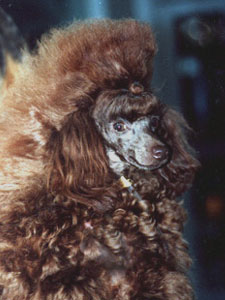
Toyvillakoira-narttu Masterpiece Brown Misterio.
Omistaja: Mirta Stati, Argentiina.
Female Toy Poodle Masterpiece Brown Misterio.
Owner: Mirta Stati, Argentine.
© Mirta Stati, kennel Masterpiece
Alkuperämaa: Ranska
Ryhmä: 9
FCI:n numero: 172f
Hyväksytty: FCI 12.12.1991
SKL-FKK 16.1.1993
Origin: France
Classification FCI: Group 9 Companion and Toy Dogs. Section 2 Poodle. Without working trial.
Date of publication of the original valid standard: 12.12.1991
KÄYTTÖTARKOITUS: Seurakoira.
YLEISVAIKUTELMA: Villakoira kuuluu seurakoiriin. Se on sopusuhtainen koira, jolle on tyypillistä kihara tai nyörimäinen turkki. Villakoira on älykäs, aina valpas ja toimelias. Se on rakenteeltaan tasapainoinen ja tekee tyylikkään ja ylpeän vaikutuksen. Liikkeet joustavat ja keveät. Villakoira ei koskaan saa liikkua maatavoittavasti eikä pitkin askelin.
LUONNE: Villakoira on tunnetusti uskollinen, oppivainen ja helppo kouluttaa. Siksi se on erityisen miellyttävä seurakoira.
UTILIZATION: Companion dog.
GENERAL APPEARANCE: Dog of harmonious type, of medium proportions, with characteristically frizzy coat, curly or corded. Appearance of an intelligent animal, constantly alert, active, harmoniously built and giving an impression of elegance and pride.
BEHAVIOUR/ TEMPERAMENT: Dog reputed for his faithfulness, willing to learn and being trained, which makes of in a particularly pleasant companion dog.
PÄÄ: Hienopiirteinen, suoralinjainen ja suhteessa runkoon. Pään pituuden tulee
olla hieman yli 2/5 koiran säkäkorkeudesta. Se ei saa olla raskas eikä massiivinen, eikä myöskään liian kevyt. Pään rakenteen tulee näkyä ihon alta.
KALLO: Hyvin muodostunut. Sen leveys on vähemmän kuin puolet pään pituudesta.
Linjat kallon sivuista kuonon kärkeen muodostavat 16 - 19°:n kulman. Kallo on ylhäältä katsottuna soikea pituussuunnassa ja sivulta katsottuna hieman kupera.
Kallon ylä- ja alalinjat ovat aavistuksen eri suuntaiset.
KULMAKAARET: Kohtuullisen ulkonevat, pitkien karvojen peittämät.
OTSAUURRE: Silmien välistä leveä ja kapenee kohti niskakyhmyä, joka on erittäin
korostunut (kääpiö- ja toyvillakoirilla se saa olla vähemmän korostunut).
OTSAPENGER: Hyvin vähäinen.
KIRSU: Korostunut ja hyvin kehittynyt, sen pystyprofiili on suora. Sieraimet ovat avoimet. Kirsu on musta mustilla, valkoisilla ja harmailla koirilla, ruskea ruskeilla koirilla, aprikooseilla väri voi vaihdella eri tummanruskean sävyistä jopa mustaan. Aprikooseilla mustaa väriä ei kuitenkaan aseteta etusijalle, mutta se hyväksytään mahdollisen pigmenttikadon välttämiseksi.
KUONO-OSA: Ylälinja on suora. Kuonon pituuden tulee olla suunnilleen 9/10 kallon pituudesta. Alaleuan molemmat sivut ovat lähes yhdensuuntaiset. Kuonon
tulee vaikuttaa vahvalta, tyylikkäältä, mutta ei terävältä. Kuonon alalinjan muodostaa alaleuka eikä ylähuulen reuna.
HUULET: Kevyet, kuivahkot ja keskipaksut. Ylähuuli tiiviisti alahuulta vasten
riippumatta sen yli. Huulet ovat mustilla, valkoisilla ja harmailla koirilla mustat, ruskeilla tummat, aprikooseilla väri voi vaihdella eri tummanruskean sävyistä aina jopa mustaan saakka. Aprikooseilla mustaa väriä ei aseteta etusijalle, mutta se sallitaan. Suupielet eivät saa olla korostuneet.
PURENTA: Leuat normaalisti kehittyneet, hampaat vahvat. Yhden poskihampaan
puuttumisesta ei saa rangaista näyttelyssä eikä jalostuksessa.
POSKET: Eivät saa olla ulkonevat, vaan luustoa myötäilevät. Kaaret silmien alla
ovat meislatut, eivät kovin täyteläiset. Poskilihakset eivät ole kovin voimakkaasti kehittyneet. Poskipäät ovat vain vähän ulkonevat.
SILMÄT: Ilme on tulinen ja silmät ovat aavistuksen vinot, otsapenkereen korkeudelle sijoittuneet. Silmäaukot mantelin muotoiset. Silmät ovat mustilla, valkoisilla, harmailla ja aprikooseilla koirilla mustat tai erittäin tummanruskeat, ruskeilla villakoirilla silmät voivat olla tumman meripihkan väriset.
KORVAT: Melko pitkät, poskenmyötäiset ja kiinnittyneet kirsun yläreunasta silmän ulkoreunan ohi kulkevaan kuviteltuun linjaan. Ne ovat litteät, kiinnityskohdan jälkeen levenevät, kiharan ja hyvin pitkän karvan peittämät ja kärjistään pyöristyneet. Korvalehtien tulee ulottua suupieliin saakka.
HEAD: Distinguished, rectilinear, in proportion with the body. Its length must be a little more than 2/5 of the dog’s height at the withers. Without heaviness or massiveness, but neither being too fine. The chiselling must be evident under the covering skin.
SKULL: Well shaped; its width is less than half the length of the head (the axes form an axial-facial angle of about 16° to 19°). The whole of the skull seen from above, appears oval in lengthwise direction and in profile slightly convex. The longitudinal axes are slightly divergent.
SUPERCILIARY ARCHES: Moderately pronounced, covered with long hair.
FRONTAL FURROW: Broad between the eyes, narrowing towards the occiput, which is very pronounced. (In the miniatures it can be less pronounced).
STOP: Very slightly marked, as in dogs of medium proportions.
NOSE: Pronounced and developed, with vertical profile; open nostrils. Black nose in the black subjects, the whites and the greys; brown in the brown subjects; in the apricot subjects the brown colour within the whole range of dark brown, may be going up to black, without this last colour being preferred but accepted to avoid possible depigmentation.
MUZZLE: Upper profile in straight line; its length is about 9/10 of the skull’s length. The two branches of the lower jaw extending almost parallel. The appearance of the muzzle is solid, elegant, but not pointed. The lower profile of the muzzle is given by the lower jaw and not by the edge of the upper lip.
LIPS: Lightly developed, rather tight, of medium thickness, the upper lip resting on the lower lip, without falling over it. Black in the black, white and grey subjects; pigmented in the browns; in the apricot subjects coloured within the range of dark brown maybe going up to black, without this last colour being preferred, but accepted. The corner of the lips must not be pronounced.
JAWS/ TEETH: Fitting normally, teeth solid. The absence of one M1 or M2 (molar 1 or 2) in the upper and of one M2 or M3 in the lower jaw would not be penalised in judging or in a breeding selection.
CHEEKS: Not prominent. shaped by the cheek bones. The sub-orbital arches chiselled and only slightly filled in. The masticatory muscles, anatomical base of the cheeks, lightly developed; the zygomatic arches very slightly pronounced.
EYES: With keen expression, placed at the level of the stop and slightly slanting. The outline of the eyelids gives the eyes an almond shape. Black or very dark brown for the black, the white, the grey and the apricot poodles; the eyes may be dark amber for the brown subjects.
EARS: Quite long, falling alongside the cheeks, set on at the extension of a line starting from above the nose and passing below the outer corner of the eye, flat, broadening after the base and rounded at the tip, covered with very long wavy hair. The Poodle whose ears do not reach the corner of the lips cannot obtain the qualification «excellent».
KAULA: Vahva, niskan jälkeen kevyesti kaartuva, keskipitkä ja sopusuhtainen.
Koira kantaa päätään ylväästi pystyssä. Ei löysää kaulanahkaa. Kaula on poikkileikkaukseltaan soikea ja päätä lyhyempi.
RUNKO: Säkä ei ole kovin voimakas. Villakoiran runko on yleisvaikutelmaltaan
sopusuhtainen. Rungon pituus on yleensä säkäkorkeutta suurempi.
ETURINTA: Normaali, rintalastan pään tulee olla hieman esiintyöntyvä ja melko
korkealla, jotta koira kantaisi päätään pystyssä luontaisen ylväästi.
RINTAKEHÄ: Ulottuu kyynärpäihin. Sen leveys on 2/3 syvyydestä (mitattuna
selkärangasta rintalastaan). Lapojen takaa mitattuna tulee rintakehän ympärysmitan olla vähintään 10 cm koiran säkäkorkeutta suurempi. Rintakehä on soikea, selästä leveä.
SELKÄLINJA: Tasainen. Selkä lyhyt, ei köyry eikä notko. Säkä suunnilleen samalla korkeudella kuin lantio.
LANNE: Kiinteä ja lihaksikas.
VATSALINJA: Nouseva, ei kuitenkaan kuten vinttikoiralla.
LANTIO: Pyöristynyt, mutta ei luisu.
HÄNTÄ: Kiinnittynyt melko korkealle samaan linjaan lanneosan kanssa. Häntä
typistetään korkeintaan 1/3 tai puoleen hännän luonnollisesta pituudesta kiharakarvaisella villakoiralla. Pitkä ja hyvin kannettu häntä ei kuitenkaan ole virhe. Häntä voidaan jättää täyteen pituuteen nyörivillakoirilla. Koira kantaa häntäänsä liikkeessä viistosti koholla.
NECK: Solid, slightly arched after the nape of the neck, of medium length, well proportioned. The head carried high and proudly. No dewlap. Neck of oval cross section; its length is inferior to that of the head.
BODY: The general appearance of the body of a poodle is of good proportions, the length of the body generally exceeding the height at the withers.
WITHERS: Moderately developed.
BACK: Short harmonious topline. Neither roach nor saddle back. The height from the ground to the withers being more or less the same as that from the ground to the rump.
LOINS: Firm and muscular.
CROUP: Rounded but not falling away.
CHEST: Descending down to elbow level, the width is equal to 2/3 of its depth (from spinal column to sternum). The thorax perimeter measured behind the shoulders must be at least 10 cm more than the height at the withers.
RIBS: Rib cage oval, broad in the dorsal part.
FORECHEST: Normal for a dog of medium proportions; the extremity of the sternum must be slightly prominent and set rather high which causes a higher, easier and more noble head carriage.
BELLY AND FLANKS: Tucked up but not excessively so.
TAIL: Set quite high at the level of the loin. To be docked by a third nearest to the body, or at the half of its natural length in the curly coated poodles. However, a long and well carried tail is not a fault. It can be kept in its full length in the corded coat poodles. The tail is raised obliquely in action.
ETURAAJAT: Lavat ovat viistot ja lihaksikkaat. Lapaluu muodostaa olkavarren
kanssa 90-110°:n kulman. Olkavarsi ja lapaluu ovat yhtä pitkät. Eturaajat ovat
täysin suorat ja yhdensuuntaiset, tyylikkäät, lihaksikkaat ja hyväluustoiset. Kyynärpään korkeus maasta on 5/9 säkäkorkeudesta.
RANNE: Yhdensuuntainen muun eturaajan kanssa.
VÄLIKÄMMENET: Vahvat, ei raskaat ja sivuilta katsoen melkein suorat.
TAKARAAJAT: Reidet ovat hyvin lihaksikkaat ja voimakkaat. Takaraajat ovat
takaa katsottuina yhdensuuntaiset. Lihakset ovat kehittyneet ja selvästi erottuvat. Kinner melko hyvin kulmautunut. Reisi, polvi ja kinnerkulmausten tulee olla melko selvät. Suoria takaraajoja tulee välttää, sillä niihin liittyy joskus ei toivottu luisu lantio. Kinner ja välijalka ovat suorat. Villakoiran tulee syntyä ilman takakannuksia.
KÄPÄLÄT: Melko pienet, tiiviit, lyhyen soikion muotoiset. Varpaat ovat hyvin
kaareutuneet, jäntevät, kiinteät ja niissä on räpylät. Ne ovat kohtisuorassa lujaan ja paksuun polkuanturaan nähden. Kynnet ovat mustilla ja harmailla koirilla mustat, ruskeilla mustat tai ruskeat, valkoisilla kynsien väri voi vaihdella sarveisaineen värin mukaisesti aina mustaan asti ja niiden tulee vastata muuta pigmenttiä. Valkoiset kynnet ovat virhe. Aprikooseilla kynsien väri voi vaihdella eri tummanruskean sävyistä jopa mustaan. Aprikooseilla kynsien mustaa väriä ei kuitenkaan aseteta etusijalle, mutta se hyväksytään.
LIIKKEET: Joustavat ja keveät. Villakoira ei koskaan saa liikkua maatavoittavasti eikä pitkin askelin.
IHO: Iho on kimmoisa, kiinteä ja pigmentoitunut. Mustilla, ruskeilla, harmailla ja aprikooseilla koirilla tulee olla turkin värin kanssa yhdenmukainen pigmentti. Valkoisilla tulee pyrkiä hopenväriseen ihoon, mutta pigmentti ei saa muuttaa turkin väriä. Joillakin valkoisilla koirilla on vaalea iho, jossa on tummia läiskiä -ei ainoastaan sisäosissa, mikä on tavallista, vaan muuallakin rungossa. Tätä ei tule pitää virheenä. Yleispigmentin tulee olla erittäin vahva mm. silmäluomissa, kirsussa, huulissa, suupielissä, kitalaessa, limakalvoissa, luonnollisissa aukoissa,
kiveksissä ja polkuanturoissa. Pigmentin tulee olla mustilla, valkoisilla ja harmailla koirilla musta, ruskeilla tummanruskea ja aprikooseilla värin tulee olla niin yhtenäinen ja tumma kuin mahdollista, vaihdellen eri tummanruskean sävyistä jopa mustaan. Aprikooseilla mustaa väriä ei kuitenkaan aseteta etusijalle, mutta se hyväksytään mahdollisen pigmenttikadon välttämiseksi.
FOREQUARTERS: Front legs perfectly straight and parallel, elegant, well muscled with good bone. The height from the elbow to the ground is of 5/9 of the height of the withers to the ground.
SHOULDERS: Sloping, muscular. The shoulder blade forming with the upper arm an angle of 90° to 110°.
UPPER ARM: The length of the upper arm corresponding to that of the shoulder blade.
PASTERN JOINT: Continuing the front line of the forearm.
PASTERNS: Solid, not massive, and almost straight seen in profile.
FEET: Rather small, firm, of a short oval shape. The toes are well arched, strong, compact, webbed, resting firmly on a hard and thick pad. The nails are black on blacks and greys, black or brown on the browns, on the whites the nails may be coloured according to the whole range of horn colour going up to black and must correspond with the pigmentation. The white nails remain a fault. In the apricot dogs, they must be coloured according to the whole range of dark brown up to black, without this last colour being preferred, but accepted.
HINDQUARTERS: Hind legs parallel, seen from behind, muscles well developed and well visible. The joint with the hock is fairly angulated. The angles: coxal-femoral, tibial-femoral and tibial-tarsal must be sufficiently pronounced so as to avoid straight quarters which sometimes produce an undesirable slanting rump.
THIGHS: Well muscled and robust.
HOCK JOINT AND HOCK: Vertical. The poodle must be born without dewclaws on the back legs.
FEET: See forequarters.
GAIT/ MOVEMENT: Light and springy, never flowing and extended.
SKIN: Supple, not loose, pigmented. The black, the brown, the grey and the apricot poodles must be pigmented according to their coat colour; for the whites, the silvery skin is desirable, but the pigmentation must not alter the coat colour. There are also white poodles whose light skin is spotted, not only on the inner parts, which is frequent, but also on the rest of the body; this does not constitute a fault. The general pigmentation in its greatest intensity is desirable on: eyelids, nose, lips, gums, palate, mucous membranes, natural orifices, scrotum, pads. It must be black in the black, the white, and the grey dogs; dark brown in the browns; in the apricots, it must be as uniform and as dark as possible, according to the whole range of dark brown which can go up to black, without this last colour being preferred, but accepted to avoid a possible depigmentation.
KARVAPEITE: Kiharakarvaisella koiralla karva on runsasta, hienolaatuista,
villavaa ja runsaasti kihartuvaa. Karva on joustavaa ja kädellä painettaessa
kimmoisaa. Karvan tulee olla tiheää, erittäin tuuheaa ja tasapitkää muodostaen
tasaisia aukikammattavia kiharoita. Kova, koskettaessa jouhimaiselta tuntuva karva ei ole toivottava ja sitä on pidettävä oikeanlaatuista karvaa huonompana.
Nyörikarvaisella koiralla karva on runsasta, hienolaatuista, villavaa ja tiivistä, ja se muodostaa hyvin tyypillisiä yhtä pitkiä nyörejä. Karvan on oltava vähintään 20 cm pitkää. Mitä pitempi karva, sen parempi. Nyörit molemmin puolin päätä voidaan sitoa nauhalla korvien päälle ja rungon päältä karvat voidaan jakaa molemmin puolin sivuille, jotta turkki ei olisi epäsiistin näköinen.
Leijonaleikkaus: Kihara- tai nyörikarvaisen villakoiran turkki leikataan takaosasta kylkiluihin asti. Myös seuraavat osat leikataan lyhyeksi: kuono ylhäältä ja alhaalta alaluomista lähtien; etu- ja takaraajat, lukuunottamatta mansetteja tai rannekkeita tai takaosan alinnaisia osia; häntä, paitsi pyöreään tai soikeaan palloon päättyvä hännän pää. Viikset ovat suositeltavat kaikille. Karvapeite etujaloissa, nk. housut ovat sallittu.
Moderni leikkaus: Karvapeitteen jättäminen kaikkiin raajoihin on sallittu, mikäli seuraavia määräyksiä noudatetaan: 1. leikataan lyhyeksi: a) Eturaajojen alaosa, kynsistä kannuksen päähän, takaraajat samoin. Pelkästään varpaiden keritseminen on sallittu. b) Pää ja häntä edellä mainittujen säännösten mukaisesti. Tässä leikkauksessa on poikkeuksellisesti sallittu - Alaleuan alla saa olla lyhyt, korkeintaan sentin pituinen karvapeite, jonka tulee noudattaa alaleuan muotoa. "Pukin-parta" ei ole sallittu. - Häntätupsun saa jättää pois (mutta tämä vaikuttaa alentavasti arvosteltaessa karvanlaatua). 2. lyhennetään:
Karva lyhennetään rungosta enemmän tai vähemmän, ei kuitenkaan alle 1 cm:n pituiseksi, niin että selkä antaa läikehtivän (moareemaisen) vaikutelman. Karva
pitenee kylkiä ja raajojen yläosia kohti. 3. tasoitetaan: a) Pään päälle jätetään kohtuullisen korkea kalotti, samoin niskaan säkään asti ja edestä keskeytyksettä raajojen ajeltuun osaan asti seuraten eturinnan yläosasta lähtevää lievästi kaltevaa linjaa. Korvien yläosasta voidaan karvaa lyhentää
saksilla tai ajella myötäkarvaan korkeintaan 1/3 verran korvan pituudesta.
Korvien alaosaan jätetään karvat, jotka pitenevät ylhäältä alaspäin ja päättyvät hapsuihin, jotka voidaan tasoittaa. b) Raajoissa tasoitetaan housut, jotka erottuvat selvästi lyhyiksi leikatuista käpälistä. Karva pitenee ylöspäin kohti lapaa ja reisiä, ollen näissä osissa 4 - 7 cm pitkää mitattuna suorista karvoista. Karvan pituuden tulee olla suhteessa koiran kokoon välttäen kuitenkin kaikkea liioittelua. Takaraajojen housujen tulee tuoda esiin villakoiralle tyypilliset kulmaukset.
Englantilainen leikkaus: Lisätään leijonaleikkaukseen takaraajoihin rannekkeet ja mansetit. Päähän top-knot. Tässä leikkauksessa viikset ovat vapaavalinnaiset.
Kaikki poikkeamat näistä normeista ovat hylättäviä. Olkoon leikkaus mikä tahansa hyväksytyistä, se ei saa vaikuttaa sijoittumiseen näyttelyssä. Kaikki saman luokan koirat tulee arvostella yhdessä.
VÄRI: Kihara- tai nyörikarvainen villakoira on musta, valkoinen, ruskea, harmaa
tai aprikoosi. A. Ruskea: Värin tulee olla puhdas, tarpeeksi tumma, yhtenäinen ja lämmin. Ruskea turkki ei saa vivahtaa beigeen tai vielä vaaleampiin sävyihin. Väri ei saa myöskään olla niin tummanruskea, että se on lähes musta (mustanruskea tai munakoison värinen). B. Harmaa: Värin tulee olla yhtenäinen. Se ei saa vivahtaa mustaan eikä valkoiseen. C. Aprikoosi: Värin tulee olla yhtenäinen vivahtamatta beigeen tai kerman väriin, punaiseen tai punaruskeaan tai ruskean eri sävyihin.
HAIR: Curly coated Poodle: Abundant hair of fine texture, woolly and curly, elastic and resistant to pressure of the hand. It must be thick, dense, of uniform length, forming even curls which are generally combed. The coat hard to the touch giving an impression of horse hair is undesirable and shall be retrograded in favour of the desired texture. Corded Poodle: Abundant, of fine texture, woolly and dense, forming characteristic thin cords of even length. They must be at least 20 cm in length. The longer they are, the more they are appreciated. The cords on each side of the head may be tied up by a ribbon above the ears and those on the body parted on each side to avoid an untidy coat.
«Lion clip»: The poodle, whether curly or corded, shall be clipped on the hindquarters up to the ribs. Also clipped: the muzzle, above and underneath from the lower eyelids; the cheeks, the fore-and hindlegs, apart from cuffs or bracelets and optional motifs on the hinquarters, the tail, except a round or oblong terminal pompom. The moustache is required for all subjects. Keeping hair on the front legs, called « trousers », is admitted.
«Modern clip»: Keeping hair on the four legs is only permitted providing the following norm standards are respected: 1. Shall be clipped: a) The lower part of the front legs, from the nails to the tip of the dewclaw, the lower part of the hindlegs up to an equivalent height. Machine clipping, limited to the toes only, is permitted. b) The head and the tail as the preceeding rules describe. Shall be exceptionnally permitted in this clipping: The presence, below the lower jaw, of hair cut short not exceeding one centimeter thickness; its lower line will be cut parallel to the lower jaw. The beard called «goat’s beard» is not tolerated. The suppression of the pompom on the tail (but this will slightly diminish the rating for «texture of coat»). 2. Shortened coat: On the body, to show on the back line a moiré (shot silk) effect more or less long of at least 1 centimeter. The length of the coat shall be progressively increased around the ribs and above the legs. 3. Regularized hair: a) On the head which stays with a casque (topknot) of reasonable height as well as on the neck, descending behind the neck to the withers, and in front, without discontinuity down to the shaven part of the foot following a slightly slanting line from the upper part of the forechest downward. On the upper part of the ears and up to a third of their maximum length, the hair may be cut with scissors or shaved in the direction of the hair. The lower part is left covered with hair of a length increasing progressively from top to bottom, to end up in fringes which can be adjusted. b) On the legs, «trousers» marking a distinct transition with the shaven part of the feet. The length of the hair increases progressively upwards to show on the shoulder as on the thigh a length of 4 to 7 cm measured on straightened hair, in proportion with the size of the dog but avoiding any «bouffant» (buffy). The «trousers» on the back legs must allow the typical angulation of the poodle to be seen. All other fancy clips which do not comply with these norm standards are eliminatory. Whatever the standard outline obtained through the grooming, it must never influence the classification at the shows, all dogs of the same class shall be judged and placed together.
«English clip»: Add to the «lion» clip motifs on the hindquarters, i.e. bracelets and cuffs. On the head: a topknot. For this clip, the moustache is optional. Absence of demarcation on the hair of the hindquarters is tolerated. The topknot is optional.
COLOUR: Poodles with curly or corded coats: black, white, brown, grey and apricot. The brown: Must be pure, rather dark, uniform and warm. The graduations in the brown shades must go neither to the beige nor to its lighter derivatives. Neither must the coat be of such a dark brown so as to be near black, i.e. excessive dark brown or aubergine coloured (dark purple). The grey: Must be uniform. The graduations in the grey colour must not reach either the black or the white. The apricot: Must be of a uniform colour neither tending to the beige or the cream, neither to the red or auburn, nor to the brown or its derivatives.
KOKO
1. Isovillakoira: Yli 45 cm 60 cm:iin asti, johon sallitaan 2 cm:n lisäys. Ison villakoiran tulee olla keskikokoisen villakoiran suurennettu kopio ja sillä tulee olla samat erityispiirteet.
2. Keskikokoinen villakoira: Yli 35 cm 45 cm:iin asti.
3. Kääpiövillakoira: Yli 28 cm 35 cm:iin asti. Kääpiövillakoiran tulee muistuttaa kokonaisuudessaan keskikokoista villakoiraa pienessä koossa. Sillä tulee olla mahdollisimman samat mittasuhteet, eikä se saa olla ulkomuodoltaan millään tavalla kääpiökoiramainen.
4. Toyvillakoira: Korkeintaan 28 cm (ihannekoon ollessa 25 cm). Toyvillakoiran tulee säilyttää kokonaisuudessaan vaikutelma kääpiövillakoirasta, ja sillä on oltava samat rotumääritelmän mukaiset mittasuhteet. Minkäänlaista kääpiömäisyyttä ei saa esiintyä, lukuunottamatta niskakyhmyä, joka voi olla vähemmän korostunut.
SIZE
Large Poodles: Above 45 cm up to 60 cm with a tolerance of 2 cm. The large poodle must be the enlarged and developed reproduction of the medium poodle from which he retains the same characteristics.
Medium Poodles: More than 35 cm up to 45 cm.
Miniature poodles: More than 28 cm up to 35 cm. This poodle size must show in its ensemble the appearance of a reduced medium poodle, retaining as much as possible the same proportions and not showing any sign of dwarfism.
Toy poodles: Below 28 cm (desirable ideal type, size of 25 cm). The Toy poodle keeps in its ensemble the appearance of the miniature poodle and the same general proportions, complying with all the requirements of the standard. All presence of dwarfism is excluded, only the occipital crest may be less pronounced.
VIRHEET: Anatomiset ja tyyppivirheet: Liian kapea tai terävä kuono, kyömy kuononselkä. Liian pieni tai liian suuri kirsu. Liian ahtaat sieraimet. Otsapenkereen puuttuminen tai liian korostunut otsapenger. Liian isot tai liian pienet, tai vaaleat tai punaiseen vivahtavat silmät. Liian lyhyet, kapeat tai taittuneet korvat. Alapurenta on virhe, josta pitää rangaista vian
vakavuuden huomioon ottaen. Penikkataudista johtuvat keltaiset hampaat eivät ole virhe, mikäli hampaat ovat suorassa rivissä. Puuttuvat hampaat tai hampaat, jotka eivät ole rivissä, arvostellaan virheen vakavuuden mukaan: koiralla on oltava kaikki etu-, kulma- ja poskihampaat; jos koiralta puuttuu yksi premolaari (1 P1), siitä ei tule rangaista, jos puuttuu 2 premolaaria (2 P1) koira voi saada laatuarvostelun erinomainen, jos 3 (3 P1 tai 2 P1 ja 1 P2) koira voi saada laatuarvostelun hyvä. Luisu lantio. Liian suorat takaraajat. Vinttikoiramaisuus. Selän päälle taipunut, liian ohut tai liian matalalle kiinnittynyt häntä. Maatavoittavat tai liian pitkät askeleet. Väritön tai läiskikäs kirsu. Pigmenttipuutokset. Yleensä riittämätön pigmentti, pigmenttikato silmäluomissa ja silmien ympärillä (silmälasit) tai karvojen
puuttuminen silmien ympäriltä. Harva tai pehmeä karva. Epäselvä tai epäyhtenäinen väri. Rinnassa saa olla joitakin valkoisia karvoja. Epäluotettava, aggressiivinen tai liian hermostunut koira. Kääpiökoiramaisilta vaikuttavat koirat eivät voi saada laatuarvostelussa mainintaa erinomainen. Selvimmät kääpiökoiramaisuuden merkit ovat pyöreä kallo, niskakyhmyn puuttuminen, korostunut otsapenger, ulkonevat silmät, terävä, liian lyhyt tai pysty kuono, lyhyt alaleuka tai liian heikko leuka.
HYLKÄÄVÄT VIRHEET: Valkoiset läiskät. Valkoiset karvat käpälissä. Koirat, joiden karvapeite ei ole yksivärinen. Kivesviat. Uroksilla täytyy olla kaksi normaalia kivespusseihin laskeutunutta kivestä. Hännättömyys. Kannukset tai jäljet kannuksista takaraajoissa. Yläpurenta. Yhden etuhampaan puuttuminen. Pään rodunomaisen ilmeen puuttuminen. Yli 62 cm korkeat koirat. Koiria, joita ei ole leikattu rotumääritelmän mukaan, ei voida palkita näyttelyssä eikä virallisissa tilaisuuksissa, mutta niitä ei kuitenkaan tule poistaa jalostuksesta.
FAULTS: Any departure from the foregoing points should be considered a fault and the seriousness with which the fault should be regarded should be in exact proportion to its degree. Lack of stop or stop too pronounced. Nose small and nostrils insufficiently open, or too big. Nose discoloured or spotted, pink. Muzzle too thin or pointed, convex nasal bridge. An undershot mouth is a fault which must be penalised according to its importance. Yellow teeth, caused by distemper, do not constitute a fault if those same teeth are themselves placed correctly. The badly placed or missing teeth constitute a fault proportional to the importance of the irregularity; all the incisors, canines, premolars and both molars 1 (M1) in the lower jaw must be present; the lack of one premolar (1 PM1) is not penalised; the lack of 2 premolars (2 PM1): maximum qualification «excellent»; lack of 3 premolars (3 PM1 or 2 PM1 and 1 PM2): maximum qualification «very good». The absence of one Molar (M 1 or M 2) in the upper jaw or of one molar (M 2 or M 3) in the lower jaw would not be penalized. Eyes too big or too small, insufficiently dark or with a reddish tint. Ears too short, too narrow or carried folded. Croup falling away. Tail curved over the back, too thin or set too low. Dog too leggy. Hindquarters too straight. Flowing or extended movement. General pigmentation insufficient, palpebral depigmentation (spectacles). Lack of hair around the eyes. Thin or soft coat. Indecisive colour or not uniform. A few white hairs on the chest are tolerated. All dogs affected by dwarfism cannot qualify «excellent». The most obvious signs of dwarfism are: protruding skull (apple head), absence of occipital crest, pronounced stop, too prominent eye, pointed muzzle, too short or turned up, lower jaw retracted, chinless. Vicious dogs, aggressive or too nervous.
ELIMINATING FAULTS: Aggresive or overly shy. Lack of expression in the type of the head. Overshot mouth. Absence of one insicor. Tailness. Dewclaws or traces of dewclaws on hindlegs. Dogs whose colour is not a solid colour (whole-coloured). White markings. White hairs on feet. Dogs exceeding 62 cm in size. The poodles which are not clipped in conformation with the standard will not (as long as they are like that) be judged for the awards at the shows and official events, without however being disqualified for reproduction. Any dog clearly showing physical or behavioural abnormalities shall be disqualified.
HUOM: Uroksilla tulee olla kaksi normaalisti kehittynyttä kivestä täysin laskeutuneina kivespussiin.
N.B: Male animals should have two apparently normal testicles fully descended into the scrotum.
Lähde/ Information: FCI Rotumääritelmä/ FCI Breed Standard (Mrs. Peggy Davis)
Lisätietoa rodusta/ More information about this breed:
Club_du_Caniche_de_France
Suomen_Villakoirakerho_ry
The_Standard_Poodle_Club
Poodle_Club_of_Southern_California
Club_Suisse_du_Caniche
Masterpiece