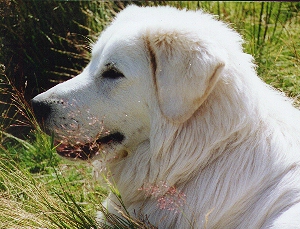
Maremmano-abruzzese -narttu Silvermere
Sensibility At Selladore (Grace).
Omistajat: Janet Finlay ja Rachel Cowgill, Iso-Britannia.
Female Maremma Sheepdog Silvermere
Sensibility At Selladore (Grace).
Owners: Janet Finlay and Rachel Cowgill, Great Britain.
© Janet Finlay & Rachel Cowgill, kennel Selladore
Italialainen rotu
FCI:n ryhmä 1
Lammas- ja karjakoirat
Hyväksytty: FCI 15.9.1992, käännös SKL-FKK 26.7.1994
KÄYTTÖTARKOITUS: Paimenkoira, jonka pääasiallinen käyttötarkoitus on laumojen suojelu ja omaisuuden vartiointi.
LYHYT HISTORIALLINEN KATSAUS: Tämä ikivanha laumojen vahtikoira polveutuu sekä paimenkoirista, joita edelleen käytetään Abruzzossa lampaita laidunnettaessa, että Toscanan ja Latiumin Maremmalla käytetyistä paimenkoirista. Erityisesti vuodesta 1860 lähtien, jolloin karjalaumoja siirrettiin alueelta toiselle, nämä kaksi rotua alkoivat sekoittua toisiinsa.
YLEISVAIKUTELMA: Maremmano-abruzzese on suuri voimakasrakenteinen ja olemukseltaan hieman karkeatekoinen koira. Samalla se on majesteettinen ja ylväs. Runko on säkäkorkeutta pitempi. Koiran koon ja eri ruumiinosien mittasuhteet ovat tasapainoiset kuten myös pään pituuden suhde runkoon.
TÄRKEÄT MITTASUHTEET: Pään pituus on 4/10 säkäkorkeudesta. Kuonon pituus on 1/10 kallon pituutta pienempi. Rungon pituus on 1/18 säkäkorkeutta suurempi. Rintakehän syvyys on hieman vähemmän kuin puolet säkäkorkeudesta. (Esim. 68 cm korkealla koiralla syvyys on n. 32 cm.)
LUONNE: Koiran pääasiallinen tehtävä on lauman ja yleensä omaisuuden vartioiminen ja puolustaminen. Se suorittaa tehtävänsä vakuuttavasti, valppaasti, rohkeasti ja päättäväisesti. Vaikka se on luonteeltaan ylpeä eikä alistu helpolla, se voi myös olla hyvin kiintynyt isäntäänsä ja ympäristöönsä.
GENERAL APPEARANCE: The Maremma and Abruzzese Shepherd dog is a large dog, strongly built of a rustic (hardy) appearance, at the same time majestic and really typical. On the whole, his shape, of average proportions, is that of a heavy dog, whose body is longer than the height at the withers; it is harmonious as to form (heterometric) and relatively harmonious in outline (halloidism).
IMPORTANT PROPORTIONS: The length of the head is four tenths of the height at the withers; the body length is greater than the height at the withers by one eighteenth. Depth of the body is slightly less than half the height at the withers. (For instance a dog of 68 cm, the depth is about 32 cm.)
The maremma is a majestic, distinguished and sturdy dog with a very intelligent expression. Lack of substance is regarded very seriously in Italy; they should be large and majestic. It is considered to be much more important to preserve and maintain 'type', that is, be typical of the breed, than it is for the dog to be 'spectacular'.
The difference between dog and bitch should be very evident, and not only physically. The dogs are larger, tougher and have a large collar, like a lion's mane. They are more extrovert, stronger in temperament and become aggressive, particularly with dogs who invade their territory. The bitches, on the other hand, may be a few inches smaller, are more elegant and can be feline in theri movements; they are much gentler and more diffident.
For his stature, this dog has only a moderate appetite. The maremma is an irregular feeder, is not a glutton and will never over-eat. His irregularity in feeding needs getting used to, and it is necessary to be sure that water is always available to him.
CHARACTERISTICS: It is a shepherd dog used mainly for the protection of flocks and guarding property. The maremma is essentially an outdoors animal. He is a calm dog, only barking if he sees something unusual, otherwise he will be lying in the shade of the house or in some cool place, sleeping or pretending to do so. Thus, even his calorific requirements are smaller than those of other breeds of the same weight.
TEMPERAMENT: His principal function as a guard and defence dog of flocks and property in general, shows itself in the manner in which he accomplishes these tasks, with perception, courage and decision. Although proud and not inclined to submission, he is also devoted to his master and his entourage. Temperament in this breed is as important as its appearance, as dogs who have the wrong temperament can develop an unwanted aggressiveness, which, besides being a problem to the owner, can do much harm to the breed.
PÄÄ: Pää on suuri ja litteä, kartion muotoinen ja muistuttaa jääkarhun päätä.
KALLO: Kallo on melko leveä, kallon sivulinjat hieman pyöristyneet. Sivukuvaltaan kallo on myös kupera. Kallon ja kuonon ylälinjat eivät ole aivan yhdensuuntaiset, mistä johtuen pään sivukuva on hiukan kupera. Kulmakaaret ovat kohtuullisen korostuneet. Otsauurre on vähäinen. Niskakyhmy on melko huomaamaton.
OTSAPENGER: Otsapenger on melko loiva. Kuonon ja otsan välinen kulma on aina hyvin avoin.
KIRSU: Kirsu on melko suuri ja samalla linjalla kuin kuononselkä. Se on kostea, viileä ja väriltään musta. Sieraimet ovat avoimet ja suuret. Sivulta katsottuna kirsun etuosa on samassa linjassa kuonon etuosan pystysuoran linjan kanssa.
KUONO: Pituudeltaan kuono on 1/10 kallon pituutta lyhyempi. Suupielen kohdalta mitattuna kuonon syvyys on vähintään puolet pituudestaan. Kuono kapenee tasaisesti kärkeä kohden; tästä huolimatta kuonon etuosa pysyy tylppänä. Kuono on silmien alta hieman kovertunut.
HUULET: Ylähuulet muodostavat yhtymäkohdassaan pienen puoliympyrän. Huulet eivät ole kovin paksut. Ne peittävät juuri ja juuri hampaat ja näin suupieli on vain hieman korostunut. Kuonon etuosan alalinja muodostuu huulilinjasta, kun taas taaempi osa muodostuu alaleuasta ja suupielestä. Huulten reunat ovat mustat.
LEUAT: Vahvat ja normaalisti kehittyneet.
POSKET: Kohtuullisesti havaittavissa.
SILMÄT: Eivät suuret koiran kokoon nähden. Iiriksen väri okra tai tummanruskea. Sivulta katsottuna silmä ei saa olla syvällä eikä ulkoneva. Ilme älykäs ja tarkkaavainen. Silmäaukot mantelinmuotoiset ja luomen reunat mustapigmenttiset.
KORVAT: Korvat ovat kiinnittyneet huomattavasti poskiluun kaaren yläpuolelle. Ne ovat riippuvat, mutta hyvin liikkuvat, muodoltaan kolmiomaiset (v-muotoiset), kärkeä kohti kapenevat, eivät koskaan leveälti pyöristyneet. Korvat ovat pienet koiran kokoon nähden. Korvien pituus on keskikokoisella koiralla korkeintaan 12 cm. Korvan kiinnityskohta on keskileveä. Ainoastaan työkoiralla voidaan sallia osittain typistetyt korvat. (Huom. Suomessa korvien typistys on kielletty.)
PURENTA: Etuhampaat säännölliset, tasaisesti asettuneet, täydellisesti kehittyneet ja täysilukuiset. Hampaat valkoiset, voimakkaat. Leikkaava purenta.
HEAD: On the whole the head is large and flat, of conical shape, reminiscent of that of a polar bear.
SKULL: Is of great width with the sides of the skull slightly rounded; in profile it is also convex. The upper longitudinal axes of the skull and muzzle are slightly divergent from each other, which makes the profile of the head slightly convex. The eyebrows are moderately arched. The medial furrow is slight. The occipital crest is not accentuated.
STOP: Should not be pronounced. The depression is only slight and the angle is always very open.
NOSE: Rather large, in line with the muzzle, with large, well-opened, moist and cool nostrils, and coloured black. In profile must not protrude beyond the front margin of the lips.
MUZZLE: Its length is one tenth less than that of the skull. Its depth, measured at the level of the corners of the lips, must equal half its length. Its width decreases progressively with the convergence of the sides of the muzzle towards the front. It is slightlly chiselled beneath the eyes.
LIPS: Seen from the front, the upper lips are shaped like a semi-circle of very small radius at the lower edge of their junction point. The lips, being only silghtly developed, barely cover the teeth, and therefore the corner of the lips is only lightly accentuated. Consequently, the lower side profile is defined by the lips only at the front part; in its rear part it is defined by the lower jaw and the corner of the lips. The rims of the lips are black.
JAWS: Look strong and are normally developed.
CHEEKS: Moderately visible.
The head of the maremma should be immediately recognisable from the heads of similar breeds, such as the Kuvasz or the Pyrenean Mountain Dog, by its typical shape and expression. Its size should be in proportion to the body, its shape large and conical; shaped like a blunt wedge and reminiscent of the head of the Polar bear, particularly about the muzzle. The conical shape means that even the sides of the muzzle must not be parallel, but taper towards the nose.
EYES: Not large in relation to the size of the dog; the iris is of an ochre colour, or chestnut brown. The eye, in lateral position, is neither deep set nor protruding. Lively and attentive expression. Eyelid opening is almond shaped, with black eyelid rims. There is never enough importance given to the eye in this breed. The eyes should be almond shaped, neither too large nor too small and not too deeply set. The dog should have the "liquid" and "smiling" expression which gives great joy to all who love the breed.
EARS: Set very high over the zygomatic arches, they hang down but are very mobile. Triangular shape (in a V), their extremities form a narrow point, never rounded; they are small in relation to the size of the dog. For a medium size dog their length must not go beyond 12 cm. The ear leather is of medium width. Cropped ears are tolerated only in dogs really used as herd dogs (NOT legal in Australia)
MOUTH: Teeth are white, strong, complete and with a scissor bite. Anything other than a scissor bite is a fault, and any deviation from the correct bite is regarded seriously.
KAULA: Sivulta katsottuna kaulan ylälinja on kohtalaisen kaareva. Pituus ei saa ylittää 8/10 pään pituudesta, eli kaula on aina päätä lyhyempi. Kaula on paksu, erittäin vahva ja lihaksikas. Ei löysää kaulanahkaa. Kaulan karvoitus on paksua ja pitkää ja siitä muodostuu kaulus, joka uroksella on erityisen selvä.
RUNKO: Voimakasrakenteinen, 1/18 säkäkorkeutta pitempi.
YLÄLINJA: Lavoista lantioon suora, sen jälkeen hieman viettävä.
SÄKÄ: Hiukan selkälinjasta koholla. Lapaluiden kärkien väli on leveä.
SELKÄ: Sivulta katsoen suora. Pituus noin 32 % säkäkorkeudesta. Selkälinjan jatkeena oleva lanne on hieman kaartunut ja voimakaslihaksinen. Lanneosan leveys on lähes yhtä suuri kuin sen pituus, joka on 1/5 säkäkorkeudesta.
LANTIO: Leveä, vahva, lihaksikas. Kaltevuus sarvennaisista hännän kiinnityskohtaan 20° vaakatasoon nähden. Kaltevuus kasvaa, jos seurataan suoliluu-istuinluu -linjaa (30° tai sitä suurempi). Näin ollen maremmano-abruzzesen lantio voidaan määritellä laskevaksi.
RINTAKEHÄ: Tilava, ulottuu kyynärpäiden tasolle. Syvä, keskikohdastaan hyvin pyöristynyt. Rintakehän ympärysmitan tulee olla noin 1/4 säkäkorkeutta suurempi ja sen leveyden, joka on suurimmillaan rintakehän keskikohdalla, tulee olla vähintään 32 % säkäkorkeudesta. Rintakehä kapenee alaspäin pysyen silti tilavana rintalastankin kohdalla. Rintakehän pituuden mitattuna vaakasuoraan rintalastan alueella tulee olla 50 % säkäkorkeudesta. Kylkiluut ovat hyvin kaareutuneet ja viistot. Kylkiluiden välit ovat hyvin leveät, viimeisetkin kylkiluut ovat pitkät, viistot ja selvästi avoimet.
ALALINJA: Sivulta katsottuna rintakehän alalinja on pitkä ja se nousee loivasti sulautuen vatsalinjaan.
NECK: Strong, of medium length, devoid of dewlap, with thick hair that forms a collar or mane.
BODY: Solidly constructed, its length (measured from point of shoulder to buttock) is one eighteenth greater than the height at the withers.
TOPLINE: Straight from behind the withers to the rump where it becomes somewhat sloping.
WITHERS: Slightly above the topline; wide because of the distance separating the shoulder blades.
BACK: Straight in profile, length is about 32% of the height at the withers. The loin which merges perfectly with the topline has a slightly curved profile with well developed muscles. The length of the loin is one fifth of the height at the withers, and its width is nearly equal to its length.
RUMP/ CROUP: Wide, strong and well muscled. Its slope from the hip to the tail set is 20 degrees, increasing to 30 degrees and more if we refer to the ileum-ischium line; that is why the rump of the Maremma and Abruzzese shepherd dog must be qualified as sloping.
CHEST: Ample, descending to the level of the elbows, deep and well rounded at mid-height. Its circumference must be one quarter greater than the height at the withers; its maximum width at mid-height must be at least 32% of the height at the withers, then decreases progressively downwards, whilst retaining a good width in the sternal region.
UNDERLINE: Its lower line, from the sternum forward, rises very slightly toward the flanks, in such a way that the belly is slightly drawn up.
ETURAAJAT: Raajojen tulee olla suorat sekä sivulta että edestä katsottuina. Raajat ovat oikeassa suhteessa runkoon, samoin niiden eri osat toisiinsa nähden.
LAVAT: Lapojen tulee olla pitkät, viistot, vahvalihaksiset ja niiden tulee sallia hyvin vapaat liikkeet. Lavan pituus on noin 1/4 säkäkorkeudesta. Kaltevuus vaakatasoon nähden 50°-60°.
OLKAVARRET: Kaksi kolmasosaa olkavarsista on tiiviisti rungon myötäistä. Olkavarret ovat vahvalihaksiset ja kaltevuus vaakatasoon nähden 55°-60°. Olkavarsien pituus on noin 30 % säkäkorkeudesta. Edestä katsottuna olkavarret ovat lähes pystysuorat. Lavan ja olkavarren välinen kulma on 105°-120°.
KYYNÄRPÄÄT: Normaalisti rintakehän muotoiset. Nahka niissä on irtonaista ja pehmeää. Kyynärpään kärki on samalla pystysuoralla linjalla kuin lapaluun kärki. Olkavarren ja värttinäluun välinen kulma on 145°-150°.
KYYNÄRVARRET: Kyynärvarret ovat vahvaluiset ja myötäilevät pystysuoraa linjaa. Ne ovat hieman olkavartta pidemmät ja hiukan alle 1/3 säkäkorkeudesta. Eturaajojen pituus maasta kyynärpäähän on 52,8 % säkäkorkeudesta.
RANNE: Ranne on samalla pystysuoralla linjalla kuin kyynärvarret. Se on voimakas, kuiva, sileä ja riittävän paksu. Herneluut selvästi esiintulevat.
VÄLIKÄMMENET: Pituus ei saa koskaan olla alle 1/6 koko eturaajan pituudesta maasta kyynärpäähän mitattuna. Ne ovat hyvin kuivat, ihonalaista kudosta on niukasti. Sivulta katsottuna välikämmenet ovat hieman viistot.
TAKARAAJAT: Edestä ja sivulta katsottuina raajojen tulee olla suorat. Takaraajat ovat mitoiltaan oikeassa suhteessa runkoon ja toisiinsa sekä niiden eri osat suhteessa toisiinsa.
REIDET: Pitkä, leveä ja voimakaslihaksinen takaosa on hieman kupera. Sen leveys on 3/4 reisien pituudesta. Reidet ovat hiukan viistot. Lonkan ja reiden välinen kulma on noin 100°.
SÄÄRET: Sääret ovat hiukan reittä lyhyemmät, 32,5 % säkäkorkeudesta. Kaltevuus vaakatasoon nähden on noin 60°. Luusto vahva, lihaksisto kuiva, kinner selvästi erottuva.
POLVET: Polvien tulee olla täysin suorassa linjassa raajoihin nähden. Ne eivät saa olla sisä- eikä ulkokierteisiä. Reiden ja sääriluun välinen kulma on kohtalaisen avoin 135° - 140°.
KINTEREET: Kintereiden korkeus on 30,9 % säkäkorkeudesta. Ne ovat sivulta katsottuna hyvin leveät. Kintereet ovat myös sopivan paksuiset. Kinnerkulma on 140° - 150°.
VÄLIJALAT: Voimakkaat, kuivat ja leveät. Niiden pituus riippuu kintereiden korkeudesta. Kannukset poistetaan, mikäli niitä esiintyy.
KÄPÄLÄT: Etukäpälät suuret, pyöreähköt. Varpaat tiiviit ja ne ovat tiheän ja lyhyen karvan peittämät. Kynnet mieluiten mustapigmenttiset, joskin ruskea väri sallitaan. Takakäpälät ovat muuten samanlaiset kuin etukäpälät, mutta soikeammat.
HÄNTÄ: Hännän kiinnityskohta on matalalla johtuen lantion viistoudesta. Häntä ulottuu yli kintereen koiran seistessä. Lepoasennossa häntä on alhaalla, mutta koiran innostuessa häntä nousee selkälinjan tasolle kärki jonkin verran kaartuneena. Häntä on tiheän karvan peitossa ilman hapsuja.
LIIKKEET: Pitkä askel, maatavoittava ravi.
IHO: Kaikkialla tiiviisti rungon myötäinen. Melko paksu. Limakalvojen ja peräaukon pigmenttien tulee olla mustat, samoin päkiöiden.
FOREQUARTERS: Straight limbs when viewed from the front and side; forequarters well balanced in relation to the body, and the various parts of the forequarters are well proportioned to each other.
SHOULDERS: Long, sloping, with powerful muscles. Must be really free in movement. In length measures about one quarter of the height at the withers. Its angulation below the horizontal is from 50 - 60 degrees.
ELBOWS: normally close to the chest, they are covered with a soft, loose skin. Their position must be parallel to the median plane of the body; the point of the elbow must be on an imaginary vertical plane from the shoulder blade. The angle formed by the junction of the humerous and the radius varies between 145 and 150 degrees.
FOREARM: Straight and vertical, heavily boned. Its length is slightly more than the length of the upperarm, whilst being a little less than a third of the height at the withers. The front leg from the ground to elbow measures 53% of the height at the withers.
PASTERN JOINT (WRIST OR CARPUS): Extends the vertical line of the forearm. Strong, clean, smooth and of good thickness; the pistiform bone at its back edge is clearly visible.
PASTERN (METACARPUS): Its length must never be less than one sixth of the foreleg measured from ground to elbow. It is lean with a minimum of sub-cutaneous tissue. Seen from the side, slopes slightly towards the front.
HINDQUARTERS: Limbs are straight when seen from behind. The general aspect is in proportion with the body, and the various parts of the hindquarters are in harmony with each other.
UPPER THIGH: Long, wide with prominent muscles and the rear edge slightly convex. Its width, measured from edge to edge, is three quarters of its length. It is slightly angulated from top to bottom and rear to front; the angle of the femur with the hip-bone is about 100 degrees.
LOWER THIGH: Its length which is a little shorter than the upper thigh, is 32.5% of the height at the withers. Its angulation below the horizontal is about 60 degrees. Strong bone, muscles lean and the groove in the leg well marked.
STIFLE: Set perfectly in the vertical line of the hind leg, turns neither in nor out. The angle of the femur and tibia is rather open and varies between 135 and 140 degrees.
HOCK JOINT: Quite thick, with broad lateral faces. The angle varies between 140 and 150 degrees.
REAR PASTERN (METATARSAL): Strong, lean and broad. Its length is 31% of the height at the withers. Dewclaws must be removed.
FEET: Front: Large of roundish shape, well closed toes, covered with short, thick hair; nails preferably black; chestnut colour is tolerated. Hind: Like the front feet but more oval.
TAIL: Low set due to the sloping rump, in normal stance reaching below the level of the hock. Hanging down when the dog is stationary; carried level with back line with a rather strongly hooked tip when the dog is moving. Well furnished with dense hair without fringes. The tail is set low, and when excited, carried straight out with onlly a slight curve at the end. Very cheerful dogs carry their tails in a slight upwards curl. A very bad fault is the so-called "spitz tail", which is generally caused by an incorrect croup. The first third of the tail, starting from its insertion in the rump, should never be carried above the level of the back, even if the last part may be waving gayly during movement.
GAIT/ MOVEMENT: Walk and extended trot. Movement is very free, but not like the German Shepherd as it si less angulated behind. maremmas are fast and as agile as any cat. They are strong dogs but they must maintain agility to be typical of the breed. This fact must be strongly emphasised as if the dogs become too heavy and too large they will lose their agility. On the other hand they must maintain their excellent bone, strength and size, also without losing their agility.
SKIN: Tight on all parts of the body; rather thick. Black pigmentation of the mucous membranes, eyelids and the central and toe pads.
KARVAPEITE: Erittäin runsasta, pitkää, karkeahkoa. Hyvin rungonmyötäistä. Kevyt aaltoilu sallitaan. Karvapeite muodostaa runsaan kauluksen kaulan ympärille ja kohtuullisen hapsumaisen karvoituksen reisien takapinnoille. Sen sijaan karva on lyhyttä kuonossa, kallossa, korvissa ja kaikkien raajojen etupuolilla. Karvan rakenne vaikuttaa hieman lasimaiselta. Karvan pituus on rungossa jopa 8 cm. Pohjavilla on runsasta vain talvella.
VÄRI: Yksivärinen valkoinen. Norsunluun, vaalean oranssin tai sitruunan väriset varjostumat sallitaan, jos niiden lukumäärä on rajoitettu.
COAT: Very well furnished. Hair long, rather harsh to the touch, closer to straight horse hair; flat to the body; slight wave is tolerated. The coat forms a rich collar around the neck and feathering of limited length on the edge of the hindquarters. It is short on the muzzle, skull, ears and front edge of the limbs. On the body it reaches 8 cm (3 ins). The undercoat is only abundant in winter.
COLOUR: Solid white. Shades of ivory, pale orange or lemon are tolerated but only if not excessive.
The dogs spend a lot of time cleaning their coats, like cats, and, although the coat is white, it does not need any special care. It sheds its coat twice a year after losing all the dead hair, which becomes yellowish, just like wool. When it rains and the dogs are wet, the coat becomes the colour of the earth, but as soon as it dries it becomse whiter than it was before.
KOKO
SÄKÄKORKEUS: Urokset 65 - 73 cm, nartut 60 - 68 cm.
PAINO: Urokset 35 - 45 kg, nartut 30 - 40 kg.
SIZE
HEIGHT: Males 65 - 73 cm (25.5 - 29 inches), females 60 - 68 cm (23.5 - 26.5 inches).
WEIGHT: Males 35 - 45kg's (77 - 99lbs), females 30 - 40kg's (66 - 88lbs).
VIRHEET: Jokainen poikkeama rotumääritelmästä on virhe, josta tulee rangaista harkiten sen merkitystä ja levinneisyyttä. Virheitä ovat myös jatkuva peitsaus tai kannusten esiintyminen.
VAKAVAT VIRHEET: Pää: Kallon ja kuononselän linjat yhdensuuntaiset. Korostunut, häiritsevä alapurenta. Häntä: Selän päälle kiertynyt. Koko: Pienempi tai suurempi kuin mitä rotumääritelmä sallii. Liikkeet: Jatkuva peitsaus.
HYLKÄÄVÄT VIRHEET: Kirsu: Täydellinen pigmenin puute. Kuononselkä: Selvästi kupera tai kovera. Silmät: Osittainen tai molemminpuolinen pigmentin puute silmäluomen reunoissa. Herasilmät. Molemminpuolinen karsastus. Purenta: Yläpurenta. Häntä: Kippurahäntä. Töpöhäntä (synnynnäinen tai typistetty). Karvapeite: Kihara. Väri: Isabellan väri, isabellan tai norsunluun väriset selvärajaiset läiskät, mustat varjostumat.
FAULTS: Any departure from the foregoing constitutes a fault which when judging must be penalised according to its seriousness and its extent. The same conditions apply to dogs which pace very often and dogs whose dewclaws have not been removed.
ELIMINATING FAULTS: Head: The axes of the skull and foreface are convergent. Mouth: Serious and disfiguring prognathism (undershot if it harms the general appearance of the muzzle; overshot if the result of bad direction of the teeth). Tail: Rolled over the back. Gait: Continual pacing. Size: Above or below the limits fixed by the Standard.
DISQUALIFYING FAULTS: Nose: Completely depigmented. Muzzle: Definitely convex or concave. Eyes: Moderate or bilateral depigmentation of the eyelids. Wall-eyed. Cross-eyed. Mouth: Overshot (when caused by lack of length of the underjaw). Tail: Tailless or short tail, whether congenital or docked. Coat: Curly. Colour: Isabella coat; well defined patches of Isabella or ivory colour. Black shadings.
HUOM: Uroksilla tulee olla kaksi normaalisti kehittynyttä kivestä täysin laskeutuneina kivespussiin.
NOTE: Male animals should have two apparently normal testicles fully descended into the scrotum
Lähde/ Information: FCI Rotumääritelmä/ Australian Breed Standard (see also Italian Standard)
Lisätietoa rodusta/ More information about this breed:
Circolo_del_Pastore_Maremmano_Abruzzese
Suomen_Maremmano-Abruzzese_ry
The_Maremma_Sheepdog_Club_of_Great_Britain
Maremma_Sheepdog_Club_of_America
Selladore