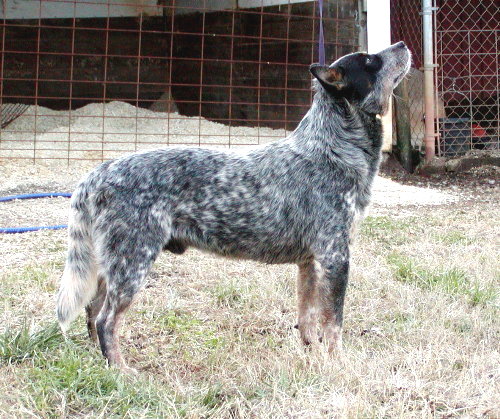
Australiankarjakoira-uros R-Bar Acres Hiredhand Rowdy (Rowdy). Omistaja: Connie Hayes, Yhdysvallat.
Male Australian Cattle Dog R-Bar Acres Hiredhand Rowdy (Rowdy). Owner: Connie Hayes, United States of America.
© Connie Hayes, kennel Hiredhand
Alkuperämaa: Australia
Ryhmä: 1
FCI:n numero: 287a
Hyväksytty: FCI 18.11.1985
SKL-FKK 8.3.1989
Origin: Australia
Group: 1
F.C.I. Standard No: 287a
Date of publication of the original valid standard: 18.11.1985
YLEISVAIKUTELMA: Vahva, kiinteä, sopusuhtainen työkoira, jolla on kyky ja halu toimittaa sille annettu vaivalloinenkin tehtävä. Sen massa, voima, tasapaino ja
vahva lihaskunto antavat vaikutelman suuresta ketteryydestä, voimasta ja kestävyydestä. Pienikin taipumus liialliseen karkeuteen tai honteluuteen on vakava virhe.
OMINAISPIIRTEET: Verraton karjan vartioija ja kuljettaja. Aina valpas, äärimmäisen älykäs, tarkkaavainen, rohkea, luotettava, velvollisuudentuntoinen ja suojeluvaistoinen.
LUONNE: Uskollisuus ja suojeluvaistot tekevät siitä oma-aloitteisen vahdin karjanhoitajalle, tämän karjalle ja omaisuudelle. Luonnostaan epäluuloinen vieraita kohtaan, mutta sen täytyy kuitenkin mukautua käsittelyyn, erityisesti näyttelykehässä. Kaikki työkoiralle vieraat luonne- tai rakennepiirteet ovat vakavia virheitä.
GENERAL APPEARANCE: The general appearance is that of a strong compact, symmetrically built working dog, with the ability and willingness to carry out his allotted task however arduous. Its combination of substance, power, balance and hard muscular condition must convey the impression of great agility, strength and endurance. Any tendency to grossness or weediness is a serious fault.
CHARACTERISTICS: As the name implies the dog's prime function, and one in which he has no peer, is the control and movement of cattle in both wide open and confined areas. Always alert, extremely intelligent, watchful, courageous and trustworthy, with an implicit devotion to duty making it an ideal dog.
TEMPERAMENT: The Cattle Dog's loyalty and protective instincts make it a self-appointed guardian to the Stockman, his herd and his property. Whilst naturally suspicious of strangers, must be amenable to handling, particularly in the Show ring. Any feature of temperament or structure foreign to a working dog must be regarded as a serious fault.
PÄÄ: Voimakas ja suhteessa runkoon.
KALLO: Leveä, korvien välissä hieman kaareva, vähäisen mutta selvän otsapenkereen kohdalla suora.
POSKET: Lihaksikkaat, eivät karkeat eivätkä ulkonevat.
LEUAT/ HAMPAAT/ PURENTA: Alaleuka voimakas, syvä ja hyvin kehittynyt. Leikkaava purenta: alaetuhampaat hieman yläetuhampaiden takana niitä kevyesti
koskettaen. Hampaat tasaisesti sijoittuneet, terveet ja vahvat, mikä on karjan
kuljettamisessa erittäin tärkeää.
HUULET: Tiiviit ja kuivat.
KUONO: Keskimittainen, syvä, voimakas, silmien alta leveä ja täyteläinen, vähitellen kapeneva. Päälaki ja kuonon selkä yhdensuuntaiset.
KIRSU: Musta.
SILMÄT: Tummanruskeat, soikeat, keskikokoiset, eivät ulkonevat eivätkä syvällä
sijaitsevat. Ilmentävät valppautta ja älykkyyttä. Varoittava tai epäluuloinen kimallus vieraan lähestyessä luonteenomainen.
KORVAT: Keskikokoiset, mieluummin pienet kuin suuret, juuresta leveät; lihaksikkaat, pystyt ja melko terävät; eivät lusikkamaiset eivätkä lepakonkorvat. Etäällä toisistaan, ulospäin suuntautuneet, herkästi liikkuvat; koiran ollessa valppaana pystyasentoiset. Paksut ja sisäpuolelta hyvin karvaiset.
HEAD: Strong and must be in balance with other proportions of the dog and in keeping with its general conformation.
SKULL: Broad, slightly curved between the ears, flattening to a slight but definite stop.
CHEEKS: Muscular, neither coarse nor prominent.
JAWS/ TEETH: Underjaw strong, deep and well developed. The teeth, sound, strong and evenly spaced, gripping with a scissor-bite, the lower incisors close behind and just touching the upper. As the dog is required to move difficult cattle by heeling or biting, teeth which are sound and strong are very important.
LIPS: Tight and clean.
MUZZLE: Medium length, deep, powerful, broad and well filled in under the eyes, tapering gradually. The skull and muzzle on parallel planes.
NOSE: Black.
EYES: Should be of oval shape and medium size, neither prominent nor sunken and must express alertness and intelligence. A warning or suspicious glint is characteristic when approached by strangers. Eye colour, dark brown.
EARS: Should be of moderate size, preferably small rather than large, broad at the base, muscular, pricked and moderately pointed neither spoon nor bat eared. The ears are set wide apart on the skull, inclining outwards, sensitive in their use and pricked when alert, the leather should be thick in texture and the inside of the ear fairly well furnished with hair.
KAULA: Erittäin vahva ja lihaksikas; keskipituinen, runkoa kohti levenevä. Ei
löysää kaulanalusnahkaa.
RUNKO: Rungon mitta rintaluun kärjestä pakaroihin on säkäkorkeutta pitempi
suhteessa 10:9.
YLÄLINJA: Tasainen.
SELKÄ: Vahva.
RINTAKEHÄ: Syvä, lihaksikas ja vahva sekä kohtuullisen leveä, pitkä mutta ei tynnyrimäinen. Kylkiluut hyvin kaareutuneet.
LANNE: Leveä, vahva ja lihaksikas.
LANTIO: Melko pitkä ja laskeva.
HÄNTÄ: Melko matalalle kiinnittynyt, seuraa laskevan lantion linjoja ja ulottuu
suunnilleen kintereeseen. Hännänpää loivasti kaartunut. Liikkeessä tai koiran ollessa jännittynyt häntä voi kohota, mutta mikään osa hännästä ei koskaan saa ylittää hännän juuren kautta piirrettyä pystysuoraa linjaa. Tuuheakarvainen.
NECK: Extremely strong, muscular, and of medium length broadening to blend into the body and free from throatiness.
BODY: The length of the body from the point of the breast bone, in a straight line to the buttocks, is greater than the height at the withers, as 10 is to 9.
TOPLINE: Level.
BACK: Strong.
CHEST: Deep, muscular and moderately broad. Ribs well sprung and carried well back not barrel ribbed.
LOINS: Broad, strong and muscular.
CROUP: Rather long and sloping.
TAIL: The set on of tail is moderately low, following the contours of the sloping croup and of length to reach approximately to the hock. At rest it should hang in a very slight curve. During movement or excitement the tail may be raised, but under no circumstances should any part of the tail be carried past a vertical line drawn through the root. The tail should carry a good brush.
ETURAAJAT: Eturaajojen luut vahvat ja pyöreät. Eturaajat edestä katsoen suorat ja yhdensuuntaiset.
LAVAT: Voimakkaat, viistot, lihaksikkaat, eivät liian lähekkäin sään kohdalla; lapaluu ja olkavarsi muodostavat selvän kulman. Lavat lihaksikkaat ja vahvaluiset, mutta liian kuormittuneet lavat ja raskas etuosa vaikeuttavat liikkumista ja rajoittavat työskentelyä.
RANTEET: Joustavat, sivusta katsoen hieman viistot.
TAKARAAJAT: Leveät, vahvat ja lihaksikkaat. Takaa katsottuna raajat kintereestä käpälään suorat ja yhdensuuntaiset, eivät liian lähekkäin eivätkä liian kaukana toisistaan.
REIDET: Pitkät, vahvat ja hyvin kehittyneet.
POLVET: Hyvin kulmautuneet.
KINTEREET: Vahvat ja matalat.
KÄPÄLÄT: Pyöreät; varpaat lyhyet, vahvat, hyvin kaareutuneet ja tiiviisti yhdessä. Päkiät kovat ja paksut, kynnet lyhyet ja vahvat.
LIIKKEET: Tasapainoiset, vapaat, joustavat, väsymättömät. Lapojen ja eturaajojen liike sopusoinnussa takaraajojen voimakkaan työnnön kanssa. Kyky nopeisiin ja äkillisiin liikkeisiin olennaista. Terveys on tärkeintä: kankeus, raskaat, löysät tai jyrkkäasentoiset lavat, heikot kyynärpäät, ranteet tai käpälät, suorat polvikulmaukset, pihtiasentoiset tai ulospäin taipuneet kintereet ovat vakavia virheitä. Ravissa raajoilla on taipumus lähetä toisiaan vauhdin lisääntyessä, seistessä raajat ovat suorat.
FOREQUARTERS: The forelegs have strong, round bone, extending to the feet and should be straight and parallel when viewed from the front. When viewed from behind, the hind legs, from the hocks to the feet, are straight and placed parallel, neither close nor too wide apart.
SHOULDERS: Strong, sloping, muscular and well angulated to the upper arm and should not be too closely set at the point of the withers. Although the shoulders are muscular and the bone is strong, loaded shoulders and heavy fronts will hamper correct movement and limit working ability.
PASTERNS: Should show flexibility with a slight angle to the forearm when viewed from the side.
HINDQUARTERS: Broad, strong and muscular.
THIGHS: Long, broad and well developed.
STIFLES: Well turned.
HOCKS: Strong and well let down.
FEET: Should be round and the toes short, strong, well arched and held close together. The pads are hard and deep, and the nails must be short and strong.
GAIT/ MOVEMENT: The action is true, free, supple and tireless and the movement of the shoulders and forelegs is in unison with the powerful thrust of the hindquarters. The capability of quick and sudden movement is essential. Soundness is of paramount importance and stiltiness, loaded or slack shoulders, straight shoulder placement, weakness at elbows, pasterns or feet, straight stifles, cow or bow hocks, must be regarded as serious faults. When trotting the feet tend to come closer together at ground level as speed increases, but when the dog comes to rest he should stand four square.
KARVAPEITE: Sileä ja kaksinkertainen. Aluskarva lyhyt ja tiheä. Päällyskarva
tiivis, jokainen karva suora, kova ja vartalonmyötäinen siten, että turkki on vedenkestävä. Rungon alta reisien takaosaan turkki on pidempi ja muodostaa "housut". Päässä, raajojen etuosassa ja käpälissä karva on lyhyttä. Kaulassa karva on pidempää ja paksumpaa. Turkin pituus rungossa keskimäärin 2,5-4 cm.
VÄRI: Sininen: sininen, sinitäplikäs tai sinilaikukas muun väristen merkkien kanssa tai ilman merkkejä. Sallittuja ovat: Mustat, siniset tai tan-merkit päässä, mieluimmin tasaisesti sijoittuneina molemmin puolin päätä. Eturaajoissa tan-väriä raajan puoliväliin ja ylös rintaan ja kaulaan. Tan-väriä leuassa. Takaraajojen sisäpinnat, polvien etupuolet, kintereet ja varpaat tan-väriset. Tan-värinen alusvilla sallittu rungossa edellyttäen, että se ei näy sinisen päällyskarvan läpi. Mustat merkit rungossa eivät toivottavia.
Punainen: kauttaaltaan punakirjava, myös aluskarva (ei siis valkoinen eikä kermanvärinen). Päässä voi olla tummemmanpunaisia merkkejä, mieluiten tasaisesti sijoittuneina. Punaiset merkit rungossa sallittuja mutta eivät toivottuja.
COAT: The coat is smooth, a double coat with a short dense undercoat. The outer-coat is close, each hair straight, hard, and lying flat, so that it is rain-resisting. Under the body, to behind the legs, the coat is longer and forms near the thigh a mild form of breeching. On the head (including the inside of the ears), to the front of the legs and feet, the hair is short. Along the neck it is longer and thicker. A coat either too long or too short is a fault. As an average, the hairs on the body should be from 2.5 to 4 cms (approx. 1-1.5 ins) in length.
COLOUR: Blue: The colour should be blue, blue-mottled or blue speckled with or without other markings. The permissible markings are black, blue or tan markings on the head, evenly distributed for preference. The forelegs tan midway up the legs and extending up the front to breast and throat, with tan on jaws; the hindquarters tan on inside of hindlegs, and inside of thighs, showing down the front of the stifles and broadening out to the outside of the hindlegs from hock to toes. Tan undercoat is permissible on the body providing it does not show through the blue outer coat. Black markings on the body are not desirable. Red Speckle: The colour should be of good even red speckle all over, including the undercoat, (neither white nor cream), with or without darker red markings on the head. Even head markings are desirable. Red markings on the body are permissible but not desirable.
KOKO
SÄKÄKORKEUS: Urokset 46-51 cm, nartut 43-48 cm.
SIZE
HEIGHT: Dogs 46-51 cms (approx. 18-20 ins) at withers, bitches 43-48 cms (approx. 17-19 ins) at withers.
VIRHEET: Kaikki poikkeamat edellämainituista kohdista luetaan virheiksi suhteutettuna virheen vakavuuteen.
FAULTS: Any departure from the foregoing points should be considered a fault and the seriousness with which the fault should be regarded should be in exact proportion to its degree.
HUOM. Uroksilla tulee olla kaksi normaalisti kehittynyttä kivestä täysin laskeutuneina kivespussiin.
NOTE: Male animals should have two apparently normal testicles fully descended into the scrotum.
Lähde/ Information: FCI Rotumääritelmä/ FCI Breed Standard
Lisätietoa rodusta/ More information about this breed:
Australian_Cattle_Dog_Club_of_Western_Australia
Suomen_Australiankarjakoirat_ry
Australian_Cattle_Dog_Society_of_Great_Britain
Australian_Cattle_Dog_Community_Europe
Australian_Cattle_Dog
Hiredhand