






Travelling in Kobe
Getting Around Your New Home
| Stepping Out | Train Lines| IC Cards | Last Train | Hub Stations | Buses | Taxis | Walking & Cycling |
| How to Save ��� |
Stepping Out From Your Apartment
As Kobe JETs, we generally live in one of three locations:

- Gakuentoshi JETs live in Nishi-ku (West Ward) and have easy access to buses and the subway.
- Hanayama JETs live in Kita-ku (North Ward) and have easy access to the Kobe Dentetsu and live stop away from the final stop on the subway line.
- The few JETs on Port Island live in Chuo-ku (Central Ward) and have easy access to the Port Liner.
Sannomiya is Kobe's central hub for transportation as well as shopping, dining, and nightlife.
Here are the fares to Sannomiya:
- From Gakuentoshi: �330
- From Hanayama: �690*
- From Port Island: �240
*Hanayama JETs should check the How to Save Yen section.
Aside from going in and out of Sannomiya we almost always use some combination of trains and buses to get to and from work. We are reimbursed for this daily commute.
Trains: Different Lines
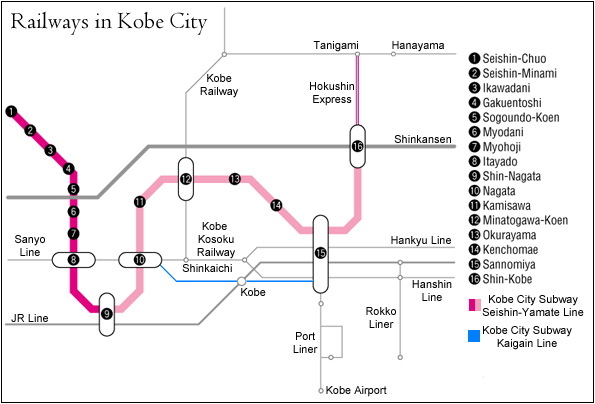
There are several major and a few minor train lines that run throughout Kobe. Many of the displays at most stations will have English as well as Japanese.
Kobe City Seishin-Yamate Line
The main subway line in Kobe's It connects at various points to other major railways in the city.
Kobe City Kaigan Line
Kobe's second, smaller, subway line, rarely used except to go the Harborland or Wing Stadium.
Hokushin Express Line
Although this line appears to be the same as the Seishin-Yamate Line, this section of track is operated by a private company.
Kobe Dentetsu (Shintetsu)
One of the oldest railways in the city. If you live in Hanayama you will use it often to get to work. It runs through all of Kita-ku to connect to Sanda and Miki cities, north of Kobe.
JR Line
Part of Japan's largest railway conglomerate. Aside from quickly getting across Kobe, the JR lines can take you just about anywhere in Japan with amazing efficiency.
Hankyu Line
One of Japan's largest private railways. It can take you through Eastern Kobe and other places in Kansai.
Port Liner
An automatic train that connects Port Island with the mainland. It also provides access to Kobe Airport.
Hanshin/Kobe Kousosku/Sanyo Lines
Three rail companies that operate different sections of the same track. The line(s) go all the way to Himeji and Osaka.
Rokko Liner
Like the Port Liner, but provides access between Rokko Island and the mainland in Eastern Kobe.
IC Cards
IC cards are replacing paper tickets in Japan. An IC card is the same size as a credit card. IC cards are like debit cards that can be 'charged up' with money. Rather than buying a ticket each time your ride the train you can simply hold the card against the ticket machine and it will automatically deduct the appropriate amount of money from the IC Card. You don't even need to take them out of your wallet to use them.
Purchasing an IC Card
- Go to any JR Station and look for a ticket machine that says 'ICOCA' on it.
- To purchase the card it costs �2000. �1500 will be yours to spend, the other �500 is a deposit, return the card to JR and they will give you back your �500.
- To add more cash to the card insert it into any machine that says 'ICOCA' and follow the instructions.
Notice
ICOCA cards can be used not just on JR, but on almost ANY railway in Kansai. They are extremely convenient and can even be used to purchase items at some stores. However, there is no discount for using them. If you can use a discount ticket be sure to buy one instead and use the IC card the next time a discount ticket is not an option.
Last Trains
Last trains, regradless of the line, are usually around midnight. The exception to this is the JR Line; Trains bound for Nishi-Akashi (not towards Osaka) run until about 1am.
Hanayama JETs will have to leave sooner from Sannomiya if they want to catch the last train around midnight from Tanigami station.
Trains: Hub Stations
Sannomiya
Sannomiya is the heart of downtown Kobe. It is the place to get anything done, find something to buy, or have a drink with friends.
Harborland (Kobe Station)
Although the JR line station here is called 'Kobe Station' it is not actually the city center. The KEC is located here. This is the chic, waterside shopping center of Kobe. There are also quite a few good restaurants.
Shinkaichi
This is where businesses that provide questionable services gather. If you'd like a good look at Kobe's seedier side, check it out.
Minatogawa
Close to Shinkaichi, Kobe's oldest shopping arcade, Higashiyama Shotengai, can be found here. The vibe here is much more local than the trendiness of the Center-Gai shopping arcade in Sannomiya.
Shin-Nagata
This area was devastated by the Great Hanshin Earthquake, but has been rebuilt with what are now mostly tall apartment towers. There is a large shopping arcade here that has a dominos pizza place (for when you crave American style pizza).
Buses
The bus system in Kobe is very efficient. Most train stations have some kind of rotary nearby where you can catch a bus to wherever you want to go. Unlike the trains, the buses rarely have anything listed in English. It will be important to know the Japanese for the place you are going.
How to Ride a Japanese Bus
In most cases you will get on at the BACK of the bus. When you get on there will likely be a small machine with a little piece of paper sticking out. Be sure to take it if it's there. You will pay when you get off the bus.
Fares
Buses operated by Kobe City have a flat rate of \200. Other private bus companies charge according to the distance traveled; When you get on these buses there will be a small white piece of paper with a number on it for you to take. The number on the paper corresponds to the number on the digital board at the front of the bus that shows the price of your journey.
Buses have machines at the front that can convert \1000 bills, and sometimes also \500 coins, into smaller change. Sometimes the machine will automatically dispense your change having automatically paid your fare. Be sure to check or you may accidentally pay your fare twice.
Different Bus Companies
- Kobe City Bus - Green
- Shinki Bus - Orange: operate between Western Kobe and Himeji City
- Hankyu Bus - Tan & Blue: owned by the rail company of the same name. They operate mostly in East Kobe and beyond.
- Sanyo Bus - Yellow: operated by the rail company of the same name. They operate between Hyogo Ward and Himeji City.
Taxis
Taxis in Japan are expensive, but reliable.
Average cab fares from Sannomiya are:
- To Gakuentoshi: /5000
- To Hanayama: /5000
- To Port Island: /1200
MK Taxi
A much better alternative to normal Taxis is MK Taxi. If you call MK Taxi and tell them where they are they will come and pick you up and take you home (or wherever) for less than what what other cabs would charge.
Store this phone number in your Keitai: 078-303-6001
Keep your eye open for the taxi cab with the heart on top that says 'MK'.
The "Maiko Trick"
Applies Only to Gakuentoshi JETs:
If you miss the last subway train but the JR line is still running (until about 1AM) you can take a taxi from Maiko. Take the JR line and get off at Maiko station. From there you can take a taxi back for only /2000.
Walking & Cycling
Walking
There is no better way to get to know a city then by walking around. Japanese cities seem to be especially made to be explored on foot. There are an endless number of cafe's, restaurants, shops, shrines, and temples to stumble upon in Kobe. Make sure to go exploring outside of Sannomiya; there actually is a lot going on in other parts of the city.
Cycling
A bike is a given in Japan. Although owning a bike in Hanayama is impractical, having one in Gakuentoshi or Port Island is a great idea. There are also many places to store bikes in Sannomiya but these bicycle parking areas cost \100 a day and the money can add up quickly.
Some important things to know about bikes in Japan:
- All bikes are registered in a national database.
- If you buy a bike, make sure to keep the registration card safe.
- If you inherit a bike from a predecessor or buy one off another JET, make sure they leave the bike registration behind for you.
- It is possible, though not likely, a police officer may stop you and ask you about the bike you are riding. Usually it will be because of something minor like not having the light on when it's dark. There are a lot of stories about foreigners being deported for having stolen a bike, which is why it's important that you don't lose the bike's registration.
How to Save \\\
Commuter Pass
Most of the time we purchase a commuter pass to get to and from work and available for use with most railways and bus companies. You can buy a pass at Seishin-Chuo, Myodani, Sannomiya, or Tanigami Stations. They can be used an unlimited number of times for the time they are valid. You are also able to get on and off at any station between the two stations designated on your pass. It may also be possible to combine your rail pass with a bus pass to achieve higher savings. Be sure to consult with your JTE or the JET who was previously at your school to find out the best deal for commuting to work. Commuter passes are usually available for 1, 3, or 6 month intervals. The higher the interval of time the more money you will save in the long run.
If you lose your Commuter Pass there is a very good chance that it will be turned in and the rail or bus company will try to contact you. Be sure to check with the lost and found of the rail or bus company you bought your pass from.
Coupon Tickets
These are like a "buy 5, get 1 free" deal. They are very limited in their use, but can save you money. They are available for the Subway and JR.
U-Line Card
The U-Line card is for use on the Subway only. You can buy them from any ticket machine in a subway station. If you buy a \5000 card there will an additional \600 yen placed on the card for free.
*Discount Tickets*
Discount tickets are one of the best ways to save money. They can be bought for almost any railway. They are not bought at stations but at various ticket shops throughout the city, especially in Sannomiya. At the cheapest discount ticket shops you can buy a round trip ticket from Sannomiya to Osaka via JR for \500. This is the best deal you can get so try to avoid paying more. Ticket shops open and go out of business relatively quickly so be sure to ask other JETs where to go for the best deal.
Discount tickets on the JR can only be used on Sundays, Saturday, and on weekdays 10am - 5pm.
If You Live in Hanayama
One of the downsides to living in Hanayama is that a one way ticket to Sannomiya costs \690. If the school you work at is "through the tunnel" then it won't matter because you will have a commuter pass to Sannomiya.
The best way to save money is by walking 20-25 minutes from Hanayama to Tanigami. Take the train from Tanigami to Shin-Kobe and walk 10-15 to Sannomiya. Although it takes much longer, it will save you \340 round trip.
| Home | Sources & References | Site Map |