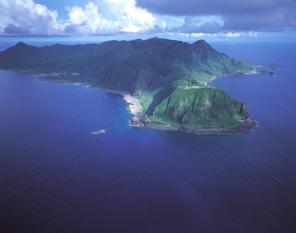
 |
| Orchid
Island located in the south-east of Taiwan |
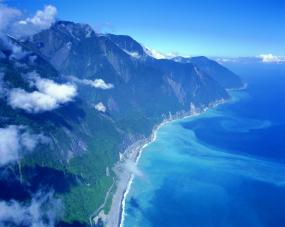 |
| Clear
Water Cliff located in the east of Taiwan |
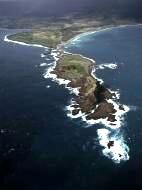 |
San-Shen-Tai
peninsula in the east coast of Taiwan. Legends of three
immortals. |
|
Off
the eastern coast of Asia lie the mountainous island arcs of the Western
Pacific. Taiwan, with a total area of nearly 36,000 sq. km, is the largest
body of the island chain between Japan and the Philippines. The island of
Taiwan is roughly shaped like a tobacco leaf. It is 394 km long and 144 km
broad at its widest point.
| |
 |
| |
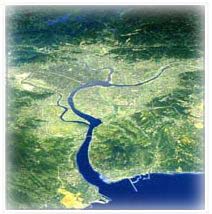
Pictured
is an areial view of the Taipei basin, location of Taipei City.
(Courtesy of the Center for Space and Remote Sensing Research,
National Central University) |
| |
|
Taiwan is separated
from the Chinese mainland by the Taiwan Strait, which is about 220 km at
its widest point and 130 km at its narrowest.
The surface geology of the island varies in age from very recent alluvial
deposits to early sedimentary and crystalline rocks. The structure,
relatively simple for the most part, is formed by a tilted fault block
running roughly northeast to southwest along the entire length. The steep
slope of this tilted block faces east and the rock mass slopes more gently
to the west. This block is composed primarily of old rocks, some of which
have been subjected to heat and pressure. Because of the terrain, scarcely
more than one-third of the land area is arable. The mountains are mostly
forested, with some minerals - chiefly coal - at the northern end.
The
population of the ROC stood at 21.74 million as of December 1997. At 601
persons per square kilometer, the population density of the Taiwan area
was the second highest in the world after Bangladesh. Taipei City, which
covers 272 sq. km, is Taiwan's most crowded urban area with 9,560 persons
per square kilometer. Kaohsiung City (154 sq. km) is next with 9,350
persons per square kilometer, and Taichung City (163 sq. km), the third
most populated area, has 5,519 persons per square kilometer.
|






 Geography