 Amphibians
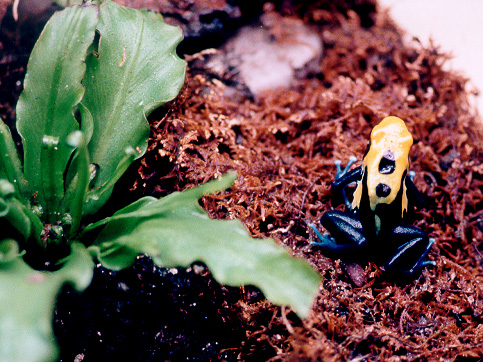
Amphibians are cold-blooded vertebrates which hatch as fishlike eggs and transform into an adult that can live on land. Frogs and toads are examples of amphibians.
Body Parts:
Amphibians use their tongues and smell out their food. They also use their tongues to grab at the food. They have a small vertebrae, a skull, and what is called a petoral girdle, or a pelvic girdle.
Reproduction:
Reproduction in Amphibians is very interesting. The eggs, which may be laid on land, in a hollow log or cupped leaf, may even be carried by a parent. They hatch into miniature version of the adult. Salamanders fertilize their eggs internally. The eggs of frogs are laid in water and are fertilized externally. They hatch into gilled larvae called tadpoles. Tadpoles develop lungs and turn into frogs.
Digestion:
Frogs are carnviores and the structure of their mouth reflects their feeding habits. Frogs do not use their teeth to chew their food, but they use them to hold their food. Their tongues are attached at the front of the mouth. This allows the frog to flick its tongue out and capture the flying insects. The frogs eat the food whole. They push it back into the gullet. Then it goes into the duodenum which is the small intestine. The liver is a large organ near the stomach. The liver produces a substance called bile which helps the diestion of fat. Food goes through, ends up in the urinary bladder, then comes out as waste.
For information:
Amphibians
http://www.gpnc.org/amphibia.htm
http://taxodium.env.duke.edu/wetland/amphibia.htm