In 1944 the Clay County Courier reported that the Clay County Rice Growers Association of Knobel had secured 150 German was prisoners to use in the rice fields. A camp was built south of Knobel in which to house the prisoners. The prisoners were necessary to help harvest the rice since so many young men of Knobel were in the United States Army.
The camp at Knobel was a branch work camp of Camp Robinson. The POW's who worked at Knobel were the famous African Corps of Erwin Rommel. The Geneva Conventions regulated the treatment of the prisoners. The Geneva Convention prohibited prisoners from working at any job which would be of danger or at any job related to the production of war materials. The German POW's therefore were given mainly farm work to do. Since the main crops of Arknsas and Germany differ so much, one can imagine the bewilderment of the men faced with cotton to pick or rice to harvest.
Most communities were happy to receive the help of the prisoners but were apprehensive about them living close to their towns. The students in the Sophomore English class have conducted interviews with people of the community who associated with the prisoners to determine the feelings of the people of Knobel toward the prisoners.
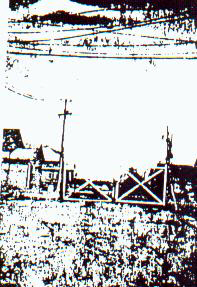
The interviews were taken by the Knobel High school Sophomore Class of 1981.
Glen Catt hauled the prisonersto work for Cecil Eaton. They were clearing ground for rice on what was known as Fisher Farm located where Gibbs Seed Company is now.
They did their clearing with an ax and a cross cut saw. If the found a tree with bees or persimmons, they would would get the honey and persimmons from them.
They would rob the bees tree without any protection from the bees. It was believed that they made some kind of wine from the persimmons becausie it didn't matter if they were green or ripe, they still took them.
Glen hauled 40 prisoners in a truck with side boards. He earned ten cents a prisoner. He would pock them up at 8:00am and take them back to POW camp at 5:00pm. An interpeter and guard would ride in the cab of the truck with Glen.
The interpeter would have some kind of trinket he would trade for cigarettes. The guard was freckled face and had red hair, They called him Red.
Glen also worked with the prisoners on a rice farm for John Brown on the Locust Road. Instead of having combines like we do today, the rice was tied in bundles with a machine simular to a haybailer, then the prisoner would stack them in shocks. Later the bundles were loaded on the trucks.
Glen Catt had a team of mule colts. One of the prisoners really liked the colts. He would call them ponies. The colts had cockleburs in their hair really bad, and the prisoner would pick them out and the colts would not even move.
One of the prisoners was a paratrooper or something simular in the German Army. He would get excited when an airplane would fly over. He showed pictures of his wife and 2 kids. When he got home from the United States, he would still have to serve 2 more years in the German Army before he would get to go home.
Some of the prisoners worked at a sawmill, for Bob Colman, located out by the Knobel Y. Ed Thompson was a foreman. The prisoners would stack ties and load trucks.
Once a supply truck from the POW camp took out on its way to Paragould. Glen Catt pulled it to the camp. He got to go up in the camp and meet the Captain and the Sergent.
It is believed four escaped from prison. One had folks in St. Louis and went there but was brought back. Two came back on their own, and one was shot.
Glen Catt also hauled some of the supplies from the prison when the prisoners were removed. John Byers bought some of the supplies. One of the reasons the prisoners were brought to Knobel is because so many young men from around here were in the Army, and the farmers needed help to get the crops in and out.
Some of the farmers who used the prisoners were, Charlie West, Cecil Eaton, John, Obie Duncan, Joe Sellmeyer, Gordon Baldwin, Don Byers and C.L Ricker.