
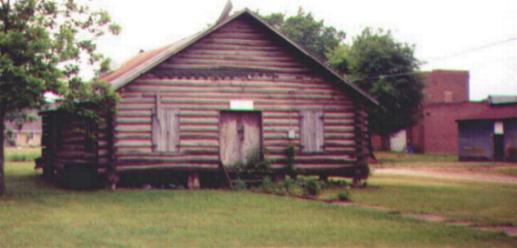
Veterans of past gather in Knobel for a ceremony to place a wreath on the door of the Legion Hut for Veterans Day, 1997.
This is the only activity at the building in years, with the exceptions of replacing a board or repairing a hinge.
"We want to place a wreath on the door as part of this year's salute to all veterans of the area who have served their country," says Post Commander Jack Bode. For 35 years, Bode has the postion of Commander. He keeps the Charter of Knobel American Legion in active status with the organization.
The oldest member is Hurley Tyler. Other members are Commander Jack Bode, Noris Boyd, Buford Green, Leroy Barnett Jr., Jim Holland, Bill Hancock, Martin Hancock, and Joe Sellmeyer.
Organized as Sinks- Crumb American Legion Post Number 0072 just after World War One, This post has been an active organization in the past, and the building they constructed has served the community in various ways. Dates of its actual construction vary because records no longer exist of its early days. Some veterans talk of hearing that leionnaires met in the Baptist Church prior to building their hut. Most people agree that it must have been in the late 1920's or early 1930's.
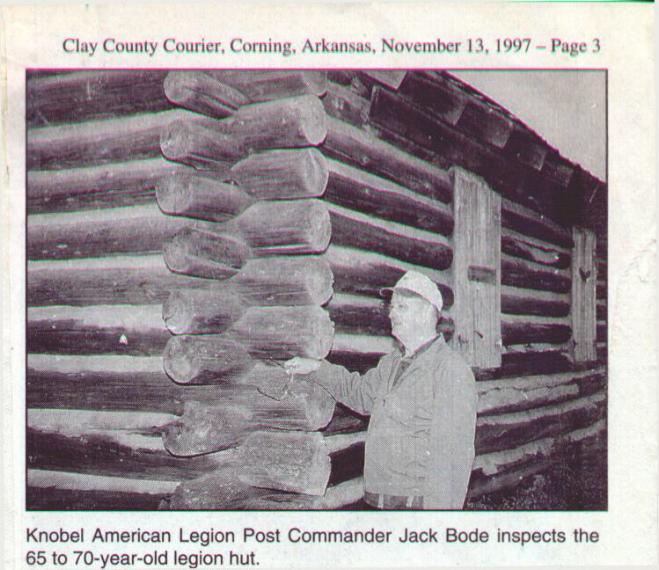
From Twaits Backout on Black River (known as Holland's Camp and Conway Camp areas), large logs were pulled to Knobel and the hut was built. Several years ago the homemade shingle roof could no longer with stand the elements, so it was replaced with tin.
In Conversation with Mrs. Lula Bullington and Clyde Boyd, they both remember the building serving as headquarters for making cotton mattresses and the area survived the throes of the depression. After a room was added to the rear of the building, a canning factory began operation. Some folks say tomatoes were canned on the premises for years after the Extension Service representatives visited the Knobel area and gave pressure-cooker classes.