| Pre-War Developments |
 |
 |
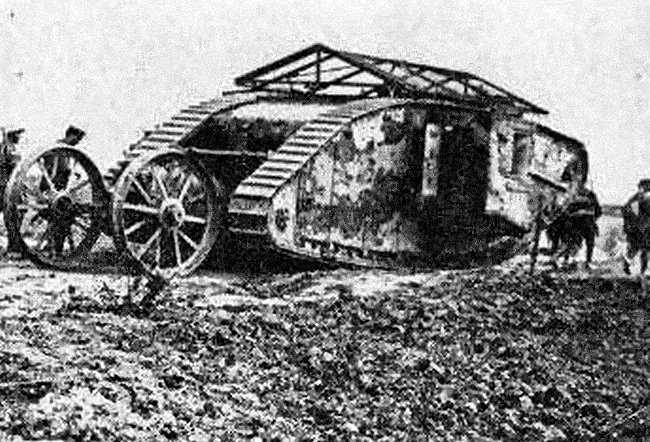
| The original tank, the Mk.1 of the First World War. It was invented to break the stalemate of trench warfare. |
| The origins of the tank lie in the trench locked warfare of WWI. All sides of the conflict discovered quickly even when you massed enormous numbers of troops to assault enemy trench fortifications you could almost never break their lines. Even when you amassed immense artillery support, it had little effect on the outcome of battle. Both sides made very little progress even with the largest possible offensives. This led to the invention of the tank. The tanks was designed to move along with the infantry and provide them with close support using cannons and machine guns. It needed only move the speed of walking soldiers, and had to be impervious to enemy machine guns. The British were the first to produce a tank. Known as the Mark I, it is unanimously recognized as the tank of WWI, although other nations did delve heavily into the idea, the most prominent being France. When tanks were first used in battle they proved highly effective against dug in enemy forces. They were indeed invincible to machine gun fire, and no real anti-tank weapons aside from basic artillery existed to stop them. The British and French massed more tanks and launched larger and larger assaults. Most of these were successful, and were only stopped when the tanks got bogged down, ran out of fuel, or out paced their infantry escort. |
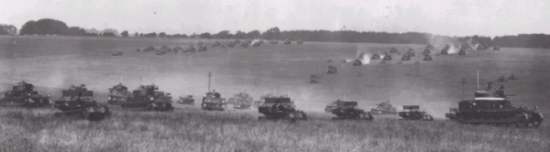
| Much could be learned from these war time experiences, and two main trains of thought emerged after the war. One strategy dictated that tanks should be used in their traditional role, working solely as a partner of infantry. They would provide close support, and be detached in small groups so as to give as much coverage as possible. The other more revolutionary thought that an entire new structure was needed for this immensely powerful weapon. It said that while tanks needed the support of infantry, they should be massed to best enhance their effect. They should also be given full use of their mobility, ranging far and wide against the enemy, and striking before a defense could be organized. The effectiveness of this new strategy was clearly proven during a famous military trial held by the British military at Salisbury Plain in 1930. In this trial a revolutionary mobile Battle Group was pitted against a standard Infantry formation of much greater strength. One of the revolutions of this battle group was the inclusion of an intricate radio network. The long the short of the battle is this, the mobile group, although greatly out numbered, soundly defeated the traditional infantry formation. |
| When the second world war did break out, the national armor strategies were clearly shown. Germany�s invasion of France is the best among many examples. It was here that German tank formations took on Frances armored units. Germany chose to concentrate all of its armored divisions on a single point in the front. Massed against them were the spread out tank battalions of France. At this point in the war the majority of German armor was outdated models, Mk.1�s, II�s, and Czeck Pz. 35�s and 38�s. France possessed a large number of superior tanks, but these, spread out as they were, had no chance of meeting the concentrated German armor, or even organizing effective counter-attacks. If there was ever a pivotal instance that proved the concentrated use of armor, it was this. |
| British tanks and armored personel carriers manuvering on Salisbury Plain during exercises in the early 1930's |
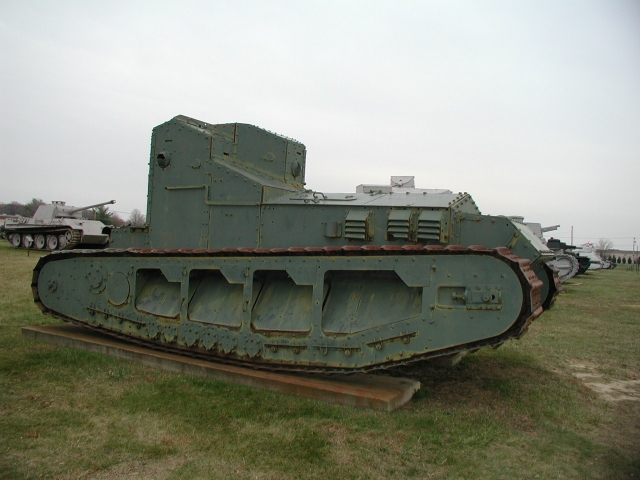 |
| Another crude but effective WWI tank, the British Whippet |
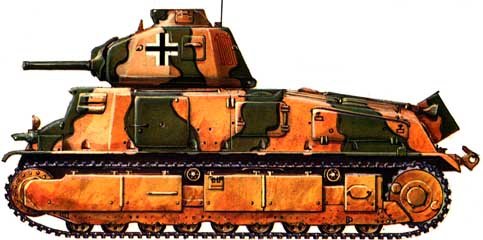 |
| The end result of the France campaign was this, Frances supierior machines were divided and conquered. Here a captured SOMUA S-35 is put into German use. |