| Scale of Military Units |
| In order too fully understand the order of battle of an armored division, you must understand the scaling of military units. Because each different military uses different numbers of men and machines, an exact number can't always be given, but most militaries follow similar lines, so you can roughly estimate the number of men in any given unit. In an armored division the smallest possible unit is a single vehicle, or a Section, which is usually comprised of 2 tanks. Two sections are formed together to create a Platoon. Likewise 3 or 4 platoons are formed together to make a Company. When you reach a company level, then there are usually addition headquarters units attached. So a tank company will roughly consist of 3 platoons of tanks(12 tanks) plus an additional platoon or section of headquarters tanks. Several tank companies are formed into a Battalion. So a single tank battalion would have an armored strength of about 36 tanks, plus additional HQ tanks. Also, once battalion level is reached, additional non-tank units may be attached. These additional units could include anti-aircraft units, engineer and infantry units, and also additional tanks for reconnaissance. Additionally, several battalions are linked together to form a Regiment or Brigade. Early in WWII it was common for an Armored Division to be equipped with 2 or more armored regiments, but by the end of the war, most had only 1. This armored regiment will provide the key fighting strength of an armored division, but within that division it was also paired with many other units, such as an infantry regiment(usually mechanized or motorized), dedicated reconnaissance and engineer units, AA and AT units, and divisional HQ elements. All of these units were formed into a single mobile group that packed far more punch then a traditional infantry division, thanks in large part to the tanks it had. Further groupings are as follows. Several divisions could be formed into a Corps. Several corps could be grouped into an Army. And finally, several armies composed an Army Group. |
| Army Group ->Army ->->Corps ->->->Division ->->->->Regiment ->->->->->Battalion ->->->->->->Company ->->->->->->->Platoon ->->->->->->->->Section |
| A simple break down of military unit scale |
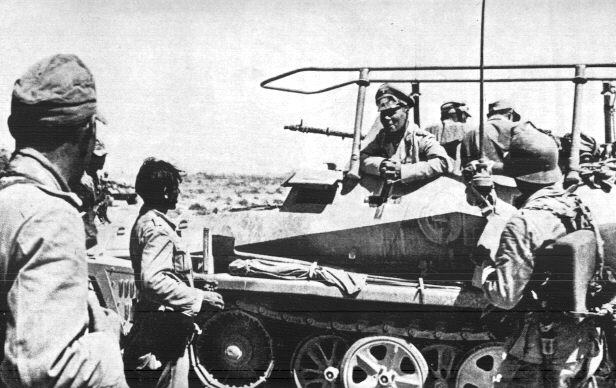 |
| The famous Panzer General Erwin Rommel, seen here in North Africa in a specialize command half track. Rommel commanded a single Division in France in 1940. By 1944 he commanded an entire army Group in the same area. |