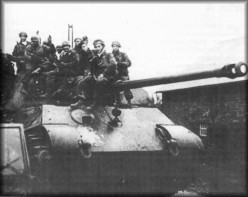
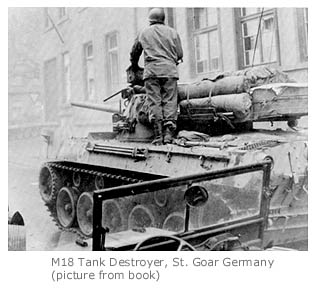
The development of the Kampfgruppe, or in the case of American units, the Combat Group or Task Force, was an important step forward in tank tactics. It signaled a significant increase in the flexibility of armored units. Although its unclear who originated the idea, or whether its applies specifically to armored formations, there is no doubt that it greatly enhanced the fighting power and elasticity of units.
The concept is a simple one. Instead of having set piece units, specifically armed and manned, multiple units would conjoin, or diverge as necessary to complete a specific task. What ever elements were required, be them infantry, armor, or artillery, would be allocated to a single command.
The effectiveness of such units was clearly illustrated on the east front, where the Germans depleted tank strength was faced with a massive soviet armored assault. When ever a Soviet force threatened to break through the infantry barrier, an armored Kampfgruppe was formed to meet, and repulse the Soviet breach. Tanks, assault guns, and mechanized infantry were formed into a single highly mobile group that could concentrate its firepower. This flexible defense worked very well, thanks largely to the mobility and firepower of the Kampfgruppe.
Another classic use of the Kampfgruppe was by the Americans during a famous POW rescue attempt ordered by General Patton. With little time at hand, a single commander was given his pick of a divisions units to form a compact Combat Group capable of performing the deep penetration mission it had to accomplish. |