| Crew Arrangements |
| The crew arrangements of WWII tanks were generally similar for most tanks. They also followed closely the arrangements in modern day tanks. The general layout of the tank and crew could and did affect the performance of the tank. Most notably the poor crew layouts in French tanks doubtlessly caused many headaches that could have easily been avoided. The key person in any tank is the commander. The commander is nearly always located in the turret of the tank. The commanders job is just that, to command the tank, or at higher levels, the formation of tanks he is leading. If the tank is well designed, the commander will have a 360 degree view of the battle while fully enclosed in the tank. This view is provided by a copula or periscopes. If these were not present, the commanders ability to monitor the battlefield were greatly hampered. Of course in any tank the best view was afforded by fully exposing your head outside of the tank, but obviously this was very dangerous in some situations. In some early tanks, the commander not only had to command, but operate the main gun, firing and loading it. This greatly hampered the over all ability of the tank, and was a weakness found in most French tanks. Sitting next to the commander in the turret was the gunner. The gunners job was simply to track and destroy targets designated by the commander. He operated the main gun, as well as a co-axel machine gun. The gunner aimed the gun using a serious of varying power optics in most cases. German tanks were well known for their superior optics, and these coupled with powerful guns like the 88mm L/56 on the Tiger I gave German gunners a distinct advantage at long ranges. The final member of the crew within the turret was the loader. His job was simply to reload the main gun. This job could be very demanding, especially when the tank was equipped with a large bore cannon. The loader had to be very fit, and also skilled at quickly reloading. His ability to keep the main gun loaded could mean the difference between life and death on the battlefield. In the front end of the superstructure of the tank sat two additional members of the crew. Usually placed on the left hand side was the driver. He controlled the movement of the tank, and responded to orders given by the commander. This was important when the tank was �buttoned up� as the drivers view could be very limited, and he had to rely on instructions given by the commander. A final member of the crew sat next to the driver. His job was to operate the bow machine gun, and also operate the wireless set. However combat experience quickly showed that the bow machine gun was somewhat ineffective. Most tanks built after the second world war did not have this fifth member of the crew. Certain exceptions to this crew layout were found. Some light tanks had a crew of only 3, or even two. Also, the French Char B1 had a full time mechanic in addition to the other crew members. However, the layout displayed above was most common. |
 |
| The crew of Sherman tank, outside of their vehicle in their respective positions. |
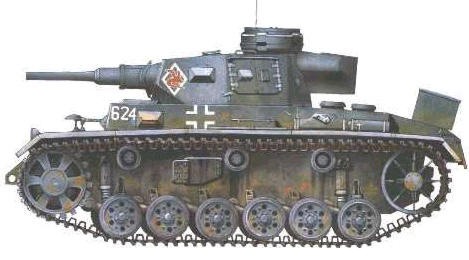 |
| The prominent copula of the Pzkpfw III is displayed here. Although they had a tendency of getting easily destroyed, the offered great visibility of the commander |