| Blitzkrieg |
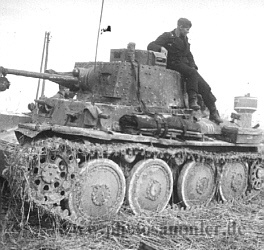 |
| The iron tip of the German blitzkrieg, the panzer. In this case a Pz. 38. |
| Blitzkrieg, or �Lightning War� is probably one of the most commonly recognized armored strategies. It was also the basis for most future mobile military tactics, and is still commonly used today, in a more refined form. Blitzkrieg originated as a German idea, authored, most say, by General Heinz Guderian. During the 20�s and 30�s while Guderian refined his strategy of blitzkrieg, there was much debate around the world about how best to employ the rapidly improving technology of the tank. Many argued that the should be parceled out in small units, and that their sole purpose was to support the infantry. However Guderian, and several others including Charles de Gualle in France, felt that tanks should be massed, to best exploit there supremacy on the battlefield. It was this massing of tanks that was one of the keys to blitzkrieg. Blitzkrieg relied on several important elements. The key element that had to be achieved was a high level of cooperation between all arms. This cooperation relied on effective radio nets, and prior cross arms training. With this collaboration achieved, that attack would take place as follows. |
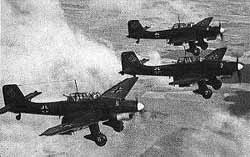 |
| Firstly close support aircraft would devastate a concentrated area of the enemy front, and destroy enemy aircraft on the ground to achieve air superiority. At the same time infantry would attack to create a breach in the line. Through this breach would move the key element of blitzkrieg, the armored division. This division would be an all arms formation on a smaller scale. It would also be highly mobile. Different break through groups would keep retreating enemy units under attack, and reek havoc among the enemies supply and communication lines. Eventually the large groups of enemy units would be completely encircled by the break through tank divisions. The German army did in fact adopt Guderian�s idea of blitzkrieg, and used it with spectacular results early in the war. The ineffectiveness of piece meal tank deployment against a concentrated effort were clearly illustrated in France. In Russia, Germany initiated what some would consider the greatest blitzkrieg, conquering thousands of miles of land, and encircling and destroying millions of Russian troops. Unfortunately for Germany�s armies, the concept of blitzkrieg in Russia was eventually self-defeating, as Russia�s lands were just too vast, and her infrastructure could not support the far ranging blitzkrieg attacks. Eventually the tables turned, and Germany was put on the defensive. The enemies of Germany had observed well, and refined their own tactics to something very close to blitzkrieg. Both America in France, and Russia conducted massive armor based assaults that ultimately led to the defeat of Germany. |
| The key element of German close air support, the Ju-87 Stuka |
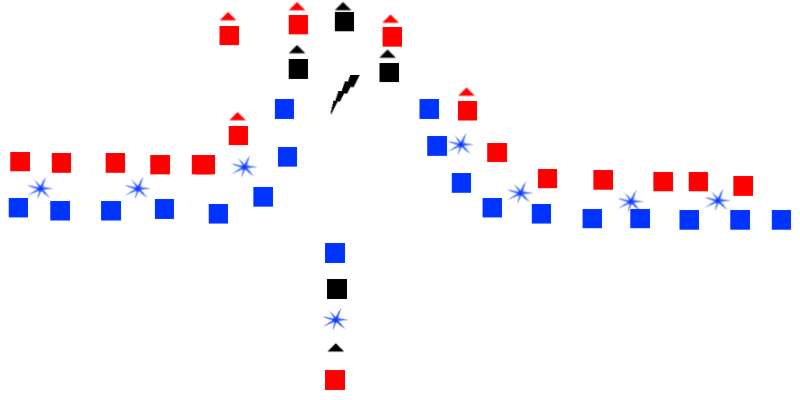 |
| Infantry Armor Fient/Holding Attack Advance/Retreat Enemy Unit |
| Blitzkrieg Basics |