| Ammunition |
| Throughout the Second World War tank guns advanced as armor became thicker. Larger caliber guns fired heavier rounds, while longer barreled guns pushed the shots out faster, increasing the energy carried by the round. Advancing right along side the gun technology was the shell. The first armor piecing rounds, or AP, were very straight forward. A solid metal shot, containing no explosives. This round relied solely on its energy and ability to retain mass to penetrate the armor of enemy tanks. Gradually it was discovered that this round was inadequate, and that there were many ways to improve its penetrating power. The first improvement lead to the Armor Piercing Capped, or APC shot. This was a simple modification of the AP round, it added a soft metal cap to the nose of the shot that helped prevent the break up of the round, especially on sloped armor. This increased its ability to get through armor. The next improvement came with a simple application of aerodynamics. If you increased the velocity of the shot, its energy was increased, and so then was its penetrating ability. The adding of an more aerodynamic cap on the front of the round increased its velocity. This type of round was known as the Armor Piercing Capped Ballistic Capped shot, or APCBC. Thus far all the shots discussed have relied on sheer energy and momentum to penetrate. This type of shot needed a high velocity, the faster it went the better it penetrated. Certain cannons, however, did not fire their rounds at high speed, thus a different kind of round was invented. Chemical rounds relied on the projecting of an explosives in a small concentrate stream when the round contacted armor. This was done with the use of a shaped charge. The most common chemical shot was the High Explosive Anti-Tank, or HEAT round. Another was of increasing the velocity of the cannon shot was to put a sub-caliber round into a sabot, a discarding cup like device that fit the small round into a large barrel. When the shot exited the barrel, the sabot fell away, and the shot continued on at a very high speed. This type of round was known as a Armor Piecing Discarding Sabot, or APDS. This became one of the most effective ways of increasing shot velocity, and is still commonly used today. One further improve was accomplished by simply increasing the quality and hardness of the metal used in AP rounds. APCR, or Armor Piercing Composite Rigid shots contained a core of Tungsten, much harder then normal metal, and this added to its penetrating effect. |
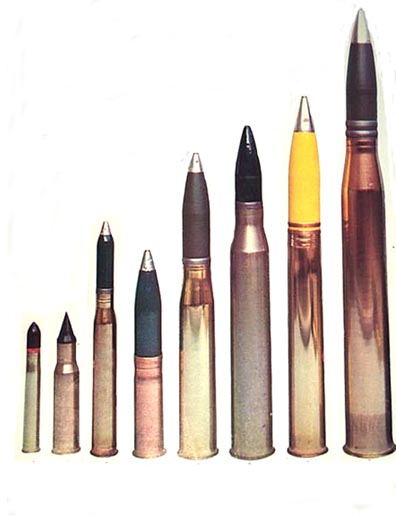 |
| German tank ammunition. From left to right: 37mm, 50mm(L/42), 50mm(L/60), 75mm(L/24), 75mm(L/43 and 48), 75mm(L/70), 88mm(L/56), 88mm(L/71) |