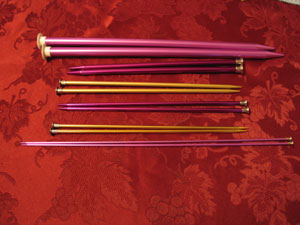
| These are your basic metal knitting needles. Needles come in a variety of sizes. When you buy your yarn, look at the lable - it will show the recommended needle size for that particular yarn. Of course, you are free to experiment with different size needles to see how the stitches look with whatever yarn you are using. Typically, the bulkier the yarn, the bigger the needle you will want to use. |
 |
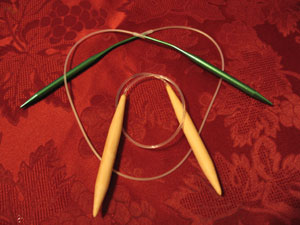
| These are circular needles. They hold more stitches than the straight needles, and are great for larger items such as afghans or sweaters. Again, they are available in a variety of sizes and lengths. You can also use circs to make hats (among other things) without having to seam. |
 |
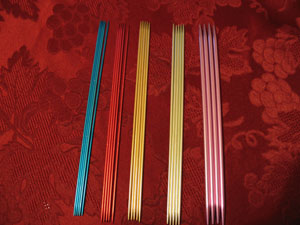
| These are double pointed needles, and again, are available in many different sizes. Like straights and circs, you can get metal, bamboo, even plastic. You can get different lenghts also. One store may not have many choices, so if you can, visit a few different places. The internet is a great place to find needles that stores may not carry. |
 |
| Below are some tools you will find useful when knitting. Along with these items, I also recommend that you have a small pair of scissors, and a few sizes of crochet needles. If you drop a stitch, the crochet hooks make it a lot easier to correct the mistake. The crochet hooks can be used to create a very pretty bind off also, or you may want to crochet a border around your knitted project. I also like to carry a small notebook and pen in my knitting bag to jot down ideas, or to sketch afghan designs, etc. |
 |
 |
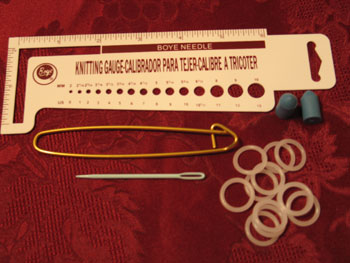
| Pictured above is a guage counter with needle size checker, (which is a great help if your needles do not have the size marked on them) a tapestry needle for weaving in loose ends or sewing pieces together, stitch markers, a stitch holder, and needle point protectors. |
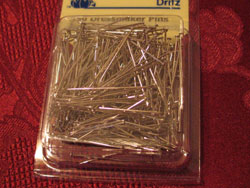
| Blocking pins -- You can use any kind of pins or needles you like, but you should make sure that they won't rust. Typically when blocking, your item will be wet, and rusty pins will ruin your project! |
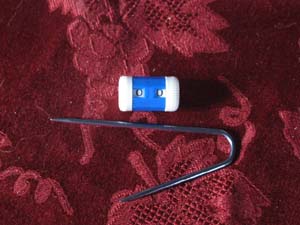 |
| Here we have a row counter and cable needle. There are several different kinds of cable needles; this one came with a kit I bought. I prefer to just use a DPN (double pointed needle) when doing cables, because I don't like how this one is curved. Row counters are an optional tool to have - you can always just keep track of how many rows you have done with good old pen and paper. |