THE FIRST FIFTY YEARS
Washington Council was organized at a meeting held in the Washington Light Infantry Armory on the spring night of April 25th, 1897, according to a Washington Post Account . 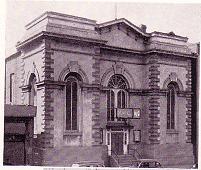 However, our first permanent home was the sturdy and dignified structure at 606 "E" Street, N. W. which boasted a splendid pipe organ and a commodious meeting hall, one of the finest in the city. Our founding members held their first assembly there on July 22nd, 1902. The Typographical Temple on "G" Street and later Carroll Hall further along the same street served as temporary accommodations for the fledgling Council in the interval before the "E" Street building was occupied. The fact that the new permanent headquarters was formerly a Baptist Church perhaps furnished early evidence of the Council's astonishing ability to forsee the coming Ecumenical movement.
The prominent firm, Parker, Bridget and Company, largest men's clothier in the city at the turn of the century, is best known to members as the home office of the first Grand Knight, Bernard M. Bridget (1861-1923). One of those first initiated by the fledgling Council was a member of the Papal Zouaves which participated in the armed conflict that led to the annexation of Rome to Italy in 1870. Somewhat remote from such scenes, was the outbreak of the Spanish-American War and the participation in that struggle by many Council members. The dues of these members were paid by the Council during their absence and at least three members repaid the kindness by presenting the Council with gavels made of wood taken from a fort on San Juan Hill and from a Spanish blockhouse at Guantanamo. A wooden cross was also contributed, reputedly fabricated from another blockhouse on San Juan Hill. Admiral Dewey's return to the capital after his victory at Manila Bay, be it noted, was the occasion for a colorful parade October 2nd, 1899, in which Council members carried red, white and blue parasols and lighted lanterns.
The patriotic sentiments of the Council were further demonstrated by the despatch of a letter of sympathy to President McKinley after he was shot at the Buffalo Exposition. Nor did the Council neglect its deeply religious character as witnessed by the small bows of purple ribbon worn by members for 30 days out of respect for the deceased Pope Leo XIII.
A close relationship was from the beginning maintained with Catholic University and the Franciscan Monastery. The University and the Monastery furnished distinguished and able speakers for the Council gatherings on many occasions while the latter supported the University in a number of ways including the donation of funds for the Chair of American History and participation in the Order's award of scholarships at the University.
The first public demonstration of the Order in Washington was held in connection with the dedication of the Franciscan Monastery in Brookland September 17th, 1899. Later the same year our Brothers served as a guard at the ceremony of the blessing of the Monastery bells.
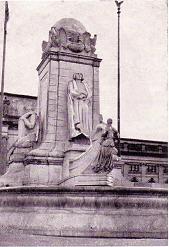 The erection of a memorial to Christopher Columbus was vigorously pressed in the early years of the century and eventually helped persuade the Government to place a statue of the Great Discoverer in Union Station Plaza where it continues to be one of the first monuments to be viewed by the arriving rail traveler. Its dedication during the Taft administration was the occasion for the outpouring of 50,000 brothers who paraded through the city to the Plaza to be reviewed by the President. President Taft later paid a visit to the K of C home on the eve of his retirement from office March 3rd, 1913.
The border difficulties and the expedition into Mexico followed by the outbreak of World War I depleted the Council's ranks while requiring the help of members in Red Cross activities, subscriptions for Liberty Loans, funds for recreation centers at the principal camps, enlisting the services of chaplains in addition to the priests in the regular corps, and similar purposes. A major contribution was the surrender of the Council's "E" Street home for the use by the armed services for recreational purposes.
The "E" Street building, permanent home of the Washington Council and four others during nearly two decades, was sold in 1921 when the Carroll Institute, a handsome Victorian building, at 918 10th Street was acquired. The new home was officially opened February 14th, 1922 after extensive improvements were made and new furnishings installed. As the Council settled into its new headquarters it could look back upon a quarter century of constructive endeavor and forward to a further 50 years of service.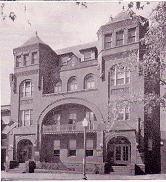
The second quarter century of Washington Council's existence began auspiciously in its newly acquired home at 918 Tenth Street. A number of distinguished guests including the late Most Rev. Archbishop Curley, attended the initial meeting held there in 1922. The cost of the commodious new building came to $117,750, a respectable sum in the solid and gold-backed dollars of the roaring twenties. The price of the building was
$65,000, while improvements, furniture, etc., plus an adjacent lot made up the remainder. (The building was later razed and replaced by another on the same site in 1963 but is no longer owned by the Knights). However, the Council's 25th anniversary celebration was not held there but at the City Club on G Street, an institution which has since disappeared from the local scene. The now familiar Barrett Box appeared at Council meetings at about this time. Named in memory of Chaplain Father Barrett, the Barrett Box has since yielded goodly sums for the Council's charitable programs from the voluntary contributions of members.
The sad passing of our first Grand Knight - Bernard M. Bridget (1861-1923) - occurred just after the Council's 25th birthday. The zeal and devotion of Brother Bridget and his worthy successors was evident in many areas not the least of which was the attainment of a membership of 1,518, the highest total reached up to that time.
One of the most popular and respected Grand Knights to preside over the Council in the mid-1920's was later to become the Rev. J. Eugene Gallery, S.J. Father Gallery's ordination to the priesthood following his leadership of Washington Council for a biennium (1925-1927) is believed to be unique in the annals of Columbianism. Though Father Gallery is doubtless best remembered as Rector of the University of Scranton, his unprecedented service successively as Chancellor, Deputy Grand Knight, and Grand Knight, gave him a special place in the minds and hearts of Council brothers. An interesting facet of Father Gallery's administration was a proposal that Catholic education be promoted by offering schooling gratis to Catholic boys and girls in parish schools. The record indicates, not surprisingly, that nothing came of the suggestion after its referral to the State Council for investigation and report. In the light of today's deepening problems of financing Catholic education, it seems almost incredible that such action was ever seriously contemplated.
The genesis of the annual custom of a week-end retreat at Manresa on the Severn grew out of a Council resolution in 1927 establishing a retreat for members there.
The depression of the thirties brought serious problems for the Council as it did indeed for all phases of American life. Decreasing membership was a major difficulty and the Tenth Street home was running a deficit. Though consideration was given to selling the building and holding meetings in the Willard Hotel, this move was not made until several years later. In an effort to stem the slide in membership, initiation fees were reduced and the reinstatement fee (for lapsed members) was lowered. Careful, not to say penurious budgeting was the order of the day and the Council was not out of debt until 1934. Despite the shortage of funds there was no lack of spirit
among members as evidenced by the appropriation of funds for the bowling team at the National Duckpin Congress held in Connecticut and the drawing held for tickets to the opening game of the 1930 season of the American League. Most probably, interest in the team was sharpened by the knowledge that the redoubtable Joe Cronin was a Brother. Indeed the interest of Council members in the Washington Senators was not a onetime phenomenon for the record shows that the leading social event in 1933 was a "smoker" in honor of Clark Griffith, President of the Club and his manager, (none other than) Joe Cronin. Turning to another and less happy event of the depression years, we find a reference to the Council's appeal for clothing for the "bonus army" then making dreary headlines in the capitol.
Although the nadir of the economic depression was reached in 1932, it was a notable year for Washington Council. Our 35th birthday fell in that year coinciding with the 50th anniversary of the Order. The national convention was held in this city to commemorate the first half-century of the founding of the Knights of Columbus. Ceremonies included a parade of members reviewed by the President of the United States and Mrs. Hoover, the Apostolic Delegate, Bishop McNamara and other notables. Other events included a special mass at St. Matthew's, the unveiling of a statue of Cardinal Gibbons erected at the Sacred Heart Church on 16th Street, a boat trip on the Potomac, visits to Catholic University, the Shrine of the Immaculate Conception and a banquet at the Mayflower.
During the last years of the 1930's disposal of the Tenth Street home and purchase of another was discussed with increasing frequency and occasional acerbity. The Council had outgrown the old building and in addition had some disagreements over finances with other tenants. The property was shared with other local councils, but Washington Council was the only one with an investment in the building (in the form of a $15,000 note). After its proposal to sell the building to the Police Boy's Club for $65,000 was rejected by the Building Company, the Council, withdrew from the property and made temporary arrangements to meet at the Willard Hotel - at a monthly rental of less than $100.
.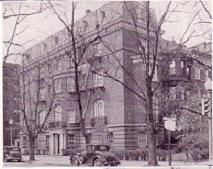 In its search for a new home the Council considered more than 40 properties. Finally the building at 1601 "R" .Street, N. W., was purchased in December 1941, but possession of the property was not obtained until a year later. Whether the sudden onset of war caused the delay was not recorded. An offer from the U.S. Government to rent the property for $400 a month was received before the Council had time to move in. It was refused, but the record does not indicate whether the offer was turned down because of its seemingly niggardly terms or because the Council did not wish to undertake a new quest for a home, In any case, after necessary repairs and refurbishing, the new home was blessed by Msgr. Guilday March 14, 1943, and the first meeting was held there two days later. Purchase price of the new quarters was $27,500 and repairs, furnishings, etc. came to $27,643.51. A modest investment by today's elevated standards. Among the amenities of the new surroundings was a pool room on the fourth floor. Incidentally membership at that time stood at 1,086(as of May 1, 1941).
World War II brought its problems and opportunities for service. Following previous practice, dues were waived for those members who entered military service. Contributions were made to the U.S.O., the Community War Fund and other patriotic causes and the Council handsomely exceeded its quota in the War Bond campaign. Members responded generously to calls from the Blood Bank. One generous effort by the Council would scarcely meet with the approval of the Surgeon General today: the donation of cigarettes to members of the Armed Forces by the "Casey Committee." The War came to an end and appropriate certificates and the grateful thanks of the Council were given to members returning from service.
The fiftieth anniversary of the Council, celebrated by a well planned program of events came two years after the close of the War. A "Home Comming" meeting was held March 25, 1947, in the Council home and the use of three floors was necessary to care for the enthusiastic gathering of the members. A particularly gratifying feature of the meeting which was addressed by Senator Danaher of Connecticut was the burning of the mortgage on the home. The schedule of events included an Anniversary Dance at the Statler Hotel; a Father and Son Night at Catholic University (where Clark Griffith made himself eternally popular with the youngsters by handing out free passes to baseball games); a Memorial Mass at the National Shrine of the Immaculate Conception followed by breakfast at Catholic University; Third Degree Exemplification; a State Council celebration at the Tenth Street Hall. This formidable series of events was climaxed by an Anniversary Banquet at the Mayflower Hotel on April 26 and the older members say that the opulent dinner was well timed -- it followed the end of the War by a decent interval so that members did not have to cope with wartime shortages of certain stimulating refreshments.
Return to History