Allan McMahon
Allan McMahon was a former Australian rugby league test player and
a former coach of the Newcastle Knights and Illawarra Steelers.
He was a member of the 1978 Kangaroo Tour, and played a total of 148
games for the Balmain Tigers, Newtown Jets and Canberra Raiders.
McMahon was the first coach of the Knights, who joined the NSWRL in
1988. He was sacked during the 1991 season, and later coached the Illawarra
Steelers. Despite signing a three-year contract, he was sacked at the end
of the 1996 season, his first at the club.
Allan McMahon died in 2003.
The Beginning - A team from the Newcastle and Hunter
district played in the NSWRL premiership in 1908-09, figuring in the 1909
semi-finals. The side wore colours of red and white. The regular
train trips to and from sydney for away games became a chore, which coupled
with the growing interest in the game back in Newcastle, meant Newcastle
only lasted two years in the NSWRL premiership. They withdrew after
the 1909 season to start their own competition the following year.
During the Newcastle competition their were significant highlights such
as wins over the touring British Lions in 1954 and 1962, and Newcastles
triumph in the 1964 state cup. In the late 1970's, their were proposals
to join the Sydney based competition. When the motion for fielding a team
arose all 36 Newcastle delegates voted against fielding a team in the Sydney
premiership. Newcastle had a strong competition at this stage at this stage
but gradually all the good players from Newcastle were being poached by
the Sydney clubs to play in their competition. The impending demise of
the Newtown Jets was seen as an opportunity to partly resurrect one of
rugby leagues oldest clubs and accomodate Newcastles ambitions. In
1981 it was proposed that the "Newcastle Jets" play half their home games
in Newcastle, the other half at Henson Park in Sydney. This proposal
never got off the ground. Newcastle had been expected to join the
Sydney based competition in 1982, but fumbled the opportunity allowing
Canberra and Illawarra to join.
Again the idea for the re entry of a joint Newcastle team was floated
by Novacastrian sports commentator Leigh Maughan in an article in the Newcastle
rugby leagues official program. Maughan suggested that rugby league
should not be left behind by the regions others major sporting teams, who
were gearing up to play on the nations stage in basketball and soccer.
Gradually, the delegates were starting to be won over about the idea of
having a Newcastle side in the Sydney premiership. Maughan enlisted the
support of Michael Hill, a Newcastle solicitor and former Nsw sheffield
shield cricketer, who would emerge as one of the clubs and the games adminsitrative
power brokers for years to come. Maughan and Hill were elected
to the Newcastle rugby league board in the early 1980's and found it easier
gaining support from the delegates by working within the system. Newcastles
proposal for acceptance by the NSWRL was re jected in 1985 and 1986.
Less than two years later, facing a threat from the expanding boundaries
of the Victorian (now Australian) football league, the rugby league
brains trust announced the premiership would be expanded from 13 to 16
teams in 1988. Finally in April 1987 approval was given for a Newcastle
based club to join the Sydney based competition. Joining Newcastle
were teams from Brisbane and the Gold Coast, as the sydney-based rugby
league empire began setting up interstate outposts.
Allan McMahon, a former Australian representative
winger and fullback, won the highly sought after position of Knights coach
while hew as employed with the Canberra Raiders as reserve grade coach
and moved to Newcastle in 1987 to prepare the knights for their inaugural
1988 Windfield Cup season. The Knights won five matches, drew one
and lost 15 matches in the season to finish 14th, and the following year
had 11 wins and 11 losses to climb seventh position. McMahon made
it to play off contention in 1990 but the Knights slipped at the final
hurdle, being beaten by Balmain in a play off match for the fifth position.
MaMahon started the 1991 season on a high note when full back Ashley
Gordon landed a field goal after the bell for the Knights to win the Nissans
Sevens Tournament. But after three wins and three draws at the start
of the season, the honeymoon was over for McMahon, and he resigned on July
2 after the club had been beaten 30 - 0 by Parramatta and had won only
four of 14 matches. Overall, McMahon coached the Knights in 81 matches
for 33 wins, 42 losses and 6 draws. McMahon returned to coaching
the Illawarra Steelers.
Paul Chief Harragon - Allan McMahon and his right
hand man Allan Bell are entitled to take much of the credit for putting
that 1988 Knights team together and setting the standards at the Knights
that are still maintained. Macca and Belly put in place the ideals that
are still adhered to at the knights. They picked kinds with the three T's"toughness,
Talent and plent of Tomorrows. And while the general consensus about those
first Newcastle teams was that we lacked a bit of flair out along the backs,
we were renowned as a team of hard men who certainly let our opponents
know they had been in a game. They wanted each of us to aspire to be the
player other players wanted to play with. That remains the credo for anyone
wearing red and blue. The first pre season seemed to go on forever but
it wasn't only conditioning and fitness work and the heavy, physical slog
that occupied our time through the summer of 1987 - 88. Macca and his staff
had to teach forty to fifty blokes some football fundamentals, like running
lines, running angles, how to defend, how to communicate, how to read game
plans and defensive systems and so on. It was mass education on a grand
scale and it was hard work, especially for the younger blokes on the fringes,
blokes like me.
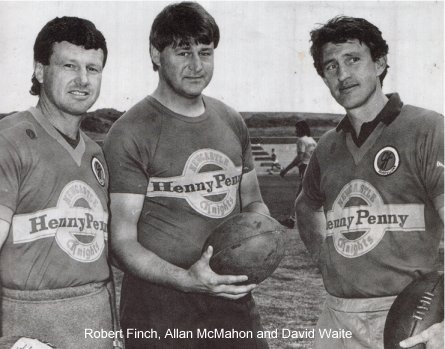 |
In June 1987 Allan McMahon and Allan Bell were
appointed to put the Newcastle team together, they had nine months and
set about training the side to NRL standards. |
Starting from Scratch
Allan McMahon stated the knights had a self imposed salary cap of $400,000
and bought a fledging club little more than unknowns, rejects and a couple
of kiwi's looking for a chance to make it in the toughest rugby league
competition in the world.
"Because of the budget of the club, what we had to do back then was
largely target those players who were the future of other clubs.
The players I'm talking about were those youngsters like Tony butterfield
and Marc Glanville, who i'm proud to say were part of the classic
event. The kiwi's looking for a chance here were sam stewart, adrian
shelford, james goulding and a couple of youngsters named tony kemp and
tea ropati. The Kiwi's also gave us the size we needed."
"And then there were the likes of Robbie McCormack and Steve Fulmer,
who both failed trialists at other clubs. They came to Newcastle
for next to nothing."
When the Knights first kicked off the majority of the available talent
was not yet ready for that level of competition. McMahon likened
those early days to a housewife on a tight budget, "We couldn't afford
to go out and buy the best, so we had to back our own. We relied on loyalty,
and the players in Newcastle are as loyal as the supporters. It was
always going to take a while to build this club, this team and this new
culture, but it had to be done."
Our town, Our turf, Our team
Newcastle does not bother pinning motivational catch phrases around
its dressing room. In fact, the only item that adorns the Knights"change
room at Marathon Stadium is a cartoon. It depicts a giant red and blue
hand reaching down to pull another hand out of the rubble of the 1989 Newcastle
earthquake. It was originally sketched by cartoonist Mick Eggleston
in the local Star newspaper after the quake. Then Knights coach Allan
McMahon had the arm coloured red and blue, and pinned to the door of the
team's sheds. They say a picture tells a thousand words and McMahon used
the cartoon as a reminder to the players of the opportunity they had to
reach down and lift the city's morale. It has been on the door ever since
and is the last thing the players see before being drowned with applause
as they run through the players"tunnel and on to Marathon Stadium.
The Formative years of the Knights club – David
Waite
David Waite explains the Knights formative years, "One phone on the
table, being shared by three guys for about three months. Now thats
tough." recalls waite, the knights inaurgural development officer and second
grade coach. Those three key men back in 1987 - when the knights
were accepted into the newly structured 16 team winfield cup along with
brisbane and the gold coast - were waite, first grade coach allan mcmahon
and marketing manager leigh maughan. All three have since departed,
but their legacy most certainly remains. When the club kicked off
in 1988 only 30 percent of local talent constituted the first grade side.
Within five years in was more than 70 percent. Last Sunday, nine
of those champions in the knights starting side had been juniors in the
local area.Waite believes the secret of their success back then was allowing,
rather than forcing, the cream to float to the top. "It was not a matter
of finding the talented kid and spending a lot of time on him, it was more
a matter of spending time with the officials who were dealing with the
talented kids. What I believe we brought to the area was a professional
approach to identifying the talent, and then nurturing it. This was
done through great coach education." Waite said.
KNIGHTS HAVE MILLION DOLLAR LOOK 23 Mar 1988,
Sydney Morning Herald
A little more than two years ago Newcastle's submission for entry into
the Sydney Rugby League premiership received a knock-back which prompted
an effort in this column on 5 March 1986, entitled: "Why Newcastle's entry
is overdue". Being a Novocastrian I was more than happy at the time to
lend what little support I could in the hope that somebody in the right
quarter might be sympathetic to their cause. One paragraph of the column
read as follows: "It is tragic that a city of Newcastle's size and
potential has been ignored when it is obvious that the people there are
keenly interested in Sydney football."
Whether my March 1986 article ever had any real effect is problematical,
but at 4.30pm on Sunday, with Balmain four points on the wrong side
of the ledger, I at last began to feel like a genuine contributor to the
Newcastle cause. With the memory of last week's win over Western
Suburbs still fresh, 24,000 Newcastle fans packed the ground in anticipation
and cheered their team to the wire. After the match, local officials
were supremely confident that it will be a record full-house crowd when
they meet the Brisbane Broncos in the next home game. Both
home games thus far have produced gate receipts well in excess of$100,000,
which is a flying start to the season in any treasurer's book. There is
now early evidence that season No 1 will produce $1 million
in gate takings for Newcastle and a future that looks as rosy as the Gold
Coast Giants' appears perilously bleak. There was never any doubt
about the potential for sponsorship and huge partisan following up there.
As pointed out in the 1986 article, the Hunter Valley Research Authority
lists the audience reached by the NBN3 television station and the
three commercial radio stations as 600,000 - a number greater than the
combined populations of Illawarra and Canberra. Knights coach Allan
McMahon told me that the Newcastle crowd have yet to learn the subtle art
of barracking properly to pressure the referees. He told me that
they've got to be educated to the "get 'em on side" chant, and the
"disgruntled roar" when the visitors feed the scrum. He's teaching them
how in his column in the local newspaper. Apart from the obvious
advantages of one city, one team, the smart businessmen and professional
people behind the Knights have allowed the coaches to buy players
and build their own teams. This was a unique opportunity to avoid some
of the dreadful problems so often dropped in the laps of coaching staff
by well-meaning officials whose desire to complete the task of signing
a playing contingent can take priority over doing it thoughtfully. There
were no contracts up there for any aging stars who were looking for a short
run to the retirement wire on a fat guarantee.
A DAY OF DAYS FOR FANS OF THE KNIGHTS
11 Apr 1988, Sydney Morning Herald
Twenty-four hours after the miracle the general manager of the Newcastle
Knights, Graham Hardes, still couldn't believe it had really happened.
How did 30,220 people endure a wretched day to watch their white Knights
do battle with Brisbane at the Newcastle International Sports Centre on
Sunday? It will go down as one of the miracles of the season, and anyone
there will not forget the atmosphere, or the loyalty of the Knights fans
who stayed on in the wind and rain when all hopes of success were lost.
Even if Newcastle don't do another thing in 1988 they are already one of
the year's success stories. "I've never experienced anything like it,"
Hardes said last night. "I've been involved in Rugby League full-time up
here for eight years, including promoting City v Country games, but there
has never been anything like the build-up or the phone calls and inquiries.
"I turned to Allan McMahon (the Newcastle coach) half an hour before the
finish (when Brisbane went an 18-8 lead) and said no-one was leaving despite
the score. "Grandstand tickets were sold out three days before the match
and the queues for outer ground tickets, when they went on sale on Saturday,
were bigger than for any Sydney grand final." He estimated that a large
part of the response was because Brisbane had never played in Newcastle
before. "I would say Wally Lewis added 6,000-8,000 to the gate," he said.
 |
"Our goal is to reach our potential. The other
goal is to have more players from which to pick, which means maximising
the number of available players in the district and have them want to play
with the Knights." Allan McMahon |
The 1988 Newcastle Knights
Graham Hardes left his full time adminstrative role with the NRL to
accept the job as general manager of the knights. One of this first
tasks was to accompany the newly appointed marketing manager, Leigh Maughan,
to sydney to register the clubs colours (Red and Blue) and the emblem.
(Knight on horse). Ken arthurson saw the artwork and loved it but general
manager John Quayle said that Brisbane had mentioned nominating red and
blue as their colours on the basis that, when combined, they made maroon,
the colour linked to Queenslands state of origin success. Still admirering
the Newcastles artwork, Arthurson replied, "well, tell Brisbane they
can't have it, Newcastle beat 'em to it."
The Knights was chosen from a long list of suggestions,
the "men of steel" image sat well with Newcastles heritage as an industrial
town. The imagery that went with the Knights emblem also assisted the cause.
Season 1988 would be called "The First Crusade", and a shiny knights mounted
on a white horse would become a feature a home games.
 |
Knights colours & logo - The
club colours of Red and Blue were picked as they are the original colours
of Newcastles first school, Newcastle East, the oldest school in Australia.
Also the famous Newcastle representative sides had played in blue jersey,
white shorts, and blue socks with red tops. The major sponsor on the jersey
was Henny Penny. The red and blue colours of Newcastle was
such a huge marketing success that within four years the regions two other
major teams (Breakers and Falcons) converted to a red and blue uniform. |
Playing staff
In June 1987 Allan McMahon and Allan Bell were appointed to put the
Newcastle team together, they had nine months and set about training the
side to NRL standards. Newcastles first pre season training camp
concentrated on the basics such as; conditioning, fitness work, running
lines, running angles, how to defend, how to communicate, how to read game
plans and defensive systems. Newcastles game plan was based on Warren
Ryans strategy of mistake free football and ruthless defence. This
strategy had won Ryans Canterbury football team back to back premierships.
McMahon looked around Newcastle for local players, however soon discovered
that most of the Hunters big time players were already playing in Sydney.
Newcastle were unable to recruit from the 60 or so current sydney first
graders in their first two years of competition. The Knights worked
on a tight budget and only bought a hand full of players from outside the
Hunter Valley. The rest of the team was made up for fringe first
graders from some of the sydney sides, a couple of New Zealand internationals
and a few local players.
KNIGHTS Team credo - "Each player aspire's to be
the player, other players want to play with."
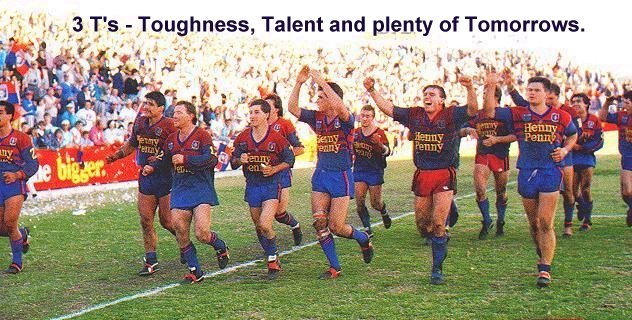
Allan McMahon (Macca) and his right hand man Allen Bell (Belly) coached
and selected the Newcastle players based
on the 3 T's; Toughness.... Talent... and plenty of Tomorrows
The Stadium - Although most of the Newcastles
rugby league die hards would have preferred the old No.1 sports Centre
as the home stadium, the board chose to invest $2 million dollars into
the International Sports Centre, later to become Marathon Stadium.
TRAINING THE PLAYERS 1987 - 88
The man in charge with the job of preparing the players was chief conditioner
and strenght coach Joe Dunnage. The goal in 1987 - 88 off season
was to make the players very fit, and to improve their strenght. The first
assessment of the players was that they were poor trainers. The first task
was assess the fitness of the players, continuous running for 30
to 50 meters was used. The location was Black butt reserve which
is a 9.5 kilometer up hill cross country run. Running of turf rather
than asphalt was surpose to prevent shine splints. Strenght
training started with the players needing strenght in their neck, shoulders,
quadriceps, thighs and arms. Pliametrics was introduced to reduce
the injury tole on the players, it develops the ability of the muscle
to stretch and contract, this strenghtens muscles around the joints so
that those muscles can absorb the shock of landing with stressing the joint.
The fibres in the muscle have been cued to accept the trauma of landing.
This type of training has also improved acceleration in the players,
along with flexibility helped diminish the incident of injury.
THE TEAM
G. Miller, A. Butterfield, S. Stewart, G. Frendo, T. Kemp, M. McKiernan,
D. Thorne, B. Quinton, R. McCormack, J. Doyle, T. Townsend, M. Glandville,
D. Boyd, G. Hanrahan, R. Tew, A. Shelford, R. Whittaker, T.
Clarke, S. Carter, J. Goulding, S. Walters, B. Shore, G. Haywood, D. Meredith,
A. Bubb, G. Foster, M. Reid. Subs - G. Mann, P.
Harragon, P. Malcolm, J. Crooks, T.Ropati, S. Seamer, D. Forward, C. McAllister.
MONEY PROBLEMS
In starting from scratch with no real assets, the approximately $2
million was needed to upgrade the ground tha build the team. The
trading result for 1989 was a loss of almost $800,000. The next year
the club lost in excess of $500,000. Despite a deeping recession
and gate fallings by $150,000 the club restricted its loss for the fourth
season to $130,000. By 1992 the club was ready to start slicing chunks
off the $2 million dollars in debt.
The First Crusade - On
Sunday, 28th February, 1988 The Newcastle Herald Challenge Cup (Pre-Season
Game) was held at the Newcastle International Sports Centre between Newcastle
Knights v Manly Warringah Sea Eagles. The game was played in high
30's, and at 4.15pm when the knights player Sam Stewart ran out onto the
International Sports Centre he was rocked by the reception. Instead of
the steep banks of the ISC being deserted, they were packed with Novacastrians.
The football starved fans had forstaken the local beaches and flocked to
the ISC to see their team play.
Before the players ran out, Coach McMahon had told the players, "There
is only one thing you have to give today, and that is your best. Thats
all." And with those words, the tension in the players would drain
and be replaced by a look of confidence. Before the kick off, the
knights players assembled in one line and moved towards the scoreboard
hill. Reaching the side line they stopped and saluted the crowd,
then turned and jogged towards the opposite sideline to deliver the same.
The fans erupted behind their team. David Waite, stated, "The emphasis
on defence was a sub conscious way of saying, geeze, I hope we don't get
a flogging. We sensed that there were people around town waiting
for us to cop a hiding. Therefore, it became an unspoken priority
for us to avoid it."
The Manly team were not ready for the game, the knights on the other
had were primed and ready to play. From the kickoff the Newcastle
defensive line hit the sea eagles with saturation bombardment that left
the visitors counting their casualities. And even when the knights
had the ball, they dished out the treatment. The Knights reputation as
a bruising, uncompromising outfit was born in the sydney based competition.
When the opposition team ran the ball up they were smashed by gang tackling
knights. Two of the players that day were Tony Butterfield, the current
captain and David Boyd, they were later referred to as the Bruise Brothers.
As the Knights players left the field for half time, they were given a
standing ovation from the large novacastrian crowd, leading 22 -6.
The end result being Newcastle 24 defeated Manly 12. The Manly match
was a victory for credability as within a few days all reserve seating
for the season was sold.
Season 1988 - The First Crusade
Newcastle Knights first premiership match was on 5 March, 1988 at the
International Sports Centre, with a crowd of 26,340. Unfortunately
Parramatta beat Newcastle 28-4. While leagues clubs in general were struggling
to get crowds to the games, Newcastles re entry into the big
time rugby league had been a runaway success. The people of the Hunter
had voted with their feet by attending the home games. A record number
of people went to the ISC on a cold and wet day to watch newcastle play
the Brisbane Broncos, 30,220 people turned up. by August newcastle had
recorded an average home attendance of 21,000 to make them the best supported
club in the league. The fans flocked to the supporters club, buying
up red and blue collectables from a selection of 200 merchandising options
to show allegiance to the cause.
First Crusade - The season
The Hunter's favourite team - 23 Jun 1998,
Newcastle Herald
The Newcastle Knights dominate the sporting scene in the Hunter Region.
It took many years before a Newcastle side was officially welcomed into
Australia's major rugby league competition. It took the efforts of such
men as the present chairman of the club, Mr Michael Hill, and the club's
former marketing manager, Mr Leigh Maughan, who for at least 10 years fought
to have a Newcastle team represented in the competition. Always in the
background, involved in the spadework and getting the club established,
were the likes of Graham Hardes and Sheree Clark.
The First Game
When the Newcastle Knights were preparing to play their first game
in the NSW Rugby League competition against Parramatta at what was then
the International Sports Centre on Saturday, March 5, 1988, four politicians
were asked to give their opinion on which team would win. The Prime Minister
at the time, Mr Hawke, said the Eels by eight points; the Leader of the
Federal Opposition, Mr Howard, also plumped for the Eels, by six points.
The NSW Premier of the time, Mr Unsworth was less generous to the Eels
but still forecast that they would win by two points, and the then Leader
of the Opposition in NSW, Mr Greiner, agreed with Mr Howard - a win to
Parramatta by six points. Their forecasts were right, but they got the
margin wrong. Parramatta won 28-4 in front of a crowd 26,340. Michael Erickson,
Eric Grothe, Peter Wynn and Steve Ella scored tries for the Eels and Ella
kicked six goals. Rob Tew became the first points scorer for the Knights
when he kicked two goals. Parramatta won the scrums 8-7 and the the penalties
were 11-10 in favour of the Eels.
The Knights listed team for that opening match was: Glenn Frendo, Brian
Quinton, Gavin Hanrahan, Glenn Miller, Rod Whitaker, Rob Tew, Steve Walters,
David Boyd, Sam Stewart (c), Michael McKiernan, Richard Clarke, Tony Townsend,
Tony Butterfield. Reserves: Marc Glanville and Peter Malcolm.
The following week the Knights, playing at Oran Park, won their first
competition game by beating Western Suburbs 20-16. This time Newcastle
scored three tries. The first try-scorer for the Knights in it inaugural
year in the competition was Brian Quinton who scored in the 31st minute
of the first half. Other try scorers were Sam Stewart and Steve Fulmer.
Rob Tew kicked three goals and Tea Ropati, one. There were only 5,011 people
to see the Knights' first win.
Next week the Newcastle Knights played their first away game, travelling
to Orana park to play the Western Suburb Magpies. A side with a tough set
of forwards and a hard to beat team at their home ground. Newcastle defeated
Wests 20 - 16. A poor crowd of just over five thousand turned up.
Round three, Newcastle played at home to the Balmain Tigers, defeating
them 20 - 16 infront of a large home crowd again, of just over 24,000.
Newcastle next travelled to Brookvale Oval and was given a lesson by the
Manly Warringah Sea Eagles, losing 44 to 12. The Manly side was full
of internationals including Dale Shearer, Michael O'Connor, Cliff Lyons,
Des Hasler, Noel Cleal, Paul Vautin. Round five saw Newcastle travel
to the Penrith Football Stadium and lose 14 - 8, in a hard slog infront
of a small crowd of under five thousand.
Round 6, Newcastle played the Brisbane Broncos in a "Wally Buster weekend",
the crowd was jammed into the International sports centre (over 30,000
attended). The knights losing 24 to 10 on a raining Sunday. The Brisbane
side had a very strong side with Joe Kilroy, Gene Miles, Michael Hancock,
Wally Lewis, Allan Langer, Greg Dowling and Greg Consecu. Newcastle
travelled to North Sydney Oval and lost 40 - 6 against the bears.
Newcastles losing streak (now 3 in a row) continued as they played the
Steelers at home, losing 24 - 16. Newcastles losing streak continued (now
4 in a row) as the Knights travelled to Caltex Field and played the St
George Dragons, losing 32 - 20.
The Knights finally won again, playing at home in Round 10, beating
the South Sydney Rabbitohs 17 to 10. Souths were a good side with
players Phil Blake, Craig Coleman, Ian Roberts, David Boyle, Mario Fenech
and Les Davidson playing that day. Newcastle played Canterbury
Bankstown in Round 11 at Belmore Sports Ground, losing 26 to 8. Mark Sargent
playing for Canterbury in this game. Playing at home to the Cronulla
side, Newcastle drew 10 all. In round 13, Newcastle travelled
to the Sydney Football Stadium and was defeated by Eastern Suburbs then
coming back home the next week and losing to the Gold Coast Giants 9 -
0.
In round 15 the Knights played the Canberra Raiders at Seiffert Oval,
losing 30 - 12. The Canberra team included Laurie Daley, Mal
Meninga, Kevin Walters, John Ferguson, Ivan Henjak, Glenn Lazarus, Steve
Walters, Bradley Clyde, Ricky Stuart. In round 16 Newcastle
beat an inform Parramatta Eels 17 - 16. But returned home the next
week to lose to the Western Suburbs side 14 - 4. This loss started
a four game losing streak which ended in the final round when Newcastle
beat North Sydney at home, 38 - 6.
The disappointed aspect of the "First Crusade" was that the Knights
did not deserve to finish last. They had battled too gamely, lost
too many games by narrow margins to be stuck with the wooden spoon.
Of the 22 premiership matches, the knights had won five, lost 16 and drawn
one. It was widely regarded as a blessing to be playing the team
the week after the knights had them, as they would still be recovering
from the defensive battering. By the end of the season no team looked
forward to the trip to Newcastle.
FANS TELL KNIGHTS HOW TO PLAY - 20 Mar 1989, Sydney Morning
Herald
Newcastle Knights supporters gave their team a clear message yesterday
-they will not put up with dull, uninterestiing football. The fans showed
their displeasure with the Knights' negative football against Canterbury
last Wednesday night by staying away in thousands from yesterday's clash
against Western Suburbs at the International Sports Centre. A crowd of
14,201 - the smallest the Knights have had for a Winfield Cup match - watched
Newcastle go all out to win back the respect of their supporters. It was
a timely message to a side that does not have the backing of a licensed
club and which relies to a major degree on gate receipts for its income.
The Knights ran in three tries, all scored by backs, to put together a
convincing 19-10 win after leading 18-0 at half-time.
Wests hit back, scoring two tries within two minutes midway through
the second half as the strain of last Wednesday night's clash with the
premiers started to take its toll. But both Wests tries came while Newcastle
had only 12 men on the field; replacement forward Michael McKiernan was
cooling his heels for 10 minutes in the sin-bin. But, more importantly,
the Knights's backs showed that once the big forwards had done their work
they could open the game up and play entertaining Rugby League. Knights
chairman Max Fox admitted that his committee expected a smaller crowd because
of last Wednesday night's drab performance. "It was probably the right
football to play against Canterbury but our supporters obviously did not
like it," he said. The good news for Newcastle is that their off-season
buys - such as Gary Wurth, Michael Hagan, Mark Sargent and Peter Johnston
- are finally starting to fit into the team.. And the club's Papua
New Guinea import, winger Arnold Krewanthy, proved just what a valuable
buy he has been. Krewanthy helped pave the way for a reserve-grade win,
then replaced goal-kicking winger Brian Quinton in the second half of the
main clash and had a blinder. Wurth said it would take time for everyone
to get to know each other's game.
"We showed today we are starting to get it together and we can only
get better," he said. The former Easts fullback was much sharper in attack
and engineered the try scored by half Steve Fulmer late in the first half.
Newcastle shut Wests out of the game in the first period with powerful
forward bursts and clever cleaning up in the backs by Hagan, Fulmer and
replacement centre Robbie McCormack. Fulmer was again Newcastle's best
player, while McCormack, called in to replace the injured Glenn Miller,
made the most of every opportunity to try to cement a permanent berth in
the side. A spate of mistakes by the young Wests backs in the first half
may have cost them the game. "You can't drop the ball 16 times and miss
14 tackles and expect to win,"Wests coach John Bailey said. "But I am happy
with the way they played. It is a young, enthusiastic attacking team and
they can only get better." Wests went into the game with Ian Schubert
on the bench and it was noticeable that once he finally got on to the field
in the second half Wests lifted their game.
"Ian simply did not play well enough in the trials to earn a place
in the side today," Bailey said. Wests' best were winger Shane Leigh, who
was involved in everything until taken off hurt in the second half, five-eighth
Dough Rawlings and young captain Cameron Blair.
IN THE LAND OF THE KNIGHTS, MASTER'S APPRENTICE IS KING
-
14 Apr 1989, Sydney Morning Herald
To his players, McMahon's wisdom and authority are beyond question.
Many of the young Knights are undoubtedly impressionable, originally greenhorns
from the bush or from Sydney's reserve grade, who have been re-assembled
into respectable first-graders in just over a season by McMahon. But then,
he had much the same effect in Canberra. In 1986, while Canberra's first-grade
coach, Don Furner, was in New Zealand with the Australian team, reserve-grade
coach
McMahon took over as caretaker coach and the Raiders played some uncharacteristically
good football. But an underground move to have McMahon eventually installed
as first-grade coach, which had the support of some senior players and
officials, foundered when Furner came to know about it. So did McMahon's
future in Canberra. When the Newcastle job came up, McMahon made it through
to the final interview along with Ron Willey. The panel seemed certain
to pick Willey, according to a Newcastle source, but changed its mind after
hearing McMahon's impassioned address. Both coaches are believed to have
been asked, among other things, what they would do if, in the middle of
the season, the Knights were missing half of their best forward pack and
were playing the intimidating Canterbury. No doubt being quite realistic,
the seasoned Willey said something like: "I'd go to church that morning
and pray." The eager McMahon instead unfolded an instant strategic plan,
detailing how he would use his smaller forwards to take advantage of Canterbury's
weaknesses. When added to a glowing reference from then-Canterbury coach
Warren Ryan that McMahon would become "the next guru coach of Sydney football",
it was enough to make the Knights take a gamble. With a neophyte first-grade
coach and few established first-graders, they might have been headed for
disaster. Yet Newcastle are a feared team in only their second season.
Canberra captain Dean Lance, who has known McMahon from their days together
at Newtown, says: "He's got them very fit, they're very aggressive, and
what they lack in skills ... they made up in aggression and attitude. They
want to do well."
McMahon's coaching philosophy and relative success at Newcastle have
been founded on teaching his tyros the percentage game - his drills at
training are innovative and geared towards recreating match conditions
- but also on building a close rapport and uunderstanding with the team.
"One thing I learnt from Warren (Ryan), he builds a very good affinity
with his players because he relives a game with them individually. I believe
that's very important, because you get closer to your player,"
Newcastle five-eighth Michael Hagan has played under Ryan and Gould.
Hagan, arguably the Knights' only truly gifted player, says that
McMahon's particular trait is his "ability to prepare you, week in week
out, and he sticks by you regardless of the outcome". "He's genuinely anxious
for the result or concerned for how we going, that he gets pretty involved
in trying to help you win the game, which is not a bad thing anyway," Hagan
says. With a side built from scratch Newcastle won only five games last
year, yet never lost hope, or trust, in their coach. Going into 1988's
last premiership round, the Knights were candidates for the wooden spoon,
along with Western Suburbs. But they didn't want its smell hanging over
them in the off-season, so, highly motivated, they thrashed Norths 38-6
and the spoon went to Wests. As Newcastle's players began celebrating hysterically
after the game, McMahon kicked everyone else out and called for attention.
When a hush fell over the dressing-room, his few words were: "Righto fellows,
that's what it's all about.
That's what I've been telling you all year. That's what you can do."
EVERY WEEKEND, A CITY'S HOPES RIDE WITH KNIGHTS - 05
May 1989, Sydney Morning Herald
The quintessential example of the outside world's perception of Newcastle,
and of Newcastle's sense of inferiority about its image, occurred when
the ABC televised a Saturday Rugby League match last year. The Knights
were playing Parramatta in their inaugural game at Newcastle's International
Sports Centre. The ABC opened the program by showing a smoke stack. It
was enough to make Novocastrians choke with rage. Leigh Maughan, the Knights'
marketing manager, recalls: "I rang them up and said: 'You dare to do that
again'. The worst part of this town is twice as good as the arse-end of
Redfern... Have a look at
the beaches, have a look at what we've got here. This is the best-kept
secret in Australia. Sure, we've got industry, but it's not the focal point
of the city any more. And people dwell on that ... the old smoky city."
Is it any wonder the Knights have galvanised the locals into a frenetic
"us against them" surge of support? In their first season in the Sydney
premiership they had the best home crowds of any team: an average of 20,660
a match, and they won only five times. Their biggest turnout was a whopping
30,220 when Wally Lewis's Broncos came to town in the wet. Newcastle officials
expect that figure to be exceeded tomorrow when the Knights, with four
wins from seven matches, play the premiers, Canterbury.
Even though this is not the top match of the weekend, Channel 10 has
deemed the Knights worthy of exposure for the first time: 30,000 screaming
fans make for better television than the 12,000 or so likely to turn up
to watch Cronulla play Penrith at Caltex Field, which normally would have
been televised. Strengthened by the signing since last season of
five-eighth Michael Hagan and prop Mark Sargent from Canterbury and
fullback Gary Wurth and prop Peter Johnston from Easts, the Knights under
coach Allan McMahon and assistant coach Allan Bell have suddenly gained
respect in Sydney. They believe they can beat Canterbury and not too many
punters would bet heavily against them on their home turf. All week the
Knights' publicity machine, orchestrated by Maughan, has been running a
campaign based on the slogan: "We'll take the Bull outta the Dogs." Feeling
between the clubs has been a little strained since they played a pre-season
Challenge
Cup match in Newcastle when the Bulldogs' chief executive, Peter Moore,
wanted more money than had originally been agreed on. Newcastle told him
to go jump, the match went ahead and the Knights won 18-16. Canterbury
promptly exacted revenge by whipping the upstarts 24-2 in the Panasonic
Cup. It's an ideal scenario for a marketing man like the irrepressible
Maughan, and he has extracted every cent's worth of publicity out of it.
Maughan explaining the campaign, he says: "We do something like that every
week - we get a little gimmicky thing and run it with the public and build
it up. "We would have come up with this anyway. Actually that blow-up over
the Challenge Cup was a storm in the teacup. But it built up some feeling
around the joint. "So this ad is certainly not caused by that. I've got
no personal feeling against Peter Moore and Canterbury and neither do the
players. That's bullshit, that's just ridiculous, we don't go in for things
like that. "But we do put out ads. Last time we were at home to North Sydney,
for instance, we billed the day as the 'Teddy Bears' Picnic'. This time,
'We'll take the Bull outta the Dogs' is our theme. In fact, I'm going to
send a copy to Peter Moore tomorrow and say, 'no offence, see if you can
stir up some publicity'."
The hype works in a Rugby League town which has produced 51 League
internationals, including such greats as Clive Churchill, Brian Carlson
and John Sattler, but had been deprived for so long of seeing the big names
from the Sydney premiership in the flesh. Before the Brisbane Broncos match
last year the Knights had thousands of T-shirts printed with a "Wallybusters"
theme based on Ghostbusters. The 30,000 crowd responded with a typically
Newcastle welcome for the
King. The Knights' biggest achievement in their short existence has
been to give Newcastle a revitalised sense of identity. Michael Hill, a
solicitor and former State cricketer who is the club's deputy chairman,
says the reaction has been "beyond expectations from the point of view
of the acceptance there has been in the community". "Just generally it's
the most talked-about subject in Newcastle," he adds. "Now, it's been significant
because it has either coincided with or been part of a revival of the morale
of Newcastle itself. Newcastle took a battering when the steelworks halved
its workforce in '83. We were later than other areas to go into the recession
in the early eighties because of all the work that was going on in the
coalmines and aluminium smelters up the valley, but because of what happened
to the BHP we were also late coming out of it. "And as we're coming out
of it now, and the morale of the place is so strong, the people have something
to get behind and support and be proud of. "You see, the team has done
it without the importation of superstars. In other words, they were able
to relate to the blokes coming here as workers. And I don't want to make
too much of the working-class situation, but they were able to relate to
the blokes as fellers who were trying and giving their best." The Knights
can call on a population of more than 500,000 in the Hunter Valley for
support. The Lord Mayor, Alderman John McNaughton, believes the Knights
are standard-bearers in showing the rest of Australia what the area is
all about. "We're very proud of them - not only the team, but everyone
behind them," he says. "It's a great community effort. It's a major community
focus."
Remarkably, the Knights raised $2.1 million last year through sponsorships
and gate takings and finished with a $60,000 surplus, for they do not have
a leagues club. The small licensed area in the grandstand at the International
Sports Centre contributed a meagre $5,000 to total revenue. Hill admits
that the club will be in trouble unless it can have its own leagues club
functioning successfully within three to five years. That is why Maughan,
a former sports commentator with NBN3 and a prime mover for more than a
decade in getting Newcastle into the Sydney premiership, places such heavy
emphasis on marketing. When it is suggested that Newcastle might be able
to teach some of the Sydney clubs about marketing, Maughan replies: "Oh,
they know nothing about it, mate. I mean, they've been in it 80 years,
and in the good old days you could throw a football team on the park and
people turned up. They had nothing to do but football, or work. "Nowadays
there's that much to do. But you've got to promote. Why shouldn't we promote
football? Cola-Cola promote the best-sold drink in the world. And we can
see it that way: as an entertainment we must compete with other entertainment
mediums. Have you seen, for instance, our beer can? We've got a Knights
logo on the Tooheys beer cans that are distributed within this valley to
the tune of in excess of 400,000 beer cans a week. "That's quite unique
in Rugby League; no-one's ever done that before. We're very proud and pleased
to be first in that. I've got another couple of things going up here in
the consumable market as well, but I haven't had them bloody passed by
those who count on the League. Quite frankly, we're a bit in front of them.
"We can do it here because we're a separate area. We don't offend anybody.
If we're not everyone's first team we're everyone's second team."
Maughan knows only too well the impact of television, which led to
the steady decline of the Newcastle competition. "Colour television changed
the attendances at home games because the grey figures in Sydney became
real people. And we had at one stage 35 of our kids playing grade down
there. Everyone was linking to Sydney on the colour TV and the attendances
fell off locally. The game would have not died, but it would have become
about a Rugby Union-type interest situation if we hadn't have got into
the Winfield Cup. "For Michael Hill and I, and others now, it's a dream
come true. We walked out of the dressing-room after the last game last
year, when we flogged Norths, honestly with a tear in our eye. And he said
to me: 'Little fella, we've lit a bonfire and no bastard will ever put
it out'."
MCMAHON ANALYSES PLAYERS WHO HOLD THE KEY = 22
Sep 1989, Sydney Morning Herald
Strategies formulated by Newcastle's coach Allan McMahon saw his Knights
defeat both Canberra and Balmain this season. Forget the obvious stars,
McMahon analyses the players who must be stopped for a win, and comes up
with some surprising names. "From Canberra's point of view, they look to
get their game going with forwards Brent Todd, Glen Lazarus, and Gary Coyne,"
McMahon said. "Ben Elias is public enemy No1. He can direct traffic to
both sides of the ruck, and throws dummies which teams always swallow,"
McMahon says. "He also often ducks at the defensive line, so lessening
the target for defenders." Elias, of course, is the lynchpin for Steve
Roach and Paul Sironen, who combine with the other forwards to give Balmain
great subtlety in the rucks. "When Balmain get their motion rolling, they
come in waves, they have close supports and back supports, and all the
forwards have good footwork at the line." The trio can can attack either
side.
Sam Stewart - Knights first 1st grade Captain
How did Alan McMahon influence your career: Living
life to the fullest, he set the tone (culture, for the Knights). Terrific
for the early years, uncompromising and tough. His slogan was "Be the player
that everyone wants to play with." I still live by those words." |
KNIGHTS BECOME THE ENTERTAINERS - 6
May 1990, Sydney Morning Herald
One wag cheekily dubbed Newcastle "the entertainers" after their committed
32-10 savaging of St George at the Newcastle International Sports Centre
yesterday. This wasn't sarcasm; this was a Newcastle fan talking and the
words made the essential point about the win eloquently. Were these the
same Knights who couldn't buy a try in a one-ticket raffle? They scored
six of them yesterday, most from quick hands, support play and the required
pace after the correct foundations had been laid. The Knights had managed
one in the previous month. Entertaining it was, but the more correct words
might have been "confidence begets confidence".
The Newcastle forwards were pushing each other out of the way to get
at the ball and power over the advantage line. That's confidence. Most
confident of all was prop Mark Sargent, who charged like a bullish joint
Rothmans Medal winner. His was a remarkable display of strength considering
he had spent two days in hospital with a debilitating virus during the
week. "We've been working at rectifying our problems," Sargent said. "We
identified what they were and today we put the answers into action. The
improvement was huge." Sargent said their resolve received extra impetus
from an incident in the opening minutes which saw hooker Scott Carter taken
to hospital with a fractured jaw. "It was an unfortunate way to get the
team revved up," Sargent said. "We were wild after that and weren't going
to give them anything." Sargent talked amid a grandfinal atmosphere but
coach Allan McMahon, the man increasingly in the gun over Newcastle's lack
of productivity, spoke minus the gloats. He pinpointed improved defence
as the reason for the tries. "We forced them to cough up the ball, which
gave us more ball to work with," he said. "They coughed up the ball early
in the game, which has been our problem." Asked about where he would fit
in captain and Queensland Origin representative Michael Hagan, McMahon
was able to ponder the classic winning coach's dilemma. "I'll worry about
that when it happens," he said.
McMahon will be brave if he separates yesterday's halves, Fulmer and
Robbie McCormack. Fulmer scored two tries and seemed to be under the illusion
he was Sargent as he charged through the St George ruck. McCormack made
Sargent-sized tackles and linked well. His has been the most courageous
effort of all these past weeks. McCormack has come back from a broken arm
so bad, retirement looked certain. This was just a day for Knights.
SALARY CAP BLOW TO KNIGHTS - 5 May 1990,
Sun Herald
The Newcastle Knights have had their salary cap cut for next season
to ensure the club curbs its spending on players. Although the Knights
have bought very few players, the club outlayed $1.8m last year in payments.
This payout is equal to the amount spent by the top five clubs in the premiership
but without the results. Newcastle is in the difficult position of surviving
in the premiership without the financial assistance of a licensed Leagues'
Club. The League, which keeps a close watch on the finances of the 16 clubs,
raised Newcastle's salary cap for this season to about $1.6m but now the
club has been told that the figure will be cut by about $400,000 for 1991.
This follows the gigantic $800,000 loss suffered by Newcastle last season
despite having big crowds at all of its home matches. The Knights have
been told of the cut in their salary cap which will be in force until the
club curbs its expenditure. After a strong start to the season, the Knights
have fallen into a hole, scoring one try in their last four matches and
at the same time the defence has deteriorated and the team has conceded
75 points. The selected team is a stronger looking one than the one which
was cannon fodder for Balmain in the last round match.
MCMAHON CAN AFFORD TO SMILE AS KNIGHTS SHINE -
20 Jul 1990, Sydney Morning Herald
A Rugby League Week poll of first-grade players in 1987 asked which
of the mooted new first-grade clubs would be a success. The poll said the
Brisbane Broncos and the Gold Coast would be successful, but Newcastle
would struggle for several years. Newcastle coach Allan McMahon recalled
the poll with relish last night on the eve of the biggest game in the Knights'
young history - the "semi-final"against Manly at the Newcastle International
Sports Centre today. He also attacked the stereotype attached to
the two combatants. That public stereotype sees Manly as the gifted attackers
and improvisors, the inventors who can create tries from anywhere. Newcastle
are the dour, aggressive, forward-dominated team of limited scoring potential
and appeal. "Our forwards have earned a lot of respect but people haven't
mentioned the Manly forwards will be a lot bigger than ours, as will their
backs. "Our forwards' success has been built on unity. They've learned
to rely on each other and work to their potential, and we'll be without
two major running forwards in Mark Sargent and Paul Harragon tomorrow."
Not surprisingly, McMahon rejects the view held by some Newcastle supporters
that the players don't realise how good they are, and consequently the
backs have
been afraid to be adventurous. "I've always had faith in the backs
and the players have believed in themselves," he said. "At the start of
the year we had problems which had to be sorted out in regard to fitness
and availability." The Knights have increasing strike power in the backs
through the likes of Michael Hagan, Jeff Doyle, Ashley Gordon and Gary
Wurth. McMahon also rejects any thought the Knights might be mentally satisfied
with coming as far as they have, just a point outside the five and realistic
semi-final aspirants should they win today. "We're not embarrassed about
how professional we are and how good we are,"he said. "Our goal is to reach
our potential." The other goal is to have more players from which to pick,
which means maximising the number of available players in the district
and have them want to play with the Knights. McMahon didn't say it, but
necessity means Newcastle must reach their potential or perish. They haven't
got bundles of cash with which to induce players. In the short term, they're
almost entirely dependent on continued success and continued spectator
support
to generate income for some seasons. The Knights' future ultimately
depends on gaining a licensed club, and hence steady income and purchasing
power.
KNIGHTS-BAGGING' REX OFFSIDE IN NEWCASTLE - 18
May 1991
Rex Mossop might be developing a cult following in some places, but
he has no following at all in Newcastle after his uncalled-for bagging
of the Knights in The Sun-Herald last weekend. He accused the team of running
one-out all the time in the forwards and of not playing the kind of football
to put bums on seats. If The Moose doesn't happen to like Newcastle's style
of football he's entitled to say so. (As important as he thinks his opinion
is, I can't see Allan McMahon losing any sleep over it). But to declare
it's not the sort of football that puts bums on seats is ridiculous. The
Knights have one of the biggest attendance averages in the league. Last
season they averaged more than 22,000 per home game. Brisbane were
the only team with a better average, beating the Knights by around 500,
but remember Brisbane has three times the population of Newcastle.
As for the idea that Newcastle play all their football running one out
through the forwards, that is, like most of Rex's opinions, severely outdated
How does he explain the fact that 10 of the 20 tries scored by the team
this season have been scored by wingers? Nineteen have been scored by backs.
John Schuster has scored six tries and Ashley Gordon five. Both are exciting
attacking players and neither scores by running from dummy-half or bashing
through the forwards. The best thing Allan McMahon can do for the
future of the game is to keep the Knights winning. And the best way he
can do that is to play to his strengths. Forward power is one of Newcastle's
strengths and McMahon would be crazy not to capitalise on that. He'd also
be crazy not to be in the market for a few more exciting, flashy backs
but, remember, he's recruiting with Newcastle's cheque book, not Manly's.
KNIGHTS BLAME PLAY THE BALLS 1 Jun 1991,
The Sun Herald
Leauge play-the-balls are taking an average 2.5 seconds this year compared
with 7.5 last year, according to Newcastle Knights' coach Allan McMahon.
Replying to questions about why the Knights have lost three games in a
row, McMahon blamed the mid-season change in rules and the faster play-the-balls.
McMahon and and co-coach Alan Bell have spent hours pouring over statistics
and changes in refereeing. Referees are heavily penalising players who
hold on to the player playing the ball. And faster play-the-balls mean
the forwards cannot now bear the full brunt of the workload in the early
tackles.
McMahon believes it is unfair that so many rule changes took place
after the season had started. "We began training last September and based
it all on last year's rules,"he said. "We went into the Challenge Cup on
a free interchange (a rule that was implemented on the Wednesday before
the first Friday night game). "Six weeks later the rule was changed from
free interchange to a maximum of six. "That was a terrible shock to a team
like Newcastle that used more than 40 interchanges per game. "On top of
that came a rule heavily penalising any infringement in the play-the-ball.
Then came the new rule barring stealing the ball if more than one player
is involved in the tackle. "The emphasis now is on mobility and athleticism
of the whole team - not just size and power that the Knights have based
their game on. "Norths, Illawarra, Wests and Easts have always paid great
attention to dummy-half running. "Now clubs such as Newcastle, Brisbane
and Cronulla are going to have to follow suit and dramatically rearrange
their style of play."
Men of Steal - Newcastle Morning Herald 1991
Captain Michael Hagan, a former Canterbury player who rated the Newcastle
pack recently as superior to the great Bulldog pack of 1984-85. John
Schuster, the former All Black centre who in June was snared by the Knights
at huge expense, has yet to play first grade, and the explanation is simple.
A gifted attacking player, Schuster said this week: "I'm having trouble
adjusting to the defensive patterns. I've missed too many tackles."
"Allan had a reputation as a Ryan-style coach ... big on defence. And we
knew that in order to build up local support, we could not afford to get
thrashed consistently early on. "He also impressed us when we spoke to
him. He was young, fresh lots of ideas. He wasn't a member of the old coaching
brigade." Moreover, both McMahon's style as a player and his personality
were consistent with the Newcastle self-perception: strong, resilient,
unpretentious. He had a major say in the players the club recruited to
begin its adventure in the Winfield Cup. He wanted young, ambitious men
whose best football was ahead of them. Commitment and dedication would
take priority over flashiness and flair; reserve grade status was meaningless
provided the player had character. The Knights were so named because they
would be "men of steel", and that is precisely what McMahon demanded. Says
a Knights insider: There are no players with God-given talent. Just guys
with guts who are willing to graft." There were two
criticisms of Newcastle during the first two years: an inability to
attack, which was disputed, and to win away games, which could not be.
According to Hagan, the decision to leave a day early gradually produced
rewards. "It's pretty well accepted now that to embark on anything longer
than an hour's journey is to give something away to your opposition," Hagan
says. "I know I despise having to go down on a bus, but by leaving a day
before... when you arrive you can play cards, walk around, have a good
feed and a good night's sleep, then the next day you're ready to play football."
Every Monday night, McMahon and the players share a drink and watch
the local League round-up at the Cricketers Arms, a pub in Cooks Hill.
Barbara Morley, wife of one of the publicans says: "The players call Allan
BFM-Big Fat Mac. They're all equals, and there's not a lair among them."
Talk about team spirit can be almost meaningless. All first-grade sides
have it but, as a result of a unique set of circumstances, Newcastle perhaps
have more than most.
Mark Hughes - As a current player enjoying
this great club as it is today I must touch on the tragic loss of our first
ever coach Alan McMahon. Tony Butterfield who was very close to Macca had
this to say. "He was a real bloke's bloke, from the first ever training
session he pulled the boys close together. He knew we weren't blessed with
the greatest ability, we would train extremely hard, but loved doing it
for him. Every Thursday night after training, it was compulsory to go to
the bar for a few squashes or the odd beer, he was a young coach, but he
wasn't just a great coach, more importantly a great mate".
I will finish by saying the main reason I enjoy
playing for this club is the way the town treats the players and in return
what the player do for the town. The current crop of players know that
this started from day one and from the stories that I get from the old
boys it is Alan McMahon who laid these foundations that will never ever
be broken, we all thank him for this. |
Former league international dead at 47 - By
James MacSmith, May 25 2003
Allan McMahon - Former rugby league international Allan McMahon
died suddenly yesterday after suffering a massive heart attack in his sleep.
He was 47. McMahon was the inaugural coach of the Newcastle Knights
in 1988 and coached Illawarra for a year. He was a prominent member of
the Newcastle and Wollongong communities and played on the 1978 Kangaroo
tour and for Canberra, Newtown and Balmain. Tributes flooded in from
former teammates after hearing of his death at his home in the northern
Wollongong suburb of Fairy Meadow. Former Kangaroo and media personality
Matthew Johns said: "He contributed so much to the [Knights] football club
and the community. The standards he set and expectations he had are still
a big part of the club and the reason it has been so successful. He was
always so encouraging."
Former first-grader and now player manager Brian Satterly coached McMahon
and was also an assistant coach alongside him. He said he would be sorely
missed. He was bigger than life itself," Mr Satterly said. "He was
always smiling and having a good time. He had a big influence on a lot
of people."
McMahon stood aside as chief executive of the Westpac LifeSaver Rescue
Helicopter Service's southern region in February 2002 while police investigated
its fundraising and business dealings. Two months later he was asked to
resign by board chairman Alan Tippett as a result of a Department of Racing
and Gaming finding against him, which said McMahon "inappropriately" handled
a raffle. "I want to stress that there is absolutely nothing to suggest
that funds had been misappropriated and every cent raised by McMahon went
to the service," Mr Tippett said at the time. McMahon is survived by wife
Glenys and children Greg, Alana and Kayla.
Allan McMahon Shield - In honour of former
Balmain International and Newcastle coach Allan McMahon, the two sides
(Newcastle and West/Balmain) will play for the inaugural Allan McMahon
Shield. McMahon suffered a heart attack and died in May and his wife Glenice
will present the shield to the winning captain after the game. Knights
coach Michael Hagan said much of the club's current success could be attributed
to their inaugural coach. "Allan McMahon instilled in this place a set
of standards that the club has been able to build success upon," he said.
Yesterdays hero - The Herald, 31 May
2003
The full time siren sounded too early for Allan McMahon. Yet
15 years after he helped launch the Newcastle Knights as the clubs inaugural
coach, McMahons legacy lives on in the men who wear the red and blue and
the fans who support them with such passion. It did not surprise
to read that tough men shed tears last week when they learned that McMahon
had passed away so prematurely, at the age of 48. "Macca" gave those men
their start and helped make them what they are today. It was also
no surprise that Knights Chairman Michael Hill labelled McMahon "the single
most influential figure in the history of this club".
McMahon was, quite simply, the perfect man to lead the Knights in their
first crusades. Ironically, the former international utility back
was not even the clubs preferred choice, winning his start only after Warren
Ryan, then coaching Canterbury, rejected the Knights advances. McMahon
was entrusted with building a club from scratch on a shoestring budget.
For that foundation season he was allocated $450,000 - roughly what andrew
Johns earns from the Knights each year - to recruit an entire squad.
Fellow newcomers Brisbane kicked off with a star studded line up, while
the Gold Coast spent extravagantly on big names who failed to deliver.
The Knights, meanwhile, invested in youth and unearthed some rare gems
in the bargain basement. Their first intake of recruits yielded Paul
Harragon, Tony Butterfield, Robbie McCormack and Marc Glanville.
A year later, they added Mark Sargent and Michael Hagan.
In those days the Knights had no full time players. They would
work during the day and train under dodgy floodlights in the evening.
There were no superstars and no egos. Just an inherant unity and
pride in what they were achieving. The Knights big - albeit unofficial
debut was in the 1988 Herald Challenge Cup pre season clash with reigning
premiers Manly. The Sea Eagles were stacked with internationals.
Across the hall in Newcastles dressing room were unknown. With 20,000
fans crammed into the remodelled ISC stadium, the young Knights were
entitled to be nervous, but McMahon's pre match address put them at ease.
"There's only one thing you have to give today, and that's your best.
Thats all."
Riding a wave of emotion and Novacastrian pride, the Knights humbled
Manly 24-12. Nobody who was there that sweltering February day will
ever forget it. There were many other milestones in McMahons tenure.
The last round shellacking of North Sydney in 1988, which helped Newcastle
avoid an undeserved woodn spoon. Scaling the ladder in 1989, the
memorable play off for fifth place with Balmain in 1990, and the stunning
triumph in the 1991 Nissan Sevens.
In thos days, almost every Newcastle victory was considered an upset,
but Knights fans packed the stadium and revelled in the boilovers.
McMahons teams were labelled dour and forward orientated, but they played
to their strengths. He regularly asked his players to "put their
bodies on the line" and they did so eagerly, without question. One
of McMahons great beliefs was that the Knights had to put their faith in
players with 'plenty of tomorrows'.
Sadly, there will be no more tomorrows for Allan McMahon. But
the club he helped build will continue to thrive long after his untimely
passing. And Macca will always have a special place in the hearts
of the players he coached, and the fans who cheer for them still.
Gone too soon - Game mourns the passing of Allan McMahon;
Sunday Telegraph. May 25, 2003.
FORMER Kangaroo winger Allan McMahon, the single most influential figure
in the history of the Newcastle Knights according to chairman Michael Hill,
died yesterday after a massive heart attack at his Wollongong home. He
was 48. McMahon, the Knights' inaugural coach in 1988, is understood to
have complained of a backache and of feeling ill after waking before 7am.
Within minutes, he collapsed and died with his wife Glenice nearby. His
death has stunned the rugby league community, with a number of close friends
struggling to come to terms with his loss. "I just can't believe it," close
mate Brian Satterley said. "I was best man at his wedding and we have known
each other for nearly 25 years. "It has just floored me. I met him through
football and he made a lot of friends from the game. He was one of the
most honourable blokes I have met -- his word was his bond."
His wife and three children were being comforted by family and friends
yesterday. McMahon's playing career included stints at Balmain, Newtown
and Canberra and he played in five World Cup games for Australia in 1975
and '77 and was a Kangaroo tourist in 1978. In all, he played 148 top-grade
games with the three clubs. After a lower grade coaching stint with the
Raiders, he became Newcastle's top-grade coach when the Knights joined
the Sydney competition in 1988. He was at the helm until he resigned in
1991 and, following that, he had an ill-fated one-season stint with Illawarra
in 1996. He had not been directly involved with rugby league since, spending
time with his growing family while running a printing business in Wollongong.
He also had stints as general manager of the Westpac rescue helicopter
service in both Newcastle and Sydney. Knights chairman Hill said it was
McMahon who laid the foundation which has made the Newcastle Knights club
a rugby league success story. "He is the single most influential person
in the history of this club and his passing will be met with a mixture
of shock and sadness in Newcastle," Hill said. "Macca knew our financial
limitations when we kicked off and went out in the marketplace to sign
players with toughness, determination and the will to succeed and never
give up. "The club has evolved since but those basic qualities which he
instilled in the place are what makes the Knights, as a club, what it is
today."
Last night the Knights players paid tribute to McMahon by wearing black
armbands during their match against the Sharks. The club observed a minute's
silence before the match. Wests Tigers have dedicated today's National
Rugby League match against high-flying Penrith to McMahon and Joe Somen,
who passed away during the week. Tigers chief executive Steve Noyce said
the news had come as a major shock to the club. McMahon was nominated for
the Wests Tigers team of the century and attended the gala dinner for its
announcement at Sydney's Star City casino on May 1. "It's dreadful news,"
Noyce said. "At the dinner he was catching up and reminiscing with others
from the team and seemed to be in fine spirits. "To get the news is tragic." |