
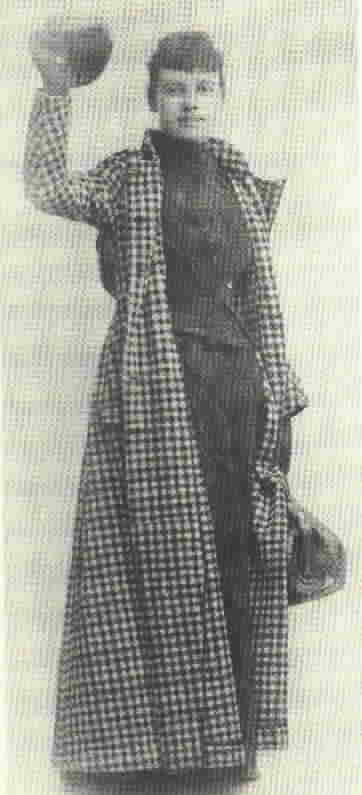
 Excerpts from Nellie
Bly’s
Excerpts from Nellie
Bly’s
Around the World in
Seventy-Two Days
CHAPTER I. A PROPOSAL TO GIRDLE THE EARTH.
WHAT gave me the idea?
It is sometimes difficult to tell exactly what gives birth to an idea. Ideas are the chief stock in trade of newspaper writers and generally they are the scarcest stock in market, but they do come occasionally.
The idea came to me one Sunday. I had spent a greater part of the day and a half the night vainly trying to fasten on some idea for a newspaper article. It was my custom to think up ideas on Sunday and lay them before my editor for his approval or disapproval on Monday. But ideas did not come that day and three o'clock in the morning found me weary and with an aching head tossing about in my bed. At last tired and provoked at my slowness in finding a subject, something for the week's work, I thought fretfully:
"I wish I was at the other end of the earth!"
"And why not?" the thought came: "I need a vacation; why not take a trip around the world?"
It is easy to see how one thought followed another. The idea of a trip around the world pleased me and I added: "If I could do it as quickly as Phileas Fogg did, I should go."
Then I wondered if it were possible to do the trip in eighty days and afterwards I went easily off to sleep with the determination to know before I saw my bed again in Phileas Fogg's record could be broken.
I went to a steamship company's office that day and made a selection of time tables. Anxiously I sat down and went over them and if I had found the elixir of life I should not have felt better than I did when I conceived a hope that a tour of the world might be made in even less than eighty days.
I approached my editor rather timidly on the subject. I was afraid that he would think the idea too wild and visionary.
"Have you any ideas?" he asked, as I sat down by his desk.
"One," I answered quietly.
He sat toying with his pens, waiting for me to continue, so I blurted out:
"I want to go around the world!"
"Well?" he said, inquiringly looking up with a faint smile in his kind eyes.
"I want to go around in eighty days or less. I think I can beat Phileas Fogg's record. May I try it?"
To my dismay he told me that in the office they had thought of this same idea before, and the intention was to send a man. However he offered me the consolation that he would favor my going, and then we went to talk with the business manager about it.
"It is impossible for you to do it," was the terrible verdict. "In the first place you are a woman and would need a protector, and even if it were possible for you to travel alone you would need to carry so much baggage that it would detain you in making rapid changes. Besides you speak nothing but English, so there is no use talking about it; no one but a man can do this."
"Very well," I said angrily, "Start the man and I'll start the same day for some other newspaper and beat him."
"I believe you would," he said slowly. I would not say that this had any influence on their decision, but I do know that before we parted I was made happy by the promise that if any one was commissioned to make the trip, I should be that one.
After I had made my arrangements to go, other important projects for gathering news came up, and this rather visionary idea was put aside for a while.
One cold, wet evening, a year after this discussion, I received a little note asking me to come to the office at once. A summons, late in the afternoon, was such an unusual thing to me that I was to be excused if I spent all my time on the way to the office wondering what I was to be scolded for.
I went in and sat down beside the editor waiting for him to speak. He looked up from the paper on which he was writing and asked quietly: "Can you start around the world day after to-morrow?"
"I can start this minute," I answered, quickly trying to stop the rapid beating of my heart.
"We did think of starting you on the City of Paris to-morrow morning, so as to give you ample time to catch the mail train out of London. There is a chance if the Augusta Victoria, which sails the morning afterwards, has rough weather of your failing to connect with the mail train.
"I will take my chances on the Augusta Victoria, and save one extra day," I said.
The next morning I went to Ghormley, the fashionable dressmaker, to order a dress. It was after eleven o'clock when I got there and it took but a very few moments to tell him what I wanted.
I always have a comfortable feeling that nothing is impossible if one applies a certain amount of energy in the right direction. When I want things done, which is always at the first moment, and I am met with such an answer: "It is too late. I hardly think it can be done;" I simply say:
"Nonsense! If you want to do it, you can do it. The question is, do you want to do it?"
I have never met the man or woman yet who was not aroused by that answer into doing their very best.
If we want good work from others or wish to accomplish anything ourselves, it will never do to harbor a doubt as to the result of an enterprise.
So, when I went to Ghormley's, I said to him:
"I want a dress by this evening."
"Very well," he answered as unconcernedly as if it were an everyday thing for a young woman to order a gown on a few hours' notice.
"I want a dress that will stand constant wear for three months," I added, and then let the responsibility lay on him.
Bringing out several different materials he threw them in artistic folds over a small table, studying the effect in a pier glass before which he stood.
He did not become nervous or hurried. All the time that he was trying the different effects of the materials, he kept up a lively and half humorous conversation. In a few moments he had selected a plain blue broadcloth and a quiet plaid camel's-hair as the most durable and suitable combination for a traveling gown.
Before I left, probably one o'clock, I had my first fitting. When I returned at five o'clock for a second fitting, the dress was finished. I considered this promptness and speed a good omen and quite in keeping with the project.
After leaving Ghormley's I went to a shop and ordered an ulster. Then going to another dressmaker's, I ordered a lighter dress to carry with me to be worn in the land where I would find summer.
I bought one hand-bag with the determination to confine my baggage to its limit.
That night there was nothing to do but write to my few friends a line of farewell and to pack the hand-bag.
Packing that bag was the most difficult undertaking of my life; there was so much to go into such little space.
I got everything in at last except the extra dress. Then the question resolved itself into this: I must either add a parcel to my baggage or go around the world in and with one dress. I always hated parcels so I sacrificed the dress, but I brought out a last summer's silk bodice and after considerable squeezing managed to crush it into the hand-bag.
I think that I went away one of the most superstitious of girls. My editor had told me the day before the trip had been decided upon of an inauspicious dream he had had. It seemed that I came to him and told him I was going to run a race. Doubting my ability as a runner, he thought he turned his back so that he should not witness the race. He heard the band play, as it does on such occasions, and heard the applause that greeted the finish. Then I came to him with my eyes filled with tears and said: "I have lost the race."
"I can translate that dream," I said, when he finished; "I will start to secure some news and some one else will beat me."
When I was told the next day that I was to go around the world I felt a prophetic awe steal over me. I feared that Time would win the race and that I should not make the tour in eighty days or less.
Nor was my health good when I was told to go around the world in the shortest time possible at that season of the year. For almost a year I had been a daily sufferer from headache, and only the week previous I had consulted a number of eminent physicians fearing that my health was becoming impaired by too constant application to work. I had been doing newspaper work for almost three years, during which time I had not enjoyed one day's vacation. It is not surprising then that I looked upon this trip as a most delightful and much needed rest.
The evening before I started I went to the office and was given £200 in English gold and Bank of England notes. The gold I carried in my pocket. The Bank of England notes were placed in a chamois-skin bag which I tied around my neck. Besides this I took some American gold and paper money to use at different ports as a test to see if American money was known outside of America.
Down in the bottom of my hand-bag was a special passport, number 247, signed by James G. Blaine, Secretary of State. Someone suggested that a revolver would be a good companion piece for the passport, but I had such a strong belief in the world's greeting me as I greeted it, that I refused to arm myself. I knew if my conduct was proper I should always find men ready to protect me, let them be Americans, English, French, German, or anything else.
It is quite possible to buy tickets in New York for the entire trip, but I thought that I might be compelled to change my route at almost any point, so the only transportation I had provided on leaving New York was my ticket to London.
When I went to the office to say good-bye, I found that no itinerary had been made of my contemplated trip and there was some doubt as to whether the mail train which I expected to take to Brindisi, left London every Friday night. Nor did we know whether the week of my expected arrival in London was the one in which it connected with the ship for India or the ship for China. In fact when I arrived at Brindisi and found the ship was bound for Australia, I was the most surprised girl in the world.
I followed a man who had been sent to a steamship company's office to try to make out a schedule and help them arrange one as best they could on this side of the water. How near it came to being correct can be seen later on.
I have been asked very often since my return how many changes of clothing I took in my solitary hand-bag. Some have thought I took but one; others think I carried silk which occupies but little space, and others have asked if I did not buy what I needed at the different ports.
One never knows the capacity of an ordinary hand-satchel until dire necessity compels the exercise of all one's ingenuity to reduce every thing to the smallest possible compass. In mine I was able to pack two traveling caps, three veils, a pair of slippers, a complete outfit of toilet articles, inkstand, pens, pencils, and copy-paper, pins, needles and thread, a dressing gown, a tennis blazer, a small flash and a drinking cup, several complete changes of underwear, a liberal supply of handkerchiefs and fresh ruchings(?), and most uncompromising of all, a jar of cold cream to keep my face from chapping in the varied climates I should encounter.
That jar of cold cream was the bane of my existence. It seemed to take up more room than everything else in the bag and was always getting into just the place that would keep me from closing the satchel. Over my arm I carried a silk waterproof, the only provision I made against rainy weather. After-experience showed me that I had taken too much rather than too little baggage. At every port where I stopped at I could have bought anything from a ready-made dress down, except possibly at Aden, and as I did not visit the shops there I cannot speak from knowledge.
The possibilities of having any laundry work done during my rapid progress was one which had troubled me a good deal before starting. I had equipped myself on the theory that only once or twice in my journey would I be able to secure the services of a laundress. I knew that on the railways it would be impossible, but the longest railroad travel was the two days spent between London and Brindisi, and the four days between San Francisco and New York. On the Atlantic steamers they do no washing. On the Peninsular and Oriental steamers--which everyone calls the P. & O. boats--between Brindisi and China, the quartermaster turns out each day a wash that would astonish the largest laundry in America. Even if no laundry work was done on the ships, there are at all of the ports where they stop plenty of experts waiting to show what Orientals can do in the washing line. Six hours is ample time for them to perform their labors and when they make a promise to have work done in a certain time, they are prompt to the minute. Probably it is because they have no use for clothes themselves, but appreciate at its full value the money they are to receive for their labor. Their charges, compared with laundry prices in New York, are wonderfully low.
So much for my preparations. It will be seen that if one is traveling simply for the sake of traveling and not for the purpose of impressing one's fellow passengers, the problem of baggage becomes a very simple one. On one occasion--in Hong Kong, where I was asked to an official dinner--I regretted not having an evening dress with me, but the loss of that dinner was a very small matter when compared with the responsibilities and worries I escaped by not having a lot of trunks and boxes to look after.
CHAPTER II. THE START
ON Thursday, November 14, 1889, at 9.40.30 o'clock, I started on my tour around the world.
Those who think that night is the best part of the day and that morning was made for sleep, know how uncomfortable they feel when for some reason they have to get up with--well, with the milkman.
I turned over several times before I decided to quit my bed. I wondered sleepily why a bed feels so much more luxurious, and a stolen nap that threatens the loss of a train is so much more sweet, than those hours of sleep that are free from duty's call. I half promised myself that on my return I would pretend sometimes that it was urgent that I should get up so I could taste the pleasure of a stolen nap without actually losing anything by it. I dozed off very sweetly over these thoughts to wake with a start, wondering anxiously if there was still time to catch the ship.
Of course I wanted to go, but I thought lazily that if some of these good people who spend so much time in trying to invent flying machines would only devote a little of the same energy towards promoting a system by which boats and trains would always make their start at noon or afterwards, they would be of greater assistance to suffering humanity.
I endeavored to take some breakfast, but the hour was too early to make food endurable. The last moment at home came, there was a hasty kiss for the dear ones, and a blind rush downstairs trying to overcome the hard lump in my throat that threatened to make me regret the journey that lay before me.
"Don't worry," I said encouragingly, as I was unable to speak that dreadful word, good-bye; "only think of me as having a vacation and the most enjoyable time in my life."
Then to encourage myself I thought, as I was on my way to the ship: "It's only a matter of 28,000 miles, and seventy-five days and four hours, until I shall be back again."
A few friends who told of my hurried departure, were there to say good-bye. The morning was bright and beautiful, and everything seemed very pleasant while the boat was still, but when they were warned to go ashore, I began to realize what it meant for me.
"Keep up your courage," they said to me while they gave my hand the farewell clasp. I saw the moisture in their eyes and tried to smile so that their last recollection of me would be one that would cheer them.
But when the whistle blew and they were on the pier, and I was on the Augusta Victoria, which was slowly but surely moving away from all I knew, taking me to strange lands and strange people, I felt lost. My head felt dizzy and my heart felt as if it would burst. Only seventy-five days! Yes, but it seemed an age and the world lost its roundness and seemed a long distance with no end, and--well, I never turn back.
I looked as long as I could at the people on the pier. I did not feel as happy as I have at other times in life. I had a sentimental longing to take farewell of everything.
"I am off," I thought sadly, "and shall I ever get back?"
Intense heat, bitter cold, terrible storms, shipwrecks, fevers, all such agreeable topics had been drummed into me until I felt much as I imagine one would feel if shut in a cave of midnight darkness and told that all sorts of horrors were waiting to gobble one up.
The morning was beautiful and the bay never looked lovelier. The ship glided out smoothly and quietly, and the people on deck looked for their chairs and rugs and got into comfortable positions, as if determined to enjoy themselves while they could, for they did not know what moment someone would be enjoying themselves at their expense.
When the pilot went off everybody rushed to the side of the ship to see him go down the little rope ladder. I watched him closely, but he climbed down and into the row boat, that as waiting to carry him to the pilot boat, without giving one glance back to us. It was an old story to him, but I could not help wondering if the ship should go down, whether there would not be some word or glance he would wish he had given.
"You have now started on your trip," someone said to me. "As soon as the pilot goes off and the captain assumes command, then, and only then our voyage begins, so now you are really on your tour around the world."
Something in his words turned my thoughts to that demon of the sea--sea-sickness.
Never having taken a sea voyage before, I could expect nothing else than a lively tussle with the disease of the wave.
"Do you get sea-sick?" I was asked in an interested, friendly way. That was enough; I flew to the railing.
Sick? I looked blindly down, caring little what the wild waves were saying, and gave vent to my feelings.
People are always unfeeling about sea-sickness. When I wiped the tears from my eyes and turned around, I saw smiles on the face of every passenger. I have noticed that they are always on the same side of the ship when one is taken suddenly, overcome, as it were, with one's own emotions.
The smiles did not bother me, but one man said sneeringly:
"And she's going around the world!"
I too joined in the laugh that followed. Silently I marveled at my boldness to attempt such a feat wholly unused, as I was, to sea-voyages. Still I did not entertain one doubt as to the result.
Of course I went to luncheon. Everybody did, and almost everybody left very hurriedly. I joined them, or, I don't know, probably I made the start. Anyway I never saw as many in the dining room at any one time during the rest of the voyage.
When dinner was served I went in bravely and took my place on the Captain's left. I had a very strong determination to resist my impulses, but yet, in the bottom of my heart was a little faint feeling that I had found something even stronger than my will power.
Dinner began very pleasantly. The waiters moved about noiselessly, the band played an overture, Captain Albers, handsome and genial, took his place at the head, and the passengers, who were seated at his table began dinner with a relish equaled only by enthusiastic wheelmen when roads are fine. I was the only one at the Captain's table who might be called an amateur sailor. I was bitterly conscious of this fact. So were the others.
I might as well confess it, while soup was being served, I was lost in painful thought and filled with a sickening fear. I felt that everything was just as pleasant as an unexpected gift on Christmas, and I endeavored to listen to the enthusiastic remarks about the music made by my companions, but my thoughts were on a topic that would not bear discussion.
I felt cold, I felt warm; I felt that I should not get hungry if I did not see food for seven days; in fact, I had a great, longing desire not to see it, nor to smell it, nor to eat it, until I could reach land or a better understanding with myself.
Fish was served, and Captain Albers was in the midst of a good story when I felt I had more than I could endure.
"Excuse me," I whispered faintly, and then rushed, madly, blindly out. I was assisted to a secluded spot where a little reflection and a little unbridling of pent up emotion restored me to such a courageous state that I determined to take the Captain's advice and return to my unfinished dinner.
"The only way to conquer sea-sickness is by forcing one's self to eat," the Captain said, and I thought the remedy harmless enough to test.
They congratulated me on my return. I had a shamed feeling that I was going to misbehave again, but I tried to hide the fact from them. It came soon, and I disappeared at the same rate of speed as before.
Once again I returned. This time my nerves felt a little unsteady and my belief in my determination was weakening. Hardly had I seated myself when I caught an amused gleam of a steward's eye, which made me bury my face in my handkerchief and choke before I reached the limits of the dining hall.
The bravos with which they kindly greeted my third return to the table almost threatened to make me lose my bearings again. I was glad to know that the dinner was just finished and I had the boldness to say that it was very good!
I went to bed shortly afterwards. No one had made any friends yet, so I concluded sleep would be more enjoyable than sitting in the music hall looking at other passengers engaged in the same first-day-at-sea occupation.
I went to bed shortly after seven o'clock. I had a dim recollection afterwards of waking up enough to drink some tea, but beyond this and the remembrance of some awful dreams, I knew nothing until I heard an honest, jolly voice at the door calling to me.
Opening my eyes I found the stewardess and a lady passenger in my cabin and saw the Captain standing at the door.
"We were afraid that you were dead," the Captain said when he saw that I was awake.
"I always sleep late in the morning," I said apologetically.
"In the morning!" the Captain exclaimed, with a laugh, which was echoed by the others, "It is half-past four in the evening!"
"But never mind," he added consolingly, "as long as you slept well it will do you good. Now get up and see if you can't eat a big dinner."
I did. I went through every course at dinner without flinching, and stranger still, I slept that night as well as people are commonly supposed to sleep after long exercise in the open air.
(And so Nellie Bly, having gotten her sea legs, journeys from New York to
Southampton, and from thence to France, where she makes a detour to visit Jules
Verne and his wife. She makes her way
to Brindisi, Aden, through the relatively new Suez Canal and then to Colombo, Ceylon, where she is delayed for
five days. Other than the short trek to see Jules Verne in Amiens, her journey
is almost entirely by sea. From Colombo, she sets sail once again for China,
and during this voyage she recounts several comic incidents, such as the
following.)
I had a cabin down below at first and I found little rest owing to the close proximity of a nurse and two children whose wise parents selected a cabin on the other side of the ship. They could rest in peace. After I had been awakened several mornings At daybreak by the squabbling of the children I cherished a grudge against the parents. The mother made some show of being a beauty. She had a fine nose, everybody confessed that, and she had reduced her husband to such a state of servitude and subjection that she needed no maids.
I have always confessed that I like to sleep in the morning as well as I like to stay up at night, and to have my sleep disturbed makes me as ill- natured as a bad dinner makes a man. The fond father of these children had a habit of coming over early in the morning to see his cherubs, before he went to his bath. I know this from hearing him tell them so. He would open their cabin door and in the loudest, coldest, most unsympathetic voice in the world, would thoroughly arouse me from my slumbers by screaming:
"Good morning. How is papa's family this morning?"
A confused conglomeration of voices sounded in reply; then he would shout:
"What does baby say to mamma? Say; what does baby say to mamma?"
"Mamma!" baby would at length shout back in a coarse, unnatural baby voice.
"What does baby say to papa? Tell me, baby, what does baby say to papa?"
"Papa!" would answer back the shrill treble.
"What does the moo-moo cow say, my treasure; tell papa what the moo-moo cow says?"
To this the baby would make no reply and again he would shout:
"What does the moo-moo cow say, darling; tell papa what the moo-moo cow says?"
If it had been once, or twice even, I might have endured it with civilized forbearance but after it had been repeated, the very same identical words every morning for six long weary mornings, my temper gave way and when he said: "Tell papa what the moo-moo cow says?" I shouted frantically:
"For heaven's sake, baby, tell papa what the moo-moo cow says and let me go to sleep."
A heavy silence, a silence that was heavy with indignation and surprise, followed and I went off to sleep to dream of being chased down a muddy hill, by babies sitting astride cows with crumpled horns, and straight horns, and no horns at all, all singing in a melodious cow-like voice, moo! moo! moo!
The fond parents did not speak to me after that. They gazed on me in disdain and when the woman got sea-sick I persuaded an acquaintance of hers to go in and see her one day by telling her it was her Christian duty. The fond mother would not allow the ship doctor to see her although her husband had to relate her ills to the doctor and in that way get him to prescribe for them. I knew there was something she wished to keep secret. The woman, true to my counsel, knocked on the door; hearing no voice and thinking it lost in the roar of the ocean opened the door. The fond mother looked up, saw, and screaming buried her face in the pillows, She was toothless and hairless! The frightened Samaritan did not wait to see if she had a cork limb! I felt repentant afterwards and went to a deck cabin where I soon forgot the moo-moo cow and the fond parents. But that woman's fame as a beauty was irrevocably ruined on that ship.
(Stopping over in Singapore, Nellie Bly makes a short tour of the city,
where she makes one of her few purchases on the trip.)
The people in Singapore have ranks as have people in other lands. There they do not wait for one neighbor to tell another or for the newspapers to inform the public as to their standing but every man, woman and child carries his mark in gray powder on the forehead so that all the world may look and read and know his caste.
We stopped at the driver's humble home on our way to the ship and I saw there on the ground floor, his pretty little Malay wife dressed in one wrapping of linen, and several little brown naked babies. The wife had a large gold ring in her nose, rings on her toes and several around the rim of her ears, and gold ornaments on her ankles. At the door of their home was a monkey. I did resist the temptation to buy a boy at Port Said and also smothered the desire to buy a Singalese girl at Colombo, but when I saw the monkey my will-power melted and I began straightway to bargain for it. I got it.
"Will the monkey bite?" I asked the driver, and he took it by the throat, holding it up for me to admire as he replied:
"Monkey no bite." But he could not under the circumstances.
(Travelling during the monsoon from Singapore to Hong Kong,, Nellie attracts an unwanted admirer. Meantime, the monkey proves to be a hardy, albeit resentful, passenger. Can you blame him?)
The terrible swell of the sea during the Monsoon was the most beautiful thing I ever saw. I would sit breathless on deck watching the bow of the ship standing upright on a wave then dash headlong down as if intending to carry us to the bottom. Some of the men made no secret of being seasick and were stretched out in their chairs on deck where they might hope to catch the first breath of air. Although there was a dreadful swell, still the atmosphere was heavy and close. Sometimes I felt as if I would smother. One man who had been quite attentive to me became seasick. I was relieved when I heard it, still I felt very cruel when I would see his pale face and hear him plead for sympathy. As heartless as I thought it was I could not sympathize with a seasick man. There was an effort on the part of others to tease the poor fellow. When I sat down on deck they would carefully take away all the chairs excepting those occupied by themselves, but it mattered little to the seasick man. He would quietly curl up on his rugs at my feet and there lie, in all his misery, gazing at me.
You would not think that I am enjoying a vacation, but I am," he said plaintively to me one day.
"You don't know how nice I can look," he said pathetically at another time. "If you would only stay over at Hong Kong for a week you would see how pretty I can look."
"Indeed, such a phenomenon might induce me to remain there six weeks," I said coldly.
At last some one told him I was engaged to the chief officer, who did not approve of my talking to other men, thinking this would make him cease following me about, but it only served to increase his devotion. Finding me alone on deck one stormy evening, he sat down at my feet and holding to the arms of my chair began to talk in a wild way.
"Do you think life is worth living?" he asked.
"Yes, life is very sweet. The thought of death is the only thing that causes me unhappiness," I answered truthfully.
"You cannot understand it or you would feel different. I could take you in my arms and jump overboard, and before they would know it we would be at rest," he said passionately.
"You can't tell. It might not be rest--" I began and he broke in hotly.
"I know, I know. I can show you. I will prove it to you. Death by drowning is a peaceful slumber, a quiet drifting away."
"Is it?" I said, with a pretense of eagerness. I feared to get up for I felt the first move might result in my burial beneath the angry sea.
"You know, tell me about it. Explain it to me," I gasped, a feeling of coldness creeping over me as I realized that I was alone with what for the time was a mad man. Just as he began to speak I saw the chief officer come on deck and slowly advance towards me. I dared not call. I dared not smile, lest he should notice. I feared the chief would go away, but no, he saw me, and with a desire to tease the man who had been so devoted he came up on tip-toe, then, clapping the poor fellow on the back, he said:
"What a very pretty love scene!"
"Come," I shouted, breaking away before the startled man could understand. The chief, still in a spirit of fun, took my hand and we rushed down below. I told him and the captain what had occurred and the captain wanted to put the man in irons but I begged that he be left free. I was careful afterwards not to spend one moment alone and unprotected on deck.
The Parsees, travelling first class, were compelled to go below when a heavy swell was on. We welcomed the storm on that account if on no other, because they had a peculiar habit of dropping off their slippers when they sat down. As they wore no hose, this habit was annoying. The doctor seriously affirmed that every time he sat down anywhere a Parsee was sure to squat alongside, drop his shoes and turn his bare, brown feet up to be gazed upon.
The monkey proved a good seaman. One day when I visited it I found the young men had been toasting its health. It was holding its aching head when I went in, and evidently thinking I was the cause of the swelling, it sprang at me, making me seek safety in flight.
(Arriving in Hong Kong, Nellie is NOT impressed. Booking her next passage at the steamship office, she receives some unexpected news.)
The town seemed in a state of untidiness, the road was dirty, the mobs of natives we met were filthy, the houses were dirty, the numberless boats lying along the wharf, which invariably were crowded with dirty people, were dirty, our carriers were dirty fellows, their untidy pig-tails twisted around their half- shaven heads. They trotted steadily ahead, snorting at the crowds of natives we met to clear the way. A series of snorts or grunts would cause a scattering of natives more frightened than a tie-walker would be at the tooting of an engine's whistle.
Turning off the shore road our carriers started up one of the roads which wind about from tier to tier up the mountain.
My only wish and desire was to get as speedily as possible to the office of the Oriental and Occidental Steamship Company to learn the earliest possible time I could leave for Japan, to continue my race against time around the world. I had just marked off my thirty-ninth day. Only thirty-nine days since leaving New York and I was in China. I was feeling particularly elated, because the good ship Oriental not only made up the five days I had lost in Colombo, but reached Hong Kong two days before I was due, according to my schedule. And that with the northeast monsoon against her. It was the Oriental's maiden trip to China, and from Colombo to Hong Kong she had broken all previous records.
I went to the O. and O. office feeling very much elated over my good fortune, with never a doubt but that it would continue.
"Will you tell me the date of the first sailing for Japan?" I asked a man in the office.
"In one moment," he said, and going into an inner office he brought out a man who looked at me inquiringly, and when I repeated my question, said:
"What is your name?"
"Nellie Bly," I replied in some surprise.
"Come in, come in," he said nervously. We followed him in, and after we were seated he said:
You are going to be beaten."
"What? I think not. I have made up my delay," I said, still surprised, wondering if the Pacific had sunk since my departure from New York, or if all the ships on that line had been destroyed.
"You are going to lose it," he said with an air of conviction.
"Lose it? I don't understand. What do you mean?" I demanded, beginning to think he was mad.
"Aren't you having a race around the world? he asked, as if he thought I was not Nellie Bly.
"Yes; quite right. I am running a race with Time," I replied.
"Time? I don't think that's her name."
"Her! Her!!" I repeated, thinking, "Poor fellow, he is quite unbalanced," and wondering if I dared wink at the doctor to suggest to him the advisability of our making good our escape.
"Yes, the other woman; she is going to win. She left here three days ago."
I stared at him; I turned to the doctor; I wondered if I was awake; I concluded the man was quite mad, so I forced myself to laugh in an unconcerned manner, but I was only able to say stupidly:
"The other woman?"
"Yes," he continued briskly; "Did you not know? The day you left New York another woman started out to beat your time, and she's going to do it, She left here three days ago. You probably met somewhere near the Straits of Malacca. She says she has authority to pay any amount to get ships to leave in advance of their time. Her editor offered one or two thousand dollars to the O. and O. if they would have the Oceanic leave San Francisco two days ahead of time. They would not do it, but they did do their best to get her here in time to catch the English mail for Ceylon. If they had not arrived long before they were due, she would have missed that boat, and so have been delayed ten days. But she caught the boat and left three days ago, and you will be delayed here five days."
"That is rather hard, isn't it?" I said quietly, forcing a smile that was on the lips, but came from nowhere near the heart.
"I'm astonished you did not know anything about it," he said. "She led us to suppose that it was an arranged race."
"I do not believe my editor would arrange a race without advising me," I said stoutly. "Have you no cables or messages for me from New York?"
"Nothing," was his reply.
"Probably they do not know about her," I said more cheerfully.
"Yes they do. She worked for the same newspaper you do until the day she started."
"I do not understand it," I said quietly, too proud to show my ignorance on a subject of vital importance to my well-doing. "You say I cannot leave here for five days?"
"No, and I don't think you can get to New York in eighty days. She intends to do it in seventy. She has letters to steamship officials at every point requesting them to do all they can to get heron. Have you any letters?"
"Only one, from the agent of the P. and O., requesting the captains of their boats to be good to me because I am traveling alone. That is all," I said with a little smile.
"Well, it's too bad; but I think you have lost it. There is no chance for you. You will lose five days here and five in Yokohoma, and you are sure to have a slow trip across at this season."
(Nellie offers some sage advice.)
At every port I touched I found so many bachelors, men of position, means and good appearance, that I naturally began to wonder why women do not flock that way. It was all very well some years ago to say, "Go West, young man; "but I would say, "Girls, go East!" There are bachelors enough and to spare! And a most happy time do these bachelors have in the East. They are handsome, jolly and good natured. They have their own fine homes with no one but the servants to look after them. Think of it, and let me whisper, "Girls, go East!"
(From Hong Kong, she travels to Canton, where she makes some macabre
pilgrimages. She visits the execution
ground, the prison, the Temple of Horrors, and a leper village. She relates the various methods of torture
and the horrific sights with a certain relish.)
I was very anxious to see the execution ground, so we were carried there. We went in through a gate where a stand erected for gambling was surrounded by a crowd of filthy people. Some few idle ones left it to saunter lazily after us. The place is very unlike what one would naturally suppose it to be. At first sight it looked like a crooked back alley in a country town. There were several rows of half dried pottery. A woman, who was moulding in a shed at one side, stopped her work to gossip about us with another female who had been arranging the pottery in rows. The place is probably seventy-five feet long by twenty-five wide at the front, and narrowing down at the other end. I noticed the ground in one place was very red, and when I asked Ah Cum about it he said indifferently, as he kicked the red-colored earth with his white-souled shoe:
"It's blood. Eleven men were beheaded here yesterday."
He added that it was an ordinary thing for ten to twenty criminals to be executed at one time. The average number per annum is something like 400. The guide also told us that in one year, 1855, over 50,000 rebels were beheaded in this narrow alley.
While he was talking I noticed some roughly fashioned wooden crosses leaned up against the high stone wall, and supposing they were used in some manner for religious purposes before and during the executions, I asked Ali Cuni about them. A shiver waggled down my spinal cord when he answered:
"When women are condemner to death in China they are bound to wooden crosses and cut to pieces."
"Men are beheaded with one stroke unless they are the worst kind of criminals," the guide added, "then they are given the death of a woman to make it the more discreditable. They tie them to the crosses and strangle or cut them to pieces. When they are cut to bits, it is done so deftly that they are entirely dismembered and disemboweled before they are dead. Would you like to see some heads?"
I thought that Chinese guide could tell as large stories as any other guides; and who can equal a guide for highly-colored and exaggerated tales? So I said coldly:
"Certainly; bring on your heads!"
I tipped a man, as he told me, who, with the clay of the pottery on his hands, went to some barrels which stood near to the wooden crosses, put in his hand and pulled out a head!
Those barrels are filled with lime, and as the criminals are beheaded their heads are thrown into the barrels, and when the barrels become full they empty them out and get a fresh supply. If a man of wealth is condemned to death in China he can, with little effort, buy a substitute. Chinamen are very indifferent about death; it seems to have no terror for them.
(Preparing to set sail for Japan, we hear once again of Nellie’s
ill-tempered monkey.)
When I first went to the ship the monkey had been transferred from the Oriental. Meeting the stewardess I asked how the monkey was, to which she replied dryly:
"We have met."
She had her arm bandaged from the wrist to the shoulder!
"What did you do?" I asked in consternation.
"I did nothing but scream; the monkey did the rest!" she replied.
(Arriving in Japan, Nellie is enchanted.
She contrasts the two races with considerable outspoken prejudice. She describes Japanese customs and fashions
in great and admiring detail.)
If I loved and married, I would say to my mate: "Come, I know where Eden is," and like Edwin Arnold, desert the land of my birth for Japan, the land of love--beauty--poetry--cleanliness. I somehow always connected Japan and its people with China and its people, believing the one no improvement on the other. I could not have made a greater mistake. Japan is beautiful. Its women are charmingly sweet. I know little about the men except that they do not go far as we judge manly beauty, being undersized, dark, and far from prepossessing. They have the reputation of being extremely clever, so I do not speak of them as a whole, only of those I came in contact with. I saw one, a giant in frame, a god in features; but he was a public wrestler.
The Japanese are the direct opposite to the Chinese. The Japanese are the cleanliest people an earth, the Chinese are the filthiest; the Japanese are always happy and cheerful, the Chinese are always grumpy and morose; the Japanese are the most graceful of people, the Chinese the most awkward; the Japanese have few vices, the Chinese have all the vices in the world; in short, the Japanese are the most delightful of people, the Chinese the most disagreeable.
(Setting sail from Yokohama toward San Francisco, Nellie makes the last
sea voyage of her journey. Determined
to beat Phileas Fogg’s record, she despairs when the ship encounters a storm.)
IT was a bright sunny morning when I left Yokohama. A number of new friends in launches escorted me to the Oceanic, and when we hoisted anchor the steam launches blew loud blasts upon their whistles in farewell to me, and the band upon the Omaha played "Home, Sweet Home," "Hail Columbia," and "The Girl I Left Behind Me," in my honor; and I waved my handkerchief so long after they were out of sight that my arms were sore for days. My feverish eagerness to be off again on my race around the world was strongly mingled with regret at leaving such charming friends and such a lovely land.
Everything promised well for a pleasant and rapid voyage. Anticipating this, Chief-engineer Allen caused to be written over the engines and throughout the engine room, this date and couplet: "For Nellie Bly, We'll win or die. January 20, 1890."
It was their motto and was all very sweet to me. The runs were marvelous until the third day out, and then a storm came upon us. They tried to cheer me, saying it would only last that day, but the next day found it worse, and it continued, never abating a moment; head winds, head sea, wild rolling, frightful pitching, until I fretfully waited for noon when I would slip off to the dining-room to see the run, hoping that it would have gained a few miles on the day before, and always being disappointed. And they were all so good to me! Bless them for it! If possible, they suffered more over the prospect of my failure than I did.
"If I fail, I will never return to New York," I would say despondently; "I would rather go in dead and successful than alive and behind time."
(The monkey, whom she is unaccountably devoted to, proves a source of
contention.)
At last a rumor became current that there was a Jonah on board the ship. It was thought over and talked over and, much to my dismay, I was told that the sailors said monkeys were Jonahs. Monkeys brought bad weather to ships, and as long as the monkey was on board we would have storms. Some one asked if I would consent to the monkey being thrown overboard. A little struggle between superstition and a feeling of justice for the monkey followed. Chief Allen, when I spoke to him on the subject, told me not to do it. He said the monkey had just gotten outside of a hundred weight of cement, and had washed it down with a quart of lamp oil, and he, for one, did not want to interfere with the monkey's happiness and digestion! Just then some one told me that ministers were Jonahs; they always brought bad weather to ships. We had two ministers on board! So I said quietly, if the ministers were thrown overboard I'd say nothing about the monkey. Thus the monkey's life was saved.
(Finally arriving in San Francisco, there appears to be a last-minute
hitch in her plans.)
But even with low runs our trip was bound to come to an end. One night it was announced that the next day we would be in San Francisco. I felt a feverish excitement, and many were the speculations as to whether there would be a snow blockade to hinder my trip across the Continent. A hopefulness that had not known me for many days came back, when in rushed the purser, his face a snow-white, crying:
"My God, the bill of health was left behind in Yokohama."
"Well--well--what does that mean?" I demanded, fearing some misfortune, I knew not what.
"It means," he said, dropping nerveless into a chair, "that no one will be permitted to land until the next ship arrives from Japan. That will be two weeks."
The thought of being held two weeks in sight of San Francisco, in sight of New York almost, and the goal for which I had been striving and powerless to move, was maddening.
"I would cut my throat, for I could not live and endure it," I said quietly, and that spurred him on to make another search, which resulted in finding the report safely lodged in the doctor's desk.
Later came a scare about a small-pox case on board, but it proved to be only a rumor, and early in the morning the revenue officers came aboard bringing the newspapers. I read of the impassable snow blockade which for a week had put a stop to all railroad traffic, and my despair knew no bounds. While the Oceanic was waiting for the quarantine doctor, some men came out on a tug to take me ashore. There was no time for farewells. The monkey was taken on the tug with me, and my baggage, which had increased by gifts from friends, was thrown after me. Just as the tug steamed off, the quarantine doctor called to me that he had forgotten to examine my tongue, and I could not land until he did. I stuck it out, he called out "all right;" the others laugh, I wave farewell, and in another moment I was parted from my good friends on the Oceanic.
(Nellie makes a triumphant train ride, in record time, from San Francisco
to Chicago.)
I ONLY remember my trip across the continent as one maze of happy greetings, happy wishes, congratulating telegrams, fruit, flowers, loud cheers, wild hurrahs, rapid hand-shaking and a beautiful car filled with fragrant flowers attached to a swift engine that was tearing like mad through flower-dotted valley and over snow-tipped mountain, on-on-on! It was glorious! A ride worthy a queen. They say no man or woman in America ever received ovations like those given me during my flying trip across the continent. The Americans turned out to do honor to an American girl who had been the first to make a record of a flying trip around the world, and I rejoiced with them that it was an American girl who had done it. It seemed as if my greatest success was the personal interest of every one who greeted me. They were all so kind and as anxious that I should finish the trip in time as if their personal reputations were at stake.
(After seventy-two days, six hours, and eleven minutes, Nellie finishes
her whirlwind tour in Jersey City on January 25, 1890.)
Almost before I knew it I was at Philadelphia, and all too soon to please me, for my trip was so pleasant I dreaded the finish of it. A number of newspaper men and a few friends joined me at Philadelphia to escort me to New York. Speech-making was the order from Philadelphia on to Jersey City. I was told when we were almost home to jump to the platform the moment the train stopped at Jersey City, for that made my time around the world. The station was packed with thousands of people, and the moment I landed on the platform, one yell went up from them and the cannons at the Battery and Fort Greene boomed out the news of my arrival. I took off my cap and wanted to yell with the crowd, not because I had gone around the world in seventy-two days, but because I was home again.