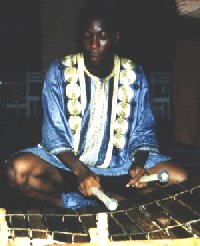
There were many things that I learned about music from the trip, many of them are probably so subtle that I will never figure them out, no matter how much they influence my appreciation and ability to play music. Nevertheless, there are many things to write about so please excuse the absence of any ideas.
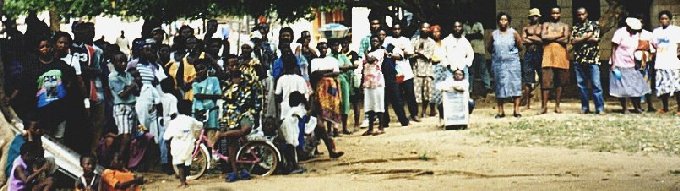
The community involvement with the music was a big part of the experience. People play together alot and all appreciate a good show, as the above picture shows the large crowd that appeared at the sound of music in Accra.
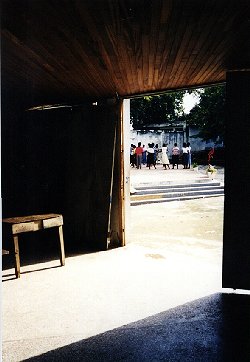 There was also the "performance" aspect of music and it was, by all scales of judgment that I have ever seen, amazing. I did feel a bit outside of the experience at times. It was hard for me to fathom what was going through the dancers minds in the above picture; how they could move so smoothly and precise. Because I am not a African, (or for that matter, even a good dancer) I was felt disconnected as a person in the audience.
It may sound funny, a guitarist discovering it through drumming, I was amazed at the relationship between singing and music, whether drumming or guitar or whatever. Although it was at first awkward hearing the men singing the rhythmic parts that they wanted us to play, it really helped. There is something with the syllables that I do not quite understand.
The link with Jazz became apparent to me when I came home. Scatting made more sense. I could hear how those syllables played by the master drum were taken in by scat. More than scatting, singing along with an improvisation fascinated me. Thelonious Monk and George Benson’s singing now made sense. There is a natural link between the voice and music that I had been ignoring. In retrospect, it makes sense; the first jazz improvisers were hornmen. Phrasing came normally to them with breath but guitar and drumming need that connection too. Seeing the men explaining the parts through the other drums into their own body and expressing it in singing brought the point home. The easiest way for me to play a part was to hear it, say it and then try to play it. Just hearing it did not work.
Before the trip I had encouraged my students to do it and I had tried a bit too. With new ideas in my head (and after the longest time ever without playing guitar) I began to sing with practicing, and my improvisations are much better than without. That "connection" between my voice and hand was never stressed before. I have always sang along with the improvisations on recordings that I own, and with singing I found myself more able to "borrow" those ideas that I have memorized.
The ensemble atmosphere that we were immersed in during drumming reminded me of what it was like to play at Rusty’s Jazz Cafe on their big band sit in night (which I did all last summer). We were given a part that everyone expected us to play and there was some improvisation available, but the song had to go on like normal. I could play the Kagan improvisations that Rafael showed me without much of a problem but while he was able to create (or recall) them easily, I was uniquely frustrated by not being able to get even close. The improvisations seemed so limited to my ear, and perhaps I was not familiar enough with the interactions of the drums to make a responsible improvisation.
One thing that I had to see for myself was how African black American music can be. There were several things that I found intreguing. First was the "woo" sound on a hand drum that is made by rubbing one’s finger across the head causing a swqooping vibration. This looks and sounds a lot like the "scratching" of records that are used in hip hop and rap. The main point in this is to add another sound to the music; it is much like Jimi Hendrix used odd tapping and backwards effects to enhance his sound.
I also now appreciate the supporting noises to the music more. When the axatses (shakers) or bell were not being played the music seemed dead- much like playing bebop wihout a drummer. It can be done but after becoming accustomed to it there is no going back. The Kroboto’s snare-like distorting belt operated in much the same way. It added so much to the music that we all felt like stopping playing when the Kroboto stopped its vebrating noise for more than a few seconds.
The African way of handling pitch was extremely interesting. The singing was different in that pitch was not the absolute focus. Although hitting the right notes was important, there was not a focus on hitting it right off; one could slide into the note and it was normal. The lunnas also carried over this idea. The pitch that was played on it was to be variated up and down but the bend into it was normal. This reminded me of the way that many guitarists bend into notes but, especially in a blues style, the bent pitch adds to the character of musical line. When I came home, the first thing that I wanted to try on guitar was a different approach to getting into notes other than just being there. I felt most like coming into notes in half steps, much like I had heard from jazz musicians who now I see were influenced by African aesthetics of pitch.
One of the most perfectly African musical things that I was was the "achabodege" stick. This was a U-shaped stick with an old can on one side and a string tied from the can to the other side of the stick. The player puts his legs through the stick and picks (much like a guitar- with a pick) the string to make a sound. The can resonates the four different noises: open, muted, and pitch up and down. All of these were done with the left hand while the right was picking. The mute was a simple pinch of the string to create accents. Pitch was variated by bending the stick in and out.
The reason why I liked this little instrument was because it related to the jazz and blues guitar so well. While I was taking jazz guitar lessons, I was made aware that I had a habit of playing in an exaggerated swing beat style- all that I needed to do to play bop was play straight 8th notes and let the accents, not the rhythm, induce the swing feel. I listened to Charlie Christian and the other greats and they were indeed playing straight eighths. This was exactly the way that the achabodege played. The rhythm was steady, but the accents and pitch differences made it sound as if it was not. The other reason why it relates so well is because the higher and lower pitches were playing what were appoximately blue notes- flatted 3rds up and flatted sevenths down.
I have never been a person who appreciates dancing much but I could appreciate the dancing on the trip. Perhaps it was because it was meant to be a community art rather than something that a select few can do, like some of the dancing is here. Of course, the performance dancing was also as impressive as anything that I have ever seen in America. The hard thing about dancing there was not getting my muscles coordinated or having good balance. It was also significantly easier to remember the moves. The thing that did make dancing different (and harder) from what I have experienced in the past is the way that it has to be felt. Like so much of the drumming, dancing relied on a familiarity with when to start and stop. It is hard to describe when was the right time, but after you heard the music for a while and followed the leaders, it just came naturally. The interaction of the music and people was very overt through dance. I remember seeing one of the women who made our food at Kopeyia dancing as if to a full drum ensemble when only a bell pattern was being played. She was dropping her feet to the rhythm of the unplayed drums, something that I thought was amazing. Seeing the groups of hired dancers follow different drums' rhythms was interesting. It is quite different from the hard "4 beat" dance music that Americans like. The principle of following your dancing to a beat was so different to me because of the differences in rhythm perception.
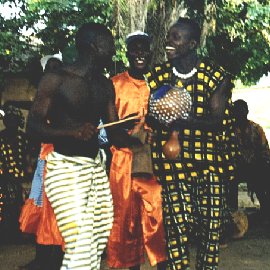
It is impossible to sum up what the musical experience was like for me. In Kopeyia, it was overwhelming to wake up and fall asleep to the drumming. I began to hear the songs when they were not around; it was almost comforting when they did start. That kind of experience is hard to write about. I guess that the way that the villagers felt about their music must have been a hundred times stronger. I cannot have that strong of a connection to African music; all I have is a respect for the connection of their lives and the music.