
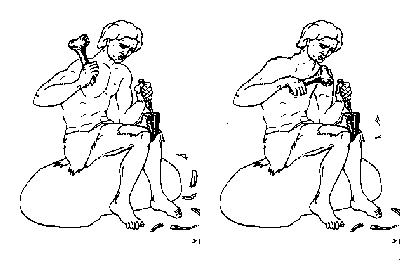
 There
were plenty of people in the world who didn't forget how to make stone tools.
Australian Aborigines, for example, continued to work stone long after Europeans
lost the necessary skills. Native Americans retained the art well after European
contact as well. But for much of the world Flintknapping was a lost art. Many
of the early archaeologists and antiquarians who came across stone tools did not
know how to interpret them. People would happen across stone tools lying on the
surface or while digging and be baffled by them. They were obviously something
special. But what? Well into the 1800's it was uncertain that humans even made
these things. Notions that they were left by elves or deposited by lightening
were rampant. (For more on this check the Folklore Section
of KA) John Frere, an English naturalist, was one of the first to recognize
that stone tools were probably made by humans and that they were in use before
metal tools.
There
were plenty of people in the world who didn't forget how to make stone tools.
Australian Aborigines, for example, continued to work stone long after Europeans
lost the necessary skills. Native Americans retained the art well after European
contact as well. But for much of the world Flintknapping was a lost art. Many
of the early archaeologists and antiquarians who came across stone tools did not
know how to interpret them. People would happen across stone tools lying on the
surface or while digging and be baffled by them. They were obviously something
special. But what? Well into the 1800's it was uncertain that humans even made
these things. Notions that they were left by elves or deposited by lightening
were rampant. (For more on this check the Folklore Section
of KA) John Frere, an English naturalist, was one of the first to recognize
that stone tools were probably made by humans and that they were in use before
metal tools.
Experimental reproduction of stone tools began shortly after their human origins were realized. Although Europeans were meeting stone using cultures abroad, at home they were much more rare. There were, however, the gunflint makers. Gunflints were produced using the same techniques used for thousands of years to produce blades from a core, and early archaeologists flocked to the gunflint quarries to observe the men producing them in order to gain some insight into ancient practices.
On the other side of The Pond, early anthropologists learned a great deal about flintknapping from one man - Ishi. Ishi was a Northern Californian Indian who from 1911 to 1916 instructed anthropologists and the public at the Museum of Anthropology of the University of California on his people's way of life.
Return to the
Main Page.