Hard Hammer Percussion
Chip Away, Chip Away at the Stone ...
Using a Hammer Stone large flakes are struck off of a core.
This is the initial stage in the reduction process. Hard hammer percussion
is used to remove the cortex from the core and the flakes which
will eventually be knapped into tools. Some terms need to be defined at
this point. The core is the chunk of rock that flakes are knocked
off of. The core itself may be turned into a tool, but more likely the
flakes become the tool. Cortex is the outer 'skin' or 'rind' of
the raw material.
Flintknapping has been likened to chess � you think about what you are
doing, you plan your strategies in advance, the masters think several moves
ahead, and you must be familiar with the rules in order to play the game.
To begin removing flakes with a hammerstone you will have to be familiar
with these three rules:
1. Conchoidal Fracture
 The stones we use
for flintknapping, (flints, cherts, obsidian, etc) all exhibit a characteristic
fracture when broken � called a conchoidal fracture. When you strike the
surface of the stone you are applying a force to the surface. This force
spreads out from the point of impact like ripples spreading out in a pond.
The force is also directed into the stone, so as the force spreads outward
it also travels inward.
The stones we use
for flintknapping, (flints, cherts, obsidian, etc) all exhibit a characteristic
fracture when broken � called a conchoidal fracture. When you strike the
surface of the stone you are applying a force to the surface. This force
spreads out from the point of impact like ripples spreading out in a pond.
The force is also directed into the stone, so as the force spreads outward
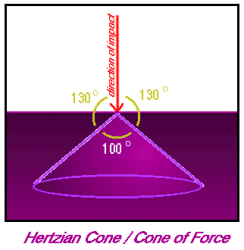
it also travels inward. 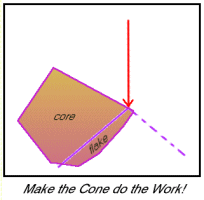 What
is produced is a cone, with the pinnacle at the point of impact and the
widest part somewhere inside the rock. This is called a Hertzian cone
or the cone of force. If you do this in the middle of the stone,
unless you hit it VERY hard the force will dissipate without detaching
a flake. The trick is to angle the blow and apply it near the edge of the
stone so that only part of the cone passes through the core. In practice,
I find it easiest to keep the direction of the blow vertical, and tilt
the core up or down to change the angle. Luckily for us, these cones always
tend to be about the same shape so the angles don�t change and once you
learn how to make the cone work for you you�ve got it made! The angle that
the flake detaches is about 130 degrees to the direction of the strike.
What
is produced is a cone, with the pinnacle at the point of impact and the
widest part somewhere inside the rock. This is called a Hertzian cone
or the cone of force. If you do this in the middle of the stone,
unless you hit it VERY hard the force will dissipate without detaching
a flake. The trick is to angle the blow and apply it near the edge of the
stone so that only part of the cone passes through the core. In practice,
I find it easiest to keep the direction of the blow vertical, and tilt
the core up or down to change the angle. Luckily for us, these cones always
tend to be about the same shape so the angles don�t change and once you
learn how to make the cone work for you you�ve got it made! The angle that
the flake detaches is about 130 degrees to the direction of the strike.
2. Near 90 degree platforms
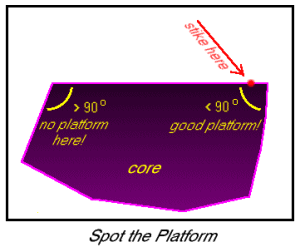 The platform
is the part of the core you strike to remove a flake. To find a potential
platform on a core you want to look for a place where two faces meet at
an angle of 90 degrees or less. It can not be greater than 90 degrees because
of the way you are going to use the cone of force to work for you. Its
not that angles greater than 90 degrees behave differently, its just that
its impossible to hit them at the correct angle to get the edge of the
cone to cut through them and remove a flake. In the Spot the Platform
diagram, the platform is shown horizontal and the striking direction is
angled. In practice, it is easier to find a near 90 degree angle, and then
tilt the core so that your striking angle is vertical, as is shown in the
Make the Cone Do the Work illustration.
The platform
is the part of the core you strike to remove a flake. To find a potential
platform on a core you want to look for a place where two faces meet at
an angle of 90 degrees or less. It can not be greater than 90 degrees because
of the way you are going to use the cone of force to work for you. Its
not that angles greater than 90 degrees behave differently, its just that
its impossible to hit them at the correct angle to get the edge of the
cone to cut through them and remove a flake. In the Spot the Platform
diagram, the platform is shown horizontal and the striking direction is
angled. In practice, it is easier to find a near 90 degree angle, and then
tilt the core so that your striking angle is vertical, as is shown in the
Make the Cone Do the Work illustration.
For more angle diagrams, follow this Link.
3. Flakes follow ridges
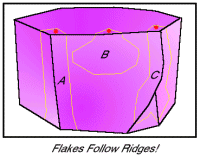 This rule is
not essential to detaching a flake, but it is essential to controlling
where your flakes travel and in planning how to remove them. When a flake
is removed from a flat surface it will fan out. The resulting flake will
be short and wide (see flake B in the diagram), and quite often will end
in a hinge or step fracture (not good). A flake struck at the same angle
and with the same force above a ridge left by previous flake removals will
travel through the area of most mass, the ridge, and will tend to be longer
and narrower (see flake A). Knowledge of this rule will be crucial to controlling
the flakes you strike off. Flake C curves and forks as it follows first
one ridge and then a second.
This rule is
not essential to detaching a flake, but it is essential to controlling
where your flakes travel and in planning how to remove them. When a flake
is removed from a flat surface it will fan out. The resulting flake will
be short and wide (see flake B in the diagram), and quite often will end
in a hinge or step fracture (not good). A flake struck at the same angle
and with the same force above a ridge left by previous flake removals will
travel through the area of most mass, the ridge, and will tend to be longer
and narrower (see flake A). Knowledge of this rule will be crucial to controlling
the flakes you strike off. Flake C curves and forks as it follows first
one ridge and then a second.
Selecting a good hammerstone can be just as important as selecting good
stone to flake. Most knappers have several different hammerstones of different
sizes and hardnesses, depending on the hardness and size of the core which
is being worked. For example, you want a soft hammerstone when working
obsidian. Harder stones create a larger bulb of percussion on the flake,
which in turn leaves a larger 'dent' in the core. These big divots in a
core can quickly wreck it. However, a soft hammerstone might not work at
all on harder materials like cherts or jasper. Judging the hardness of
your hammerstone will come with practice.
Hammerstones are usually round to egg shaped and range in size from
a chicken egg to larger than your fist. Even larger ones have been found
at prehistoric quarry sites, but most knappers today don't use hammerstones
to quarry their own raw material. One of the most important qualities of
a hammerstone is that it fit comfortably in your hand. I prefer egg-shaped
hammerstones, using the little end as the striking end. You can find suitable
stones in most creeks and rivers. Alternatively, look along railroad tracks.
The grade of gravel used along railroads (in my part of the world, anyway)
is often exactly what you are looking for.
 Back to Flintknapping
Fundamentals.
Back to Flintknapping
Fundamentals.
Return to the
Main Page.
Questions? Suggestions? Mail me.
Knappers Anonymous was prepared by Tim Rast and is being updated by Mike Melbourne