
One theory of love that is very popular is the Triangular Theory of Love, which was developed by Yale University Professor Robert J. Sternberg. Sternberg's theory states that love is made up of 3 interconnected components: intimacy, passion, and decision/commitment. These components can be thought of as forming a triangle, which looks like this:
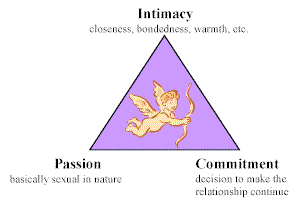
The intimacy component refers to the close, bonded feelings that exist within loving relationships, the passion component refers to the drives that lead to physical attraction and sexual acts, and the decision/commitment component refers to the decision to love someone and to maintain that love. By combining these 3 components, Sternberg came up with 8 types of loving. These types are listed in the table below, along with a checklist of the 3 components that make up each type.
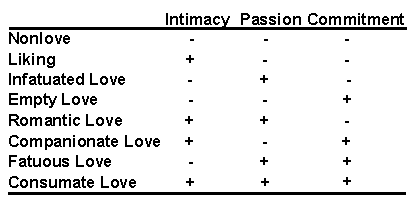
Nonlove refers to the absence of all three components. Liking occurs when we just have intimacy, such as in friendships. Infatuation occurs when we only have passion, such as in love at first sight. This type appears quickly and disappears almost as fast. Empty love occurs when we only have commitment, and is often the residual love that remains once the other types have faded. Romantic love, on the other hand, is the combination of intimacy and passion. In this way, it involves both liking and physical desire for the other person. Companionate love is a combination of commitment and intimacy, and often occurs in the later stages of a relationship after the passion has faded. Fatuous love is a combination of passion and commitment, therefore lacking intimacy. Finally, consumate love is a combination of all three components. This is our society's ideal type of love, because it involves close friendship, physical urges, and a strong commitment.
To see a visual representation of the 8 types of loving (although nonlove is not shown), click here.
Sternberg's theory also states that love is made up of more than just a single triangle, and outlines several different types of triangles. Some of his ideas include the real vs. ideal triangles, the self vs. other triangles, the self-perceived vs. other-perceived triangles, and the thought vs. action triangles. Sternberg believes that these triangles are not independent, but that they interact with one another. These interactions between the components and the triangles account for the complexity that exists within loving relationships.
Discover the components of your love relationship! Fill out a pen-and-paper version of Sternberg's Triangular Love Scale here, or create your own real and ideal love triangles here.
References:
Sternberg, R.J. & Barnes, M.L. (1988). The psychology of love. New Haven, CT: Yale University Press.
Edwards, D.C. (1999). Motivation & Emotion. Thousand Oaks, CA: SAGE Publications.
Go back to the home page.