RYLIE PRAIRIE DALLAS COUNTY, TEXAS
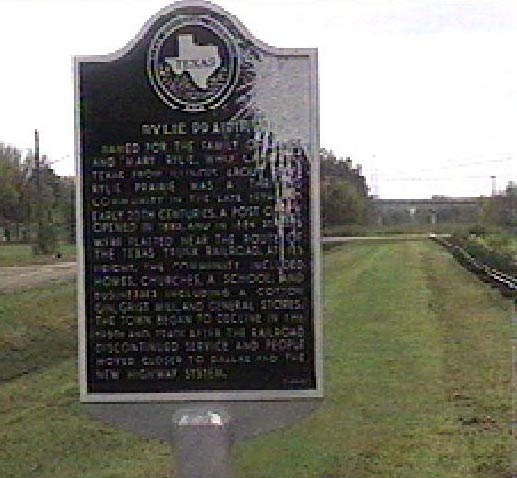
The Peters Colony, a company authorized by the Texas government to promote settlement in the state, was known to have advertised heavily in Illinois. The family followed the steady stream of other pioneers and migrated from Illinois to Texas before July 1, 1848.3 Dallas County tax rolls list James as having paid Poll and County tax as early as 1846, the first year records were available.
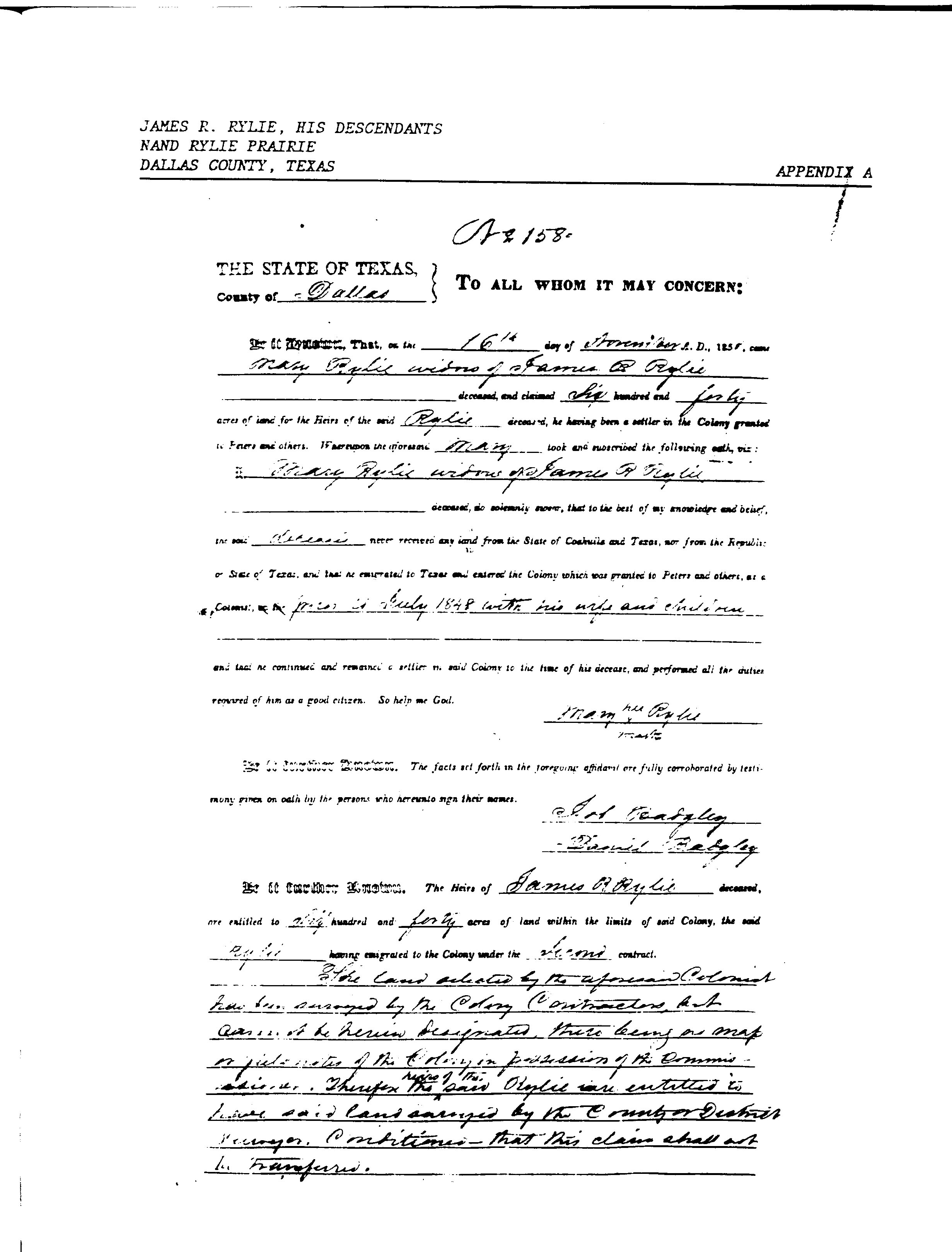
The family settled in the city of Dallas with James earning money as a blacksmith. He died after a two week illness with complications from an inflamed spleen in October of 1849.4 According to the 1850 census for Dallas County, Mary remained in the city of Dallas with her children. She applied for a Peters Colony certificate on November 16, 1852.5 This certificate, a Nacogdoches 3rd Class, was granted and filed on May 16, 1853 for 640 acres, the amount issued for a widow with dependents.6 See end of Page); According to this certificate, the land Mary chose had been surveyed by the Commissioners of the Colony, bur no maps or field notes could be found. She was allowed to have the survey performed by the County or District surveyor with the stipulation that it not be transferred.
By 1860, Mary Rylie was living with her son John and his family at Scyene moving closer to their Peters Colony grant located just south.Texas law allowed Mary to receive half of her husband's estate (320 acres). The remaining half was divided equally among the children (80 acres each).; On January 28, 1862, "for and in consideration of [her] love; and affection", Mary deeded her 320 acre interest of her husband's estate to John with conditions that he care for her for the rest of her natural life.8; This gave him a total of 400 acres leaving her daughters without any further inheritance after her death. , Mary died c. 1867 and it is not known where she is buried.9
Sarah and William Muncey had four children: Mary J., Zerelda A., Guilford Cortez, and Minerva. Sarah died on September 30 1867 13; leaving her ; husband -to raise the; children alone.13 Unfortunately,; William died in January 1869, leaving ; the children as orphans.14 Probate records reveal that on April 28, 1869, Sarah and William's oldest daughter, Mary, requested from Judge A Bledsoe that Samuel Beeman be appointed her legal guardian. Not only was her request granted but Judge Bledsoe also appointed Sam Beeman as the legal guardian for all of Sarah and William's children, denying a direct petition from their Uncle John to be so appointed. John was, however, appointed executor of the estate. John's presumed mismanagement of the estate led to lawsuits by the Muncey children in 1876.15 These lawsuits were not settled until 1881 when,John Rylie was ordered by the court to pay the heirs $2,538.17.16
James and Mary Rylie's only son, Johnmarried Harriet Harding on October 30, 1856.17 In 1870 Jchn and Harriet lived with their children Mary J., Major H., James R. (Jim), John W. and Ira Bill, on their farm located in the Rylie Survey.18 At this time the closest post office was at Haught's Store.; They raised cotton, corn and oats along with the usual array of farm animals and cattle. John also sold cord wood from the 250 acres of woodland located on his land.19
As people began to settle in the survey a town began to take shape. John and Harriet became very active in the community and the county. John served,on the Board of Trustees for the county school district in 1874.20 and Harriet was a charter member of the Rylie Christian Church.21
Education was very important to the early pioneers of Texas and Rylie was no exception to this thought. If the family could afford it they sent their children to Dallas for school. The Muncey children attended Columbia School located in Dallas.22 The need for a school close to the growing community was apparent and so on July 20, 1878, a plot measuring "70 yards square".was donated to the County of Dallas by John and Harriet for the-purpose of a "free" school in Rylie.23
The settlers erected a one-room log school house on one corner of the plot. Over the years, the log school became too small to accommodate the students and was replaced with a larger six-room wooden school. Woodmen of the World meetings were held here,24 and at one time was used by the Rylie Christian Church for services. 25 The wooden school was also outgrown and another school was built; this time of brick and in another part of town on land the Rylie First Baptist Church now occupies near the interchange of Highways 175 and 635. The old wooden school was purchased by Bunk Sewell, moved, and used as a general store.26
When Redden Allumbaugh died on April 19, 1889 he would be buried on the school property. He had just recovered from the measles when he was caught in a rain storm. Complications soon set in and he died as a result.27 The school grounds would now be used as a cemetery. Redden's grave is marked with a simple stone marker as R. Allumbaugh.
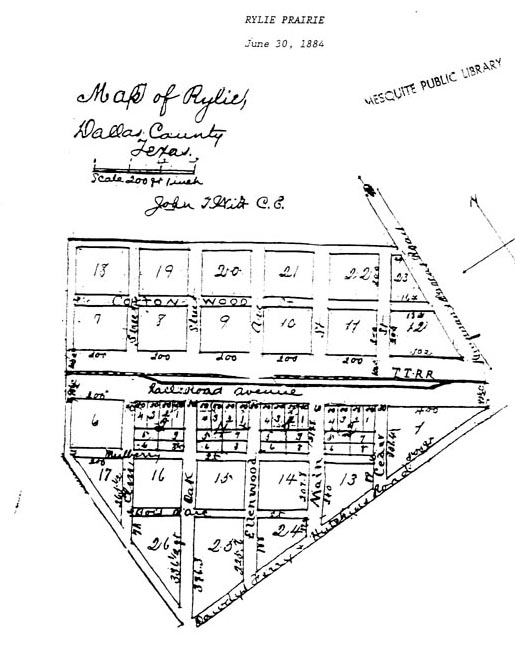
On June 30, 1884, John would approve the map of the town of Rylie Prairie as laid out and surveyed by John T. Witt, Civil Engineer.28 (See map) Hartwell Cox, railroad agent, is credited with naming the streets of which two names remain today, Ellenwood and Mulberry Street.29 The main street through town. Railroad Avenue, ran parallel to the Texas Trunk Railroad and is now called Cade Road.
Rylie Prairie, or as more commonly called, Rylie, was situated approximately 12 miles southeast of the Dallas County courthouse in the James R. Rylie Survey. This 640 acre survey was located in an area consisting of gently rolling black land prairies, numerous small creeks, and light woods in the eastern and southeastern portion Of the survey. A large tributary of the Trinity River, Prairie Creek, runs due west with the East Fork of the Trinity River running southwest of the survey. Nearby communities of Kleberg, Seago (later Seagcville) and Haught's Store (also known as Slap Foot or Lawscn) , were all located east of Rylie Prairie. Northern communities included Scyene, Mesquite, and later Balch Springs. The closest community west was that of Elam. Of these towns, only Seagoville, Balch Springs, and Mesquite exist today. The cities of Dallas and Balch Springs would consume what remaining county lands were left in the area during the late 1970s and along with Scyene, Kleberg and the others, Rylie Prairie would be no more.
The Texas Trunk Railroad (formerly the Dallas, Palestine, and Southeast Railroad) laid during the 1870s established a depot in Rylie.30 This railroad had the dubious distinction of having had more receivers than any other railroad in Texas or the United States -- seven in fifteen years. In 1895 the Southern Pacific bought the line and in 1899 the Texas and New Orleans, a part of the Southern Pacific, was authorized to own and operate the Texas Trunk.31 The railroad ceased operation to Rylie Prairie in the early 1930s and the tracks are now slated for use as light rail for the Dallas Area Rapid Transit
Authority. The depot was purchased and moved by Joe Roberts in the early 1900s .32
The cemetery was enlarged over the years from the original school plot of "70 yards square" and new contains over 400 graves. Many of the early burials are of infants or young children; a testament to the rugged life that overcame them. The Rylie Cemetery Association, founded in 1962, maintains the cemetery grounds through private donations, mostly from family descendants. The cemetery is in excellent condition, protected by a chain-link fence and adorned with a United States flag. Both were made possible by contributions from this Association. As a "free" cemetery, anyone may be buried there, however, very few spaces remain. Some of these spaces have been set aside by family descendants of the original pioneers.
One of Dallas County's early pioneers was Hartwell Bolin Cox (b. 22-Jan-1340 - d. 23-Jan-1918). His grave is the only known Civil War veteran, though there may be others. Mr. Cox was born in Illinois and moved to Texas in 1844. He served as a Private in Co. B, 19th Regiment, Texas Cavalry, participating in several conflicts in Arkansas, Missouri, and Louisiana.33 He was a charter member of the Dallas County Pioneer Association.34 Mr. Cox also served as railroad agent and postmaster for Rylie.
One of the oldest institutions in Rylie is the Rylie Christian Church. Organized in 1834 in the log home oF Will Hedge, the Church thrives today in a more modern facility built in 1953. The first ministers present were Charlie Cole and Jim Hodge.
Charter members of the Church included:
Mrs. John Bostick Mrs. Alice Marshall
Rachel Cary Mr. and Mrs. John Rylie Montgomery
Mrs. Nancy Cory Jane Moore
Mr.,' and Mrs. H.B. Cox Mr. and Mrs. Orlando Prewitt
Matdilda Ann Freeman Mr. and Mrs. Robertson
Mr. and Mrs W.S. Freeman Mrs. Harriet Rylie
Mattie Hodge Mrs. Sallie Sewell
Mr. and Mrs. Will Hodge Mr. and Mrs. John Snow
Ann Hurd Mrs. and Mrs. Emory Sweet
Mr. and Mrs. Joe Hurd Lucy Sweet
Miss Nancy Hurd Mrs. Tine Sweet
Mrs. Jane Jones Zerelda Thompson
Mr. and Mrs. Martin Love Peggy Lisa Wilson
Mrs. Jane York
The congregation first met in the Rylie log school house and used split log benches for seating.36 After the log school was torn down, the congregation then met with other denominations whose ministers took turns preaching. In 1907, a large one room building was erected on the corner of Ellenwood and Mulberry. The Church was heated with a wood burning stove, lite with gasoline lamps and the people "cooled" themselves with open windows and fans.
The Church had no baptistery and so baptisms would be
performed in a tank or a nearby creek. Local tanks that were used included John Corder's, the Hull tank (Miller), and the Hughes tank (Sam Tucker's). Also used was Prairie Creek and Harwood Spring located near Kleberg.
As the Church borrowed the school facilities for worship at
one time, so did the school borrow the Church. The first time was between the period of occupying the log school and the wooden school. The second time came prior to 1936 when the second school building or wooden school burned.
At one time, Rylie Prairie was a thriving community with a school, 2 churches, a postoffice, a grist mill, cotton gin, and general stores. Along with the Rylie Christian Church, Ryle First Baptist Church is also located in the area serving the needs of their congregation. The Christian Church celebrated its 100th anniversary in 1984.37 Rylie's first postmaster Hartwell b. Ccx, was appointed February 3, 1833 and served in this position for several years.38 During the winter the road were often in bad enough shape that a wagon could not go through. The postman would then deliver the mail by horseback.39 The post office was discontinued in 1932. The cotton gin was located on land owned by John 3. Sewell who also operated a general store. Over the years there were other general stores owned and operated by local residents. They included: W.S. Freeman, G.W. Paul, and Francis M. Williams.
Francis Williams was a local farmer and merchant who served as Justice of the Peace for Precinct 4 for two consecutive terms, from 1908 - 1912. 40 Precinct 4 included Scyene, Mesquite. Haught' s Store, Seagoville, and Kleberg. He and Jim Rylie, John's son, both ran for the Office of Constable in 1884. Francis received 135 votes and Jim 61. Both lost to Mr. Cumby who garnered 178 votes.41
The area that made up Rylie Prairie was never officially incorporated which also added to its decline. In the 1970s, the remaining county land was divided among the neighboring cities of Dallas, Kleberg and Balch Springs with Dallas getting the majority of the area. Later, Kleberg would also be absorbed by its big neighbor, Dallas.
Today there is a new elementary school, several modern homes, and improved streets.
; If you drive down present day Haymarket to Cade Road you can make out one or two turn of the century homes located near the old center of town. Several family descendants of the original settlers still live in the area. They include Gladys Allumbaugh Atkinson, W.B. "Joe" Sewell, as well as the Cade, Malone, and Marshall families. As long as these descendants remember and pass on to their children Rylie's rich heritage, the town will not be forgotten.
Bennett, James D., Searching back into the Past... U.S. Post Offices in 1890. J.D. Bennett, 1973.
Brown, John Henry, Historv of Dallas County. Texas from 1837 to >1887. Milligan, Cornett and Farnham, 1887.p; 1
Carlisle, Mrs. George F., Dallas County Land Surveys. 1954.
Connor, Seymour V., The Peters Colony of Texas. Texas State Historical Association, 1959.
Cochran, John H., Dallas County. Service Publishing Co., 1928. Curtis, Jinunie Crouch, The Suburban Tribune. July 21, 1989.
Dallas Genealogical Society, Marriages. Dallas County. Texas. Book A-E. (1846-1877). Vol. 1, 1978.
------, Marriages Dallas Countv. Texas. Books F. G. H. (1877-1885'). Vol. II,
1986.
Dunsmore, Pamela, The Suburban Tribune.
Impey, Blanch, Ethel Deane Duke and Edna Herd, Historv of Rvlie Christian Church. 1884 - 1984, Rylie Christian Church, Dallas, 1984.
Jackson, Ronald Vern, Mortality Schedule. Texas 1850. Accelerated Indexing Systems, 1979.
Reed, S.G. A Historv of the Texas Railroads. Arno Press, 1941. Rogers, John William, Lusty Texans of Dallas. Dutton, 1951.
Schibel, Walter J.E., Ed. D., Education in Dallas. Ninety-two Years of History. 1874-1966, 1966.
Sistler, Byron and Barbara, Early Middle Tennessee Marriages. Byron Sistler & Association, 1988.
Sloan, Bill, Dallas Times Herald. September 19, 1965. R.L. Polk & Co., Texas State Gazetteer and Business Directory 1914-1915.
------, 1884-1885.
------, 1890-1891.
The Texas State Historical Association, The Handbook of Texas. 1952.
Texas Trunk Railroad Company, Prospectus of the Texas Trunk, (1880). Atkinson, Gladys Allumbaugh, Personal Interview, June 1991.
r
------, July 1991.
Sewell, W.B. "Joe", Personal Interview, September 1991.
Dallas Public Library, Microfilm Collection, Agricultural Census for 1870 and 1880.
------, Microfilm Collection, Dallas County Census Records for 1850, 1860,
1870, 1880, 1900, and 1910.
------, Microfilm Collection, Dallas County Deed Records, Vol. I, Deeds 67
and 71.
------, Microfilm Collection, Dallas County Mortality Schedules for 1850.
------, Microfilm Collection, Dallas County Probate Records, Case #s 401,
406, 413, 461.
------, Microfilm Collection, Election Registers, Elected and Appointed State
and County Officers. 1907-1908, 1910-1912.
Dallas Weekly Herald. November 13, 1884.
ENDNOTES
1.Byron and Barbara Sistler, Early Middle Tennessee Marriages. Byron Sistler & Association, 1988, Vol. I, Grooms, p. 475.
2. Williamson County Census for 1830.
3. John Henry Brown, History of Dallas County. Texas from 1837 to 1887. Milligan, Cornett and Farnham, 1887, p. 91.
4.Ronald Vern Jackson, Ed. , Mortality Schedule. Texas 1850. Accelerated Indexing Systems, 1979, p. 20.
;1850 Mortality Schedule, Dallas Public Library Microfilm Roll #54, p. 77.
5.Seymour V. Connor, The Peters Colony of Texas. Texas State Historical Association, 1959, p. 384.
6.; Certificate #158, Texas General Land Office, copy in possession of author.
7.; Dallas County Census for 1860, p. 358.
8.; Dallas County Deed Records, Vol. I, p. 94.
9.; Abstract of Title City of Balch Springs, Dallas Count", Texas. 1348 -1910. Nancy Horton Davis Chapter Texas Society NSDAR, 1984, Items 2,5, and 9.
10. Dallas Genealogical Society, Marriages, Dallas County. Texas. Book A -E (1846 - 1877). Vol. I, 1978, p. 3.
11.Ibid, p. 4.
12. Ibid, p. 7.
13. Dallas County Probate Court Records, Case #413, Dallas Public Library Microfilm Roll #4.
14. Ibid, Case #461.
15. IbicL, Case #406.
16.Dallas County Probate Court Records, Case #1069, Dallas Public Library / Microfilm Roll #8.
17.Dallas Genealogical Society, Marriages. Dallas County, Texas. Book A -E (1846 - 1877). Vol. I, 1978, p.6.
18. Dallas County Census for 1870, p. 455.
19. Dallas County Agricultural Census for 1870, Dallas Public Library Microfilm, Precinct 5, p. 55.
20. Dallas Weekly Herald. November 13, 1884, p. 4.
21. Blanche Impey, Ethel Dean Duke and Edna Herd, History of Rylie Christian Church: 1884 - 1984. Rylie Christian Church, p. 5.
22. Dallas County Probate Court Records, Case Y/461, Dallas Public Library Microfilm Roll #4.
23. Dallas County Deed Records, Vol. 71, p. 158.
Bill Sloan, "Cemetery Care 'on the house'", Dallas Times Herald. September 19, 1965, Sec. A, p. 6A, Col. 2.
Gladys Allumbaugh Atkinson, Niece to Redden Allumbaugh, Personal Interview, June 1991.
24. W.B. "Joe" Sewell, Personal Interview, September 1991.
25. Impey, Duke and Herd, p. 4.
26. Sewell, September 1991.
27. Atkinson, June 1991
28. Dallas County Deed Records, Vol. 67, p. 151.
29.Atkinson, Personal Interview, July 1991.
30. The Handbook of Texas. The Texas State Historical Association, 1952,. p.
522.
31. S.G. Reed, A History of the Texas Railroads. Arno Press, 1941, p. 232.
32. Sewell, September 1991.
33. Diary of Hartwell Bolin Cox, in the possession of Helen Thompson Sullivan, granddaughter.
34. Cochran, John H. Dallas County. Service publishing Co., 1928, p. 142.
35; Impey, Duke and Herd, p. 3.
36; Ibid p. 4.
39.; Sewell, September 1991.
40. Election Registers, Microfilm, Dallas Public Library, Elected and Appointed State and County Officers. 1907 - 1908. 1910 - 1912.
41. Dallas Weekly Herald. November 13, 1884.
42. The Handbook of Texas, p. 522.
43. Walter J.E. Schibel, Ed. D., Education in Dallas. Ninety-two years of History. 1874-1966. p. 256, File #12077 Volume 40, p. 347, DISD records.
This is a copy of the Application filed with the Texas Historical commisson to receive the State Marker in 1994.