|

|
|
|
HOME
|
ASIAN
SOCIAL INSTITUTE | KKK
THE ORG |
PHOTO GALLERY "What
lies behind us and what lies before us are tiny matters
compared to what lies within us."
Oliver Wendel Holmes THE
ASI YOUTH ACCOMPANIMENT PROGRAM
"Empowering
Tomorrow's Leaders Today" Mission
Statement To
Empower Young Individuals, Groups, and Organizations through Capability
Building and Creative Skills Training towards Social Consciousness and
Social Responsibility Centered on the Environment, Culture, Peace and
God. Vision A
Youth Social Action Arm of the Asian Social Institute Empowering the
Youth Towards a Society Promoting Justice, Peace and Integrity of
Creation. Training
and Development Programs Capability
Building Training
Organizational
Development
Talks/Seminars/Workshop
-
Personal
Mastery
-
Personhood
-
Building
a Learning Organization
-
Emotional
Intelligence in Organizations
-
Use
of Synergy in achieving Organizational Excellence
Symposiums
-
Youth
Speak Series
-
Kultura't
Kapayapaan
Conferences
-
Multi-sectoral
Conference 99'
-
Multi-sectoral
Conference 2000 Theme: "Globalization w/o Marginalization,
Globalizaton w/o Exclusion"
-
Youth Conference
Series 2001 Theme: "Kabataan, Kabahagi sa Prosesso ng
Pagpapagaling"
-
Manila Youth Congress
2002 "Pagsasakasaysayan"
Research
How it all started:
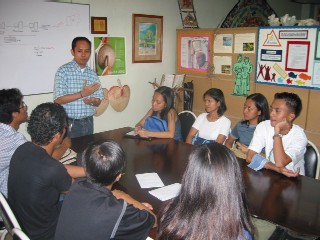 In
1984 at the request of the Catholic Bishops Conference of the
Philippines (CBCP) through the Lay Apostolate Commission of the Bishops
headed by Most Rev. J. Sorra, ASI was requested to train and undertake a
national research study on the Youth in preparation for the
International Year of the Youth in 1985. Fifty-one youth
priest-and-lay-directors of the diocesan youth from Luzon , Visayas and
Mindanao were trained by ASI and took the research. For one year ASI
facilitated a participatory research study covering 4000 respondents,
the result of this study is the creation of a separate Commission for
the Youth in CBCP and a National Office. ASI helped also to gather funds
for some delegates to be at the International Youth Meeting in Rome in In
1984 at the request of the Catholic Bishops Conference of the
Philippines (CBCP) through the Lay Apostolate Commission of the Bishops
headed by Most Rev. J. Sorra, ASI was requested to train and undertake a
national research study on the Youth in preparation for the
International Year of the Youth in 1985. Fifty-one youth
priest-and-lay-directors of the diocesan youth from Luzon , Visayas and
Mindanao were trained by ASI and took the research. For one year ASI
facilitated a participatory research study covering 4000 respondents,
the result of this study is the creation of a separate Commission for
the Youth in CBCP and a National Office. ASI helped also to gather funds
for some delegates to be at the International Youth Meeting in Rome in 1985. Moreover, it assisted in giving scholarship for a leadership
training in EAPI which had two of its resource persons coming from ASI.
One striking finding of the study was that while the youth voiced out
their need for money and food that time, their image of the church is
quite positive and from the Church they would expect spiritual
formation. Thus, started a series of training sessions in the various
dioceses. It was in this study that ASI had an insight into why the poor
youth from the provinces are pushed to come to Manila.
1985. Moreover, it assisted in giving scholarship for a leadership
training in EAPI which had two of its resource persons coming from ASI.
One striking finding of the study was that while the youth voiced out
their need for money and food that time, their image of the church is
quite positive and from the Church they would expect spiritual
formation. Thus, started a series of training sessions in the various
dioceses. It was in this study that ASI had an insight into why the poor
youth from the provinces are pushed to come to Manila.
The ASI Communication
Center, aware that most young people are audio-visual individuals and
that they are highly influenced by the media in their value-system, had
the idea of making young people aware of the influence of media while at
the same time training them in micro-media communication skills. These
skills could help them in their leadership formation. The ASI
Communication Center gave trainings in some dioceses of Luzon, Visayas
and Mindanao. From then on ASI began its involvement in accompanying
young people towards empowerment. To date, ASI through the Youth
Accompaniment Program has been accompanying a youth organization started
by five young individual, organized as Kilusan para sa Kinabukasan ng
Kabataan (KKK )
“Movement of Youth for the Future”. This movement of KKK facilitated
by ASI staff started with a consultation of groups of various sector of
youth-Farmers, Fisherfolk, Urban Youth and Indigenous Youth. The result
of the consultation started a process of immersion of youth from school
and universities in the communities of grassroot groups, and a
participatory research study on “Youth and Globalization” in Luzon. The
contact between university and school youth with grassroot youth has
fortered )
“Movement of Youth for the Future”. This movement of KKK facilitated
by ASI staff started with a consultation of groups of various sector of
youth-Farmers, Fisherfolk, Urban Youth and Indigenous Youth. The result
of the consultation started a process of immersion of youth from school
and universities in the communities of grassroot groups, and a
participatory research study on “Youth and Globalization” in Luzon. The
contact between university and school youth with grassroot youth has
fortered
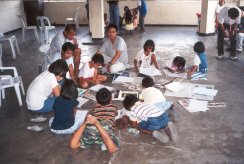 creativity
among these sectors. The vision of the movement is that youth of various
sectors will share common responsibility in building a world that lives
on the principle, “Globalization without Marginazation, Globalization
without Exclusion”. University and school youth and young professionals
will not only make grassroots youth as merely beneficiaries but real
partners in creating wholesome families, communities, nations and
societies. This approach to integrate the schooled youth with the
majority who make up the grassroot will have a long-range influence. It
is known that there are 200 universities in the Philippines besides
other schools and colleges. creativity
among these sectors. The vision of the movement is that youth of various
sectors will share common responsibility in building a world that lives
on the principle, “Globalization without Marginazation, Globalization
without Exclusion”. University and school youth and young professionals
will not only make grassroots youth as merely beneficiaries but real
partners in creating wholesome families, communities, nations and
societies. This approach to integrate the schooled youth with the
majority who make up the grassroot will have a long-range influence. It
is known that there are 200 universities in the Philippines besides
other schools and colleges. Institutional leaders come from these universities and yet much is left
to be desired with regard to student being grounded in the reality of
the monetarily poor people. The People Power 2 that ousted the
Philippine President popular to the masses, belong to the middle class
and the conscienticized poor. But ASI’s informal study showed that the
great majority in the country – the monetarily poor – are of the opinion
that EDSA People Power 2 was just a quarrel among the rich, among
politicians who are fighting for power, that no Philippine president has
substantially done anything to them.
Institutional leaders come from these universities and yet much is left
to be desired with regard to student being grounded in the reality of
the monetarily poor people. The People Power 2 that ousted the
Philippine President popular to the masses, belong to the middle class
and the conscienticized poor. But ASI’s informal study showed that the
great majority in the country – the monetarily poor – are of the opinion
that EDSA People Power 2 was just a quarrel among the rich, among
politicians who are fighting for power, that no Philippine president has
substantially done anything to them.
The ASI’s Youth
Accompaniment Program is focused on harnessing the energies of these
young individuals from KKK and other youth groups towards the theme:
“Globalization without Marginalization, Globalization without Exclusion”
with sub-themes: Culture, Environment, Solidarity and Peace.
|